Introduction
D2C brands struggle with a problem that product quality can't fix: most content they publish never reaches anyone. The brand that places its message in front of the right audience first often captures the sale — regardless of whether it offers the better product. Distribution, not creation, is now the competitive edge.
The numbers confirm it. An Ahrefs analysis of 14 billion web pages found that 96.55% of content receives zero organic traffic from Google — meaning nearly all published content is invisible.
Algorithms shift without warning, ad costs keep climbing, and consumer attention is scattered across more platforms than ever. D2C marketers are producing more content while seeing fewer returns. The strategies below address exactly that gap.
Key Takeaways
- D2C success requires integrating owned, earned, and paid distribution channels—relying on one channel alone fails in 2026
- Email delivers the highest ROI of any owned channel—no algorithms, no ad blockers, direct inbox access
- Short-form video and social commerce on TikTok and Instagram Reels drive top-of-funnel reach at scale
- Creator partnerships build trust faster and at lower cost than paid ads—often with stronger conversion rates
- Track channel-attributed revenue and subscriber growth, not vanity metrics like impressions
Why Content Distribution Defines D2C Success in 2026
Most D2C brands misallocate resources by over-investing in content creation while under-investing in distribution. This imbalance produces predictable results: beautifully crafted content that no one sees. The gap between creation and distribution is where most brands quietly lose.
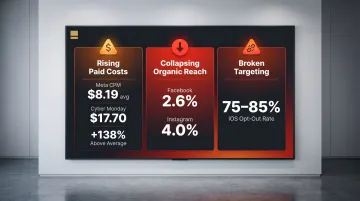
Three structural headwinds have reshaped the 2026 distribution landscape:
- Rising paid costs: Social CPMs rose 5% year-over-year, with Meta averaging $8.19 — and peak days like Cyber Monday spiking to $17.70, a 138% jump above annual averages.
- Collapsing organic reach: Facebook sits at 2.6% reach; Instagram at 4.0%. Fewer than 1 in 20 followers see a brand post without paid amplification.
- Broken targeting infrastructure: Apple's App Tracking Transparency pushed 75-85% of iOS users to opt out of tracking, forcing brands to rebuild around first-party data.
This convergence has pushed brands toward content formats designed for distribution rather than static publication. UGC travels through peer networks. Newsletters bypass algorithms entirely. Short-form video receives algorithmic amplification on platforms actively rewarding high-engagement formats. The brands winning in 2026 create content optimized for sharing and discovery, not just consumption.
Best Content Distribution Strategies for D2C Companies in 2026
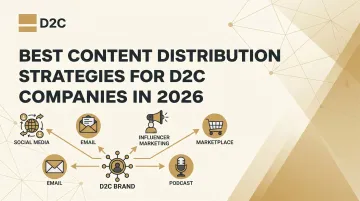
The most sophisticated D2C brands treat distribution as an integrated system with distinct levers, each serving different roles in the customer journey. Each strategy below covers a specific channel — its audience, cost structure, and how it converts.
Email and Newsletter Marketing
Email remains the most powerful owned distribution channel available to D2C brands: no algorithm mediates delivery, ad blockers can't touch it, and segmentation enables personalization at scale. Email marketing delivers $36 for every $1 spent, outperforming every other channel tracked. For e-commerce specifically, automated abandoned cart emails generate 30x more revenue per recipient than one-time campaigns.
D2C brands face a strategic choice between two approaches: building their own email list or advertising in established newsletters. Building a proprietary list provides full ownership but requires months or years to reach meaningful scale. Advertising in established newsletters with engaged audiences provides immediate access to targeted, high-intent readers without the list-building runway.
House of Summary's network of specialized newsletters—Presidential Summary, Geopolitical Summary, Dubai Summary, and London Summary—gives D2C brands direct access to 500,000+ global executives and business professionals who convert.
Click-through rates run 4x higher than Google AdWords, with one ad per edition ensuring undivided inbox attention. Newsletter advertising bypasses ad blockers, algorithms, and the visual clutter that plagues social platforms.
Effective newsletter content for D2C distribution requires:
- Value-first editorial tone that informs rather than sells
- Clear product context without aggressive promotional language
- Consistent publication frequency that builds reader habit
- Segmentation options targeting specific demographics or interests
Short-Form Video and Social Commerce
Short-form video formats—TikTok, Instagram Reels, and YouTube Shorts—have become the dominant top-of-funnel discovery mechanism for D2C brands in 2026. Platform data shows 70% of TikTok users discover new products there, with 83% saying the app influences purchasing decisions.
The format's advantage is threefold: brevity matches shrinking attention spans, algorithm amplification rewards engaging content, and native integration feels natural rather than interruptive.
The social commerce layer collapses the traditional funnel from discovery to purchase. TikTok Shop's US sales grew 407% in 2024 and another 108% in 2025, reaching $15.82 billion and capturing 18.2% of total US social commerce. Instagram Shopping and Pinterest's purchase features similarly enable transactions without leaving the platform.
To succeed with short-form video distribution:
- Produce content that entertains while introducing products softly
- Maintain consistent posting cadence (daily or multiple times weekly)
- Use platform-native formats including vertical video and trending audio
- Create content specifically for each platform rather than repurposing identical videos
- Test products in social commerce features for immediate conversion opportunities
Influencer and Creator Partnerships
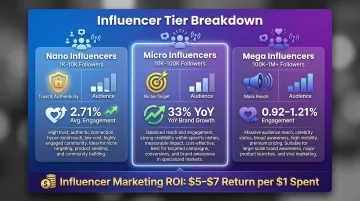
The influencer landscape shifted dramatically toward micro (10K-100K followers) and nano influencers (1K-10K) who command higher engagement and niche audience alignment. Brands collaborate with 33% more micro-influencers year-over-year, and brands now request short-form video for 87% of collaborations. Nano influencers achieve 2.71% average engagement across platforms, well above mega influencers' 0.92-1.21% rates.
Smaller creators earn trust through consistent, niche-specific content — and that trust converts. Influencer marketing delivers $5 to $7 for every dollar spent, driven largely by this micro-tier performance.
Structure creator partnerships for distribution rather than one-off awareness:
- Develop long-term ambassador models rather than single sponsored posts
- Implement affiliate commission structures aligning creator incentives with sales
- Seed products for authentic review content that lives on the creator's channel
- Focus on content formats that don't look like ads: unboxing, tutorials, "day in my life" integration, and honest reviews
- Repurpose high-performing creator content into paid ads (66% of brands plan this approach)
User-Generated Content and Community Distribution
UGC functions as a distribution multiplier by routing brand messages through trusted peer networks that paid advertising cannot replicate. 79% of consumers say UGC highly impacts purchasing decisions, and it proves 9.8x more impactful than influencer content. When customers create and share content about products, they distribute brand messages through their personal networks at zero media cost.
Generate UGC systematically through:
- Post-purchase email sequences requesting photos or reviews
- Branded hashtag campaigns incentivizing social sharing
- Loyalty program rewards for customers who submit content
- Featured customer content on brand-owned channels to encourage additional submissions
Community distribution channels gained importance in 2026 as consumers seek peer recommendations over brand messaging. Reddit product communities, Facebook groups, Discord servers, and niche forums host high-intent buyers actively seeking advice. Organic brand mentions in these spaces carry far more weight than paid advertising.
SEO and AI Search-Optimized Content
Search-optimized content—blog posts, buying guides, comparison pages—captures mid-funnel consumers actively researching product categories. Unlike paid channels requiring continuous spend, organic search accounts for 51% of website traffic and compounds over time as content accumulates ranking authority.
The critical 2026 addition involves Answer Engine Optimization (AEO) and Generative Engine Optimization (GEO). As AI-powered search tools like ChatGPT, Perplexity, and Google AI Overviews answer product questions directly, D2C brands must structure content to appear in these responses. AI search accounts for less than 1% of referral traffic but grows at double-digit monthly rates, making it the fastest-growing channel tracked.
Optimize for AI discovery by:
- Providing clear, factual answers to common product questions
- Implementing structured data and schema markup
- Creating authoritative, well-sourced content AI engines trust
- Maintaining strong traditional SEO fundamentals as the foundation
Paid Distribution and Retargeting
Paid distribution serves as an amplification layer for content proving organic resonance rather than the primary acquisition channel. Rising CPMs and iOS privacy constraints reduced paid social effectiveness, with CPAs increasing 30-50% following Apple's ATT implementation. The strategic response: boost posts already performing organically rather than creating paid-first content.
The most effective paid formats for D2C in 2026:
- Meta retargeting for site visitors using content-led creative
- TikTok Spark Ads boosting creator content natively (delivering 134% higher completion rates than standard In-Feed ads)
- Pinterest promoted pins for discovery-phase shoppers
- Programmatic native advertising for scaled reach
How to Build Your D2C Content Distribution Mix
The owned-earned-paid framework gives distribution planning its shape. Owned channels — email, website, blog — build the foundation slowly but compound over time. Earned channels like UGC, press coverage, and organic influencer mentions bring trust and reach that paid placements can't replicate. Paid channels add speed and precise targeting when you need them. Which combination makes sense depends on your brand's stage, available budget, and where your target customers actually spend time.
A D2C beauty brand and a D2C specialty food brand operate in very different distribution environments. Research your customer's actual media consumption patterns before committing resources to specific channels. Survey existing customers, analyze referral sources, and test small before scaling.
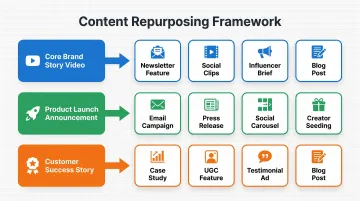
Once you know which channels to prioritize, repurposing content across them multiplies your distribution efficiency without multiplying your production workload:
- Core brand story video → Newsletter feature + Social clips + Influencer brief + Blog post
- Product launch announcement → Email campaign + Press release + Social carousel + Creator seeding
- Customer success story → Case study + UGC feature + Testimonial ad + Blog post
Build owned audience assets as the foundation regardless of channel mix. Email lists, SMS subscribers, and community memberships are the only distribution channels your brand fully controls. Platform algorithm changes can wipe out your reach overnight — owned channels can't be taken away by a platform update.
How to Measure Content Distribution Performance
Distribution success requires measurement at two levels: channel performance (reach, engagement rate, click-through rate) and business impact (channel-attributed revenue, customer acquisition cost by channel, subscriber growth rate).
Vanity metrics like total impressions mislead. They inflate perceived reach while masking poor conversion quality — a channel driving 100,000 impressions and zero buyers is underperforming one driving 5,000 targeted clicks.
Set up attribution properly for multi-channel distribution:
- UTM parameters for all newsletter and social links
- Multi-touch attribution models crediting multiple touchpoints (improving measured ROI by up to 40% versus last-touch)
- First-touch tracking identifying which channel introduced customers to the brand
- Last-touch tracking showing which channel closed the conversion
As Mailchimp's attribution guide explains, last-touch attribution oversimplifies customer journeys by crediting only the final interaction before purchase. This systematically undervalues upper-funnel distribution channels that create awareness and consideration.
Quantitative models only tell part of the story. By 2026, qualitative signals had become equally critical as algorithm-driven metrics grew less reliable. Comments, saves, DM replies, and community mentions often reveal distribution quality better than engagement counts — particularly for earned and owned channels where depth matters more than breadth.
Conclusion
The most resilient D2C content distribution strategies in 2026 combine owned channel foundations—especially email—with consistent short-form social presence, trusted creator relationships, and search visibility. Reserve paid distribution for amplifying proven content rather than depending on rented audiences with rising costs and declining effectiveness.
For D2C brands looking to reach premium, purchase-ready audiences quickly, newsletter advertising offers a direct channel that social and search rarely match. House of Summary's network places brand messages in front of 500,000+ executives and professionals across specialized publications — no algorithms, no ad blockers, just inbox placement with click-through rates that run 4x higher than Google AdWords.
Publications include Presidential Summary, Geopolitical Summary, Dubai Summary, and London Summary, each targeting a distinct, engaged readership. Reach out to sales@houseofsummary.com to explore advertising options.
Frequently Asked Questions
What is the most effective content distribution channel for D2C brands in 2026?
No single channel dominates—successful D2C brands use email as their owned foundation for reliability and ROI, short-form video for top-of-funnel reach, and creator partnerships for trust-building. The optimal mix depends on your specific audience demographics and product category.
How can D2C brands distribute content without a large paid media budget?
Focus on owned channels like email list building, blog content, and SEO for organic traffic. Implement UGC campaigns encouraging customers to share content through their networks. Partner with micro-influencers who typically work on product seeding or affiliate commission structures rather than large upfront fees.
What is the difference between content distribution and content promotion?
Distribution refers to the systematic channels and infrastructure delivering content to audiences (email, social platforms, search, syndication), while promotion refers to active campaign-specific efforts amplifying particular content pieces through paid or outreach tactics.
How should D2C brands measure content distribution ROI?
Track channel-attributed revenue, customer acquisition cost by channel, and owned audience growth (email subscribers, community members) — not vanity metrics like impressions or follower counts. Multi-touch attribution is essential for crediting upper-funnel channels that influence purchases without being the final touchpoint.
How does email newsletter advertising fit into a D2C content distribution strategy?
Newsletter advertising gives D2C brands immediate access to engaged, pre-qualified audiences — without the months required to build a proprietary list. It's especially effective for niche demographics, delivering click-through rates up to 4x higher than Google AdWords with no interference from ad blockers.
How important is short-form video for D2C content distribution in 2026?
Short-form video represents the primary discovery format for most D2C product categories, especially fashion, beauty, food, and lifestyle. According to TikTok for Business, 70% of TikTok users discover products on the platform, with engagement rates of 3.73% versus Instagram's 0.48%. Brands skipping TikTok, Reels, or YouTube Shorts forfeit the largest organic reach opportunity currently available.