
According to the Congressional Research Service, 67.1 million viewers tuned in for the September 2024 presidential debate, showing the intense public interest these elections generate. Yet many still struggle to understand how primaries differ from caucuses, what the Electoral College does, or why a candidate can win the popular vote but lose the presidency.
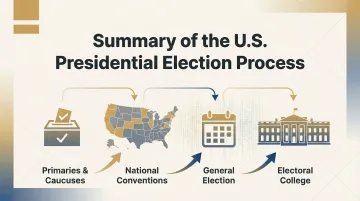
This guide breaks the entire process into clear steps: primaries and caucuses, national conventions, the general election, and the Electoral College. By the end, you'll understand how a candidate moves from announcing their campaign to taking the oath of office.
Key Takeaways
- Presidential elections occur every four years, with Election Day on the first Tuesday of November
- Candidates compete within their party through primaries and caucuses to secure the nomination
- National conventions nominate one candidate per party and confirm their VP pick
- On Election Day, voters decide how electors are allocated; a candidate needs 270 electoral votes to win
- The winner is inaugurated on January 20th of the following year
Who Can Run? Constitutional Requirements
The Constitution establishes three strict eligibility requirements for presidential candidates:
- Natural-born U.S. citizen — must be a citizen at birth (though the Supreme Court has never issued a controlling definition)
- At least 35 years old — no younger candidates permitted
- U.S. resident for 14 years — must have lived in the United States for at least 14 years
These are the only formal legal requirements. No federal statutes impose additional qualifications beyond these constitutional mandates.
Meeting those three requirements is enough to run legally. What comes next is the harder part: actually building a campaign capable of surviving.
The Pre-Primary Campaign Phase
Before the first primary vote, potential candidates spend a year or more laying the groundwork:
- Declare their candidacy publicly and build initial media presence
- Raise millions of dollars to fund staff, travel, and advertising
- Hire strategists, communications directors, and field organizers
- Travel to key states early to establish name recognition and donor relationships
Candidates from the Democratic Party, Republican Party, and third parties all enter the race during this phase. Fundraising totals and early polling act as informal filters — many who announce drop out before a single primary ballot is cast.
Primaries and Caucuses
Primaries and caucuses are internal party competitions where voters select their preferred presidential candidate. These are not the general election — they determine who will represent each party on the national ballot.
Primary vs. Caucus: Key Differences
Primaries:
- Registered party members cast secret ballots
- Voting works like a standard election
- Most states use this method
Caucuses:
- Party members gather in person to discuss candidates
- Voters indicate preferences through group voting processes
- Some caucuses involve moving to different areas of a room to show support
- Less common but historically influential in states like Iowa
How the Delegate System Works
Voters in primaries and caucuses don't vote directly for candidates — they select delegates who represent their state at the national convention.
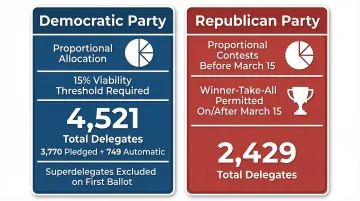
Democratic Party allocation:
- Delegates awarded proportionally based on vote share
- Candidates must reach a 15% viability threshold at district or statewide level
- Total of 4,521 delegates in 2024 (3,770 pledged, 749 automatic)
Republican Party allocation:
- Contests before March 15 must allocate proportionally (with up to 20% minimum thresholds)
- Contests on or after March 15 may use winner-take-all or hybrid methods
- Total of 2,429 delegates in 2024
Early States and Super Tuesday
Traditional early states — Iowa, New Hampshire, Nevada, and South Carolina — historically vote first and carry outsized influence. A strong showing builds momentum; a poor result often ends a campaign before most states have voted.
In 2024, the two major parties diverged on their calendars:
- Democrats held South Carolina first on February 3, 2024
- Republicans maintained Iowa's first-in-the-nation status on January 15, 2024
On Super Tuesday (March 5, 2024), 17 jurisdictions voted simultaneously, awarding roughly 36% of all delegates for both parties in a single day — making it the most decisive date in the primary calendar.
The primary season runs from February through June. The candidate who reaches a delegate majority becomes the presumptive nominee.
National Conventions and the Official Nomination
Each major party holds a national convention in the summer before the November election. Delegates formally cast their votes to officially nominate the presidential candidate.
2024 Convention Dates:
- Republican National Convention: July 15–18 in Milwaukee, Wisconsin
- Democratic National Convention: August 19–22 in Chicago, Illinois
The Role of Delegates at Conventions
Delegate rules differ between the two parties:
- Republicans: Bound to vote according to their state's primary or caucus results on the first ballot
- Democrats (pledged): Must reflect voter preferences from their state's primary or caucus
- Democrats (superdelegates): Party leaders and elected officials who cannot vote on the first ballot unless a candidate has already secured a verified majority
Democrats adopted this rule after 2016 to effectively remove superdelegate influence from contested first-ballot nominations.
Selecting the Vice Presidential Running Mate
The presidential nominee selects a vice presidential running mate, typically announced during or just before the convention. This choice is often strategic — balancing the ticket geographically, demographically, or ideologically. The convention formally ratifies the choice.
Once both parties have their nominees, the general election campaign begins — typically a 10-week sprint from late August through Election Day in November.
The General Election Campaign and Debates
From August through early November, candidates focus intensively on battleground or "swing" states — states where neither party dominates and small vote margins determine the outcome.
Campaign activities include:
- National rallies and local events
- Television, digital, and radio advertising
- Door-to-door voter contact operations
- Fundraising for the final stretch
Presidential Debates
Televised presidential debates are a critical feature of the general election. In 2024, the traditional Commission on Presidential Debates was bypassed, with networks hosting debates directly:
- June 27, 2024: CNN hosted the first debate, drawing 51.3 million viewers
- September 10, 2024: ABC News hosted the second debate, drawing 67.1 million viewers
- October 1, 2024: CBS News hosted the vice presidential debate
Those viewership numbers reflect how much is at stake — a strong debate performance can shift momentum in competitive states in the final weeks of the campaign.
Election Day, the Electoral College, and Inauguration
Election Day falls on the first Tuesday of November in election years. Eligible U.S. citizens cast ballots for their preferred candidate — but the path from that vote to the presidency runs through the Electoral College, not a direct national tally.
Understanding the Electoral College
When Americans vote for president, they're technically voting for a slate of electors pledged to that candidate, not directly for the candidate themselves.
How it works:
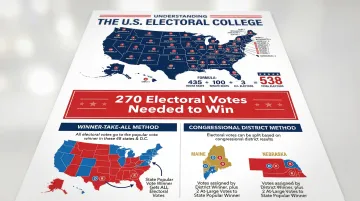
- Each state receives electors equal to its total Congressional representation (House seats plus two Senate seats)
- Total of 538 electors across all states plus Washington D.C.
- 270 electoral votes required to win the presidency
Winner-Take-All vs. District Method
Most states follow one of two allocation methods:
- 48 states and D.C. use winner-take-all — whichever candidate wins the state's popular vote receives all of that state's electoral votes
- Maine and Nebraska use the congressional district method, awarding two at-large electoral votes to the statewide winner plus one electoral vote per congressional district
Post-Election Timeline
Electors meet: On the first Tuesday after the second Wednesday in December, electors gather in their state capitals to cast official electoral votes (3 U.S.C. §7).
Congress counts votes: On January 6, Congress meets in joint session to certify the Electoral College results (3 U.S.C. §15).
Inauguration: On January 20, the winning candidate is sworn in as President of the United States at noon (20th Amendment).
Contingent Elections and Term Limits
The scenarios above cover the standard process — but the Constitution also accounts for an inconclusive result. If no candidate reaches 270 electoral votes, the 12th Amendment triggers a contingent election. The House of Representatives elects the President, with each state delegation casting one vote. The Senate elects the Vice President.
Separately, the 22nd Amendment limits presidents to two elected terms, capping how long any individual can hold the office regardless of electoral outcome.
Frequently Asked Questions
What is the difference between a primary and a caucus?
A primary uses a standard secret ballot vote, while a caucus is an in-person group discussion where participants signal their preference. Both methods allocate delegates to the national convention.
How does the Electoral College work?
Each state has electoral votes equal to its Congressional representation. In most states, the candidate winning the state's popular vote receives all of that state's electoral votes.
How many electoral votes are needed to win the presidency?
A candidate must secure at least 270 of the 538 total electoral votes. If no candidate reaches 270, the House of Representatives decides the election with each state delegation casting one vote.
When does the U.S. presidential election take place?
Election Day occurs on the first Tuesday of November every four years (2024, 2028, etc.). The winning candidate is inaugurated on January 20 of the following year.
Can a candidate win the popular vote and still lose the election?
Yes. The presidency is determined by the Electoral College, not the national popular vote. This has occurred five times in U.S. history — most recently in 2000 (Bush vs. Gore) and 2016 (Trump vs. Clinton).