

Introduction
Even well-produced sponsored content fails when it lands in the wrong place. With digital ad inventory expanding faster than audience attention, the question isn't just what you publish — it's where you publish it and who actually sees it.
According to the IAB and PwC, U.S. internet ad revenue reached $258.6 billion in 2024, yet engagement rates on standard display formats continue to disappoint. Budgets are growing; attention is not.
That gap comes down to distribution. This guide covers what sponsored content distribution networks are, how they work, what types exist, and how to choose the right one for your goals — whether you're a media buyer comparing newsletter networks to native platforms, or a brand deciding where your next campaign should run.
Key Takeaways
- Sponsored content distribution networks are paid media channels delivering brand-funded content to curated audiences, distinct from technical CDNs like Cloudflare.
- The four main types: newsletter/email networks, native advertising platforms, content syndication services, and social media sponsored placements.
- Newsletter networks skip the algorithm entirely, landing content directly in the inbox of readers who opted in.
- Choosing the right network means auditing audience quality, engagement metrics, and editorial fit — not just subscriber counts.
What Is a Sponsored Content Distribution Network?
A sponsored content distribution network is a system of media channels (owned by publishers, newsletter operators, or ad networks) that delivers brand-funded content to a specific, curated audience. Advertisers pay for guaranteed placement within trusted editorial environments, not anonymous impressions won through auction.
Not to Be Confused with a CDN
The term occasionally gets tangled with a technical "content delivery network" (CDN). A CDN — like Cloudflare or AWS CloudFront — is infrastructure: a distributed group of servers that caches website files close to users to reduce load times.
It has nothing to do with audience targeting, editorial placement, or advertising. If you're researching where to run your next campaign, a CDN is irrelevant to that decision.
The Three-Party Model
Every sponsored content distribution network operates on the same structure:
- The advertiser — the brand funding the content
- The distribution network — the publisher or platform controlling audience access
- The audience — subscribers, readers, or users who receive the content
The network's credibility is central to this model. Audiences trust the editorial environment first; that trust extends (or doesn't) to whatever content the network carries.
How the Channel Evolved
Sponsored content distribution evolved through distinct phases:
- Print advertorials and magazine inserts
- Programmatic web display and banner advertising
- In-newsletter sponsorships, native article placements, and content syndication
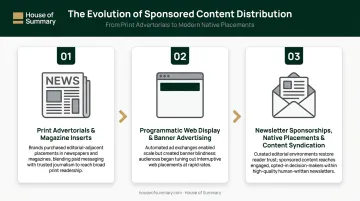
U.S. native display ad spending is projected to reach $147.98 billion in 2026, according to EMARKETER — a 13.1% increase — reflecting how the industry has shifted away from interruption-based formats.
Sponsored vs. Organic Distribution
That evolution shaped a clear fork in how content reaches audiences. Organic distribution depends on SEO, social sharing, and word-of-mouth — unpredictable by nature. Sponsored distribution offers guaranteed delivery to a defined audience segment on a defined timeline. For brands with specific reach and timing requirements, that predictability is the entire point.
How Sponsored Content Distribution Networks Work
Audience Segmentation and Curation
Networks build and maintain audience pools organized by interest, profession, geography, or behavior. Advertisers select the segment that matches their target customer; the network guarantees delivery to that segment.
This contrasts with broad programmatic buys, where audience quality is harder to verify and invalid traffic is a persistent concern. MRC digital audience standards require viewable impressions with filtration for both general and sophisticated invalid traffic — a baseline worth confirming before committing spend.
Content Placement Mechanics
Sponsored content is embedded within an editorial environment rather than displayed as a separate ad unit. Examples:
- A feature slot inside a newsletter send
- A "recommended article" placement on a publisher site
- A sponsored post within a social feed
The key distinction from banner advertising: sponsored content matches the format and tone of the surrounding editorial. Readers aren't jarred out of their reading experience by an obviously intrusive ad. This reduced friction is a primary reason engagement rates outperform display.
Scheduling and Delivery Models
| Delivery Type | How It Works | Trade-off |
|---|---|---|
| Fixed schedule (newsletters) | Content delivered to subscribers on set days | Predictable, measurable, reliable |
| Algorithmic delivery (social/native) | Platform decides when to show based on engagement signals | Can optimize performance, but adds variability |
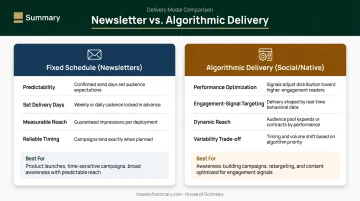
For advertisers who need certainty around a product launch, an event, or a quarterly campaign, scheduled delivery wins on reliability alone.
Editorial Trust and Brand Safety
That reliability matters — but so does where the content lands. Nielsen research found that branded content delivered 86% average brand recall compared to 65% for pre-roll, and that publisher partnerships produced roughly 50% higher brand lift than brand-owned publishing.
IAB/Edelman research reinforced this — a positive perception of a news site's credibility can increase perceived sponsored-content credibility by 33%. In practice, this means a brand's message inherits trust from the publication carrying it — making publisher selection a strategic decision, not just a placement one.
Measurement and Reporting
Reporting capabilities vary by network type:
- Newsletter networks — direct open rates, click-through rates, subscriber-level delivery data
- Web-based native networks — pixel tracking, last-click attribution, viewability scores
- Social platforms — platform-native analytics, reach, and engagement metrics
Engagement-based metrics tell the real story: click-through rate, time on page, and downstream conversions carry more weight than raw impressions.
Types of Sponsored Content Distribution Networks
Newsletter and Email Distribution Networks
Newsletter networks deliver sponsored content directly to subscribers' inboxes on a predictable schedule. Browser-based ad blockers filter web experiences — they don't operate inside email clients. Content arrives in an environment where the reader is already engaged, having chosen to open the issue.
Mailchimp's benchmark data shows an average email open rate of 35.63% and click rate of 2.62% across industries, with Business and Finance newsletters averaging 31.35% open rate and 2.78% click rate. These figures reflect an audience that opted in and chose to engage — a meaningfully different signal than a passive display impression.
House of Summary operates this model across four specialized newsletters — Presidential Summary, Geopolitical Summary, Dubai Summary, and London Summary — collectively reaching 500,000+ subscribers with 254,866+ emails opened daily. The network covers global news, international politics, UAE business, and London markets, attracting decision-makers, executives, and high-income professionals across the US, UK, and UAE. Advertisers can target a single newsletter audience or run coordinated campaigns across the full network.

Native Advertising Networks
Native advertising platforms — Outbrain, Taboola — place sponsored content recommendations within the editorial feeds of publisher websites. The content resembles an article or recommendation rather than a traditional ad, which improves click-through rates over standard display.
Taboola reports its Realize platform reaches approximately 600 million daily active users across publishers, apps, and OEMs. Outbrain publishes case results including 90% lower CPA versus social for certain campaigns — though these are vendor-provided figures, not independent benchmarks.
Key limitation: native web placements are still subject to ad blockers, and publisher site inventory quality varies considerably. Audience verification and viewability standards matter more here than on newsletter networks.
Content Syndication Platforms
Content syndication republishes existing content — articles, videos, infographics — across third-party websites to expand reach. HubSpot defines it as distributing the same asset on one or more different platforms for discovery and awareness.
Syndication serves a different purpose than sponsored placement. Syndication works best for:
- SEO link building and domain authority
- Top-of-funnel brand awareness
- Extending the reach of existing high-performing assets
The audience tends to be broader and less qualified than curated newsletter or native audiences. Syndication targets discovery; it's not typically a conversion channel.
Social Media Sponsored Content
LinkedIn, Facebook, Instagram, and X all offer sponsored content formats — boosted posts, sponsored articles, influencer-led branded content. The audience targeting capabilities are sophisticated, and creative iteration is faster than with most other channel types.
EMARKETER, citing Clutch research, found that 93% of consumers skip or block ads, with 55% skipping when they can and 37% ignoring them entirely. Social feeds are algorithmically controlled, so paid placement doesn't guarantee consistent visibility — and ad fatigue is accelerating as inventory grows.
That said, social remains effective for retargeting, fast creative testing, and broad reach campaigns. For high-intent audiences and measurable engagement, email-first alternatives are harder to beat.
Why Advertisers Choose Sponsored Content Distribution Networks
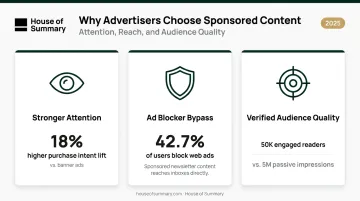
Three factors consistently push media buyers toward sponsored content networks over conventional display formats:
- Stronger attention metrics. The IPG Media Lab/Sharethrough study found native ads registered 18% higher lift in purchase intent and 9% lift in brand affinity compared to banner ads. Nielsen's brand recall data supports the same conclusion: editorial context holds attention in ways interruptive formats don't.
- Built-in ad blocker bypass. Blockthrough reports that 42.7% of internet users worldwide use ad blocking software — 530 million on mobile, 290 million on desktop. Any campaign running on web display or social feeds is invisible to nearly half its audience before the creative loads. Newsletter sponsorships reach the inbox instead.
- Verified audience access over raw volume. Sponsored content networks sell curated, qualified readers rather than broad impression pools. For brands targeting finance professionals, C-suite executives, or luxury consumers, 50,000 verified, engaged readers routinely outperform 5 million passive impressions on a generic platform — especially once engagement rates and conversion quality are factored in.
How to Choose the Right Sponsored Content Distribution Network
Match Audience Profile to Your Target Customer
Before evaluating any network, define your ideal reader — profession, geography, interests, decision-making role. Then audit whether the network's actual audience composition matches. Ask for first-party subscriber demographics, open rate history, and geographic distribution data — not just total subscriber counts.
House of Summary, for example, publishes that 66% of its subscribers are US-based (concentrated in New York and Los Angeles), with additional audiences in London and Dubai — a strong fit for brands targeting affluent decision-makers across those markets.
Evaluate Engagement Quality, Not Just Reach
Audience size tells you little on its own. What matters is whether subscribers are actually reading. Prioritize networks that can demonstrate click-through rates, open rates, and engagement metrics with transparency.
Use the Mailchimp Business and Finance averages — 31.35% open rate, 2.78% click rate — as a baseline for what a qualified newsletter audience should deliver.
Assess Editorial Alignment and Brand Safety
Your sponsored content will be judged by the company it keeps. Evaluate whether the network's editorial standards, content accuracy, and tone reflect how you want your brand perceived.
A network that verifies its content before publication — and maintains clear prohibitions on sensationalism, misleading claims, and inappropriate ad categories — transfers that credibility to every brand it works with. Editorial rigor isn't just a reader benefit; it's advertiser protection.
Frequently Asked Questions
What is a content delivery network (CDN) and can you give an example?
A CDN is a technical infrastructure network — like Cloudflare or AWS CloudFront — that distributes website files (images, scripts, videos) from servers close to the user to reduce load times. This is entirely separate from a sponsored content distribution network, which is a media and advertising channel for delivering brand messages to target audiences.
What is the difference between a VPN and a content delivery network (CDN)?
A VPN (Virtual Private Network) routes user traffic through a private encrypted server for privacy and security. A CDN routes web content through geographically distributed servers for speed and reliability. Both are technical infrastructure tools with no connection to marketing content distribution.
Should I enable a CDN for my website?
Enabling a CDN is a website performance decision — it helps with page load speeds, traffic resilience, and security. It's a separate consideration from choosing a sponsored content distribution network, which is a marketing decision about where to place branded content to reach specific audiences.
What is the difference between sponsored content and native advertising?
Sponsored content is brand-funded editorial-style content placed within a trusted publisher's environment — typically longer-form and clearly disclosed. Native advertising is a broader format category where ads match the look and feel of the surrounding platform, which can include short recommendation links, thumbnails, and in-feed units.
How do newsletter distribution networks compare to social media platforms for sponsored content?
Newsletter networks deliver content directly to a subscriber's inbox on a predictable schedule with no algorithmic filtering. Social platforms offer broader reach and targeting tools but depend on algorithms, are vulnerable to ad blocking, and suffer from feed-skipping behavior. Newsletter placements generally produce higher engagement rates with more qualified audiences.
What metrics should I track for a sponsored content distribution campaign?
Key metrics to track by channel type:
- Email/newsletter: open rate and click-through rate
- Web placements: time on page and scroll depth
- All channels: cost per click and cost per acquisition
- Conversions: leads, sign-ups, or purchases
Engagement rate is more meaningful than raw impressions when evaluating distribution quality.