
Sponsored content works differently. It meets audiences inside content they already trust — matching the format, tone, and value of the platform where it appears — rather than interrupting it. The best sponsored content informs or entertains first; the brand message follows naturally from that positive experience.
Done right, it builds brand equity. Done wrong, it gets scrolled past just like everything else.
This article covers five best practices that separate effective sponsored content from wasted budget: choosing the right channel, leading with reader value, disclosing properly, measuring what matters, and investing in partnerships that compound over time.
Key Takeaways
- Place sponsored content only where your target audience already actively engages and trusts the publisher
- Lead with genuine value — useful information, entertainment, or a fresh perspective — then let the brand message follow
- Disclose on every individual placement, prominently and without ambiguity — FTC rules apply regardless of format
- Define SMART goals before launch and track KPIs that span attention, engagement, and downstream conversion
- Recurring partnerships outperform one-off placements; consistency is what builds lasting brand recognition
Best Practice 1: Choose the Right Channel and Match Your Audience
The most common sponsored content mistake is selecting a channel based on reach alone. A large subscriber count or follower number means very little if those readers have no relevant interest in what you're selling. Channel selection has to start with audience intent.
Passive Scrolling vs. Active Reading
Ask one question before choosing any platform: where does your target audience actively seek information versus passively scroll?
Social feeds are passive-consumption environments. Audiences encounter content between posts from friends and brands competing for the same fractional second of attention. Rival IQ's 2024 Social Media Benchmark Report found median engagement rates of just 0.063% on Facebook and 0.029% on Twitter/X, with both platforms trending down year over year.
High-intent environments — email newsletters, niche podcasts, trade publications — work differently. Audiences in these channels have opted in deliberately. They're reading with purpose, not scrolling reflexively.
Why Newsletter Sponsorships Stand Out
Newsletter advertising sits in a particularly strong position. Readers have subscribed, opened an email, and chosen to engage. That's three deliberate actions before they see a single word of sponsored content.
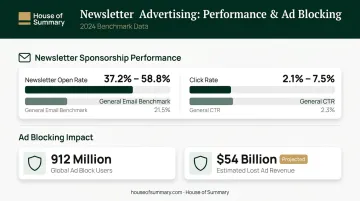
Paved's 2026 newsletter sponsorship marketplace data shows open rates ranging from 37.2% to 58.8% and click rates from 2.1% to 7.5% across listed categories — above the general email marketing average of 21.5% open rate and 2.3% CTR reported by Campaign Monitor across 100 billion emails.
Those engagement numbers hold up partly because of how newsletters are delivered. eyeo's 2023 ad-filtering report estimated 912 million global ad-blocking users and projected $54 billion in publisher revenue lost to ad blocking in 2024. Newsletter placements bypass browser-based ad blockers entirely — the content arrives as part of an email the reader requested. House of Summary's network of specialized newsletters, reaching 500,000+ subscribers, operates on exactly this delivery model.
What to Ask Before Committing to a Publisher
Don't rely on subscriber counts alone. Request:
- Geographic and demographic breakdowns of the audience
- Historical open rates and click rates (not projections)
- Evidence of audience loyalty — repeat openers, low unsubscribe rates
- Editorial tone and subject matter alignment with your brand
A mismatch between the publisher's voice and your brand's values creates friction that no budget can fix.
Best Practice 2: Lead with Value, Not a Sales Pitch
Sponsored content that prioritizes the reader's needs above the brand's promotional goals outperforms content that opens with a product. Readers engage with content that teaches them something useful, answers a real question, or tells a story worth following. The brand association grows from that positive experience — not from a headline that reads like a press release.
Brief the Publisher Like an Editor, Not an Ad Agency
When working with a publisher or newsletter, share your messaging goals and the key points you want readers to take away. Then step back and let the publisher write in their own voice.
Overly scripted, brand-heavy content breaks the trust the publisher has built with their audience. Readers recognize advertorial instantly, and the moment they do, the content stops working. The goal is for sponsored content to feel like a natural extension of what the publisher already produces — not a thinly disguised ad.
IAB/Edelman research found that a positive view of a publisher's credibility produced a 33% increase in perceived credibility of in-feed sponsored content. Publisher trust transfers to the brand — but only when the content actually earns it.
Match the Format to the Platform
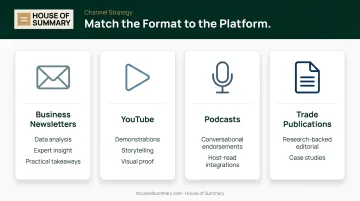
Content type must fit the platform's natural behavior:
- Business newsletters — data-driven analysis, expert insight, practical takeaways
- YouTube — demonstrations, storytelling, visual proof
- Podcasts — conversational endorsements, host-read integrations
- Trade publications — research-backed editorial, case studies
Forcing the wrong format into a channel erodes both performance and brand perception. A polished brand video that reads perfectly on Instagram looks out of place in a data-focused morning briefing.
The Three-Question Gut Check
Before any sponsored content goes live, ask:
- Does this content serve the reader, independent of the brand message?
- Would this piece embarrass the publisher or the brand if the sponsorship label were removed?
- Does the brand integration feel natural, or does it interrupt the reading experience?
Content that can't pass all three questions will underperform — and in a trust-based medium like newsletters, underperformance is hard to undo.
Best Practice 3: Disclose Clearly, Prominently, and Every Time
What the FTC Actually Requires
The FTC finalized updated Endorsement Guides on June 29, 2023 (16 CFR Part 255, 88 FR 48102). The rules apply to social posts, newsletter placements, blog articles, podcasts, and videos — no exceptions. The standard is clear and conspicuous: disclosures must be difficult to miss and easily understood by ordinary consumers.
In practice, that means:
- The disclosure appears before or alongside the branded content — not buried at the end
- It uses plain language: "Sponsored," "Ad," "Advertisement," or "Paid Partnership" are acceptable; "Promoted" is riskier because the FTC has flagged it as potentially ambiguous
- It's visible enough that readers encounter it before they engage with the brand message
- Platform disclosure tools (like Instagram's "Paid Partnership" tag) may not be sufficient on their own — verify visibility before assuming compliance
The FTC's 2016 Lord & Taylor settlement illustrates exactly where brands go wrong. The retailer paid for a Nylon article and influencer posts without adequate disclosure. The campaign reached 11.4 million Instagram users and generated 328,000 brand engagements — strong numbers that didn't protect them from regulatory action. Under FTC rules, reach and engagement are irrelevant if the disclosure obligation wasn't met.
Why Disclosure Tends to Strengthen Engagement
Complying with disclosure rules is the floor — what happens above it matters too. Many marketers assume disclosure will reduce engagement, but audiences who recognize sponsored content and still find it genuinely useful tend to reward both the brand and the publisher with stronger credibility. Labeling content as sponsored signals that the brand stands behind its quality without needing to hide the relationship.
Build a disclosure checklist for every campaign:
- Confirm every individual placement — each newsletter issue, post, or episode — carries its own visible disclosure
- Don't assume a disclosure in one piece covers related content published separately
- Verify disclosure visibility across different email clients and devices before sending
Best Practice 4: Set Goals Before Launch and Measure What Matters
Sponsored content campaigns without defined goals cannot be evaluated or improved. Define SMART objectives — specific, measurable, achievable, relevant, time-bound — before content is created. What you're trying to accomplish determines which numbers actually matter.
Match KPIs to Campaign Goals
| Campaign Goal | Primary KPIs to Track |
|---|---|
| Brand awareness | Impressions, open rates, social shares |
| Engagement | Time-on-content, CTR, comments |
| Lead generation | Form completions, promo code redemptions |
| Direct conversion | Attributed sales, landing page conversions |
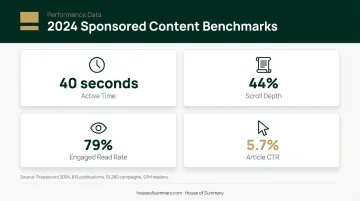
Pressboard's 2024 full-year benchmark report — covering 819 publications, 10,280 campaigns, and 93 million readers — provides useful reference points: 40 seconds average active time, 44% average scroll depth, 79% engaged read rate, and 5.7% article CTR. Use these figures as a baseline — if your campaign falls significantly below them, the placement or content format warrants a closer look.
Track Beyond the Click
Attribution requires infrastructure set up before launch:
- UTM parameters on every link to trace traffic back to the specific placement (Google's Campaign URL Builder makes this straightforward)
- Dedicated landing pages for each sponsored placement to isolate results
- Pre-campaign baselines — document current website traffic, branded search volume, and direct traffic so post-campaign data has a meaningful reference point
A sponsored article may generate brand recall and direct search traffic several days after the initial send. Monitoring search volume changes and direct traffic in the week following a placement captures that delayed impact — treat it as a signal worth tracking, not a certainty.
Best Practice 5: Prioritize Long-Term Partnerships Over One-Off Placements
A single sponsored article may produce a short traffic spike. It rarely builds the repeated brand exposure and audience familiarity that drive actual purchase consideration.
Nielsen's branded content research found that publisher-distributed branded content produced 50% higher brand lift than brand-owned distribution — a result Nielsen attributes to publisher trust, audience loyalty, and editorial context. That trust transfer doesn't happen from one placement. It compounds over time.
What Recurring Partnerships Look Like in Practice
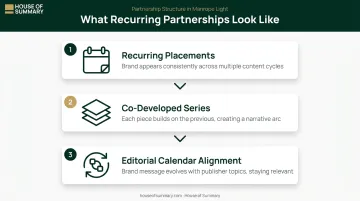
Long-term publisher relationships go beyond buying multiple slots:
- Recurring placements across multiple content cycles, so the audience encounters the brand consistently rather than once
- Co-developed series where each piece builds on the previous one, creating a narrative instead of isolated ad units
- Campaigns that evolve with the publisher's editorial calendar, keeping the brand message relevant rather than repetitive
For brands targeting high-intent readers in specialized publications, consistent placement means the brand becomes part of the trusted information environment the reader returns to regularly. House of Summary's multi-week packages — ranging from 2 to 12 weeks, with meaningful discounts versus single-issue rates — are structured around this principle, because sustained presence outperforms single-campaign bursts.
Treat Publishers as Strategic Partners
The best publisher-brand relationships improve over time because both parties learn what the audience responds to. Involve the publisher early in campaign planning. Respect their editorial standards. Use performance data from early placements to refine messaging for subsequent ones.
Publishers are not distribution pipes. They supply editorial context, audience trust, reader expectation, and the credibility transfer that makes sponsored content worth buying in the first place.
Frequently Asked Questions
What is the difference between sponsored content and native advertising?
Native advertising is a broad category covering paid ads that match the form of the platform — including promoted search results and social ads. Sponsored content is a specific type of native advertising where a brand pays a publisher to create or place editorial-style content that blends with the publication's regular output, explicitly labeled as sponsored.
Does sponsored content always need to be labeled?
Yes, every time. FTC guidelines require clear disclosure on every individual piece of sponsored content regardless of platform. Labels like "Sponsored," "Ad," or "Paid Partnership" must appear where readers encounter them before or alongside the content — not at the end, not in fine print.
How do you measure the ROI of a sponsored content campaign?
ROI depends on your campaign goal. Use UTM links, dedicated landing pages, and engagement metrics (CTR, time-on-page, scroll depth) to track performance against your objective. Establish baseline metrics before launch so post-campaign data has a meaningful comparison point.
What makes a good sponsored content partnership?
Strong partnerships start with audience alignment between brand and publisher, editorial credibility with that audience, and clear communication about goals and content guidelines. Commit to multiple placements rather than a single buy — one-off placements produce spikes; recurring partnerships build recognition.
Is sponsored content effective for B2B brands?
Sponsored content works well for B2B brands when placed in the right channels. Industry newsletters, trade publications, and professional platforms reach decision-makers actively seeking relevant information — making them ideal for thought leadership, category education, and lead generation. The key is channel fit, not format alone.