
Introduction
Banner blindness is real. Research consistently shows that the majority of consumers actively tune out or skip digital ads — and over half take deliberate steps to block them entirely. Ad budgets keep climbing while audience attention keeps retreating.
Native advertising is the strategic response to that gap. Unlike display or banner ads that interrupt the user experience, native ads match the look, tone, and format of the platform where they appear — so they feel like content readers were already looking for. The adoption numbers reflect that logic: EMARKETER forecasts U.S. native display ad spend at $108.83 billion in 2024, accounting for 63.1% of total U.S. display ad spend.
That scale only grows if the execution is right.
This article breaks down 10 actionable best practices that help marketers build a native advertising strategy that earns attention, drives engagement, and converts — without burning budget on placements that get scrolled past or blocked outright.
Key Takeaways
- Native advertising works by matching the look, tone, and format of the platform — making it feel useful rather than intrusive
- Strong campaigns start with SMART goals, a clear audience profile, and metrics that reflect the full customer journey
- Content quality, contextual relevance, and platform fit separate effective native campaigns from wasted spend
- FTC disclosure isn't optional — clear labeling protects both brand trust and legal standing
- Continuous A/B testing and optimization are what move a native campaign from decent performance to consistent, measurable returns
What Makes Native Advertising Different?
The IAB defines native ads as paid placements that are cohesive with page content, assimilated into the design, and consistent with platform behavior — so the viewer feels they belong. Native advertising isn't a different ad format — it's a different philosophy for how ads should exist within content.
Standard display advertising — banners, pop-ups, fixed sidebar units — occupies designated ad slots that are visually distinct from editorial content. Readers have learned to ignore them. Ad blockers have been built specifically to remove them. YouGov found that 52% of consumers across 48 global markets had installed or used an ad blocker on a browser or mobile device.
Native advertising avoids that friction in two ways:
- Format alignment: Native ads mirror the editorial style of the platform, so they register as content rather than interruption
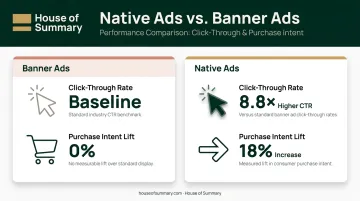
- Engagement advantage: IAB Europe data cites native ads delivering 8.8x higher click-through rates than banner ads and increasing purchase intent by 18%
The result is an ad format that readers engage with rather than skip past.
10 Best Practices for a Native Advertising Strategy
These 10 practices work as a system. Each one reinforces the others — skipping any one weakens the whole.
Practice 1: Set SMART Goals Before You Launch
Vague objectives like "increase visibility" don't give campaigns direction. SMART goals — Specific, Measurable, Attainable, Realistic, and Time-bound — create the benchmarks that determine everything downstream: content type, platform choice, and how you define success.
Common native campaign goals include:
- Brand awareness — measured by reach, viewability, and share of voice
- Consideration — measured by site visits, engagement, and on-site actions
- Conversions — measured by clicks, sales, and cost per acquisition
The goal you set shapes the metrics you track and the content you create. A campaign targeting brand awareness needs different content, placement, and KPIs than one built to drive trial sign-ups. Define the goal first; build everything else around it.
Practice 2: Build a Detailed Audience Profile
Audience understanding determines everything downstream. Which platform to use. What tone to write in. What content format connects. Where the reader sits in the funnel.
Gather first-party data from:
- Website analytics (behavior, pages visited, referral sources)
- Customer surveys (language, pain points, decision drivers)
- On-platform insights (what your best customers actually read and share)
That data should shape more than targeting. It should influence the specific language in your headline, the framing of your value proposition, and the offer you put in front of readers. A financial services brand writing for CFOs needs a different tone than one writing for first-time investors — even if the product is the same.
Practice 3: Choose Metrics That Match Your Goals
Click-through rate alone doesn't tell you enough. Native campaigns require both quantitative and qualitative measurement to capture the full picture.
| Metric Type | Examples |
|---|---|
| Quantitative | CTR, conversion rate, cost per acquisition, site visits |
| Qualitative | Engagement rate, time on content, brand lift, purchase intent |
Brand lift and purchase intent are where native advertising's long-term value lives. IAB Europe data suggests native content can increase purchase intent by 18% — a metric that reflects brand affinity rather than a single transaction. If your goals include building audience trust over time, your measurement framework needs to reflect that longer arc. Tracking only transactional metrics misses the cumulative value that makes native advertising worth the investment.
Practice 4: Prioritize Contextual Relevance in Platform Selection
Even excellent content underperforms when it lands in the wrong environment. Contextual fit between your ad and the editorial context around it is a prerequisite for engagement.
IAB Europe research found that 81% of consumers prefer ads that match the content of the page they're viewing, and 65% of UK consumers report a more favorable opinion of brands that use contextually relevant advertising. That's the gap between a campaign that converts and one that gets ignored.
What contextual relevance looks like in practice:
- A fintech brand placed within a business news newsletter reaches a self-selected, high-intent audience already primed for that category
- The same brand on a general interest site reaches a mixed audience with no particular orientation toward financial content — and typically converts at a fraction of the rate
Email newsletters offer a uniquely high-context native advertising environment. Readers have opted in, attention is undivided, and there's no algorithm filtering or ad blocker interference. For example, House of Summary's newsletter network reaches 500,000+ subscribers across global news, geopolitics, and business — with 254,866+ emails opened daily by decision-makers and executives who have chosen to be there.
Practice 5: Produce High-Quality, Genuinely Useful Content
Native advertising content has to clear a higher bar than a standard ad. The reader's implicit expectation is editorial quality — content that educates, informs, or solves a problem. Copy that reads like a sales pitch breaks the experience and erodes trust.
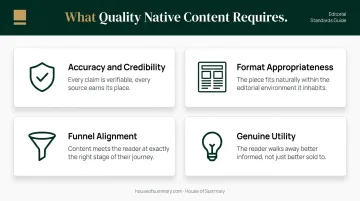
Elements of quality native content:
- Accuracy and credibility — source your claims and make them verifiable
- Format appropriateness — length, structure, and visuals should match the platform
- Funnel alignment — the message should match where the reader is in their decision process
- Genuine utility — the reader should get something valuable even if they never buy
Quality content also extends its reach. High-engagement native pieces get shared and referenced beyond the original placement, extending campaign value without additional spend.
Practice 6: Craft Headlines That Stop the Scroll
A headline is often the only element a reader sees before deciding whether to click. It needs to be specific, benefit-oriented, and honest — without resorting to clickbait that over-promises and under-delivers.
IAB UK notes that image thumbnails are often the most-viewed element of a native ad, which means the creative system extends beyond the headline itself. Treat these elements as a connected unit:
- Headline — specific and benefit-driven
- Subheading or preview text — adds context and reinforces the click decision
- Thumbnail image — aligns visually with the editorial environment and the headline's promise
If any one element is weak, it undermines the others. A strong headline paired with a generic image loses clicks that a matched creative system would have captured.
Practice 7: Write in Natural, Conversational Language
Formal or promotional copy is the fastest way to break native advertising's core strength. Readers come to native content expecting editorial tone. The moment they detect a sales pitch, trust drops and engagement follows.
Write as if addressing one specific person:
- Use plain language over industry jargon
- Match the vocabulary and reading level of the platform's typical audience
- Let the publication's own editorial voice guide your register
This doesn't mean avoiding brand messaging — it means delivering it in a way that earns attention rather than demanding it. The best native copy reads like a knowledgeable colleague sharing something relevant, not a brand shouting for attention.
Practice 8: Include a Purposeful Call to Action
Even awareness-focused native campaigns need a CTA. Without one, readers engage with the content but have no clear path forward — and that engagement goes nowhere.
The CTA should be explicit and matched to the campaign's funnel stage:
- Top-of-funnel / awareness: "Learn more," "Explore our research," "Read the full guide"
- Mid-funnel / consideration: "Download the report," "See how it works," "Compare your options"
- Bottom-of-funnel / conversion: "Start your trial," "Request a demo," "Get a quote"
A bottom-of-funnel CTA on an awareness piece confuses readers and suppresses results. Match the ask to the moment — and make the next step obvious.
Practice 9: Disclose Clearly and Build Trust Through Transparency
FTC guidelines require all paid native content to be clearly labeled. Acceptable labels include "Ad," "Advertisement," and "Paid Advertisement" — placed prominently and close to the ad focal point. The FTC has warned that terms like "Promoted" can be ambiguous if readers don't recognize them as indicating advertising.
The Lord & Taylor case is the clearest enforcement example: the brand settled FTC charges in 2016 after failing to disclose a paid article in Nylon magazine and paid influencer posts. The reputational cost of that case far exceeded any short-term engagement gain from obscuring the sponsorship.
Reframe disclosure as a trust asset. Readers who recognize sponsored content but still find it valuable come away with a stronger brand impression than readers who feel misled. Transparency is what turns a native ad into a brand-building moment.
Practice 10: Test, Measure, and Continuously Optimize
No native campaign should run static. The optimization cycle is what separates campaigns that stall from campaigns that build momentum:
- Launch with a defined hypothesis about what will drive engagement
- Measure engagement and conversion rates against your SMART goals
- Identify which variables are underperforming — headline, visual, copy, CTA
- Test alternatives through A/B testing against a consistent control
- Reallocate budget toward what's performing, away from what isn't
- Repeat — each iteration produces better data than the last
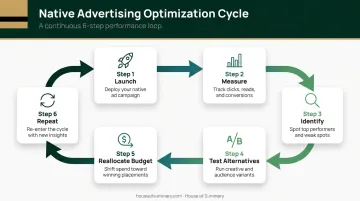
The cumulative benefit is real. A campaign that improves by 10% per iteration across six cycles doesn't just perform 60% better — it generates data that makes the next campaign sharper before it even launches.
How to Choose the Right Native Advertising Channel
Channel selection comes down to three questions:
- Audience alignment — does this platform reach your exact target segment?
- Format compatibility — does the channel support the content type you're creating?
- Cost structure — does the pricing model (CPC, CPM, flat-fee) fit your campaign goals?
Major Native Advertising Channel Categories
| Channel Type | Funnel Stage | Key Characteristic |
|---|---|---|
| In-feed / in-content social ads | Awareness, consideration | High reach, algorithm-dependent distribution |
| Content recommendation widgets | Awareness, traffic acquisition | Broad discovery reach, lower intent audiences |
| Branded / native content | Consideration, brand lift | Deep engagement, trust-building format |
| Email newsletter placements | Consideration, conversion | Opt-in audience, no ad blockers, undivided attention |
Of these four categories, email newsletter placements remain the most consistently overlooked — particularly by B2B brands and premium consumer advertisers who would benefit most from them.
Newsletter ads reach readers who chose to be there. They bypass ad blockers, arrive without visual clutter, and land when the reader is already in an active, focused mindset — conditions that most digital channels can't replicate.
For brands targeting executives, business professionals, or high-intent news readers, newsletter networks like House of Summary offer direct access to an opted-in audience of 500,000+ subscribers across global news, geopolitics, business, and city-specific verticals.
Native editorial placements appear inline with editorial content, labeled clearly as sponsored, and reach readers in a context where engagement is already present.
Conclusion
The best native advertising doesn't feel like advertising. It feels like content the reader was already looking for, and that's precisely why it works. Getting there requires every element to pull in the same direction: clear goals, precise audience targeting, contextually matched platforms, genuinely useful content, and transparent disclosure.
Native advertising is also a long-game investment. The practices outlined here improve individual campaigns, but their real value accumulates over time as audience trust deepens, data builds, and each campaign sharpens the next.
For brands ready to reach engaged, high-intent readers through a direct inbox channel with no algorithms, no ad blockers, and click-through rates that run 4x higher than Google AdWords, House of Summary offers native advertising placements across specialized newsletters covering global news, business, geopolitics, and more. Reach out at sales@houseofsummary.com to explore what a fit looks like.
Frequently Asked Questions
What are native advertising strategies?
Native advertising strategies are planned approaches to running paid content that blends into the style and format of a host platform. Core components include audience targeting, content creation, platform selection, FTC-compliant disclosure, and performance optimization — all aligned to specific campaign goals.
What is native advertising with an example?
Native advertising is paid content designed to match the look, tone, and format of the editorial environment around it. A sponsored article on a news site, a promoted post in a social media feed, or a branded editorial segment within an email newsletter all qualify as native advertising.
How is native advertising different from display advertising?
Display advertising (banner ads, fixed units) appears in designated slots that are visually distinct from editorial content and are frequently blocked by ad blockers. Native advertising matches the form and function of surrounding content, resulting in higher engagement rates and far less ad avoidance from readers.
How do you measure the success of a native advertising campaign?
Native campaign success requires both quantitative metrics (CTR, conversion rate, cost per acquisition) and qualitative metrics (engagement rate, time on content, brand lift). The right mix depends on campaign objectives: awareness campaigns prioritize reach and brand lift, while conversion campaigns weight CTR and cost per acquisition more heavily.
Does native advertising work in email newsletters?
Email newsletter native advertising is highly effective for reaching opted-in, high-intent audiences. Newsletter ads bypass ad blockers entirely and reach readers in a distraction-free inbox environment, typically outperforming standard display formats in both engagement and click-through rates among business and professional readers.