Introduction
The D2C advertising landscape has become genuinely harder to work in. Meta CPMs rose 5% year-over-year in 2024, with Black Friday peaks hitting $16.85 CPM and Cyber Monday reaching $17.70 CPM. Apple's iOS 14.5 privacy changes hit Facebook targeting hard, with 62% of iPhone users opting out of tracking and eliminating the audience signals D2C brands had built campaigns around.
Meanwhile, 1.77 billion internet users now deploy ad blockers — 32.5% of the US market alone.
These aren't minor headwinds. They're fundamental shifts that have driven customer acquisition costs up 222% over the past decade. D2C brands now lose an average of $29 per new customer acquired, compared to just $9 in 2013.
Native advertising has emerged as one of the most discussed responses to this pressure. But knowing the term and understanding how it actually works — and whether it fits your D2C acquisition strategy — are two different things. This guide covers both.
Key Takeaways
- Native advertising blends into platform content without interrupting the reader experience
- Runs through direct publisher placements or programmatic real-time auctions
- Primary formats: in-feed social ads, sponsored articles, promoted listings, newsletter placements
- Addresses D2C challenges: ad fatigue, rising acquisition costs, and cold-audience trust
- Must carry clear "Sponsored" or "Ad" labels per FTC guidelines—transparency is legally required
What Is Native Advertising?
Native advertising is paid media where the ad matches the design, tone, and format of surrounding content. Unlike display banners or pop-ups, it doesn't visually interrupt the user experience—it integrates into it. You'll see it labeled as "Sponsored," "Partner Content," or "Branded Journalism," depending on the publisher.
Traditional digital ads generated consumer backlash. Research shows 86% of internet users experience banner blindness, with only 8% of users accounting for all display ad clicks. Native advertising emerged as the industry's answer to declining engagement with interruptive formats.
It's also worth distinguishing what native advertising is not. It's not content marketing — which is owned, unpaid content created by brands — and it's not organic editorial. It's paid, commercial, and must be disclosed. But it earns attention by providing genuine value or matching context seamlessly.
Native advertising isn't a single format but a category. It exists across search engines, social feeds, publisher sites, and newsletters. The common thread: contextual integration, not a specific channel.
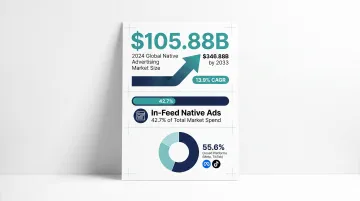
That breadth reflects strong market momentum. Key figures from 2024:
- The global native advertising market hit $105.88 billion in 2024, projected to reach $346.88 billion by 2033 (13.9% CAGR)
- In-feed native ads account for 42.7% of total spending
- Closed platforms like Meta and TikTok represent 55.6% of the market
How Does Native Advertising Work?
Native advertising follows a clear sequence: identify placement, match ad to context, deliver it within the content experience, and use engagement data to optimize. Each stage has direct implications for D2C advertisers tracking where their budget goes.
Placement and Targeting
Native ad placement gets triggered through two primary models:
Direct publisher deals: A brand pays a newsletter or publication to run a sponsored article. These placements offer editorial control, audience specificity, and premium positioning.
Programmatic buying: When a user loads a page, a real-time auction occurs. A Supply-Side Platform (SSP) signals available inventory, and a Demand-Side Platform (DSP) bids on behalf of advertisers. The highest bid wins the placement.
Targeting operates on two levels:
- Contextual targeting: Matches ad content to the subject matter of surrounding editorial (e.g., running a fitness product ad alongside health content)
- Audience-based targeting: Uses first-party data or behavioral signals to reach specific user segments
Contextual targeting is gaining renewed importance as third-party cookies phase out. Google reversed its 2024 cookie deprecation timeline in favor of a user-choice model — but the direction of travel is clear. Native advertising platforms that never relied on third-party tracking are well-positioned for what comes next.
Creative Matching
The ad creative — headline, image, description — is formatted to mirror the platform's style. On a news site, it looks like a news article. In a social feed, it appears as a post. In a newsletter, it reads like editorial content.
Matching format is not deception. FTC guidelines require native ads to carry clear disclosures using terms like "Sponsored," "Paid," or "Advertisement." The goal is seamless visual integration, not hidden commercial intent — brands that skip disclosure risk both regulatory consequences and audience trust.
Delivery and Engagement
When creative and context align, the delivery payoff is measurable. Users encounter the ad as part of their normal content experience — no banner blindness, no scroll-past reflex. Native ads average a 0.2% click-through rate versus 0.05% for display, a 4x advantage. Eye-tracking studies show native ads receive 53% more visual attention than display ads.
Engagement data — clicks, time-on-content, conversions — feeds back into the campaign. For programmatic native, this optimizes bids and targeting in real-time; for direct placements like sponsored newsletter content, it shapes future creative and audience decisions.
Types of Native Advertising D2C Brands Should Know
Primary Format Categories
In-feed social ads: The largest native advertising category. These sponsored posts match the look and feel of organic content in social feeds — same format, same placement, paid distribution. D2C brands with visual products get the most mileage here.
Promoted listings: Paid product placements inside e-commerce or marketplace search results. Amazon's sponsored products are the most recognizable version — same design as organic listings, surfaced above them through paid placement.
Sponsored articles and editorial content: Branded content published inside media outlets or blogs, labeled as sponsored. Most effective for products that require some education before purchase — complex categories, new-to-market concepts, or anything where context drives conversion.
Newsletter Native Advertising
Of these formats, newsletter placements stand apart. A sponsored block appears inside a curated email delivered to an opted-in subscriber list — readers are already in a focused, distraction-free environment before they see the ad.
Key advantages over web and social:
- Bypasses ad blockers entirely — ad blocking software operates at the browser level and has no effect on permission-based email delivery
- Reaches subscribers directly, with no platform algorithm deciding whether your message gets seen
- Delivers higher baseline engagement — newsletter open and click rates consistently outperform web display benchmarks by a wide margin
For D2C brands targeting specific audience segments — business professionals, finance readers, lifestyle audiences — newsletter networks like House of Summary offer access to engaged, high-intent readers across specialized publications. Newsletter advertising adoption reached 64% of marketers in 2025, up 25% year-over-year, with spending surging 40% — reflecting a broader shift toward owned, algorithm-free channels.
Programmatic Native (Open Web)
Beyond social, listings, and newsletters, recommendation widgets from platforms like Taboola or Outbrain make up the third major native format. These content discovery units appear as "You might also like" sections at the bottom of articles — high volume, broad reach.
Caveat: Open-web programmatic placements offer less editorial control and audience specificity than direct publisher or newsletter partnerships. They provide scale but sacrifice the premium positioning and brand safety that direct placements deliver.
Why Native Advertising Works for D2C Companies
Solves the D2C Acquisition Problem
D2C brands don't have retail shelf presence or distributor relationships. They rely heavily on paid social and search for customer acquisition. This concentration creates vulnerability as those channels become more expensive and less effective.
The numbers tell the story:
- Customer acquisition costs have risen 222% over the last decade
- Meta projected $10 billion in lost revenue in 2022 from iOS 14.5 tracking changes alone
- Facebook CPMs tripled from $6 to $18 within two years of Apple's privacy update
Native advertising provides channel diversification outside walled gardens where signal loss and rising costs squeeze margins.
Addresses Ad Fatigue and Banner Blindness
Retargeting-heavy campaigns saturate the same audiences fast. Meta defines creative fatigue as cost per result reaching 2x the historical benchmark — a threshold most brands hit within the first 7 days.
Native advertising breaks this pattern by offering content that earns attention rather than demanding it. Categories like wellness, fashion, food, and personal finance rely on this effect — consumers research extensively before buying.
Builds Trust at Top of Funnel
Cold audiences have never heard of your brand and have no reason to trust it yet. A well-placed sponsored article or newsletter feature introduces the brand in a credible editorial context, borrowing trust from the publication.
Research shows native ads generate 18% higher purchase intent and 9% higher brand affinity compared to display ads. This trust-building happens before the brand asks for a sale.
Fits Into Full-Funnel Strategy
Native advertising is most effective for awareness and consideration, not direct conversion (though it can contribute). Native ad spend complements bottom-funnel performance channels — it doesn't replace them.
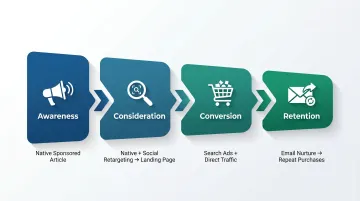
Typical customer journey integration:
- Awareness (Native): Sponsored article in industry publication introduces brand and category
- Consideration (Native + Social): Retargeting ads reinforce message, drive to landing page
- Conversion (Performance): Search ads and direct traffic convert ready buyers
- Retention (Email): Owned channels nurture repeat purchases
Measurable Performance
Unlike brand sponsorships, native ads can be tracked and optimized. Key metrics include:
- CTR (click-through rate): Native ads average 0.2% vs. 0.05% for display
- Time on content: Measures engagement depth beyond the click
- Scroll depth: Indicates how much sponsored content users consume
- Downstream conversion tracking: UTM parameters connect native impressions to sales
Realistic benchmarks vary by format. Open-web programmatic native (Taboola/Outbrain) typically costs $3–$7 CPM and $0.10–$0.50 CPC. Social in-feed native runs $5–$20 CPM and $0.20–$2.00 CPC, though high-competition niches can push well beyond these ranges.
How to Run a Native Ad Campaign as a D2C Brand
Three Foundational Decisions
1. Define the goal
What outcome drives this campaign?
- Focus on reach and impressions for brand awareness
- Optimize for lead capture if email list growth is the priority
- Drive traffic to educational landing pages for product consideration
- Push users toward product pages for direct traffic (works better as a retargeting tactic)
The goal shapes every downstream decision — format, channel, and how you measure success.
2. Choose the right channel
- Social in-feed works best for visual products and broad reach on established platforms
- Open-web programmatic offers scale but less control over placement quality
- Direct publisher and newsletter partnerships provide editorial control, audience specificity, and premium positioning
Direct placements deliver higher engagement but less scale — a trade-off worth understanding before committing budget.
3. Set a realistic budget
Native placements are typically auctioned on a CPM or CPC basis. Costs vary by platform, audience quality, and competition. Expect:
- Open-web programmatic: $3–$7 CPM
- Social in-feed: $5–$20 CPM
- Newsletter sponsorships: Varies by publisher; benchmark $20–$66+ per 1,000 subscribers
Test with modest budgets before committing to long-term campaigns.
What Makes Native Creative Effective
For D2C brands, effective native content leads with value — a useful insight, compelling story, or relevant comparison — rather than product features.
Creative best practices:
- Write headlines that match the editorial tone of the publication (drop the promotional language)
- Use authentic, unpolished imagery with clear focal points rather than styled product shots
- Lead with the benefit or insight, not the brand name
- Always label content as "Sponsored" or "Ad" per FTC requirements
Clear disclosure doesn't hurt performance — when content genuinely helps readers, the "Sponsored" label doesn't suppress engagement.
Beyond disclosure, format details affect results more than most brands expect. Taboola's platform research points to several consistent patterns:
- Landing pages with 400–600 words (though shorter 250-word pages can also perform)
- Performance videos under 15 seconds
- Numbered lists and timely components in headlines
- Dynamic keyword insertion for personalization (location, day of week)
The Optimization Loop
Unlike performance ads that show results within days, native content needs several weeks to accumulate statistically meaningful data. Build that timeline into your planning.
Standard optimization process:
- Launch campaign with clear success metrics defined upfront
- Track performance data — CTR, bounce rate, time on page, and conversion events
- A/B test variations across headlines, visuals, and landing page copy
- Refine targeting based on which audience segments engage most
- Adjust creative to match what resonates
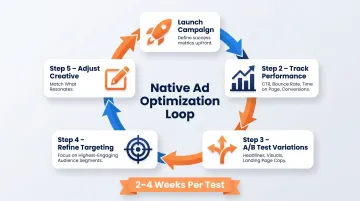
Allow 2–4 weeks minimum per test variation. Make one change at a time to isolate what drives improvement.
Frequently Asked Questions
What are the common types and formats of native advertising?
The IAB recognizes six primary formats: in-feed ads (social and editorial), paid search units, recommendation widgets, promoted listings, sponsored articles, and newsletter placements. Each matches the format of its surrounding environment, whether that's a social feed, search results page, or email inbox.
Where do native ads appear?
Native ads appear wherever content is consumed: social media feeds (Facebook, Instagram, TikTok), search engine results pages (Google, Bing), publisher websites (news and editorial sites), e-commerce platforms (Amazon, eBay), and email newsletters. The format adapts to each environment.
How effective is native advertising for marketing and branding?
Native ads consistently outperform standard display formats. They generate 4x higher click-through rates (0.2% vs. 0.05%) — and studies show 53% more visual attention and 18% higher purchase intent compared to banner ads. The format is particularly effective for brand awareness and consideration stages of the funnel.
Is native advertising paid content and how can you spot it?
Yes, native advertising is paid and must be disclosed using labels like "Sponsored," "Ad," or "Promoted." Readers can spot it by checking for these labels, noticing calls to action toward specific brands, or comparing the author byline to the publication's regular staff writers.
What is the average cost of native advertising?
Costs vary by format and platform. Programmatic native CPMs typically run $3–$7 for open-web placements; social in-feed native ranges from $5–$20 CPM based on audience quality and competition. Newsletter placements are priced on a flat-fee or CPM basis, with premium publishers commanding higher rates.
What is native advertising and what are some examples?
Native advertising is paid content designed to match the look and feel of its surrounding editorial environment. Common examples include a sponsored article on Bloomberg labeled "Partner Content" and a promoted product listing inside Amazon's search results.