Introduction
When paid media budgets are finite and CAC targets are tight, the last thing a D2C advertiser can afford is running the wrong format at the wrong funnel stage. Both branded content and native advertising promise audience engagement — but they pull budgets in opposite directions and require completely different success metrics.
The distinction matters more for D2C brands than for B2B or large CPG companies. Unlike those categories, D2C advertisers typically need faster attribution, tighter cost-per-acquisition control, and direct conversion signals. Choosing the wrong format at the wrong funnel stage—or failing to understand when each format delivers ROI—can derail an otherwise promising campaign.
US native display ad spending is projected to reach $147.98 billion in 2026 — a 13.1% year-over-year increase. The global branded entertainment market hit $19.6 billion in 2024, with North America holding 41% of that share. Both formats are growing fast, and both are competing for the same budget line. This guide breaks down exactly how they differ, where each earns its spend, and how to choose between them.
Key Takeaways
- Branded content is brand-owned storytelling designed to educate or entertain; native advertising is paid placement that blends into a publisher's editorial environment
- Branded content prioritizes long-term trust and brand recall; native advertising drives faster reach and measurable traffic
- Early-stage D2C brands gain more from native advertising's targeting precision; established brands rely on branded content to deepen loyalty
- Combining both formats works best: branded content for depth, native ads for distribution
Branded Content vs. Native Advertising: Quick Comparison
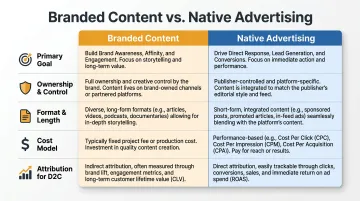
Here's how the two formats stack up across five dimensions that matter most for D2C advertisers.
| Dimension | Branded Content | Native Advertising |
|---|---|---|
| Primary Goal | Build brand identity, trust, and long-term audience affinity through storytelling | Drive immediate traffic, reach, or conversion through contextual paid placement |
| Ownership & Control | Brand owns the content and controls messaging; can live on owned or third-party channels | Brand creates the ad unit, but placement and surrounding editorial are controlled by the publisher |
| Format & Length | Long-form (articles, videos, podcasts, mini-docs); built for depth and engagement | Short-form ad units (in-feed ads, recommendation widgets, sponsored listings); built for clicks |
| Cost Model | Typically a flat fee, production cost, or influencer partnership fee; ROI is harder to attribute directly | Usually performance-based (CPC or CPM); easier to tie spend to traffic or conversion events |
| Attribution for D2C | Harder to directly attribute to sales; better measured via brand lift, recall, or email list growth | Easier to track with click-through data and pixel-based attribution; fits D2C's need for measurable CAC |
What is Branded Content?
Branded content is content funded or produced by a brand — or a creator working on its behalf — designed to entertain or educate rather than pitch a product. The brand's involvement is transparent, but it's not the focal point. The content itself is the value exchange.
For D2C brands, branded content helps build an identity beyond the product itself. This is especially important in crowded categories like skincare, food, and fitness, where differentiation is emotional rather than functional. Research from IPG Media Lab and Forbes found that brand recall is 59 percentage points higher for branded content than for standard display ads. In the same study, consumers were 14% more likely to seek out additional content from the brand after a single exposure.
Common branded content formats D2C brands use include:
- Founder story videos that establish origin narratives
- Editorial-style articles placed on publisher sites
- Podcast sponsorships with host-read segments
- Influencer collaborations where the creator produces native content for the brand's channels or their own
Use Cases of Branded Content for D2C Advertisers
Those formats serve a specific strategic purpose. Branded content fits in the top-of-funnel awareness and mid-funnel consideration stages — it works best when a D2C brand needs to build category authority or establish emotional relevance before a customer is ready to buy.
Scenarios where branded content is the stronger choice:
- A new brand entering a crowded market and needing to establish differentiation
- A brand pivoting its positioning or messaging
- A D2C brand trying to reduce dependence on paid social by cultivating an owned audience
The trade-offs are real: branded content requires higher upfront investment — production, creator fees, or publisher partnerships — and results take longer to materialize. Direct ROI is harder to isolate, which makes it a tougher sell when CAC targets are tight or finance teams demand last-click attribution.
What is Native Advertising?
Native advertising is a paid format where the ad unit matches the form, feel, and function of the editorial content surrounding it. Common formats include:
- In-feed social ads
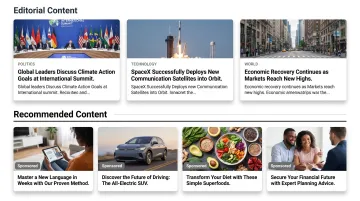
- Recommendation widgets (Taboola, Outbrain)
- Promoted search listings
- Sponsored newsletter placements
Every placement is labeled ("Sponsored" or "Ad") but designed not to interrupt the reader's experience.
For D2C brands, native advertising enables reach at scale with granular demographic and interest-based targeting, paying only for engagement. Native ads deliver click-through rates 8.8x higher than traditional banner ads, according to IAB Europe — and the same research found they increase purchase intent by 18% compared to banner formats.
Newsletter sponsorships occupy a distinct position within native advertising. The ad matches the editorial tone, reaches a pre-qualified audience directly in the inbox, and bypasses algorithm filtering and ad-blocker interference. House of Summary's newsletter placements deliver click-through rates 4x higher than Google AdWords by placing brand messages in front of engaged readers across specialized publications.
Use Cases of Native Advertising for D2C Advertisers
Native advertising fits primarily in the top-of-funnel discovery and bottom-of-funnel retargeting stages. Native ads are effective for introducing a product to a cold audience on a relevant publisher's platform, or for re-engaging users who have already visited the brand's site.
Scenarios where native advertising is the stronger choice:
- Launching a product and needing rapid reach to cold audiences
- Testing new audience segments before committing budget to branded content
- Running a time-sensitive promotion where clicks and conversions outweigh storytelling depth
The practical limits: Native ads offer less creative control over surrounding editorial context. As the format grows more common, audiences in high-saturation categories can develop ad blindness. Creative quality and publisher selection become the deciding factors.
Branded Content vs. Native Advertising: Which Works Better for D2C Brands?
The answer depends on three D2C-specific variables: brand maturity (new vs. established), funnel objective (awareness vs. conversion), and budget structure (flat creative investment vs. performance spend). The right format shifts as a brand grows.
Early-Stage D2C Brand
Native advertising is typically the stronger starting point. It provides faster feedback loops on audience response, measurable attribution, and the ability to A/B test messaging before investing in expensive branded content production.
Native ad cost benchmarks range from $0.10 to $0.50 per click (CPC) or $3 to $7 per 1,000 impressions (CPM), depending on the network, targeting, and placement. This makes it accessible for brands with limited budgets.
Growth-Stage D2C Brand with Proven Product-Market Fit
A hybrid approach works best. Specifically:
- Use native ads to acquire new customers efficiently at controlled CPMs
- Invest in branded content — editorial articles, video series, podcast sponsorships — to build loyalty
- Retain existing customers by giving them something worth coming back to
Established D2C Brand Competing on Brand Equity
Branded content becomes the primary lever for differentiation. Native advertising serves as the distribution mechanism to amplify that content beyond owned audiences.
Whichever stage applies, evaluate each format on cost-per-outcome. Native ads offer lower entry costs and predictable CPM/CPC benchmarks. Branded content carries higher upfront investment, but generates compounding returns that native ads rarely match:
- Evergreen SEO traffic
- Organic shares and backlinks
- Email list growth
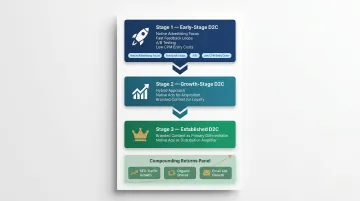
Over time, these returns reduce cost-per-acquisition — often significantly.
Real-World Examples for D2C Advertisers
Example 1 — Native Advertising in Action
Naked Wines, a D2C online wine subscription brand, used Taboola's content discovery platform to distribute interactive educational content—quizzes and advertorials—on premium publisher sites.
The campaign delivered 8,000 new sign-ups across the UK, US, and Australia in just 8 months. Taboola-acquired customers had a 33% higher lifetime value than the Naked Wines average. In the UK specifically, the campaign achieved a 33% increase in video completion rate and an 18% decrease in cost-per-acquisition within 4 months.
Example 2 — Branded Content in Action
Dollar Shave Club produced a founder-led comedic brand video ("Our Blades Are F***ing Great") on a budget of approximately $4,500. The video functioned as branded content—entertainment-led, brand-narrative-driven, not a direct product ad.
It generated 12,000 paying customers within 48 hours of launch. The company website crashed due to traffic volume. This single piece of branded content helped build a brand that Unilever acquired for $1 billion in 2016.
These two examples sit at opposite ends of the format spectrum — one brand scaled through paid distribution, the other through a single piece of owned storytelling. Yet both succeeded for the same underlying reason.
Practical takeaway: The strongest D2C brands treat these formats as a sequence, not a choice:
- Branded content builds emotional resonance and brand narrative
- Native advertising puts that story in front of the right audience at scale
Conclusion
Branded content and native advertising each earn their place in a D2C media mix depending on the brand's stage, funnel objective, and budget tolerance. The real question is which format addresses your current bottleneck: are you struggling to reach new audiences, build credibility, or prove ROI to your finance team?
Brands that treat these formats as either-or leave acquisition or retention gains on the table. Those that sequence them strategically—native ads to acquire, branded content to convert and retain—build more durable customer relationships and lower blended CAC in the process.
Frequently Asked Questions
What is the difference between native and branded content?
Branded content is brand-owned storytelling (produced by or for the brand to entertain or educate) while native advertising is a paid ad unit designed to match the look and feel of a publisher's editorial content. Both are transparent about brand involvement but serve different primary purposes.
Which format is better for D2C brands with limited budgets?
Native advertising typically offers lower entry costs, clearer performance metrics (CPC/CPM), and faster feedback—making it the more practical starting point for D2C brands with tight CAC targets. Branded content requires more upfront investment but compounds over time.
Can branded content and native advertising be used together?
Many D2C brands use both together: branded content builds the narrative (such as a founder story or editorial series) while native ads distribute it to cold audiences. That pairing gives you depth with existing customers and reach with new ones.
Do native ads get blocked by ad blockers?
Standard display and banner ads are commonly blocked, but native ads embedded in editorial feeds or delivered via email newsletters bypass most ad blockers because they are part of the content itself. Newsletter placements in particular offer D2C advertisers a clean, unblocked path directly into the inbox.
What metrics should D2C brands use to measure branded content performance?
Brand recall, time-on-page, social shares, email list growth, and repeat purchase rate are the most relevant proxies. Branded content seldom shows up in last-click attribution, so track it through brand lift studies or engagement depth instead.
Is native advertising the same as sponsored content?
Sponsored content is a type of native advertising—it lives on a publisher's site and matches the editorial tone. But native advertising is the broader category that also includes in-feed ad units, recommendation widgets, paid search listings, and promoted marketplace listings.