Introduction
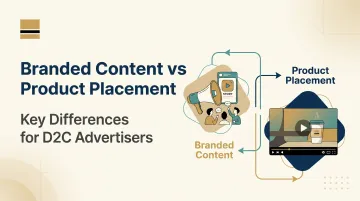
D2C advertisers face a real tension: both product placement and branded content promise brand exposure, but they work differently, cost differently, and serve different goals. For most D2C brands operating on lean budgets where every dollar must perform, picking the wrong format is an expensive mistake.
Product placement offers cultural cachet — your brand appearing in a Netflix series or a YouTube creator's channel. Branded content offers control — your story told your way, with trackable links and measurable ROI.
The two formats aren't interchangeable. One is built for awareness at scale; the other is built for conversion you can measure. Knowing which fits your current growth stage and budget is what this article is about.
What follows breaks down exactly what each format delivers, where each falls short, and how to choose between them.
Key Takeaways
- Product placement puts your product inside someone else's story; branded content makes your brand the story
- Use product placement for passive, broad awareness — branded content for trust, engagement, and purchase intent
- D2C brands get clearer ROI signals and more direct-response alignment from branded content
- Pricing ranges from $40K agency retainers (product placement) to modest newsletter sponsorships (branded content) — scale varies widely
- The strongest D2C advertisers use both, matched to the right funnel stage
Branded Content vs. Product Placement: Quick Comparison
| Dimension | Product Placement | Branded Content |
|---|---|---|
| Format | Brand appears inside pre-existing entertainment or media content (TV shows, films, influencer videos) | Brand funds or co-creates dedicated editorial content built around the brand's message |
| Brand Control | Minimal—brand is a prop in someone else's narrative; no control over context or portrayal | Full—advertiser controls voice, story, CTA, and positioning throughout |
| Cost Range | $40K-$300K annual agency retainers; $3-10M for TV integrations; $10M-$140M+ for film franchises | $10-$75 CPM for newsletters; $500-$25K for influencer integrations; scales with budget |
| Primary Goal | Broad awareness, cultural visibility, implicit brand associations | Trust-building, engagement, category education, purchase intent |
| Measurability | Difficult—relies on brand lift studies, EMV, and media mix models; no direct click tracking | Strong—supports UTM links, promo codes, landing pages, and direct attribution |
| Best Fit | Established brands with proven awareness seeking cultural reach and long-term impressions | Early-to-scaling D2C brands needing trackable ROI, audience precision, and conversion focus |
Common Source of Confusion:
Product placement goes by several names based on how deeply the brand is woven into the content. "Embedded marketing" and "brand integration" are the most common alternatives. The distinctions break down by type:
- Visual placement: Logo or product appears on screen passively
- Verbal placement: A character references the brand by name
- Signage placement: Brand appears in the background environment
- Brand integration: Product becomes central to the storyline — think Wilson in Cast Away or Reese's Pieces in E.T.
Brand integration is the deepest form and commands the highest fees. Most placements sit in the first three categories.
What is Product Placement?
Product placement is the paid inclusion of a brand's product or service within pre-existing entertainment or media content—films, TV shows, video games, music videos, or influencer content—where the brand appears as part of the scene rather than as an explicit advertisement.
Three Main Types D2C Advertisers Encounter
- Visual placement: Brand logo or product visible on screen (a character drinking a recognizable beverage)
- Verbal placement: A character or creator mentions the brand by name in dialogue or narration
- Signage placement: Branded items, billboards, or ads appear in the background environment
Brand integration is the most immersive form, where the product becomes essential to the storyline. Wilson Sporting Goods paid $0 for Cast Away yet earned an estimated $1.85M+ in ad value from 10.5 minutes of screen time—because the volleyball wasn't a prop, it was a character.
That level of narrative integration is what separates forgettable background logos from placement that actually moves brand perception.
Core Benefits for D2C Brands
- Reaches viewers while they're engaged, not during commercial breaks when 92% skip or avoid ads
- Delivers scale through pre-built audiences—major productions pull millions of viewers per episode or film
- Generates impressions for years as content lives across streaming platforms, syndication, and social media
- Transfers positive sentiment through association with beloved characters or creators
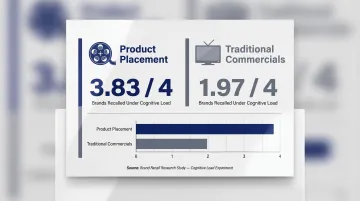
Research comparing product placement to traditional commercials found that under realistic viewing conditions, product placement significantly outperformed traditional ads. When viewers were cognitively loaded, they recalled 3.83 out of 4 brands from placement versus only 1.97 from commercials.
Significant Limitations D2C Brands Must Weigh
- Costs scale fast: agency retainers run $40K–$300K annually; primetime TV integrations reach $3–10M; major film deals can hit $10M–$140M+
- Offers no control over portrayal, screen time, or surrounding context once the deal is signed
- Lacks direct attribution—measurement depends on brand lift studies, earned media value, and media mix models rather than click-to-conversion tracking
- Risks going unnoticed entirely if a scene is crowded or the placement is brief
- Works better for recognized brands; unknown D2C products rarely generate impact from fleeting exposure
Use Cases of Product Placement
Product placement fits best in upper-funnel awareness campaigns where the goal is cultural visibility rather than immediate conversion. For example, a D2C beverage brand appearing in a Netflix original or a D2C fashion label worn by a YouTube creator with 5M+ subscribers.
Traditional film and TV placement is too costly for most early-stage D2C brands. Influencer-based product placement offers a more accessible entry point, with rates ranging from $100–$500 for nano influencers (1K–10K followers) up to $100K–$1M+ for mega influencers and celebrities. The tradeoff: lower reach per placement and authenticity risk if the integration feels paid rather than genuine.
What is Branded Content?
Branded content is content that a brand funds, co-creates, or sponsors, where the editorial substance is built around a topic, story, or theme genuinely valuable to the audience—while the brand's message is woven organically throughout. Unlike product placement, the brand is the originator of the content, not a guest inside someone else's production.
Formats Most Relevant to D2C
- Sponsored editorial articles in trusted publications
- Newsletter sponsorships delivering brand stories directly to inboxes
- Branded podcast episodes with narrative storytelling
- Short-form video series on social platforms
- Long-form social content (LinkedIn articles, Instagram carousels)
The critical requirement: the content must provide standalone value. The moment it reads like an ad, it stops functioning as branded content and loses the trust advantage that makes the format effective.
Core Advantages for D2C Advertisers
- Controls brand voice, positioning, tone, and call to action throughout the entire piece
- Drives 81% aided recall versus 63% unaided recall, lifting brand awareness by ~10 percentage points
- Targets channels that match your ideal customer profile rather than relying on broad reach
- Supports trackable outcomes — clicks, sign-ups, and purchases — unlike product placement
Research from Meta/Facebook found that mixed campaigns combining branded content and brand ads drove purchase intent lift at 82% lower cost than brand ads alone.
The Challenges
- Without a defined brand identity, there's no compelling narrative to build around
- Results accumulate over time — this is not a channel for immediate conversion goals
- Poor execution actively damages trust rather than building it
Research on native advertising disclosure found that only 45.2% of readers noticed disclosure labels, but when they did, it triggered both transparency perception and skepticism—a paradox that underscores the importance of genuine value, not promotional fluff.
Use Cases of Branded Content
That trust dynamic points directly to where branded content performs best. It fits mid-to-lower funnel stages where the goal is building credibility, educating the audience about differentiation, and moving readers from awareness to consideration. It works particularly well for D2C categories with higher purchase hesitation — skincare, supplements, financial products — where customers need to evaluate before committing.
Newsletter advertising has emerged as a particularly high-performing branded content format for D2C brands. Readers have actively opted in, placements bypass algorithmic filtering and ad blockers (which affect 912M users globally, including 33% of US internet users), and the inbox environment commands a level of focus that social feeds rarely deliver.
House of Summary, for example, gives D2C advertisers direct access to decision-makers and executives across specialized newsletters covering global news, geopolitics, Dubai, and London. With 500,000+ subscribers and 254,866+ emails opened daily, it's the kind of placement where branded content reaches a qualified audience — without fighting an algorithm for attention.
Key Differences That Matter for D2C Advertisers
Control and Creative Alignment
Branded content keeps the D2C brand in the driver's seat. The tone, the story, and the call to action all reflect the brand's exact positioning. You decide what gets emphasized, how the product is framed, and what readers do next.
Product placement trades that control for reach. The brand becomes a prop in someone else's story — and if the character holding your product is unlikable, or the scene gets cut in editing, you have no recourse. That's not a hypothetical risk. It's a structural one.
With branded content, the brand retains:
- Full narrative control over tone and framing
- Direct ownership of the call to action
- Flexibility to update or repurpose the asset
Attribution and Measurement
Product placement lacks native digital attribution. Measurement relies on brand lift studies (pre/post surveys), earned media value calculations, attribution reports comparing exposed versus non-exposed audiences, and media mix models. None of these methods provide direct click-to-conversion tracking.
Branded content, by contrast, supports direct response elements. You can include UTM parameters, unique promo codes, dedicated landing pages, or pixel-based conversion tracking. This makes branded content far more compatible with D2C performance marketing goals, where return on ad spend (ROAS) and customer acquisition cost (CAC) need to be tracked directly — not estimated after the fact.
Audience Precision vs. Mass Reach
Product placement trades on volume—huge passive audiences who may or may not be the right buyer. A primetime TV placement might reach 5M viewers, but if only 2% fit your target profile, you're paying for 4.9M wasted impressions.
Branded content, particularly in niche channels like specialized newsletters, allows D2C brands to reach highly qualified audiences already interested in the relevant category. This dramatically improves conversion efficiency. For example, a supplement brand sponsoring a health-focused newsletter reaches readers actively seeking wellness information, not passive viewers watching a sitcom.
Cost-to-Impact Ratio for D2C Scale
Product Placement Costs (approximate):
- Agency retainers: $40K-$300K/year
- Primetime TV integrations: $3-10M
- Major film franchise deals: $10M-$140M+
- Influencer integrations: $100-$500 (nano) to $100K-$1M+ (mega/celebrity)
Branded Content Costs (approximate):
- Newsletter sponsorships: $10-$75 CPM (cost per thousand readers)
- Sponsored editorial articles: $500-$10K depending on publication
- Branded podcast episodes: $3K-$25K depending on audience size
- Influencer branded content: $500-$25K (micro to mid-tier)
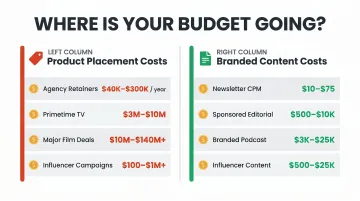
For D2C brands operating on $50K-$500K monthly ad budgets, branded content consistently delivers more measurable impact per dollar — with the added advantage of full creative ownership and real attribution data.
Which Should D2C Advertisers Choose?
By Growth Stage
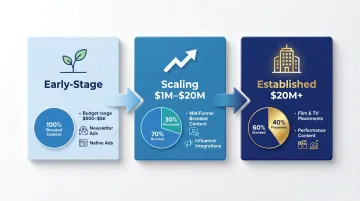
| Growth Stage | Primary Tactic | Budget Split | Best Formats |
|---|---|---|---|
| Early-stage (pre-PMF, <$1M revenue) | Branded content | 100% branded content | Newsletter sponsorships, native ads, micro-influencer placements ($500–$5K) |
| Scaling ($1M–$20M revenue) | Both, branded-led | 70% branded / 30% placement | Branded content for mid-funnel; influencer integrations for awareness |
| Established ($20M+ revenue) | Both, balanced | 60% branded / 40% placement | Film/TV placements for cultural visibility; branded content for performance |
The Case for Using Both
Branded content and product placement are not competing tactics—they're complementary. Branded content builds the relationship and drives conversion. Product placement seeds cultural awareness that makes branded content perform better over time.
The sequence matters: start with branded content to establish credibility, then layer in product placement to amplify reach. Without proven messaging and recognizable branding, fleeting placement exposure rarely converts.
Start With Branded Content That Delivers Measurable Engagement
For D2C brands looking to build trust, drive clicks, and measure results, newsletter advertising offers a high-intent, algorithm-free path to serious readers. House of Summary's network of specialized newsletters—Presidential Summary, Geopolitical Summary, Dubai Summary, and London Summary—connects D2C advertisers with 500,000+ engaged professionals, executives, and affluent consumers across the USA, UK, and UAE.
Newsletter placements reach readers where other ad formats can't:
- No ad blockers filtering your message before it lands
- No algorithmic feed competing for attention
- Direct inbox delivery to readers who opted in
Reach out to explore what a branded content placement looks like for your brand: sales@houseofsummary.com.
Frequently Asked Questions
What is the difference between product placement and branded content?
Product placement inserts a brand into content someone else created — films, TV shows, influencer videos — where it appears as part of the scene. Branded content is built around the brand's story, with the brand funding and directing the narrative. Control over the content is what separates them.
How do product placement and branded content fit into a marketing mix?
Product placement works best for broad reach at the awareness stage — it gets a brand in front of large, passive audiences. Branded content earns attention more deliberately, delivering value that converts audiences into customers. Together, they cover different stages of the funnel rather than competing for the same role.
What are the three types of product placement?
The three types are: visual placement (brand logo or product visible on screen), verbal placement (a character or creator mentions the brand by name), and signage placement (branded signage or advertising appears in the background of a scene). Brand integration is a deeper form where the product becomes central to the storyline.
What is the difference between product positioning and branding?
Product positioning defines where a product sits in the market relative to competitors — the "why choose this" rationale. Branding is the identity, tone, and emotional associations built around a company. Positioning is strategic; branding is experiential — and both shape how each advertising format should be executed.
Can D2C brands use both product placement and branded content at the same time?
Yes — they complement each other when sequenced correctly. Branded content builds trust and drives mid-to-lower funnel conversions, while product placement seeds awareness at the top. Smaller brands should establish credibility through branded content first, then layer in product placement as budgets grow.
Is branded content or product placement better for a small D2C brand?
Branded content is generally more suitable for smaller D2C brands because it offers better cost control, precise audience targeting, trackable results, and full creative ownership. When budgets are tight and every dollar must perform, branded content provides the measurability and flexibility that product placement cannot match.