
The distinction matters because each approach operates through a fundamentally different mechanism. Branded content builds emotional connection by putting the brand's story at the center of the experience. Content marketing builds audience trust and drives conversion by putting the audience's needs first, with the brand playing a supporting role.
This article clarifies both definitions, compares them across five key dimensions, and offers a practical framework for deciding which approach — or which combination — fits a given marketing objective.
Key Takeaways
- Branded content is story-driven: the brand is the protagonist, with the goal of emotional resonance and awareness.
- Content marketing is value-driven — the audience's problem is the protagonist, and the goal is education, trust, and conversion.
- Branded content is campaign-based; content marketing runs on a consistent publishing calendar, month after month.
- Each approach uses a different success scorecard: awareness and sentiment vs. traffic, leads, and conversions.
- The two strategies work together — most serious marketing programs use both, at different stages.
Branded Content vs. Content Marketing: Quick Comparison
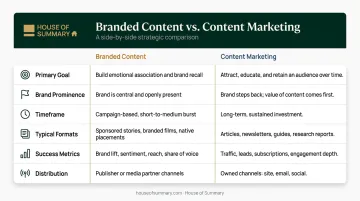
The two approaches differ across nearly every dimension — from how the brand shows up to how success gets measured. Here's a side-by-side breakdown:
| Dimension | Branded Content | Content Marketing |
|---|---|---|
| Primary Goal | Build brand identity and emotional resonance | Attract, educate, and convert a defined audience |
| Brand Prominence | Brand is the protagonist | Brand is the guide or resource |
| Timeframe | Episodic campaigns | Ongoing publishing calendar |
| Typical Formats | Videos, documentaries, branded podcasts, influencer collaborations, sponsored editorial | Blog articles, SEO guides, newsletters, webinars, case studies |
| Success Metrics | Brand recall, sentiment, earned media, affinity | Organic traffic, keyword rankings, leads, conversions |
| Distribution | Third-party media partnerships, paid amplification | Owned channels — blog, email list, SEO |
What Is Branded Content?
Branded content is a storytelling approach where the brand's identity, values, or mission sits at the center of the content itself. It entertains, moves, or inspires the audience while making the brand inseparable from the narrative. It's typically funded or co-produced by the brand — often in partnership with media companies, creators, or publishers.
The format is chosen based on cultural relevance, not keyword rankings:
- Long-form and documentary-style video
- Branded podcast series
- Influencer collaborations
- Sponsored editorial features within trusted publications
- Newsletter sponsorships within premium media environments
What separates branded content from traditional advertising is its intent. It doesn't directly sell — it creates emotional associations that shape how audiences feel about the brand over time. Research from Nielsen found branded content averaged 86% brand recall versus 65% for pre-roll ads, and publisher partnerships produced 50% higher brand lift on average.
When Branded Content Works Best
Branded content is most effective when:
- Launching a product that requires a shift in brand perception
- Entering a new audience segment that doesn't yet know the brand
- Repositioning a brand around new values or a cultural moment
- Participating in a broader cultural conversation in a way that traditional ads can't
Real-world example: The LEGO Movie is one of the clearest cases of branded content done right. The film grossed $470.76M worldwide, and LEGO's 2014 annual report attributed significant contribution from The LEGO Movie product line to the 13% revenue growth that year, bringing total revenue to DKK 28.6B. The film didn't advertise LEGO — it was LEGO.

Branded content doesn't require a blockbuster budget to work. At the other end of the scale, sponsored editorial placements in trusted publications operate on the same principle — the brand earns attention through context and relevance rather than interruption. The format changes; the logic doesn't.
What Is Content Marketing?
Content marketing is a long-term discipline built around one idea: give your audience something genuinely useful, and they'll keep coming back. Unlike branded content, the audience's needs and questions drive the editorial agenda — the brand stays in the background as a resource.
Primary formats are built to be found and shared repeatedly over time:
- SEO-driven blog articles and how-to guides
- Newsletters and email sequences
- Webinars and educational video
- Case studies and product comparisons
- Infographics and research reports
Each of those formats maps to a different stage of the buyer journey. Awareness content answers broad questions; consideration content helps audiences compare options; decision-stage content — case studies, product comparisons — moves them toward a purchase.
HubSpot's analysis shows why the long-term investment pays off: compounding posts — those that keep earning traffic months after publication — make up just 10% of all posts but generate 38% of total blog traffic, with older posts driving 76% of monthly views and 92% of monthly leads.
When Content Marketing Works Best
Content marketing pays off most clearly when:
- Building domain authority in a competitive niche over 12-24+ months
- Generating consistent inbound leads without ongoing paid spend
- Educating a market that doesn't yet understand a new product category
- Nurturing prospects through a long B2B sales cycle
Real-world example: American Express built OPEN Forum — now evolved into Business Class — as a content hub for small business owners, running for nearly 20 years before being updated to include formats like 60-70 second educational shorts. The program became a reference point for B2B content marketing because it consistently prioritized the audience's business problems over product promotion.
Content marketing's biggest operational challenge is attribution. CMI's 2025 B2B research found that while 74% of B2B marketers generated demand or leads through content marketing, 56% struggled to attribute ROI clearly. Build your measurement framework before scaling production.
Key Differences Between Branded Content and Content Marketing
Purpose and Brand Placement
Every other difference between the two flows from one core distinction: branded content centers the brand's story, while content marketing centers the audience's problem. In branded content, the brand drives the narrative. In content marketing, the brand serves as the resource that helps an audience navigate one.
That single distinction cascades into every other difference: how success is measured, what formats make sense, how distribution is structured, and what creative choices work.
Audience Engagement Goals
- Branded content seeks emotional resonance — it aims to make audiences feel something (loyalty, admiration, gut-level trust)
- Content marketing seeks informational value — it aims to make audiences do something (subscribe, download, convert)
These different engagement goals shape creative choices entirely. A branded content campaign asks: "What story will move this audience?" A content marketing editorial calendar asks: "What questions is our audience searching for answers to?"
Timeframe and Campaign Structure
Branded content is episodic. It's tied to a cultural moment, product launch, or brand milestone and creates a spike of awareness. Content marketing operates on a regular publishing schedule, building organic reach that accumulates over months and years.
A brand campaign can generate more attention in a week than a blog post generates in a year. But a well-optimized content archive keeps delivering traffic and leads long after the campaign budget runs out.
Distribution and Ownership
| Approach | Primary Distribution | Audience Ownership |
|---|---|---|
| Branded content | Third-party platforms, media partnerships, paid amplification | Low — dependent on partner reach |
| Content marketing | Owned channels — blog, email list, SEO | High — brand controls the relationship |
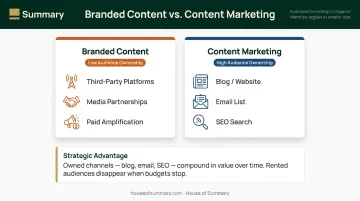
Content marketing's dependence on owned channels is a strategic advantage over time. An email list and indexed content archive belong to the brand. Social reach and media partnerships don't.
The ad-blocking context also matters here. The 2023 eyeo/PageFair report found 912 million active ad-blocking users worldwide — up 11% from 2021 — with a projected $54B in publisher revenue losses in 2024. Owned channels and inbox delivery sidestep this entirely.
Measuring Success
The real mistake is applying content marketing metrics to a branded content campaign, or expecting branded content to generate leads the way a well-optimized blog does. These are different tools measured by different standards.
Branded content metrics:
- Brand recall and aided awareness
- Familiarity and affinity scores
- Share of voice and earned media impressions
- Social engagement and sentiment
Content marketing metrics:
- Organic traffic and keyword rankings
- Email subscriber growth
- Lead volume and conversion rate
- Assisted pipeline and revenue attribution
Knowing which metrics apply to which strategy keeps teams from drawing the wrong conclusions — and from defunding work that's actually performing well for its purpose.
Which Strategy Is Right for Your Business?
The right choice depends on three factors:
- Business objective — shifting brand perception vs. acquiring and converting an audience
- Time horizon — immediate awareness spike vs. compounding long-term value
- Available resources — production budget for high-quality storytelling vs. editorial capacity for consistent publishing
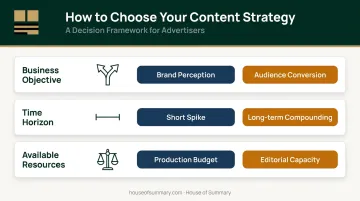
Choose branded content when the goal is to change how audiences feel about the brand — awareness, repositioning, entering a cultural conversation, or establishing emotional salience in a new segment.
Choose content marketing when the goal is to attract, educate, and convert a defined audience over time — building organic traffic, generating inbound leads, nurturing a long sales cycle.
Why Most Mature Strategies Use Both
Branded content and content marketing work best in sequence, not competition. Branded content creates the emotional pull that makes content marketing more efficient. Audiences who already feel connected to a brand are more likely to engage with its educational content, subscribe to its newsletter, and convert when the time is right.
The practical sequence: launch branded content to build awareness and affinity, then use content marketing to deepen the relationship and move audiences toward a decision.
The Newsletter Channel as a Bridge
A single sponsored placement within a trusted editorial newsletter can carry both branded storytelling and educational value — delivered directly to readers who opted in, with no algorithmic filters or ad blockers in the way.
That's where the two strategies meet in practice. House of Summary's network — Presidential Summary, Geopolitical Summary, Dubai Summary, and London Summary — reaches 500,000+ subscribers with 254,866+ emails opened daily. The audience spans decision-makers, C-suite executives, and high-income professionals across the US, UK, and UAE.
Sponsored content placements within these newsletters are written in each publication's editorial voice, with clear advertiser disclosure, and appear inline with content rather than in separate ad blocks. This format suits brands whose value proposition requires context, narrative, or category education — luxury, fintech, and healthcare brands among them. It blends branded content principles with the qualified, engaged audience reach that content marketing is built to deliver.
Key placement characteristics:
- Written in each newsletter's editorial voice for native fit
- Inline placement — not separated into ad blocks readers skip
- Clear advertiser disclosure maintains reader trust
- Delivered directly to opted-in inboxes, no algorithmic filtering
To explore sponsored placements, reach the team directly at sales@houseofsummary.com.
Frequently Asked Questions
What is the difference between branded content and content marketing?
Branded content puts the brand's story and values at the center with the goal of building emotional connection and awareness. Content marketing puts the audience's needs first, using the brand as a background resource to attract, educate, and convert a defined audience over time.
What are the 3 C's of content marketing?
The 3 C's are Content, Consistency, and Context. Content must be genuinely valuable. It needs to be published on a defined schedule. And it should match the audience's needs at each stage of the buyer journey.
Can branded content and content marketing be used together?
Yes, they work well together. Branded content builds awareness and emotional affinity at the top of the funnel, while content marketing nurtures that interest with useful information, guiding audiences from discovery through to conversion.
Is native advertising the same as branded content?
They're related but distinct. Native advertising is a paid placement format designed to blend with surrounding editorial content. Branded content is the broader creative strategy, and native advertising is often the distribution mechanism that carries it.
Which is better for lead generation: branded content or content marketing?
Content marketing is more effective for direct lead generation because it targets specific audience needs through searchable, shareable, compounding assets. Branded content is better suited for top-of-funnel awareness, brand perception, and emotional affinity.
What are the most common formats for branded content?
The main formats include branded videos, documentary-style films, sponsored podcast series, influencer collaborations, and branded editorial features within trusted publications and newsletters — with format selection driven by cultural relevance and audience interest rather than SEO.