
The format you choose determines who creates the content, where it lives, whose audience it reaches, and whether FTC disclosure is required. Each of those factors directly affects ROI. Choosing wrong doesn't just waste money — it can undermine the campaign goal entirely.
This article defines both formats clearly, breaks down the key differences with a side-by-side comparison, and offers a practical decision framework for choosing the right one based on your specific goals.
Key Takeaways
- Branded content is produced by (or for) the brand and published on brand-owned channels; sponsored content is paid placement within a third-party publisher's platform
- The simplest test: ask "who made it?" and "where does it live?"
- Branded content builds long-term audience ownership; sponsored content buys immediate reach into an existing publisher's audience
- Sponsored content requires FTC disclosure; branded content on owned channels does not
- Neither is universally better. The right choice depends on your goals, timeline, and where your audience spends attention
Branded Content vs. Sponsored Content: Quick Comparison
Here's how the two approaches stack up across the dimensions that matter most to marketers and publishers.
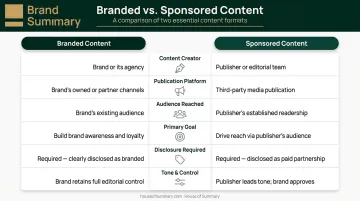
| Dimension | Branded Content | Sponsored Content |
|---|---|---|
| Content Creator | Brand or agency | Brand + publisher's editorial team |
| Publication Platform | Brand-owned channels (website, blog, social, podcast) | Publisher's platform (media outlet, newsletter, blog) |
| Audience Reached | Brand's existing audience | Publisher's established audience |
| Primary Goal | Long-term brand equity and audience building | Immediate reach and credibility transfer |
| Disclosure Required | Typically not required on owned channels | Yes — "Sponsored," "Paid Partnership," per FTC |
| Tone & Control | Full editorial control by brand | Guided by publisher's editorial standards |
What Is Branded Content?
Branded content is content produced by or on behalf of a brand and published on brand-owned platforms. It's not designed to sell directly — it's built to communicate the brand's values, voice, and purpose in a way that creates genuine audience connection over time.
That distinction matters. Branded content is not a product pitch, a press release, or a display ad. Where traditional advertising interrupts, branded content informs, entertains, or educates. The brand is the author, not just the advertiser.
Core Benefits
Three advantages make branded content worth the investment:
- Sets the narrative, tone, and format without external editorial constraints
- Every reader earned belongs to the brand, not a platform or publisher
- Evergreen content keeps driving traffic and trust long after publication
Nielsen's 2016 analysis of more than 100 pieces of branded content found average brand recall of 86% for branded content versus 65% for pre-roll ads — a meaningful gap that reflects how storytelling-first content sticks with audiences in ways interruption-based formats don't.
Formats
Branded content spans a wide range of executions:
- Articles and blog posts
- Video series and brand documentaries
- Podcasts
- Interactive tools and calculators
- Email newsletters
- Live events and webinars
Use Cases
Branded content works best for brands investing in long-term audience ownership — particularly B2B companies with longer sales cycles, businesses building thought leadership in a specific category, and brands with a distinct editorial voice worth developing.
American Express is the textbook example. OPEN Forum (now American Express Business Class) launched as a small-business content hub delivering genuine financial and operational guidance to entrepreneurs — with no sales pitch. Content Marketing Institute notes the platform has run for nearly two decades, establishing AmEx as a trusted resource rather than just a card issuer. GE Reports followed a similar model: brand journalism covering science, technology, and innovation that positioned GE as a thought leader, not a product catalog.
What made both work was consistency of purpose: the content served the reader first, and the brand benefit followed. That's the core mechanic — and it's what separates branded content from formats where the commercial relationship is more visible, like sponsored content.
What Is Sponsored Content?
Sponsored content is paid content placed within a third-party publisher's platform, designed to blend naturally with that publisher's editorial environment. The brand pays for access to an established audience, and typically the publisher's editorial team helps shape the content to fit their tone and standards.
The structure is straightforward: the brand provides the brief, product, or message; the publisher produces and/or distributes the content to their own audience, lending the brand their credibility and reach in exchange for a fee. The label "Sponsored" or "Paid Partnership" isn't optional : the FTC requires clear, prominent disclosure whenever a paid relationship exists, so consumers can identify commercial content and make informed judgments.
Core Benefits
Sponsored content delivers what branded content can't do quickly: access to someone else's audience.
The format varies by channel and campaign goal:
- Sponsored articles in media outlets and digital publications
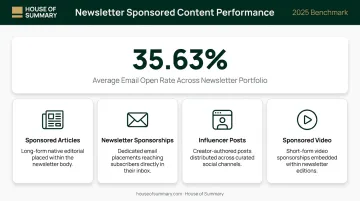
- Newsletter sponsorships (dedicated placements within a publisher's email)
- Influencer-created posts on social media
- Sponsored video on YouTube or streaming platforms
Newsletters stand out among these formats. They land directly in the inbox with no algorithmic interference and no ad blockers, reaching a subscriber who actively chose to be there. Mailchimp's 2023 benchmark data shows an average open rate of 35.63% across email campaigns. For brands targeting high-intent audiences, newsletter networks like House of Summary provide access to 500,000+ subscribers, including executives and policy professionals across New York, London, and Dubai, through placements that appear inline with editorial content rather than banner clutter.
Use Cases
Sponsored content works best when speed, reach, or third-party credibility are priorities:
- Launches that need fast, broad exposure before an organic audience exists
- Market entry into segments the brand hasn't reached independently
- Niche campaigns where audience alignment matters more than volume (a fintech brand placing in a trusted finance newsletter, for example)
- Messaging that benefits from publisher credibility rather than brand-owned channels
Cole Haan's collaboration with the New York Times T Brand Studio ("Grit and Grace") illustrates the format well. The paid post explored the discipline and passion behind ballet — a theme adjacent to the brand that matched the NYT's editorial quality and delivered genuine storytelling rather than a product rundown. It read like an NYT feature because, structurally, it was one.
Key Differences That Actually Matter
1. Creator and Control
Branded content gives the brand complete creative control. Sponsored content involves collaboration with — or delegation to — a publisher's editorial team.
More control with branded content means more creative freedom, but also more responsibility for quality, distribution, and audience development. Sponsored content means accepting the publisher's editorial voice and standards — with the benefit of a team that already knows what resonates with their audience.
2. Platform and Audience Ownership
This is the most strategically significant difference.
Branded content lives on brand-owned channels. Every reader the brand earns is an asset — a direct relationship the brand controls. Sponsored content reaches the publisher's audience immediately, but the brand doesn't own that relationship.
Put simply: sponsored content is rented reach; branded content is owned reach. Rented reach delivers immediate exposure but disappears when the partnership ends. Owned reach builds on itself — each piece adding to an audience the brand can reach again without paying a third party.
3. Disclosure and Trust Dynamics
Sponsored content requires FTC-mandated labels — "Sponsored," "Paid Partnership," "#ad." Branded content on owned channels faces no such requirement.
Transparent disclosure within a trusted publication often increases reader trust, not reduces it. When readers see a sponsored label from a publisher they respect, they tend to extend that credibility to the brand. The disclosure signals honesty. A 2018 Cornell study on sponsored blog content found that disclosure can increase trust in the publisher and produce more favorable brand evaluations — when readers process it as a signal of expertise rather than a warning sign.
4. Timeline and ROI Profile
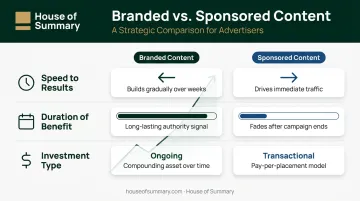
| Branded Content | Sponsored Content | |
|---|---|---|
| Speed to results | Slow — months to build traction | Fast — immediate audience exposure |
| Duration of benefit | Long — evergreen SEO, organic sharing, loyalty | Short — ends when the partnership ends |
| Investment type | Ongoing (creation, distribution, SEO) | Transactional (per placement or campaign) |
The strongest content strategies use both. Branded content nurtures existing audiences and builds authority over time; sponsored content introduces the brand to new, relevant audiences on a predictable cadence. One builds the asset. The other fills the top of the funnel.
Which Format Should You Choose?
The Goal-Based Decision
Choose branded content when:
- Building long-term brand authority is the priority
- The brand has a strong, unique editorial voice worth developing
- The goal is establishing thought leadership through owned content
- The sales cycle is long enough to justify audience development
Choose sponsored content when:
- Fast, targeted reach into an established audience is the goal
- Entering a new market or launching a product
- The target audience already lives inside a specific publisher's readership
- Third-party credibility adds meaningful lift to the message
Budget and Publisher Quality
Branded content requires ongoing investment: content creation, SEO, and distribution infrastructure. The cost doesn't stop after publication — it continues as long as the brand wants to grow its owned audience.
Sponsored content has a more predictable, transactional cost structure. But the critical variable isn't cost per placement — it's the quality and engagement level of the publisher's audience. A smaller, highly engaged newsletter audience can significantly outperform a large but passive web readership for high-intent advertisers. Reach without relevance rarely moves the needle.
The Case for Using Both
Leading brands treat branded and sponsored content as complementary, not competing. Branded content builds the foundation: authority, audience trust, and SEO value. Sponsored content drives discovery — placing the brand in front of new readers who may then seek out that owned content on their own terms.
House of Summary's newsletter network gives advertisers direct access to exactly that kind of discovery-ready audience — decision-makers who read with intent, not habit. To explore what a sponsorship placement looks like, contact sales@houseofsummary.com.
Frequently Asked Questions
What is the difference between sponsored and branded content?
Branded content is produced by the brand and published on brand-owned channels — website, blog, podcast, social. Sponsored content is paid placement within a third-party publisher's platform. The core distinction is who creates it and where it lives.
Is sponsored content the same as native advertising?
They overlap but aren't identical. Native advertising is the broader category — it includes promoted listings, recommendation widgets, paid search units, and display ads designed to match a platform's format. Sponsored content specifically refers to editorial-style content created collaboratively with or by a publisher on behalf of a brand.
Does sponsored content have to be disclosed?
Yes. The FTC requires clear, prominent disclosure of any paid relationship. Readers typically see labels like "Sponsored," "Paid Partnership," or "#ad". These are legal requirements, not optional branding decisions.
Which is better for brand awareness — branded or sponsored content?
Sponsored content reaches new audiences faster and is generally the stronger tool for rapid awareness-building. Branded content builds deeper, more durable brand recognition over time. Both serve brand awareness — at different speeds and investment horizons.
Can sponsored content work in newsletters?
Newsletters are among the most effective sponsored content channels available. Content lands directly in the inbox of a subscriber who chose to be there — no algorithms, no ad blockers, no competing clutter. Engagement rates consistently outperform web and social placements as a result.
What makes sponsored content effective?
Effective sponsored content matches the publisher's editorial voice, delivers real value to the reader, and reaches an audience that actually fits the brand. Clear FTC disclosure matters too. Far from hurting performance, transparent labeling tends to reinforce brand credibility with readers who already trust the publication.