
The distinction isn't semantic. These two formats operate on different authorship models, serve different strategic goals, and produce measurably different outcomes for audience trust. Choosing between them without understanding the difference is like choosing between a press release and a feature story and expecting the same result.
This article breaks down exactly what separates an advertorial from sponsored content, when each format fits, and how to make the call before your next campaign brief.
Key Takeaways
- Advertorial: brand-written content that mimics editorial format — the brand controls every word
- Sponsored content: publisher-written content shaped by the host's editorial voice; the publisher controls execution
- The core distinction comes down to authorship, editorial integration, and strategic intent
- Both require FTC disclosure; neither escapes the label requirement
- Choose advertorials for control and speed; choose sponsored content for trust and authority
Advertorial vs. Sponsored Content: At a Glance
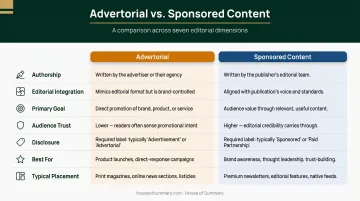
| Dimension | Advertorial | Sponsored Content |
|---|---|---|
| Authorship | Brand writes the content | Publisher writes the content |
| Editorial Integration | Mimics layout; may not match voice | Matches layout, tone, and editorial style |
| Primary Goal | Promotional messaging, brand control | Brand authority, audience trust |
| Audience Trust Level | Lower — identifiable as brand-driven | Higher — readers trust the publisher's voice |
| Disclosure Requirement | Yes (FTC mandated) | Yes (FTC mandated) |
| Best For | Product launches, tight deadlines, technical messaging | Thought leadership, niche audience reach, long-term brand building |
| Typical Placement | Web publications, print supplements | Editorial websites, specialized newsletters |
Both formats sit within the native advertising category — they integrate with the look and feel of the host platform rather than sitting in a banner or display slot. The IAB's Native Advertising Playbook defines native ads as paid placements cohesive with page content, assimilated into design, and consistent with platform behavior.
Some major career and marketing platforms define sponsored content as "also called an advertorial" — a conflation that leads to poor format decisions. The two share a native delivery mechanism, but their authorship models and audience effects are different in ways that affect outcomes.
What Is an Advertorial?
Merriam-Webster defines an advertorial as "an advertisement that imitates editorial format" — a term with roots going back to 1917. The format was born in print, where brands paid newspapers and magazines to run promotional content styled to look like journalism. Digital media inherited the model almost unchanged.
How Advertorials Work
The authorship dynamic is straightforward: the brand writes the content and submits it to the publisher. The brand controls messaging, tone, claims, and structure. The publisher provides the platform and the audience.
In practice, this means advertorials often adopt a publication's visual layout — fonts, color palette, article structure — while using language that reads closer to a press release than a feature story. A loyal reader of the host publication will usually notice: the voice is off, the framing is promotional, and the product is front and center.
A 2018 study of 800 US adults found that when readers recognize native advertising as paid content, it negatively affects their perception of both the publisher and the ad itself. Brand-written content that breaks the editorial illusion carries that risk.
When Advertorials Make Sense
Advertorials are the right call in specific situations:
- Selling a technical product or regulated service where a third-party writer misrepresenting a claim creates real liability
- Working against tight deadlines that leave no room for a publisher's editorial process
- Operating with strong in-house copywriting that already produces publication-quality content
- Running a short-term promotional campaign where message control matters more than editorial fit
The trade-off is real: control comes at the cost of editorial authenticity. A real-world example sits on The Guardian's Advertisement Features page, where placements from brands including AXA Health and Honda are labeled "Paid for by [brand] and produced by the Guardian Labs team." Because Guardian Labs is publisher-adjacent, these placements read more credibly than pure brand submissions.
For a starker example, Nieman Lab documented how The Washington Post hosted "China Watch," presented by China Daily, as a "Paid Supplement" — brand-controlled content placed directly within a major editorial environment.
What Is Sponsored Content?
Sponsored content flips the authorship model. The publisher writes the content — or a professional writer working under the publisher's editorial standards does. The brand pays for the placement and typically provides a brief, key messages, or source access. But the final piece reflects the publisher's voice, not the brand's.
That separation is exactly what gives sponsored content its credibility advantage.
The Authorship Advantage
When readers encounter content written by a publisher they already trust, they engage with it differently than they engage with brand-produced material. Nielsen's 2023 research on branded content found that branded content can increase brand awareness by 10 percentage points, with an aided recall rate of 81% compared to 63% unaided recall. That's not just exposure — that's retention.
A strong example of sponsored content done well: the Financial Times runs "Partner Content" placements, including a piece titled "APAC's Mosaic of Opportunity" produced in partnership with UBS. The content carries FT copyright, follows FT editorial standards, and is labeled clearly as partner content — but it reads as FT journalism because it was written by FT's commercial editorial team.
Sponsored Content Beyond Articles
The format isn't limited to web-based editorial. Sponsored content appears as:
- Long-form features and investigative-style pieces
- Listicles and how-to guides
- Infographics and interactive content
- Video and multimedia formats
- Newsletter placements — the highest-attention environment available
Newsletter sponsored content deserves specific attention. In a newsletter, a sponsored article reaches opted-in readers who have chosen to receive that publication. There are no algorithms filtering reach, no ad blockers suppressing delivery, and no competing visual noise. Mailchimp's December 2023 benchmarks put the average email click rate at 2.62% across all industries — compare that to DoubleClick's display benchmark of roughly 0.14% for standard banner units, and the attention gap becomes concrete.
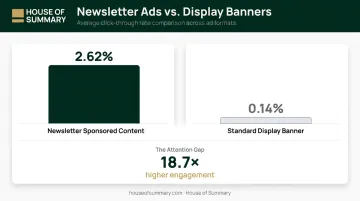
For brands targeting executives, finance professionals, or globally engaged readers, that gap translates directly to campaign performance. Premium newsletter networks — like House of Summary's publications covering global news, geopolitics, Dubai, and London — offer direct inbox access to over 500,000 subscribers, including decision-makers in New York, Los Angeles, London, and Dubai.
BSH Hausgeräte's campaign within Dubai Summary produced click-through rates 4x higher than Google AdWords, according to the company's CEO. That's the outcome when editorial quality, audience trust, and format alignment converge.
When to Use Sponsored Content
- Thought leadership campaigns where building authority over time matters more than immediate conversion
- Entering new markets where the brand needs a trusted editorial voice to introduce it
- Niche audience access — reaching readers who already trust a specific publisher's judgment
- Brand awareness in premium contexts — finance, business intelligence, luxury, and executive audiences
Key Differences Between Advertorials and Sponsored Content
Authorship and Editorial Control
This is the foundational difference. The brand writes an advertorial; the publisher writes sponsored content.
That single distinction cascades into everything else. Advertorials reflect the brand's voice. Sponsored content reflects the publisher's voice. Readers who trust a publication extend some of that trust to content written in its voice — they don't automatically extend it to content written by the brand and placed within the publication.
Degree of Editorial Integration
An advertorial can replicate a publication's visual layout without capturing its editorial character. Promotional language, structured product descriptions, and brand-forward framing often signal "this isn't from the editorial team" to attentive readers — even when the fonts and column widths match.
Sponsored content achieves deeper integration. It must match not just the visual design but the tone, vocabulary, thematic focus, and structural conventions of the host publication. That's harder to produce, which is why publishers charge accordingly and why the editorial team controls the output. That production difficulty is also what earns sponsored content a meaningfully different reader response.
Audience Trust and Reader Response
Research is clear on one point: overt promotional cues increase reader skepticism. A 2020 literature review of native advertising studies found that high brand presence — multiple brand mentions, product-forward framing — activates persuasion resistance in readers. The more an ad reads like an ad, the more skeptical the reader becomes.
Sponsored content, written in the publisher's voice, avoids most of those cues. The brand message is present, but it arrives through a trusted editorial lens. Readers may notice the disclosure label, but the quality of the content makes continued engagement worthwhile.
Disclosure Requirements
Both formats require clear, prominent disclosure under FTC native advertising guidance. The FTC evaluates the "net impression" a piece creates — meaning the overall experience of format, text, images, and context — not just the label.
Acceptable labels include:
- "Ad"
- "Advertisement"
- "Paid Advertisement"
- "Sponsored Advertising Content"
The FTC has specifically warned that vague labels like "Promoted" may mislead readers. The Lord & Taylor case (2016) illustrates the stakes: the brand settled FTC charges after placing a paid, edited article in Nylon with no disclosure — a campaign that reached 11.4 million users.
The FTC treats advertorials and sponsored content under the same unified framework. Brands and publishers that understand this upfront avoid the compliance gaps that surface most often when the two formats are conflated.
Which Format Should You Choose?
The decision comes down to what your campaign actually needs.
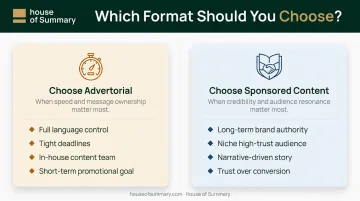
Choose an advertorial when:
- You need full control over exact language (regulatory, technical, or legal requirements)
- You're working against a tight deadline with no time for a publisher's editorial process
- Your internal team produces publication-quality content
- The campaign is short-term and promotional — visibility matters more than editorial fit
Choose sponsored content when:
- Long-term brand authority is the goal
- You want to reach a niche or high-intent audience that already trusts the publisher
- The brand story requires context, narrative, and category education
- Trust-building matters more than immediate conversion
These formats aren't mutually exclusive. A layered media strategy can run advertorials for product-specific pushes while running sponsored content placements in parallel for brand-building — each doing the job it's actually suited for.
That parallel approach works especially well when one of those placements reaches readers who've already opted into a trusted editorial voice. For brands targeting executives, finance professionals, or readers with global news interests, newsletter sponsorships offer something display advertising can't: direct inbox delivery with no algorithms or ad blockers in the way. House of Summary's publications — Presidential Summary, Geopolitical Summary, Dubai Summary, and London Summary — place sponsored content within the reading flow of each newsletter, written in that publication's editorial voice and clearly disclosed.
Conclusion
The choice between an advertorial and sponsored content isn't about which format is universally superior. It's about matching the format to the objective.
Advertorials give brands direct control: every sentence reflects the intended message, shaped without editorial mediation. Sponsored content trades that control for credibility — the publisher's voice carries the message to an audience that already trusts it.
Before choosing, define your primary objective: is this campaign about promotional messaging or brand credibility? The format that serves that goal better is the right one. So is the publisher who can deliver it without compromising either.
Frequently Asked Questions
What is the difference between advertorial and sponsored content?
The core difference is authorship. A brand writes an advertorial; a publisher writes sponsored content. That distinction determines how well the content integrates with the host publication's editorial voice and how much audience trust it inherits from that publication.
What is the difference between advertorial and advertisement?
A traditional advertisement — a banner, display ad, or print ad — is explicitly promotional in form. An advertorial mimics editorial content's visual and structural format while remaining brand-controlled. It borrows the appearance of journalism without the editorial independence.
Is an advertorial considered advertising?
Yes. Advertorials are a form of advertising and must be disclosed as such under FTC guidelines. The FTC's native advertising guidance applies regardless of how closely the content mimics editorial format — if the commercial nature isn't obvious, a clear disclosure label is required.
What is an example of an advertorial?
A beauty brand submitting a product-focused article to a lifestyle magazine is a classic example. The piece mirrors the magazine's layout and is written entirely by the brand's marketing team, labeled "Advertisement." The brand controls every claim; the magazine provides the platform and audience.
Does sponsored content need to be disclosed?
Yes. The FTC requires all sponsored content to be clearly labeled — "Sponsored," "Paid Post," or "Partner Content" are common formats. The label must be clear and prominent enough that a reasonable reader understands the commercial relationship before engaging with the content.
Which is better for brand awareness: advertorial or sponsored content?
Sponsored content generally performs better for long-term brand awareness — it reaches audiences through a trusted editorial voice, and Nielsen research shows it can lift awareness by 10 percentage points with an 81% aided recall rate. Advertorials suit short-term promotional goals where message control matters more than editorial fit.