The line has also shifted. In the print era, the distinction was simple: paid placement was advertorial, press coverage was editorial. Today, brands publish daily on their own blogs and newsletters, native ad spend is forecast to hit $147.98 billion in the US in 2026, and the format of a piece tells you almost nothing about its intent. That intent is what actually matters for strategy.
This article covers clear definitions, a side-by-side comparison, the use cases where each format wins, and a practical framework for deciding which to deploy — and when.
Key Takeaways
- Editorial is audience-first: designed to inform or educate without a promotional agenda — it earns trust but offers no placement guarantee
- Advertorial blends brand messaging with editorial format, giving you message control and guaranteed reach — but only works when it delivers real reader value
- Intent and approach — not payment — are what actually separate the two formats
- Both formats belong in a sophisticated strategy — the decision turns on goal, timing, and channel context
- Newsletter advertorials reach opted-in readers with no ad blockers, no algorithms, and no competing distractions
Advertorial vs Editorial: Quick Comparison
| Dimension | Editorial | Advertorial |
|---|---|---|
| Primary Intent | Inform, educate, or entertain the audience | Promote brand, product, or service |
| Content Control | Publisher/journalist controls final output | Brand controls messaging and framing |
| Cost Structure | Earned (no direct payment for placement) | Paid (guaranteed placement fee) |
| Placement Guarantee | None — coverage depends on newsworthiness | Yes — runs as scheduled |
| Disclosure Requirement | Not required if genuinely independent | Required by FTC (US) — "Sponsored," "Ad," etc. |
| Primary Trust Mechanism | Independence from commercial influence | Quality of content + transparent disclosure |
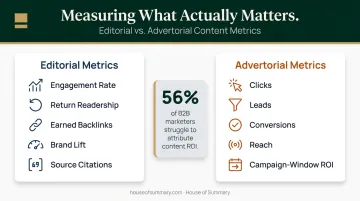
| Key Success Metrics | Engagement, backlinks, return readership, brand lift | Clicks, leads, conversions, reach |
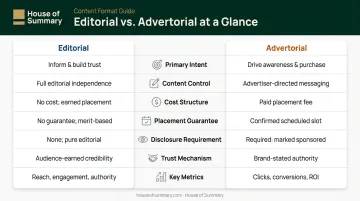
This table reflects traditional definitions. Owned media — brand blogs, company newsletters — adds a layer of complexity, because the same format can carry editorial or advertorial content depending on intent. What determines which is which comes down to who controls the message and whether a commercial relationship exists. The sections below work through that distinction directly.
What Is Editorial Content?
Editorial content is audience-first material created to inform, educate, or entertain — with no direct promotional agenda attached. Its value to the brand is indirect: demonstrated expertise earns reader trust, which drives authority and eventual business opportunity. The value exchange runs through the reader, not around them.
The Earned Media Dynamic
Editorial coverage in third-party publications requires a genuinely newsworthy angle, a solid journalist relationship, or a compelling pitch. No payment shortcut exists — and that's exactly the source of its credibility. Nielsen's global trust research found 66% of consumers trust editorial content such as newspaper articles, compared to 46% for social network ads and 42% for online banner ads. Readers understand editorial independence, and that understanding is baked into the trust gap.
Common editorial formats in a modern marketing context:
- Thought leadership articles and bylined columns
- Data-driven industry reports
- News coverage and journalist features
- Expert interviews and podcasts
- Newsletters written in an objective, editorial voice
How to Measure Editorial Success
Editorial performance doesn't map neatly to a conversion funnel. The metrics that matter here are:
- Engagement rate and time on page
- Return readership and newsletter open rates
- Earned backlinks from other publications
- Brand association in reader surveys
- Source citations in industry coverage
Once a pitch goes to a journalist, the brand loses control. Quotes get cut, angles shift, and coverage is never guaranteed. Editorial is a high-reward but unpredictable channel.
Use Cases for Editorial Content
Editorial is the stronger choice when:
- Building brand authority from scratch — credibility must be earned before conversion becomes realistic
- Running an SEO content strategy — organic editorial content earns unqualified backlinks; paid links require
rel="sponsored"orrel="nofollow"attributes and don't pass ranking credit the same way - Establishing C-suite thought leadership — an executive contributing a bylined column to a business outlet carries weight that a sponsored post cannot replicate
- Entering trust-sensitive categories — finance, health, and law audiences apply heightened scrutiny to promotional content; editorial credibility matters disproportionately here
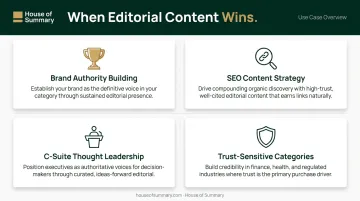
In each of these scenarios, the absence of a commercial agenda isn't a limitation. It's the mechanism. A CFO's bylined piece in a financial journal only carries weight because no one paid for it to be there.
What Is Advertorial Content?
Advertorial content is brand-driven material that adopts the tone, format, and structure of editorial content while serving a commercial purpose — whether that's generating leads, driving product awareness, or shifting brand perception.
The format has been around since print "advertising features" ran alongside editorial pages. Digitally, it evolved into native ads on publisher sites, branded content on owned platforms, and sponsored placements inside email newsletters. The IAB defines native advertising as paid ads made cohesive with surrounding content — assimilated into design and consistent with platform behavior so the placement feels like it belongs.
Message Control, Guaranteed Delivery — With One Condition
Advertorial gives brands message control plus guaranteed delivery. Unlike editorial, the brand determines what's said, how it's framed, and when it runs. For campaign-specific goals with defined windows, that reliability is worth a great deal.
The critical condition: good advertorial still prioritizes reader value. Content that reads as a thinly disguised sales pitch undermines trust and wastes spend. The editorial style isn't just aesthetic — it signals a commitment to informing the reader, not just converting them.
Research supports this trade-off. A 2023 Journal of Interactive Advertising study found that while disclosure can activate persuasion awareness and modestly lower purchase intent, it also increases perceived transparency. Don't hide sponsorship. Build the value proposition around content quality — readers reward transparency when the content earns their time.
Why the Newsletter Channel Works for Advertorial
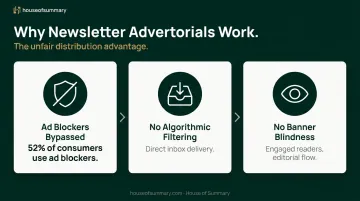
Newsletter advertorials operate in a structurally different environment than web display or social ads. Consider what they bypass:
- Ad blockers — 52% of consumers globally use ad blockers, but they don't work on email
- Algorithmic filtering — newsletter content lands directly in inboxes without platform algorithms deciding who sees it
- Banner blindness — native placements within editorial flow reach readers whose attention is already engaged
House of Summary's network — Presidential Summary, Geopolitical Summary, Dubai Summary, and London Summary — delivers advertorial placements to more than 500,000 subscribers, with 254,866+ emails opened daily. The audience skews toward decision-makers, executives, and high-income professionals concentrated in New York, Los Angeles, London, and Dubai.
Sponsored content runs in the natural editorial voice of each publication, with clear advertiser disclosure, reaching readers in an environment free of visual clutter and algorithmic noise.
Use Cases for Advertorial Content
Advertorial is the stronger choice when:
- Launching a product or service that requires controlled messaging and a defined campaign window
- Running lead generation campaigns with specific conversion targets and trackable response metrics
- Reaching a pre-segmented audience through a trusted publication — particularly when editorial coverage in that outlet is unlikely
- Building awareness in a new geography where the brand lacks existing relationships
Concrete examples:
- A luxury brand placing a sponsored feature in a premium lifestyle newsletter to reach high-net-worth readers
- A financial services firm using a native article to educate readers about a new product category before asking for a conversion
- A global brand running a multi-issue newsletter advertorial series to establish presence in a new market
Key Differences That Matter for Your Marketing Strategy
Intent Is the Most Important Differentiator
Editorial serves the audience first. Advertorial serves the brand first, though the best-performing advertorials serve both.
This matters because the trust dynamics run on different timelines. Audience-first content builds compounding credibility: each useful piece reinforces the brand's authority, making future content more credible.
Brand-first content produces more immediate impact but doesn't compound the same way. One poor-quality piece can damage perception faster than any single missed editorial opportunity.
The Paid, Owned, and Earned Framework
Format alone doesn't determine type. Purpose does.
| Media Type | Editorial or Advertorial? | Example |
|---|---|---|
| Third-party press coverage | Editorial (earned) | Journalist feature in a trade publication |
| Sponsored article in a publication | Advertorial (paid) | Native article in a business newsletter |
| Brand blog written objectively | Editorial (owned) | Unbranded industry trend report |
| Brand newsletter with sponsored section | Advertorial (owned/paid) | Sponsored feature inside a company newsletter |
CMI's 2025 B2B research found 84% of B2B marketers use corporate blogs and 71% use email newsletters — which means most brands are already operating both editorial and advertorial channels simultaneously, often without a clear governance framework for each.
Disclosure Requirements
In the US, FTC guidelines require clear, conspicuous disclosure whenever content is paid or sponsored. Standard labels include:
- "Ad" or "Advertisement"
- "Sponsored" or "Sponsored Content"
- "Paid Partnership"
- "Advertising Feature"
The FTC's 2016 enforcement action against Lord & Taylor — which involved a paid Nylon article and paid posts by 50 influencers who weren't required to disclose compensation — shows clearly what non-disclosure costs: regulatory action, public reputational damage, and lost audience trust. Sophisticated readers notice the absence of a label, and they don't forget it.
The Measurement Gap
Disclosure keeps brands legally protected, but it doesn't resolve the harder strategic problem: knowing whether the content is actually working. Editorial success is harder to attribute directly to revenue, which creates friction in short-term budget cycles. 56% of B2B marketers struggle to attribute content ROI, according to CMI. Advertorial performance is more trackable — clicks, leads, conversions are measurable within a campaign window — but those metrics may not capture longer-term brand equity effects.
The practical answer: use both types of metrics. Track engagement and authority signals (backlinks, return readership, brand lift) alongside conversion data. Brands that optimize exclusively for short-term advertorial conversions while neglecting editorial often find their campaigns performing well on paper while their audience gradually stops trusting them.
Advertorial vs Editorial: Which Should You Use?
The Decision Framework
Use editorial when:
- The primary goal is long-term credibility, SEO authority, or thought leadership
- You're operating in a trust-sensitive category (finance, health, law)
- You have the time and relationships required to earn coverage
- You need organic backlinks that pass ranking credit
Use advertorial when:
- You need message control and guaranteed placement
- A defined campaign window requires predictable delivery
- You're targeting a pre-segmented audience through a trusted publisher
- Direct response metrics (clicks, leads, conversions) are the primary KPIs
The Flywheel, Not the Fork
The most effective approach runs both formats in parallel. Editorial builds the brand reputation that makes advertorial more credible. Advertorial generates the near-term engagement and revenue that funds the time investment editorial requires.
The relationship is self-reinforcing. Editorial authority makes sponsored content more persuasive. Sponsored content expands the audience that eventually discovers — and trusts — the editorial. Each format strengthens the other when both are executed well.
For brands looking to test advertorial in a high-intent newsletter environment, House of Summary offers sponsored placements across Presidential Summary, Geopolitical Summary, Dubai Summary, and London Summary. Each placement reaches executives and decision-makers directly in their inboxes, with clear editorial disclosure and no ad blockers or algorithmic gatekeeping. Contact sales@houseofsummary.com to explore newsletter sponsorships as a complement to your editorial strategy.
Frequently Asked Questions
What is the difference between an advertorial and an editorial?
Editorial is audience-first content built to inform without a promotional agenda — its credibility comes from independence. Advertorial blends brand messaging with editorial format, trading message control for transparency about its commercial purpose. The real distinction is underlying intent, not whether money changed hands.
What is an example of editorial and advertorial content?
Editorial example: a fintech company earning a journalist feature in a trade publication, with no brand involvement in the story. Advertorial example: a sponsored newsletter article that educates readers on a new product category while positioning the brand as the solution, clearly labeled "Sponsored."
Is advertorial content more effective than editorial for brand awareness?
It depends on the goal and timeline. Advertorial delivers faster, measurable reach with controlled messaging. Editorial builds slower but more durable brand authority. Both contribute to awareness differently — advertorial through guaranteed reach, editorial through third-party credibility that compounds over time.
Do I need to disclose advertorial content to readers?
Yes. FTC guidelines require clear, conspicuous disclosure when content is paid or sponsored. Standard labels include "Sponsored," "Ad," or "Paid Partnership." Transparency also protects brand trust with audiences who recognize — and distrust — undisclosed paid content.
Can a newsletter be both editorial and advertorial?
Yes. A newsletter can carry objective, audience-first editorial coverage in one section and clearly labeled sponsored features in another. The key is consistent disclosure and holding sponsored content to the same quality bar as the editorial surrounding it.
Which content type performs better for long-term SEO?
Editorial content typically performs better for SEO because it earns organic backlinks and engagement signals that search engines weight positively. Advertorial placements require rel="sponsored" or rel="nofollow" attributes and shouldn't pass ranking credit. Owned editorial compounds in value over time as it accumulates links.