
That's the problem advertorials were built to solve. By wrapping a brand message inside genuinely useful content, advertorials earn reader attention instead of interrupting it. This guide covers exactly what an advertorial is, how it differs from other ad formats, and a practical step-by-step process for writing one that actually converts.
Key Takeaways
- An advertorial is a paid ad written in editorial style — it educates or informs first, then promotes
- It outperforms traditional display ads because readers choose to engage with it rather than being forced to
- The format works best when the product needs explanation, trust-building, or objection-handling before purchase
- Strong advertorials follow a clear arc: hook → value → benefits → proof → offer
- Disclosure is required by law — FTC rules mandate clear labeling on all sponsored content
What Is an Advertorial?
An advertorial is a paid advertisement written to look and read like editorial content. Merriam-Webster defines it as "an advertisement that imitates editorial format" — a portmanteau of "advertisement" and "editorial" with roots dating back to 1917. It reads like a genuine article, how-to piece, or reported feature while subtly promoting a product, service, or brand.
Three Practical Types
Advertorials fall into three categories:
- Brand-image advertorials — build favorable perception through storytelling; a luxury hotel brand publishing a feature on "what makes exceptional hospitality" is one example
- Advocacy advertorials — argue for a position, policy, or corporate value; a financial services firm explaining why fee transparency matters falls here
- Journalism-style advertorials — most closely mimic editorial reporting; think a technology company sponsoring an in-depth analysis of a market trend their product addresses
Where They Appear
Advertorials run across virtually every content channel: print magazines and newspapers, news websites, niche blogs, social platforms, and email newsletters. The New York Times' T Brand Studio, for instance, publishes long-form branded stories like Square's paid post "My Goal This Year Is to Grow" — full editorial pieces, clearly labeled, hosted alongside organic journalism.
The format changes across channels, but the core principle holds: value first, promotion second.
That's what separates an advertorial from a banner ad. A banner interrupts. An advertorial gets read because it offers something useful — which is precisely why the brand message sticks.
Advertorial vs. Traditional Ad vs. Native Ad
These three formats get conflated constantly. They're not the same.
| Format | Style | Length | Primary Goal |
|---|---|---|---|
| Traditional ad | Openly promotional | Brief | Direct response / awareness |
| Native ad | Matches feed/platform | Short to medium | In-feed discovery |
| Advertorial | Editorial, long-form | 500–2,000+ words | Education, trust, conversion |
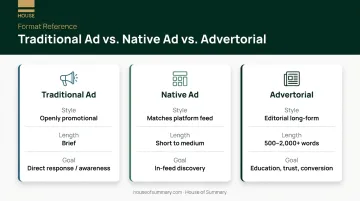
That depth is what sets advertorials apart. Per IAB Europe's guide to native advertising, advertorials fall within content-based native advertising — they match the editorial environment's look and feel, but go further by adopting the full structure of a reported piece or how-to article.
According to eMarketer, consumers view native ads 53% more frequently than banner ads. Advertorials, operating within that native format but with greater depth, extend that attention advantage further.
When to Use Each Format
- Traditional ads: broad awareness campaigns, direct-response offers, retargeting
- Native ads: in-feed discovery on social platforms or content networks
- Advertorials: products requiring education, brands entering new markets, high-consideration purchases where objections need addressing before a decision
Sponsored influencer posts look similar to advertorials on the surface, but the persuasion mechanism is different. Influencer posts borrow credibility from a person's following. Advertorials build it through structure, evidence, and editorial framing — no personality required.
Why Advertorials Work
The ad-blocking problem is real and growing. With 45% of US consumers using blockers and Lumen Research reporting that only 30% of viewable ads are actually seen, that's a 70% gap between served and seen. Advertorials don't bypass blockers through technical tricks — they bypass the psychological filter by not looking like ads.
Three factors drive the format's effectiveness:
- Editorial structure signals information, not a pitch — readers lower their guard before they've read a word
- Readers actively choose to click in; no one opts into a banner ad
- A well-written advertorial can rank in search, earn backlinks, and drive conversions long after the campaign ends
Those advantages compound when the placement itself is already trusted. That's the case for newsletter advertorials in particular.
The Newsletter Advantage
Newsletter-based advertorials are among the highest-performing placements available. The reason is structural: email reaches opted-in readers who asked to receive the content, with no algorithm controlling delivery and no ad blocker capable of intercepting it.
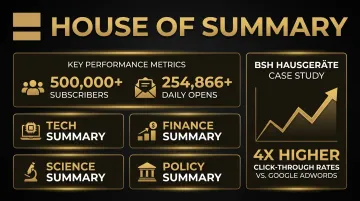
House of Summary's newsletter network — covering Presidential Summary, Geopolitical Summary, Dubai Summary, and London Summary — reaches 500,000+ subscribers with 254,866+ emails opened daily. The audience skews toward decision-makers and executives in New York, London, and Dubai.
BSH Hausgeräte (parent company of Bosch, Siemens, and Gaggenau) ran a sponsored placement in Dubai Summary and reported click-through rates 4x higher than Google AdWords, noting that "the editorial tone aligned with high-intent readers." That result comes down to context: when the reader's mindset already matches the content category, a relevant advertorial feels useful rather than intrusive.
How to Write an Advertorial: A Step-by-Step Guide
Step 1 — Define Your Audience and Objective
Before writing anything, answer two questions precisely:
- Who is this for? (Demographics, pain points, current awareness of your product)
- What one action do you want them to take?
A vague audience produces a vague advertorial. If you're writing for "professionals interested in finance," you'll produce something generic. If you're writing for "mid-career finance directors frustrated by manual reporting," you'll produce something that resonates.
Step 2 — Choose the Right Platform
The best placement is wherever your target audience already reads and trusts. Main options:
- Trade publications and industry magazines
- General news sites with topic-specific sections
- Niche blogs with loyal readership
- Newsletters with segmented, high-intent subscribers
Specialized newsletter networks tend to outperform broad-reach options for brands that need context. A geopolitics newsletter audience arrives primed for international business content. A finance-focused newsletter reaches a segment that's costly and difficult to reach through paid digital channels.
Step 3 — Write a Value-First Headline
The headline should promise an insight or outcome. It should not lead with the brand name.
Effective headline structures:
- Problem-solution: "Why Most Sales Teams Miss Quota — and the Process Fix That Changes It"
- Outcome-led: "How One Operator Cut Inventory Costs by 31% Without Changing Suppliers"
- Curiosity gap: "The Hiring Signal That Predicts Revenue Growth Six Months Out"
The goal is to hook a specific reader. If everyone would click the headline, it's too generic.
Step 4 — Open with a Relatable Problem
Consider this opening: "Last quarter, our client's sales team spent more time logging calls than making them." That's a specific frustration a reader either recognizes or doesn't. If they recognize it, you've already earned their attention.
This is the mechanism behind Green and Brock's transportation theory: narrative immersion reduces counter-arguing. When readers identify with a scenario, they evaluate the story rather than the pitch.
Open with a situation, not a product feature. "Our CRM integrates with your existing tools" tells readers nothing they care about yet.
Step 5 — Balance Information and Promotion
A rough guideline: 70–80% genuine value, 20–30% product.
Structure it like this:
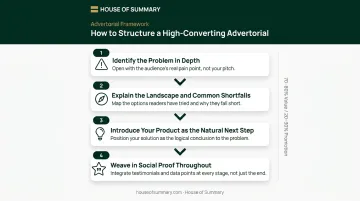
- Identify the problem in depth
- Explain the landscape or common approaches (and why they fall short)
- Introduce your product as the natural next step, not an abrupt gear-shift
- Weave social proof throughout (customer quotes, usage stats, specific results)
Don't stack all testimonials at the end. Place them near the specific claims they support — after you've introduced a benefit, before the reader decides whether to believe it.
Step 6 — Add a Contextual CTA and Clear Disclosure
The call to action should feel like a logical next step:
- ✅ "See how [Company] solved this"
- ✅ "Read the full case study"
- ❌ "Buy now"
- ❌ "Sign up today"
Place your CTA at least twice — once near the top (after the hook) and once at the close.
Disclosure is mandatory. The FTC requires clear, prominent labeling using terms like "Sponsored," "Paid Content," or "Advertisement." The UK's ASA recommends "Advertisement Feature." Place the label near the headline, not buried at the bottom. Google also requires a rel="sponsored" tag on outbound paid links to avoid a search penalty.
What Makes an Advertorial High-Converting
Four elements separate advertorials that convert from those that get read and forgotten:
1. Immediate audience identification The first sentence or headline should make clear who this is for. This filters in qualified readers and filters out the wrong audience — improving both time-on-page and conversion quality.
2. Value signals near the top Nielsen Norman Group research found that users spend 57% of their page-viewing time above the fold. Put your strongest claim, most compelling stat, or clearest benefit statement in the first screen. Readers who don't find a reason to continue won't scroll far enough to reach your offer.
3. Social proof placed mid-content Testimonials and statistics land hardest at the moment readers are weighing whether to act. Place them after readers understand the benefits but before they've seen the final offer. A customer quote mid-article carries more weight than the same quote appended at the close.
4. A close that reduces risk The most effective advertorial endings combine three elements:
- A clear, specific offer
- A reason to act now (limited availability, time-sensitive pricing, or a bonus)
- A risk reducer (free trial, guarantee, or no-commitment option)
When each element earns its place in this order, readers arrive at the offer already convinced — the close just removes the last reason not to act.
Compliance, Disclosure, and Ethical Guidelines
Disclosure isn't optional, and treating it as a footnote is a mistake on two levels: legal and strategic.
Legal requirements:
- US (FTC): Native ads must be clearly identified. Acceptable labels include "Ad," "Advertisement," "Paid Advertisement," and "Sponsored Advertising Content." Vague labels that don't make the commercial nature obvious don't comply.
- UK (ASA/CAP): "Advertisement Feature" is the recommended label when an advertiser has paid for and controls the content.
- Google: Links within paid advertorials must carry
rel="sponsored"to avoid being treated as manipulative link schemes.
The ethical case: Clear disclosure actually protects advertorial performance. Nielsen's 2023 research on emerging media reports an 81% aided recall rate for branded content — and that recall only happens when readers feel informed, not misled.
When readers discover hidden paid intent, they don't just disengage — they lose trust in the publication entirely. Honest disclosure keeps the format working as intended: building credibility rather than quietly eroding it.
Frequently Asked Questions
What is the difference between an advertorial and an ad?
A traditional ad is short, direct, and openly promotional. An advertorial is long-form, editorial in structure, and designed to educate or inform before making a pitch. The core distinction: an ad announces; an advertorial earns attention first.
Do advertorials need to be labeled as sponsored content?
Yes. FTC guidelines in the US and the ASA in the UK both require clear disclosure. Labels like "Sponsored," "Paid Content," or "Advertisement Feature" must appear prominently near the headline, not buried in fine print or scrolled past before the reader engages.
How long should an advertorial be?
Most advertorials run 500 to 2,000 words. Simple consumer products often need less; B2B or high-consideration purchases benefit from longer formats that address objections and build credibility before the offer.
Where can you publish an advertorial?
Main channels include print publications, news websites, niche blogs, social platforms, and email newsletters. The best choice is wherever your audience already reads and trusts content that matches your product category.
What makes a good advertorial headline?
The best headlines promise a benefit or insight without leading with the brand name. Problem-solution framing, outcome-led statements, and curiosity gaps all work well because they hook the reader before the promotional intent is visible.
How do you measure advertorial performance?
Track time on page and scroll depth (engagement), CTA click rate (intent), and downstream conversions (ROI). Then compare against a baseline landing page to confirm the editorial format is outperforming a standard ad unit.