Introduction
Most sponsored content fails before a reader reaches the second paragraph. Not because of where it runs, but because of how it's written. The piece reads like a thinly veiled ad, the reader clocks it immediately, and they're gone.
Advertorial copy has to read like editorial content and perform like sales copy at the same time. Closing that gap requires a specific craft most brand copywriters never develop. They approach advertorials as ads with longer word counts, not as genuine editorial pieces that happen to reference a product.
This guide covers what makes advertorial copy actually work: the preparation, the writing process, the variables that separate high-converting placements from forgettable ones, and the mistakes that sink campaigns before they gain traction.
Key Takeaways
- Advertorials earn attention through genuine information value first, then introduce the product as a logical extension
- The structure that works: hook as story or problem → useful standalone content → natural product integration → editorial-style CTA
- Match the publication's voice precisely — the moment marketing language appears, readers clock the shift and disengage
- The editorial frame is your credibility — protect it through every paragraph, including the CTA
- High-trust, low-distraction placements like email newsletters consistently outperform display and social contexts for advertorial performance
What Is Advertorial Copywriting and Why It Works Differently
Advertorial copywriting is paid content that runs inside a publication's editorial format, discloses its sponsored nature, and earns reader engagement through genuine information value before introducing a product or brand. The IAB defines branded content as paid brand content published in the same format as full editorial, while the ASA classifies advertorials as advertising subject to ad codes — meaning disclosure isn't optional.
How Advertorials Differ From Other Formats
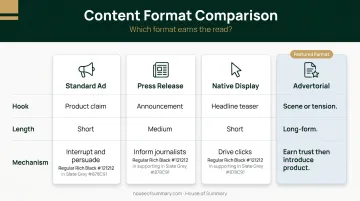
| Format | Hook | Length | Core mechanism |
|---|---|---|---|
| Standard ad | Product claim or visual | Short | Interrupt and persuade |
| Press release | Announcement | Medium | Inform journalists |
| Native display | Headline teaser | Short | Drive clicks to landing page |
| Advertorial | Scene, tension, or observation | Long-form | Earn trust, then introduce product |
The disclosure label — "Sponsored," "Paid post," or similar — does not kill performance. Research from Cornell found that readers of blog posts containing conflict-of-interest disclosures actually reported increased trust in the writer. Readers accept sponsored content when it still delivers value. Attempting to obscure the commercial intent triggers both reader distrust and publisher rejection.
The single standard against which all advertorial copy should be measured: if the product reference were removed entirely, the article should still be worth reading.
House of Summary applies this standard directly when reviewing sponsored content across its newsletter network. Advertorials that can't hold a reader's attention without the product mention don't make the cut — the same editorial bar that governs news coverage applies to paid placements.
What You Need Before Writing an Advertorial
The quality of your advertorial is determined entirely by what you gather before you write a single sentence. Rushing to draft without this research produces generic copy that editorial reviewers reject and readers abandon.
Research and Audience Inputs
Gather these before opening a blank document:
- The offer and core claim — what the product does and what it specifically enables
- The problem it solves — described in the audience's language, not the brand's
- Audience vocabulary — pull from forums, reviews, Reddit threads, and community discussions where your target reader describes their frustration in their own words
- Publication voice — read 5–10 recent high-performing articles from the target publication; note sentence length, paragraph structure, framing conventions, and the types of examples the editors favor
The American Press Institute is clear that sponsored content must be relevant and valuable to the publisher's audience — and that low-quality or overly promotional content risks audience alienation and trust erosion. Poor fit gets flagged by editors before readers ever see it.
Publication and Placement Fit
Assess whether the brand's offer genuinely belongs in the publication's topic territory. An advertorial placed in a mismatched context will be flagged by editors and ignored by readers regardless of how well it's written.
Also confirm the format type before writing. House of Summary's newsletter network, for example, offers several distinct formats:
- Sponsored content — branded editorial articles written in the newsletter's voice
- Native ad placements — inline with content flow
- Display formats — contained, high-visibility units
- Full-issue takeovers — complete brand ownership of a single send
Each format requires different structural decisions. A native editorial article needs narrative architecture; a display placement needs punchy, contained copy. Knowing which you're writing before you start prevents structural mismatches that waste revision cycles.
How to Write a Powerful Advertorial: Step by Step
Step 1: Define the Angle and Format Before Writing Anything
Choose the advertorial format that matches the platform and offer:
- Story/narrative — founder journey, customer transformation, before-and-after
- News-style — something new or surprising just happened in this space
- How-to — teaches a skill the audience wants, product appears as one tool
- Listicle — comparisons, rankings, or options across a category
Choosing the wrong format for the platform is a common reason advertorials fail editorial review. A listicle submitted to a long-form magazine context, or a narrative piece submitted to a publication that runs only short, punchy briefs, will be flagged before readers ever encounter it.
Then identify the central editorial argument of the piece — not the product claim, but the idea the article will defend. For example: "Most finance teams are solving the wrong problem when they try to reduce costs." The product will emerge as evidence for this argument. Not the other way around.
Step 2: Write the Hook as Story or Problem, Not as Product Claim
The hook is the highest-leverage paragraph in the piece. It determines whether anyone reads past the first sentence.
Draft an opening that begins with:
- A recognizable scene the reader has experienced
- A tension or contradiction they already feel
- A surprising observation that reframes something familiar
Test every hook against this rule: if someone reads only the first paragraph and closes the tab, they should walk away with something interesting — not with a product pitch.
Hooks that open with "Looking to improve your X?" or any version of a product question are the fastest path to editorial rejection. They signal immediately that what follows is promotional, and readers disengage before the piece has a chance to earn their attention.
Step 3: Build the Useful Content Body
Write the middle section as genuine editorial: a framework, a contrarian take, a set of specific lessons, or a well-explained process the reader can use independently of the product. It must be substantive enough that someone who never buys the product still considers the article worth their time.
Keep it in the publication's voice. Match the vocabulary, sentence cadence, and paragraph length of the editorial content around it. This is where most copywriters lose the piece — they revert to marketing language ("powerful," "transformative," "seamless") that breaks the editorial frame. Readers may not articulate why the piece suddenly feels off, but they feel it and stop reading.
Step 4: Integrate the Product Naturally
Introduce the product partway through as one example of how to apply the lesson just taught.
Not: "Introducing X — the platform that helps teams…"
But: "One way high-performing teams handle this is with a tool like X, which handles Y automatically, without requiring the team to rebuild their existing workflow."
The reader should feel the product is a logical extension of the argument, not a pivot away from it. Research by Pressboard and UBC found that brand mentions in the first 25% of sponsored content increased brand recall by 10%, but headlines that included the brand name had lower CTR than those without it. Keep the product out of the hook; bring it in after the editorial value has been established.
Limit direct product mentions to two or three within the body. More than this shifts the piece from editorial to promotional — and publishers and readers both sense it, even when they can't pinpoint why.
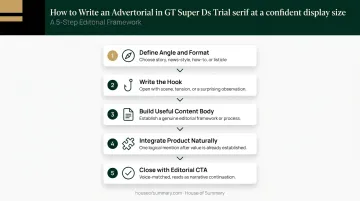
Step 5: Close With an Editorial-Style CTA
Write a closing that fits the article's voice and frames the next step as a natural continuation of the argument.
Works: "If your team is dealing with the same problem, [Brand] put together a guide on how they handle it at scale."
Doesn't work: "Start your free trial today. Limited spots available."
Then run a final editorial check. Read the piece as the publication's editor, not the brand's copywriter. Flag and cut anything that would not survive a legitimate editorial pass:
- Superlatives and unsubstantiated claims
- Urgency language ("limited time," "act now")
- Sentences that only make sense if a product exists
Key Variables That Determine Advertorial Performance
Technical competence gets copy to the starting line. These four variables determine whether it actually performs.
Hook Specificity
Copyblogger's headline data puts it plainly: 8 out of 10 people read the headline, and only 2 out of 10 read the rest. The hook must reflect the exact language and specific tension this audience already feels — not a paraphrase of the product brief, but the words actual readers use in forums and communities when describing the problem.
Copy that uses generic problem language ("many people struggle with X") reads as written from the outside. Copy that uses the audience's exact vocabulary reads as written by one of them. That difference alone separates high-completion pieces from abandoned ones.
Publication-Audience Fit and Trust Environment
The channel matters as much as the copy. Advertorials placed in high-trust, low-distraction environments consistently outperform the same copy placed in high-clutter display contexts.
Newsletter placements are structurally different from display or social. House of Summary's newsletter network, for instance, delivers each advertorial with no competing visual ads in the same issue, no algorithm standing between the sender and the inbox, and editorial credibility already established with the reader — so the advertorial inherits the trust the publication has built.
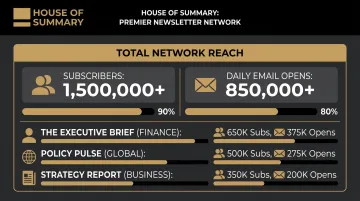
That reach matters too: 500,000+ subscribers across decision-makers, executives, and high-income professionals, with 254,866+ emails opened daily. That's an audience difficult to access reliably through programmatic channels.
When readers arrive already in an attentive, reading mindset, the advertorial has a structural advantage it cannot replicate in a scrolling social feed.
Disclosure Handling
FTC guidance is specific: labels such as "Ad," "Advertisement," or "Sponsored Advertising Content" communicate clearly, while "Promoted," "Presented by," or "Brought to You by" may not. A disclosure placed prominently and naturally — at the top of the article, in the publication's standard format — signals confidence and increases credibility. Burying it triggers suspicion among readers who notice it and rejection from publishers reviewing for compliance.
Testing Angle and Hook Variations
No single angle will be optimal for every audience segment. Plan to test at least two or three different hooks for any significant campaign — varying the emotional framing across fear, aspiration, curiosity, and social proof.
Track completion rate and CTR separately — they diagnose different failures. A high read rate with low CTR usually means the hook attracted the wrong reader or the CTA doesn't follow from the narrative. A low read rate means the hook itself isn't working.
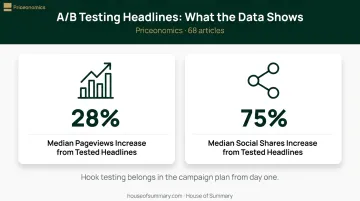
Priceonomics found that A/B-tested headlines increased median pageviews by 28% and median social shares by 75% across 68 articles. That's a large enough performance gap to build hook testing into the campaign plan from the start, not bolt it on after results disappoint.
Common Mistakes That Kill Advertorials
Don't open with a product claim. Hooks framed as brand statements get rejected by editorial reviewers and abandoned by readers. The piece earns the right to mention the product by delivering value first — start with a scene, observation, or tension instead.
Don't mention the product in every paragraph. Frequent brand appearances signal promotion regardless of how well individual sentences are written. One natural mention in the body, plus the CTA, is enough.
Don't ignore the publication's voice. An advertorial that sounds like the brand's website — too formal, too jargon-heavy — breaks the editorial frame and tanks both read rates and conversion. Read the target publication before writing.
Frequently Asked Questions
What is advertorial copywriting?
Advertorial copywriting is paid content written to match a publication's editorial format. It discloses its sponsored nature while delivering genuine information value first, then introduces a product or service as a natural extension of the editorial argument rather than as the lead.
What is the 80/20 rule in copywriting?
80% of the copy's job is to deliver value, education, or story that earns trust — only 20% makes the actual sales argument. In advertorials, this maps directly to structure: most of the piece should be standalone editorial, with product integration concentrated toward the end.
What makes an advertorial different from a regular ad?
Regular ads lead with product claims and rely on visual creative to capture attention. Advertorials lead with information value, use editorial format and narrative structure, and introduce the product only after the reader is already engaged with the content.
How long should an advertorial be?
Length depends on the publication and format. Most native sponsored posts run 800–1,200 words; newsletter advertorials typically perform well shorter, while magazine and landing page formats run longer. Always check the publication's media kit for exact specifications.
Where is the best place to run advertorials?
High-trust editorial environments — particularly email newsletters with engaged, topic-specific audiences — outperform display and social placements. Networks like House of Summary's specialized newsletters reach readers already in a reading mindset, with no competing ads and no algorithmic friction between the content and their attention.
How do you write a hook for an advertorial?
Open with a specific scene, recognizable tension, or surprising observation the target reader already experiences. Never open with a product claim. Test whether the first paragraph holds up with the product reference removed — if it doesn't, rewrite it.