
That gap — between ignored ads and genuinely consumed content — is exactly where advertorials live.
An advertorial blends advertising and editorial content into a format that earns attention rather than demanding it. It informs first, persuades second, and never quite feels like an ad. This guide covers what advertorials are, why they consistently outperform traditional formats, how to write one that actually works, where to place it, and how to tell if it's delivering.
Key Takeaways
- Advertorials blend paid messaging with editorial-style writing — readers engage instead of scrolling past
- Lead with value — insight, a story, or a useful fact — before introducing any brand message
- Match the tone and format of the host publication, not your brand's marketing voice
- Email newsletters outperform most channels for advertorial placement: inbox delivery bypasses ad blockers and reaches readers who actively opted in
- Measure success through engagement depth (time on page, brand recall, conversions), not click counts alone
What Is an Advertorial?
"Advertorial" is a portmanteau of "advertisement" and "editorial." It describes paid content deliberately written to look and read like the surrounding editorial content of the publication it appears in. The brand pays for the placement, but the writing is structured to inform rather than directly sell.
The core mechanism is simple: instead of interrupting a reader with a promotion, an advertorial earns attention by delivering something genuinely useful — then connects that value back to the sponsoring brand.
A Brief History
The FTC's first advisory on print ads mimicking news formats came in 1968, but the underlying dynamic is older than that. Mid-century magazines had already discovered that informational content held readers longer than display ads.
By the 1980s, the same logic was driving the infomercial boom — long-form TV programming built around education and demonstration. Tony Robbins-style personal development content became one of the most recognizable examples: part education, part pitch, structured so the value and the product were inseparable.
Digital publishing accelerated the advertorial's reach. Blogs, online magazines, and email newsletters all mimic editorial environments that readers already trust. That trust is the advertorial's core asset. Squander it with obvious selling, and the format loses the one thing that separates it from a standard ad.
Advertorials vs. Traditional Ads: Key Differences
The structural gap between these two formats is narrow on paper — but it shapes how readers respond to everything that follows.
| Traditional Ad | Advertorial | |
|---|---|---|
| Opening | Leads with the product or offer | Leads with a problem, insight, or story |
| Tone | Direct and benefit-focused | Informational and editorial |
| CTA placement | Front and center | Earned through the content arc |
| Reader posture | Skeptical, ready to skip | Open, expecting value |
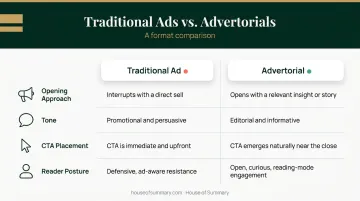
A traditional ad leads with the product: "Buy our project management software." An effective advertorial leads with the reader's problem — "How remote teams are cutting meeting time by half" — letting the software surface as the natural solution once the reader is already invested.
One misconception trips up many brands: writing advertorials in their own marketing voice instead of the editorial voice of the host publication. The result feels jarring, and readers disengage immediately. Matching the publication's tone — analytical if the publication is analytical, conversational if it is casual — is what makes an advertorial feel like content rather than a placement.
Why Advertorials Work: The Core Benefits
They Earn Attention Display Ads Can't
Research by IPG Media Lab and Sharethrough — based on eye-tracking data from 200 participants and surveys of 4,770 consumers — found that native ads were viewed 53% more frequently than display ads, with 25% more consumers viewing in-feed native placements than standard display units. Purchase intent lifted 18% higher, and brand affinity 9% higher, compared to banner ads.
They Sidestep Ad Blockers and Banner Blindness
By Q2 2023, 912 million users worldwide had active ad blockers installed, up 11% from late 2021. Display ads face this wall constantly. Advertorials placed in email newsletters bypass it entirely — ad blockers don't operate inside inboxes, and content embedded in editorial flow doesn't trigger the same psychological skip response that banner ads do.
They Build Longer-Lasting Awareness
A well-written advertorial published on an indexed web page or archived newsletter keeps working long after the initial send — compounding traffic and brand awareness over months. Nielsen's branded content research found 81% aided recall and a 10 percentage-point awareness lift in their branded content impact norms database. Display campaigns stop the moment the budget does. Editorial-style content doesn't.
They Hold Readers Longer
Because advertorials are actual content, readers spend more time with them. Pressboard found readers spend an average of 45 seconds engaging with written branded content — far longer than the fraction of a second a banner ad receives. That sustained attention drives deeper processing of the brand message, which is why recall and conversion intent consistently run higher for advertorials than for interruptive formats.
The difference shows up clearly across formats:
- Recall: Readers who engage with branded editorial content remember the brand at significantly higher rates than those exposed to display ads
- Intent: Purchase intent lifts when audiences read content that informs rather than interrupts
- Longevity: Indexed advertorials generate organic traffic and impressions well beyond the initial campaign window
How to Write an Effective Advertorial: Step by Step
Start With the Hook, Not the Brand
The first rule of advertorial writing: your product should not appear in the opening paragraph. Open with something the reader finds independently compelling — a counterintuitive statistic, a relatable problem, a short story that mirrors their own situation.
Sell the concept first. Introduce the product as the logical solution once the reader is already engaged.
Know Your Audience Before Writing
Effective advertorials aren't generic. They're built around a specific reader profile. Before writing a word, answer these questions:
- What does this reader worry about professionally or personally?
- What do they aspire to understand or achieve?
- What language and references will feel familiar in their world?
The answers should shape the angle, the examples, and the tone. The call to action comes last — not first.
Write a Headline That Promises Value
Your headline must function like an editorial headline. It should promise a useful insight or solve a problem, not announce a product.
Compare these two:
- ❌ "Introducing Our New Finance Tool"
- ✅ "Why High-Net-Worth Investors Are Rethinking Where They Keep Their Cash"
The second headline earns a click on its own merits. It leads with curiosity and delivers a specific promise — both of which outperform product announcements every time.
Match the Tone of the Host Publication
Readers are attuned to voice. A single mismatched paragraph signals that the content is an insertion, not a contribution — and that breaks the spell.
Use the publication's existing content as a calibration guide before writing a word:
| Publication Style | What Your Advertorial Should Do |
|---|---|
| Data-driven and precise | Cite evidence, use specific figures, avoid soft qualifiers |
| Conversational and warm | Match the register, use contractions, lead with relatable scenarios |
| Analytical and long-form | Build arguments, include research, earn conclusions |
| Concise and direct | Keep paragraphs short, front-load key points, skip throat-clearing |
Brands that ignore these signals make their advertorial feel out of place within the first two sentences.
Transition Smoothly Into the Brand Message
The structure of a successful advertorial follows a clear arc:
- Hook — open with something worth reading on its own: a striking statistic, a scenario the reader recognizes, or a counterintuitive claim
- Value delivery — provide education, insight, or narrative that the reader walks away from having gained something
- Brand introduction — position the product or service as the natural next step, not an interruption
- Low-pressure CTA — extend an invitation (read more, explore, learn) rather than pushing for an immediate transaction
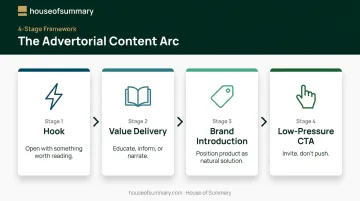
The transition from editorial content to brand message should feel earned. If it feels forced, the advertorial has failed regardless of how strong the opening was.
Include Disclosure Without Disrupting Flow
Transparency is both a legal requirement and a trust-building tool. The FTC requires that disclosures be clear, prominent, and placed before consumers engage — not buried at the bottom or revealed only after a click. Appropriate labels include "Ad," "Advertisement," "Paid Advertisement," and "Sponsored Content."
Readers who trust a publication's editorial standards will extend some of that trust to clearly labeled advertorials — particularly when the content genuinely delivers value.
Where to Place Your Advertorial for Maximum Reach
Print and Online Publications
Traditional magazine and news website placements work well for mass-market awareness, especially when the publication's readership closely matches the brand's target demographic. The reach is broad; the attention quality varies.
Email Newsletters: The High-Attention Channel
Newsletter placements are among the most underrated channels for advertorial content. Readers have opted in. They're in a focused reading mode, not passively scrolling. There are no ad blockers, no visual clutter, and no algorithm gatekeeping how many subscribers actually see the content.
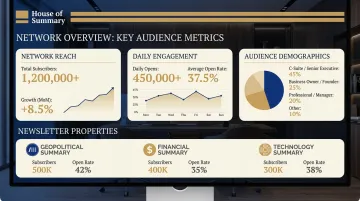
House of Summary's newsletter network — spanning Presidential Summary, Geopolitical Summary, Dubai Summary, and London Summary — delivers advertorial content directly to 500,000+ subscribers, with over 254,000 emails opened daily. The audience skews heavily toward executives, decision-makers, policy professionals, and high-net-worth individuals across the US, UK, and UAE.
For brands that need context or category education before a purchase decision lands — financial services, luxury goods, healthcare, fintech — a pre-qualified, high-intent readership is a fundamentally different environment than a passive social scroll.
Faik Serkan Ergun, CEO of BSH Hausgeräte, described their Dubai Summary campaign as "one of the smartest ad buys we made this year," citing click-through rates 4x higher than Google AdWords and strong audience quality.
Social Media and Influencer Advertorials
Sponsored content through influencer partnerships has grown rapidly, but comes with real structural challenges: algorithm dependency, shorter format constraints, and growing audience skepticism around influencer promotions. The controlled, distraction-free environment of a newsletter advertorial is harder to replicate on social platforms.
Match Platform to Audience Intent
Placement strategy isn't only about reach — it's about receptivity. The right channel depends on what your reader is doing when they encounter your content:
- Email newsletters: High-focus, opted-in readers actively seeking information
- Print/online publications: Broad reach, variable engagement quality
- Social/influencer: High volume, but algorithm-dependent and increasingly skeptical audiences
A subscriber reading a curated business newsletter is in a fundamentally different mindset than someone encountering a sponsored post mid-scroll. That context gap directly affects conversion.
How to Measure Whether Your Advertorial Is Working
Core Metrics to Track
| Metric | What It Tells You |
|---|---|
| Click-through rate | Whether the CTA and content angle motivated action |
| Time on page / scroll depth | How thoroughly readers engaged with the content |
| Conversion rate | How many readers took the desired next step |
| Direct traffic lift | Whether the advertorial drove branded search or site visits |
Brand Lift Indicators
Advertorials are often awareness and trust tools as much as direct-response tools. Nielsen's 2023 research found that brand recall influenced 38.7% of brand lift in emerging media — meaning direct conversions alone won't capture the full picture. Beyond conversions, track:
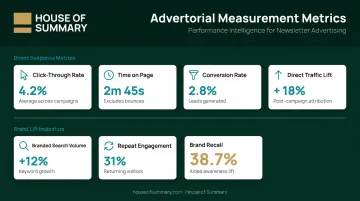
- Branded search volume increases in the weeks following placement
- Repeat engagement from the same audience segment after advertorial exposure
Iterate and Optimize
Treat early campaigns as structured learning. Run variations on hooks, headlines, and CTAs across placements — then double down on what actually moves the needle. An advertorial that resonates in one newsletter may fall flat in another. The content can be identical; the audience context is what changes the result.
Frequently Asked Questions
What is the purpose of an advertorial?
An advertorial's primary purpose is to promote a brand, product, or service through informative, editorial-style content. It builds trust and awareness without the overt sales pressure of traditional advertising, making readers more receptive to the brand message.
Who uses advertorials?
Advertorials are used across industries — luxury brands, financial services, SaaS companies, healthcare firms, and consumer goods brands. They're especially effective for products that require context or narrative before a purchase decision.
What does advertorial mean?
The word combines "advertisement" and "editorial." It describes paid content deliberately designed to look and read like the editorial content of the publication in which it appears, informing rather than directly selling.
How can I identify an advertorial?
Advertorials are typically labeled "Sponsored," "Paid Content," or "Brought to You By." Beyond the disclosure, they're recognizable by their informational tone, longer-form copy, and a sales message that's subtle rather than direct.
Are advertorials the same as native advertising?
Advertorials are a type of native advertising. Native advertising is the broader category — including promoted social posts, content recommendation widgets, and in-feed ads — while advertorials specifically refer to longer-form, editorial-style sponsored content.
How long should an advertorial be?
Most effective advertorials run between 500 and 1,200 words. That range gives enough space to deliver genuine value and build toward a brand message, without losing the reader before it lands.