Introduction
Native advertising has grown into a $105.88 billion global market because ads blend seamlessly into content—but most buyers focus on volume and cheap CPCs, not on whether those clicks come from the right people. The real challenge is filtering for quality audiences once you're in market.
Most campaigns prioritize impressions over audience composition, routing budget to cheap clicks that bounce immediately. 42% of internet users worldwide now use ad blockers, with adoption highest among males aged 25-34 — a demographic that overlaps heavily with professional audiences.
The inventory problem compounds this. 21% of programmatic impressions flow to low-quality made-for-advertising (MFA) sites that generate clicks without delivering real business value. Optimizing for volume in that environment actively works against reaching high-intent buyers.
This guide covers how to buy native ad traffic strategically — from pre-campaign setup through targeting parameters and the placement decisions that separate quality audiences from wasted spend.
Key Takeaways
- Native ads deliver 2.5x higher CTR than standard display, but quality matters more than volume
- Reaching executives and finance professionals requires targeted channel selection, not just high-traffic networks
- Define your audience profile, set placement quality standards, and establish conversion benchmarks before buying
- Success comes down to four variables: how precisely you target, where your ad appears, how well your creative fits the audience, and which bidding model you use
- Buying cheap traffic on mass networks and measuring success by clicks — not conversions — is how most native ad campaigns fail
How to Buy Native Ad Traffic That Reaches High-Value Audiences
Step 1: Define Your Target Audience and Campaign Objectives
Identify your high-value audience profile before touching any platform interface:
- Job function and income level – Are you targeting CFOs, marketing directors, or business owners?
- Content consumption habits – What publications do they read? What topics do they research?
- Geographic market concentration – New York financial professionals versus London executives require different approaches
Set campaign objectives tied to business outcomes—leads, sign-ups, pipeline value—not just CTR. Native platforms optimize toward whatever KPI you give them. A campaign optimized for clicks will find cheap traffic; one optimized for conversions will prioritize quality.
Decide your funnel stage:
- Top-funnel (awareness): Brand exposure, thought leadership
- Mid-funnel (consideration): Content downloads, newsletter sign-ups
- Bottom-funnel (conversion): Demo requests, purchases
This determines both platform choice and creative format.
Step 2: Choose the Right Native Ad Channel for Your Audience
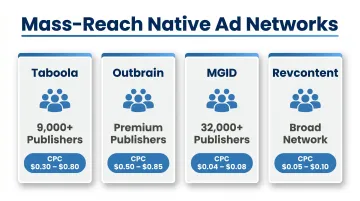
Mass-reach content recommendation networks offer broad volume at lower costs. Key platforms by scale and price:
| Platform | Publisher Reach | Typical CPC |
|---|---|---|
| Taboola | 9,000+ publishers | $0.30–$0.80 |
| Outbrain | Premium publishers | $0.50–$0.85 (desktop) |
| MGID | 32,000+ publishers | $0.04–$0.08 |
| Revcontent | Broad network | $0.05–$0.10 |
Premium placement channels deliver more concentrated high-value audiences:
- Programmatic native DSPs (StackAdapt) offer contextual targeting and first-party data integration
- Newsletter-native platforms reach opted-in subscribers directly in their inboxes
For executives, finance professionals, and business decision-makers specifically, prioritize channels where audience composition is verifiable. Newsletter-native platforms like House of Summary's network deliver ads to subscribers' inboxes—bypassing ad blockers entirely and reaching readers who've actively opted in for global news, geopolitics, and business content.
Compare placement performance: Finance newsletter sponsorships achieve 4.7% CTR, approximately 6x higher than content recommendation network average of 0.78% CTR.
Evaluate publisher lists and vertical alignment. If your audience reads financial news and geopolitical coverage, ensure your platform has meaningful publisher concentration in those categories—not just overall reach numbers.
Step 3: Configure Targeting, Creative, and Bidding
Audience Targeting
- Contextual targeting (page topic, content category matching your offer)
- Geographic filters for wealth-concentrated metros
- Device type preferences
- First-party or interest-based audience segments aligned to professional profiles
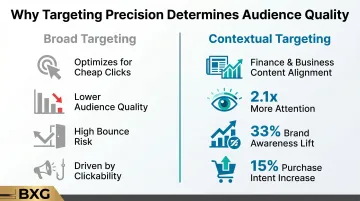
Research shows contextually aligned targeting generates 2.1x more attention than non-aligned placements.
Creative Assets
Prepare assets that match native format requirements: headline, image, description. Tone must align with the editorial environment — high-value audiences disengage fast from clickbait or mismatched messaging. Headlines framed around insight or problem-solving consistently outperform promotional language with professional audiences.
Bidding Model
- CPC: For content-click campaigns where traffic quality is your focus
- CPM: For awareness campaigns prioritizing reach ($1–$5 typical range)
- Target CPA: When the platform supports it and you have sufficient conversion data (requires 20+ conversions in 30 days for Outbrain)
Set an initial budget allowing enough impressions for meaningful data. Typical minimums: Taboola requires $500–$1,000; Outbrain requires $25/day minimum, with $250/day recommended for performance campaigns.
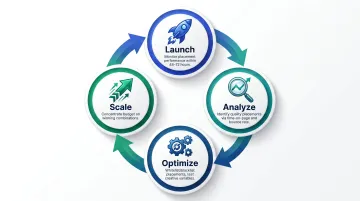
Step 4: Launch, Monitor, and Optimize
Monitor placement-level performance within 48–72 hours. Identify which publisher sites or newsletter placements deliver engaged visitors—time on page, scroll depth, low bounce rate—versus those generating clicks that bounce immediately.
Use site-level reporting to build whitelist and blacklist decisions. Research shows 78% of private marketplace deals included MFA inventory, with nearly a quarter allocating more than 25% of budget to low-quality sites.
Concentrate budget on placements where post-click behavior confirms audience alignment. Native ads convert at 0.92% versus 0.71% for display—but only when placement quality is actively managed.
Establish structured testing for creative variables:
- Headlines: insight-driven framing versus direct promotional language
- Images: professional context versus lifestyle/casual
- Descriptions: lead with benefit or lead with feature
- Landing page CTA: soft ask (download/read) versus hard ask (demo/buy)
Native platform algorithms shift budget toward better-performing creatives automatically — give them enough variants to work with. Scale winning combinations methodically rather than all at once.
When Should You Buy Native Ad Traffic?
Native ad traffic performs best when you have content worth promoting: articles, guides, reports, case studies, or editorial-style landing pages. Direct product ads with no supporting content rarely perform well here.
Strong use cases include:
- Campaigns targeting professionals where trust and contextual relevance matter
- Full-funnel programs that use top-of-funnel content to warm audiences before retargeting
- Brands entering new markets requiring audience education before conversion
- High-consideration purchases where decision cycles are measured in weeks, not seconds
Native isn't the right fit when:
- Budgets are too small to survive the learning phase (under $1,000/month typically)
- Creative assets are purely transactional with no content value
- The offer requires immediate impulse decision inconsistent with native's considered-engagement model
- You lack conversion tracking infrastructure to measure downstream results
What You Need Before Buying Native Ad Traffic
Three foundations determine whether your native campaigns generate real results: audience intelligence, conversion tracking, and creative readiness. Skip any one of them and you're funding a learning exercise, not a campaign.
Audience Intelligence and Conversion Tracking
Document an audience profile beyond demographics. Understand what content your high-value audience consumes, what problems they research, and what they consider authoritative sources. This informs both platform selection and creative tone.
Ensure conversion tracking is properly installed—pixel, UTM parameters, or server-side event tracking—before spending a dollar. Native platforms need downstream conversion data to optimize bidding intelligently. Without it, they default to click optimization — which inflates traffic numbers but misses the buyers, subscribers, or leads you actually need.
Creative Assets and Landing Page Readiness
Prepare multiple headline and image variations for A/B testing from day one. Platforms need variation to optimize; launching with a single creative leaves the algorithm with nothing to work with.
Before you spend, audit the landing page against these basics:
- Load speed under 3 seconds (mobile and desktop)
- Mobile responsiveness that doesn't break layout or CTAs
- Message continuity — the landing page should feel like a natural extension of the ad
- A specific, relevant headline (not a generic product page)
Native viewability rates of 81% outperform desktop banner's 64% — but that advantage disappears the moment a strong ad clicks through to a weak page.
Key Parameters That Affect Results When Buying Native Ad Traffic
Outcomes in native advertising are highly sensitive to a small number of control variables.
Audience Targeting Precision
Native networks with broad mass-reach audiences default to optimizing for clickability, not audience quality. Unless you constrain targeting to relevant contexts and verticals, the algorithm finds the cheapest clicks, not the most valuable readers.
Tight contextual and interest-based targeting — finance content, business news, executive-level publications — measurably improves who sees and clicks your ad. Case studies show a 33% brand awareness lift and 15% purchase intent increase from emotionally aligned contextual targeting.
Placement Environment and Publisher Quality
Native ad performance varies enormously by publisher. A placement on a premium finance publication reaches a fundamentally different reader than the same ad on a low-quality content farm, even if CPCs look identical.
Premium placement environments — especially inbox-delivered formats like newsletter sponsorships — produce higher attention, stronger brand recall, and better downstream conversion rates than open-web placements. Finance newsletter CTRs of 4.7% significantly outperform content recommendation network averages of 0.78%.
That performance gap comes down to context. Newsletter-native placements reach engaged subscribers with no algorithmic interference and no ad blocker risk. House of Summary's network of specialized publications, for example, delivers ads directly to finance professionals and executives who've opted in for content on global news, geopolitics, and business.
Creative-to-Audience Fit
Readers process native ads that match the editorial tone of the surrounding content as recommendations. Ads that feel out of place get ignored — or worse, create negative brand association.
Headlines framed around insight, data, or problem-solving consistently outperform promotional language with high-value professional audiences. Track not just CTR but time-on-page and return visit rate as quality signals. Native ads drive 18% higher purchase intent when tone aligns with audience expectations.
Bidding Model and Budget Allocation
Pure CPC optimization on platforms that route budget toward high-click, low-quality placements will undermine audience quality even when your targeting is set correctly.
Once you have sufficient conversion data, shift to conversion-based bidding (target CPA or ROAS). Before that:
- Use CPM bidding with tight placement controls during the learning phase
- Avoid CPC on open networks where click volume outweighs placement quality
- Prioritize publisher allowlists over algorithmic placement decisions
Common Mistakes When Buying Native Ad Traffic
Most wasted native ad spend traces back to a handful of recurring errors. Avoid these before committing budget.
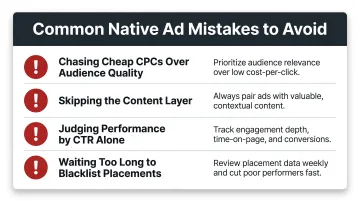
Chasing cheap CPCs over audience quality: Low minimum bids on mass-reach networks rarely deliver the executive or finance-professional audience high-value campaigns require. Research the publisher mix and reader demographics first.
Skipping the content layer: High-value audiences need context and trust before converting. Pushing traffic directly to a sign-up page produces higher bounce rates and wasted spend — a mid-funnel content piece changes that dynamic.
Judging performance by CTR alone: A 0.8% CTR with 90-second average session time and real conversions beats a 2% CTR that bounces in 10 seconds. Instrument downstream metrics before declaring any campaign successful.
Waiting too long to blacklist placements: Native networks span a wide range of publisher quality. Without placement-level monitoring and active blacklisting in the first week, budget drains to low-quality sites that inflate click numbers without converting.
Frequently Asked Questions
What is a native ad network?
A native ad network connects advertisers with publishers to place ads that match the visual style and tone of surrounding content. Networks range from open-web content recommendation engines (Taboola, Outbrain) to premium newsletter-native platforms delivering directly to subscriber inboxes.
What platforms are best for native ads?
The best platform depends on the audience being targeted. Mass-reach networks like Taboola and Outbrain suit broad consumer campaigns, while programmatic DSPs like StackAdapt and premium newsletter-native channels suit professional and executive audiences requiring verifiable composition and contextual alignment.
What is the average CTR for native ads?
Native ads consistently outperform standard display: content recommendation networks average 0.78% CTR and in-feed formats reach 1.16%, versus 0.46% for standard display. Newsletter-native placements exceed both, with finance newsletters achieving 4.7% CTR.
What is the difference between native and non-native ads?
Native ads are designed to match the format and tone of the content environment they appear in—in-feed articles, sponsored newsletter placements—and blend seamlessly with editorial content. Non-native ads like banners or display units are visually distinct from content and are more easily ignored or blocked by ad-blocking software.
How much does a display ad cost?
Display ad costs vary by format, audience, and platform. Google Display Network averages $3.12 CPM; programmatic open-exchange averages $5.85 CPM. CPC typically runs under $1, though competitive industries like finance can push it above $50.
Are display ads still effective?
Display ads remain widely used but are losing ground to ad blockers and banner blindness — 42% of internet users now block ads. For high-value professional audiences, native and newsletter formats deliver stronger results, with native viewability at 81% versus desktop banner at 64%.