
Traditional CPM display makes this hard. You pay for reach, hope for engagement, and spend significant time explaining why impression volume didn't translate to pipeline. According to the ANA's 2023 programmatic transparency study, roughly $20 billion of the $88 billion open-web programmatic market is wasted — that's about 23 cents of every dollar going nowhere measurable.
Native CPC advertising is increasingly discussed as a fix, but the actual case for it often gets buried in platform jargon. This article cuts through that. You'll find the specific, trackable advantages that make native CPC a better choice for marketers who need budget accountability, quality audiences, and results they can actually report.
Key Takeaways
- Native CPC means paying only when someone clicks — zero cost for passive views
- Native formats earn more attention than display ads in editorial contexts
- 290 million desktop users block display ads — email-native placements bypass blockers entirely
- CPM display charges for impressions regardless of engagement; CPC eliminates that waste entirely
- Consistent optimization improves click quality and lowers CPA over time
What Is Native CPC Advertising
Native CPC advertising combines two ideas: format and pricing model.
The format side means the ad matches the look, feel, and function of the surrounding content — whether that's an editorial article, a newsletter, or a content feed. The IAB's Native Advertising Playbook defines native ads as paid placements "so cohesive with the page content, assimilated into the design, and consistent with the platform behavior" that they feel like they belong there.
The pricing side means you pay only when a user clicks. Not for views, not for impressions, not for scroll-bys — only for the moment a real person chose to engage.
You'll find native CPC most commonly in:
- Content discovery networks like Outbrain (which runs exclusively on CPC) and Taboola (which supports both CPC and CPM)
- In-feed editorial placements that mirror surrounding article design
- Newsletter sponsorships embedded within editorial email content
- In-content publisher placements that sit within article flow rather than around it
Native CPC is not an aesthetic choice. It's a performance model that ties budget directly to audience action — brand visibility follows, but cost accountability drives every placement decision.
Key Advantages of Native CPC Advertising
The three advantages below are trackable, not theoretical. Each connects to metrics marketers already report: cost per click, conversion rate, and ROAS.
Advantage 1: You Only Pay for Engagement, Not Exposure
With CPM, your budget depletes whether anyone engages or not. With CPC native, nothing leaves your account until a user clicks.
This matters in practical terms. A brand running a native CPC campaign can set a daily budget, watch spend accumulate only as clicks arrive, and redirect budget mid-campaign if certain placements underperform. No impressions are wasted on audiences who scroll past.
For newsletter placements, Paved's 2025 newsletter advertising guide reports CPC rates typically ranging $1–$5 per click, with sponsorship CPMs often running $15–$30 per 1,000 opens. For comparison, WordStream's 2026 PPC benchmark — based on 13,000+ US campaigns — puts average Google Search CPC at $5.42. Newsletter-native CPC can offer comparable or lower entry costs, in a higher-attention environment and with less competitive bidding pressure.
What this shifts in practice:
- Finance teams can approve CPC campaigns more confidently — accountability is structural, not added in post-reporting
- Performance is visible in real time, not inferred after budget is spent
- Underperforming placements can be cut quickly, protecting the rest of the budget
KPIs directly impacted: cost per click, cost per lead, conversion rate, ROAS, budget utilization
Best suited for: campaigns with defined conversion goals, brands with limited budgets, advertisers who need to demonstrate ROI to internal stakeholders
Advantage 2: Higher Engagement From Intent-Aligned Audiences
Where an ad appears determines who sees it — and what they're thinking when they do.
A native ad placed inside a business newsletter reaches someone who subscribed to that newsletter, opened it deliberately, and is actively reading. A banner ad served mid-scroll on a social feed reaches someone doing something else entirely. The behavioral context is completely different, and CTR reflects that gap.
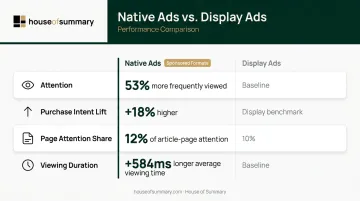
The research supports the attention advantage. A 2013 IPG Media Lab and Sharethrough study of 4,770 consumers found that people looked at native ads 53% more frequently than display ads, and that native placements generated an 18% higher lift in purchase intent than banner ads.
A peer-reviewed 2022 mobile study found native ads drew 12% of total article-page attention versus 10% for display, with 584 milliseconds longer average viewing time. Intent alignment drives this effect: the ad feels like a natural extension of what the reader is already consuming, not an interruption.
For House of Summary advertisers specifically, placements go into newsletters read by executives, policy professionals, and finance decision-makers who subscribed because they want to stay informed. That's a self-selected, verified audience — not a modeled proxy.
KPIs directly impacted: CTR, cost per acquisition, traffic quality (time on page, bounce rate), downstream conversion rate
Best suited for: B2B campaigns targeting executives, niche professional audiences, high-consideration products, situations where click quality matters more than click volume
Advantage 3: Ads Reach Audiences Ad Blockers Cannot Touch
Ad blocking isn't a niche behavior. Blockthrough/PageFair's 2022 report — which analyzed over 10 billion pageviews across 9,453 websites — found 290 million monthly active desktop ad-block users globally, with an average block rate of 21% across sites.
That means roughly one in five web ad impressions never renders. For CPM campaigns, you're paying for those ghost impressions anyway.
Newsletter-native placements bypass this entirely through email delivery infrastructure. Ad blockers operate at the browser level, intercepting external scripts and display units on web pages. Email content arrives directly in the inbox — the blocker has no mechanism to intercept it. House of Summary's ad placements are embedded within editorial email content, which means they load with the newsletter itself, not as external ad calls.
This creates a measurable advantage for premium audience targeting. Executives, finance professionals, and high-income readers — the people hardest to reach and most likely to block web ads — are fully reachable through inbox-delivered editorial placements.
KPIs directly impacted: verified impressions, effective click rate against real reach, deliverability, audience quality
Best suited for: campaigns targeting premium professional audiences, high-consideration or luxury products, brands whose ideal customer is statistically likely to use an ad blocker
What Happens When Native CPC Is Overlooked
When native CPC gets passed over, the default tends to be CPM display or social impression buys. The appeal is familiar: large reach numbers, straightforward reporting, established workflows. The problem is accountability.
CPM campaigns charge for impressions whether or not anyone engages. The waste compounds fast. DoubleVerify's 2024 Global Insights report found display viewability at 71% on average — meaning nearly 3 in 10 paid impressions were never actually seen. In unprotected campaigns, that number dropped to 59% authentic viewability.
The downstream costs are predictable:
- Spend looks active on impression dashboards, but conversion data stays flat
- Teams compensate by increasing volume rather than improving targeting or format — which increases cost, not results
- High-intent audiences using ad blockers remain completely unreachable, regardless of budget
- CPA rises, and diagnosing why becomes harder without click-level accountability
Brands that skip native CPC early often return to it after CPM campaigns miss their conversion targets. By then, a meaningful portion of budget has done the work of confirming the gap.
How to Get the Most Value from Native CPC
Getting value from native CPC comes down to execution, not just setup. Relevant ad placement, a landing page that matches what was promised, and data that actually drives decisions — these determine whether a campaign improves over time or stalls.
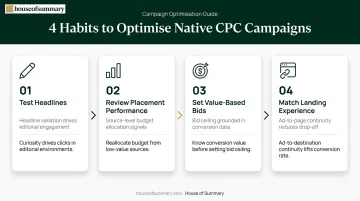
Practical optimization habits:
- Test headlines regularly — in editorial environments, curiosity drives clicks. A weak headline raises effective cost-per-click by suppressing CTR, not by inflating bids
- Review placement-level performance — traffic quality varies significantly by publisher and feed. Identify which placements send engaged visitors and reallocate budget away from low-value sources
- Set bids that reflect conversion value — know what a qualified visit is worth before setting a ceiling. Overbidding on low-converting traffic bleeds budget; underbidding means losing impressions to competitors
- Match the landing experience to the ad — a reader who clicked a headline about fintech trends shouldn't land on a generic homepage. Continuity between ad and destination directly affects conversion rate
Campaigns that run these habits consistently tend to see CPA improve quarter over quarter. The gains aren't dramatic in week one — they build as the data gets richer and optimizations get sharper.
Conclusion
Native CPC earns its place in a media budget because the structure itself creates accountability. Every dollar spent corresponds to a real user decision. That single mechanic changes how budgets are managed, how performance is measured, and how efficiently campaigns can scale.
The advantages compound: intent-aligned placements lift CTR, inbox delivery reaches audiences web display misses entirely, and CPC pricing gives marketers real data to act on instead of estimated reach to guess from. For teams justifying spend to finance or CMOs — and for brands targeting senior professionals who tune out programmatic noise — that combination is hard to build any other way. If cost-effective reach to high-intent audiences is the goal, native CPC is where to start.
Frequently Asked Questions
Which is better for native ads: CPM or CPC?
CPC is better for performance-driven campaigns where every dollar needs to tie to a measurable action. CPM makes more sense for brand awareness goals where reach and visibility matter more than immediate clicks. The right choice depends entirely on what the campaign is trying to achieve.
What is a good CPC for native advertising?
For newsletter placements, Paved's 2025 marketplace data puts typical CPC in the $1–$5 range. Content discovery networks like Taboola and Outbrain don't publish standardized vertical benchmarks, so expect variation by targeting and audience. What counts as "good" depends on the conversion value behind each click, not the CPC figure alone.
How does native CPC compare to Google AdWords CPC?
WordStream's 2026 benchmark puts average Google Search CPC at $5.42 across 13,000+ US campaigns. Newsletter-native CPC can fall within or below that range while reaching audiences in a higher-attention, less competitive context — though a meaningful CPA comparison requires conversion data from your own campaign.
What type of content performs best in native CPC campaigns?
Content that informs, educates, or solves a problem relevant to the placement environment consistently outperforms promotional copy. Native CPC rewards relevance. Readers click because something is genuinely useful or interesting to them, not because an ad interrupted their attention.
How do I measure ROI on native CPC advertising?
Track CPC, landing page conversion rate, cost per lead or acquisition, and downstream revenue. UTM tagging and conversion tracking must be configured before launch, since retroactive attribution is unreliable and often gaps your data.
Can native CPC work for small advertising budgets?
Yes. CPC native is particularly suited to smaller budgets because there's no waste on unengaged impressions. A modest daily budget on well-targeted, relevant placements can outperform larger CPM spends on broad, untargeted display inventory.