The result? Mediocre performance that confirms the wrong lesson: that native advertising "doesn't work."
Native advertising works. What doesn't work is running it without expertise. According to research from IPG Media Lab and Sharethrough, native ads are viewed 53% more often than display ads and produce an 18% higher purchase-intent lift. That gap doesn't happen by accident—it happens when advertisers get the fundamentals right.
This guide covers the four areas where native advertising expertise actually lives: targeting precision, creative discipline, channel selection, and continuous measurement.
Key Takeaways
- Native ads outperform display on attention and purchase intent when the format, content, and context align
- Expert campaigns start with audience clarity and funnel-stage matching—not platform selection
- Creative performance comes down to headlines, visual tone, and post-click experience—get all three right or the conversion breaks down
- Newsletter placements offer opted-in, high-intent audiences with no algorithmic filtering and minimal ad-blocker interference
- Optimizing for CTR alone misleads—engagement depth, lead quality, and post-click behavior are the metrics that reflect actual performance
What Separates Expert Native Advertising from the Basics
The Format, Defined Correctly
The IAB Native Advertising Playbook 2.0 defines native ads as paid placements that are cohesive with page content, assimilated into site design, and consistent with platform behavior. Native advertising is sponsored content that mirrors the editorial tone of the environment it appears in—not a banner, not a pop-up, not a retargeting pixel. When it works, readers encounter it as content first, and as an ad second, if at all.
The Performance Gap Is Real
The IPG/Sharethrough data puts a number on the difference: 53% more views, 18% higher purchase intent, 9% higher brand affinity compared to banner ads. That's not a marginal improvement—it's a structural advantage that comes from matching the content environment rather than interrupting it.
One practical side effect: native formats are far less vulnerable to ad blockers. YouGov's 2024 data across 48 markets found that roughly 52% of consumers had installed or used an ad blocker. Advertisers running display campaigns are losing reach to that segment. Native placements embedded in editorial content—and particularly in email—largely bypass this problem.
What "Expertise" Actually Means
Those performance numbers don't materialize on their own. Expertise in native advertising is what bridges the format's potential to actual campaign results. It comes down to four interconnected practices:
- Match the campaign objective to a funnel stage before choosing any format
- Select publisher environments where the audience profile fits your target customer
- Produce content that earns attention rather than demanding it
- Measure the right signals and act on them systematically—not just track impressions
Native advertising and content marketing are related but distinct. Content marketing earns organic reach through SEO and social distribution. Native advertising is paid and guarantees placement.
The two work well together—native can amplify existing content marketing assets—but they require different success metrics. Treating them as interchangeable means optimizing for the wrong signals, which produces misleading performance data and misallocated budget.
Build a Targeting Foundation Before Running Any Ad
Start with Funnel Stage, Not Platform
The single most important pre-campaign decision isn't which platform to use—it's identifying where your target audience sits in the buying funnel.
- Awareness stage — readers don't know they have a problem; educational or story-driven content works here
- Consideration stage — readers are comparing options; proof-based content, comparisons, and case studies perform better
- Decision stage — readers are close to acting; offer-driven content and testimonials close the gap
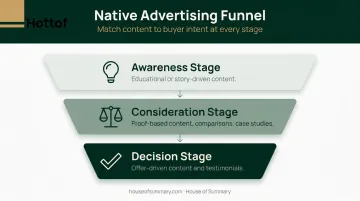
Running decision-stage creative at awareness-stage audiences, or vice versa, wastes the placement entirely. The content format and message must match the funnel stage.
Use First-Party Data to Build a Real Audience Profile
Platform-level demographic targeting is broad by design. Treat it as a starting point, then layer in owned data before activating any campaign.
Expert native advertisers build audience profiles from these owned data sources:
- Website analytics (behavior, pages visited, session depth)
- CRM segments (customer value, purchase history, lifecycle stage)
- Email list behavior (open patterns, click categories, engagement frequency)
- Customer interviews (language, problems, objections)
IAB's 2024 State of Data report found that 71% of brands, agencies, and publishers planned to increase first-party data investment that year—nearly double the 42% who said the same in 2022. That gap is where targeting advantage compounds over time.
Intent Signals Matter More Than Demographics
High-intent audiences—people actively researching a topic, reading specialized publications, or consuming niche content—respond measurably better to native ads than passive scrollers. IAS's 2022 Tobii eye-tracking study found that contextually relevant ads were noticed in 0.4 seconds versus 1.0 second for out-of-context placements, with 14% higher purchase intent and 5% higher brand favorability.
Publisher selection is itself a targeting decision. Where you place an ad determines who sees it and how receptive they are—before a single headline is written.
Create Native Content That Earns Attention
The Editorial Test
Every piece of native content should pass a simple test: if the "Sponsored" label were removed, would it still feel like it belongs on the page?
Content that fails this test—too promotional, too product-forward, too disconnected from the editorial environment—generates poor engagement regardless of how much is spent on the placement. The goal isn't to disguise the ad. It's to make the content genuinely worth reading.
Headline and Hook Craft
The headline does most of the work. Outbrain's copywriting guidance points to several consistent principles for effective native ad headlines:
- Use specific numbers — concrete figures outperform vague claims
- Create a curiosity gap — give readers a reason to want the answer
- Frame around the reader, not the brand — "How finance teams reduce reporting time" outperforms "Our platform saves you time"
- Keep it concise — Outbrain's Classic Native format caps titles at 30 characters; brevity is a constraint, not a limitation
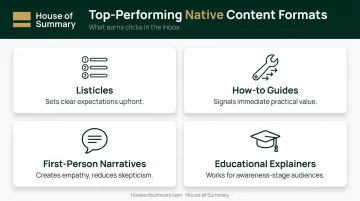
Content formats that consistently outperform in native environments include:
- Listicles — they set clear expectations upfront
- How-to guides — they signal immediate practical value
- First-person narratives — they create empathy and reduce skepticism
- Educational explainers — they work for awareness-stage audiences who don't yet know what they need
Visual and Format Alignment
Visuals should match the publisher's aesthetic, not the brand's campaign style guide. Overly polished, clearly produced imagery signals "advertisement" and triggers the same scanning behavior that makes banner ads invisible.
Blending with the surrounding editorial design is the standard — not the exception. Authentic imagery drawn from real environments and real contexts performs better in native placements because readers don't stop to identify it as an ad.
That attention advantage carries only as far as the click. If the landing page doesn't deliver on the headline's promise, readers leave. A mismatch between the ad's editorial tone and a hard-sell landing page erases everything the native format worked to earn.
Choose the Right Publisher and Channel for Maximum Impact
Contextual Relevance as a Placement Principle
Publisher selection is where many native campaigns underperform. A financial services brand placing ads in a general entertainment feed will reliably underperform compared to the same ad appearing in a finance-focused editorial context—even with identical creative.
The audience's mindset when they encounter the ad determines how they receive it. Context shapes receptivity.
Matching Channel to Campaign Goal
The major native distribution channels serve different purposes:
| Channel | Audience State | Best For |
|---|---|---|
| Open-web networks (Outbrain, Taboola, StackAdapt) | Passive browsing | Scale, awareness, content amplification |
| Social native (LinkedIn, Meta in-feed) | Semi-engaged scrolling | B2B targeting, social proof formats |
| Newsletter native | Active, opted-in reading | High-intent engagement, premium audiences |
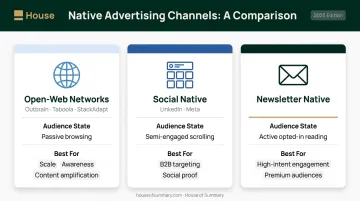
Expert advertisers don't default to one channel. They match the channel to the campaign goal and the audience's intent level at that moment.
The Case for Newsletter Native Advertising
Newsletter placements occupy a different attention environment than open-web native. Readers have opted in to receive content from a specific source and arrive deliberately — no sidebar clutter, no autoplay video competing for attention. The brand's message appears inside the content the reader came for.
House of Summary's newsletter network — reaching 500,000+ subscribers across Presidential Summary, Geopolitical Summary, Dubai Summary, and London Summary — operates precisely in this environment. The audience is concentrated among C-suite executives, founders, policy professionals, and high-net-worth individuals:
- 66% based in the US (New York and Los Angeles)
- 18% in the UAE
- 10% in the UK
For advertisers targeting decision-makers in finance, professional services, luxury, or B2B categories, this represents a contextual match that programmatic channels struggle to replicate. The network generates 254,866+ emails opened daily, and campaigns include dedicated brand consultation across formats ranging from native editorial placements to full-issue takeovers.
Track the Metrics That Actually Matter and Optimize Continuously
Beyond CTR
Click-through rate is a directional signal, not a success metric. High CTR with poor post-click behavior—high bounce rates, low time-on-page, no conversions—typically indicates a headline-content mismatch, not a successful campaign. The headline generated curiosity that the destination content didn't satisfy.
The metrics that actually indicate campaign health:
- Engagement rate and scroll depth — did readers consume the content or abandon it?
- Time-on-page — a proxy for genuine interest
- Lead quality — what did the clicks convert into?
- Cost-per-acquisition — what did the campaign actually cost to generate a result?
Outbrain's attention metrics framework adds viewability, dwell time, and contextual alignment as meaningful signals alongside CTR. No single number tells the full story.
The Optimization Loop
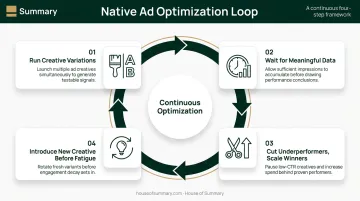
Native campaigns improve through systematic iteration, not gut instinct:
- Run creative variations — test headlines, images, and formats simultaneously
- Wait for meaningful data — 24-48 hours isn't enough; let the data accumulate over a window that reflects real audience behavior
- Cut underperformers, scale winners — pause underperformers immediately, then reallocate budget to what's working
- Introduce new creative before fatigue sets in — StackAdapt recommends rotating assets and setting frequency caps; the exact cadence depends on placement frequency and audience size
Qualitative Signals Are Underused
The optimization loop above focuses on numbers — but in newsletter and content-rich environments, qualitative feedback often surfaces before quantitative data catches up. Reader comments, shares, direct replies, and advertiser-reported lead quality all feed into a smarter optimization loop.
A campaign with modest CTR but consistently high-quality inbound leads is performing better than a campaign with double the clicks and no conversions. Build your measurement framework around outcomes, not activity — and you'll know exactly where to push harder next time.
Frequently Asked Questions
What is the difference between native advertising and content marketing?
Native advertising is paid and guarantees placement—the ad appears because the advertiser paid for the slot. Content marketing earns organic reach through SEO, social sharing, or email distribution. The two complement each other: native ads can amplify content marketing assets by driving targeted traffic to high-performing organic content.
How do you measure the success of a native advertising campaign?
Success metrics depend on the campaign's funnel stage goal. Quantitative signals include CTR, CPA, and conversion rate; qualitative signals include engagement depth, scroll behavior, and lead quality feedback. Optimizing for clicks alone misses the full picture—post-click behavior often reveals more about campaign health than CTR.
What makes newsletter native advertising different from web-based native ads?
Newsletter readers have opted in to a trusted source, making their attention more deliberate than passive web browsing. The inbox has no sidebar clutter, no algorithmic filtering, and no ad-blocker interference — measurably higher engagement depth is the consistent result.
How do you choose the right publisher for a native advertising campaign?
Match the publisher's readership to your target customer profile and ensure the editorial tone aligns with your brand's content style. A contextual mismatch, even with strong creative, consistently underperforms. Publisher fit is a targeting decision, not an afterthought.
What types of content perform best in native advertising?
Listicles, how-to guides, educational explainers, and first-person narratives consistently outperform promotional content in native environments. Format selection should match the audience's funnel stage: educational content for awareness, proof-based content for consideration, offer-driven content for decision.
How often should native ad creative be refreshed?
Creative fatigue sets in faster on high-frequency placements, so the right refresh cadence depends on how often your audience encounters the ad. Regular A/B testing and rotation before engagement rates decline is the standard approach — waiting for metrics to drop first means sacrificing performance you didn't need to lose.