
Introduction
Banner ads are losing the battle for attention. According to Eyeo's 2023 research, there are 912 million active ad-blocking users globally, with publishers facing an estimated $54 billion in lost revenue. Meanwhile, a Nielsen Norman Group eye-tracking study found that a right-rail ad area received just 0.8% of attention despite occupying 25% of the screen — 33 times less than its size warranted.
Traditional display formats aren't just being ignored. Readers are blocking them, skipping them, or training themselves not to see them at all.
Native advertising offers a different approach: paid content that fits the environment it appears in, so readers engage with it rather than tune it out. This article covers the measurable advantages of native advertising: engagement rates, brand trust, audience targeting, and the formats that generate the strongest ROI for advertisers.
Key Takeaways
- Native ads blend into editorial environments, making them harder to ignore and impossible to block in email
- Consumers view native ads 53% more frequently than display ads, with significantly higher CTRs
- Native ad spend in the US is projected to reach $147.98 billion in 2026, reflecting demonstrated ROI
- Trust compounds when native placements appear in high-quality editorial contexts — accelerating purchase intent
- Brands that add native formats to their mix reach more of their audience at lower cost and with less friction
What Is Native Advertising?
Native advertising is paid content designed to match the look, tone, and function of the platform or publication in which it appears — so it feels like part of the reading experience rather than an interruption.
Native ads appear across multiple environments:
- Editorial content feeds — in-feed articles on news sites and blogs
- Email newsletters — sponsored content within curated inbox publications
- Search results — promoted listings that mirror organic results
- Recommendation widgets — "you might also like" placements at the end of articles
- Social media streams — promoted posts styled like organic content
Native advertising works because it removes friction between a brand's message and a reader's attention. When the format matches the environment, audiences are less likely to skip, block, or dismiss the content — resulting in higher read-through rates and more meaningful engagement per impression.
Key Advantages of Native Advertising
The advantages below connect directly to metrics marketers and media buyers track: engagement rates, cost efficiency, audience trust, and brand visibility. These aren't theoretical benefits — they show up in campaign data.
Higher Engagement Rates and Ad Blocker Resistance
Native ads sit inside the content flow readers are already consuming. That positioning alone changes how audiences interact with them.
Research from IPG Media Lab and Sharethrough found that consumers viewed native ads 53% more frequently than display ads, with in-feed placements attracting 25% more viewers than standard display units. The same study found native ads drove an 18% higher purchase-intent lift than banners, with 32% of respondents saying they would share a native ad versus 19% for display.
On CTR, the performance gap is consistent. Outbrain reports a native average CTR of 0.2% versus 0.05% for display — a 4x difference. IAB Europe puts the gap even wider, citing native CTRs 8.8x higher than banner ads.
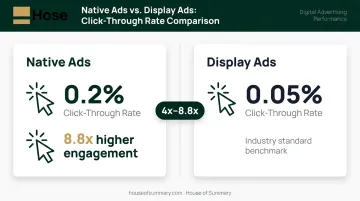
Why this matters for campaign economics: if your CPM spend is fixed, a higher CTR means a lower effective cost per click. You're extracting more value from the same budget.
Ad blocker resistance adds another layer. Display ads served via third-party scripts are easily detected and stripped by browser extensions. Native ads embedded in a publisher's editorial structure — and especially those delivered through email newsletters — bypass this entirely. Newsletter placements like those in House of Summary's network land directly in subscribers' inboxes, where ad blockers have no effect. Every delivered impression reaches a real reader.
KPIs impacted: CTR, effective CPC, impressions delivered, engagement rate
When it matters most: campaigns targeting tech-savvy or premium audiences with high ad-blocker adoption, and any brand running in editorial environments where banner blindness is severe.
Audience Trust and Credibility Through Context
When a brand appears as sponsored content in a publication readers already trust, that credibility transfers to the advertiser. This is called the "halo effect," and it has measurable implications for conversion.
Research cited by Digital Content Next found that ads in high-quality content environments were perceived 74% more favorably than identical ads in low-quality settings. The same research showed quality environments produced 20% greater engagement and 30% more memory encoding — meaning readers not only noticed the ads more, they retained them longer.
For native advertising specifically, this plays out in practice when a brand appears as sponsored editorial content in a respected newsletter or niche publication. Readers extend the publication's authority to the brand, accelerating trust-building that standalone display ads cannot achieve.
The trust dynamic cuts both ways. Early research found that when a respected publisher runs native advertising for an unrecognized brand, a significant share of readers lose trust in the publisher itself. The lesson is clear: the editorial environment and the advertiser need to be a reasonable fit. A mismatch damages both parties.
KPIs impacted: brand lift, brand recall, purchase intent, conversion rate, customer lifetime value
When it matters most: high-consideration categories — finance, luxury goods, B2B services, healthcare — where trust is a prerequisite for purchase. Also particularly effective in niche publications where readers have strong affinity for the editorial voice.
Targeting Precision and Cost Efficiency
Native advertising enables contextual targeting: placing ads within content that's already relevant to the brand's category. When the surrounding editorial content and the advertiser's message align, the audience self-selects for relevance.
IAS research found contextually relevant ads drove 14% higher purchase intent and 5% higher favorability than non-contextual placements. Attention metrics were also significantly higher.
For advertisers targeting narrow or premium audiences — C-suite executives, finance professionals, luxury consumers — this matters more than scale. A broad-reach display buy might generate volume but deliver low-intent clicks. A native placement in a specialized newsletter reaching decision-makers in your category delivers fewer but far higher-quality impressions.
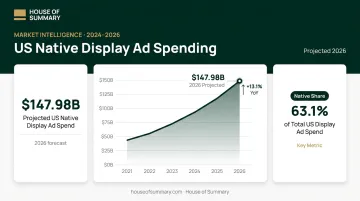
EMARKETER projects US native display ad spending to reach $147.98 billion in 2026, growing 13.1% year-over-year. Native already accounts for 63.1% of total US display ad spend, reflecting where media buyers are directing budgets based on demonstrated returns.
Newsletter-based native placements add a further targeting advantage: no algorithm determines who sees the content. An ad in a newsletter like Presidential Summary or Geopolitical Summary reaches every subscriber who opens that edition. House of Summary's network delivers 254,866+ opened emails daily across 500,000+ subscribers, concentrated in the US (66%), UK, and UAE, with a reader base skewed toward executives, founders, and policy professionals.
KPIs impacted: cost per click, cost per action, ROAS, reach within target segment
When it matters most: constrained budgets, narrow or premium target audiences, and campaigns where previous broad-reach buys delivered volume but weak conversion quality.
What Happens When Native Advertising Is Ignored
Continuing to rely exclusively on display formats is a losing strategy — and the data makes that hard to ignore.
The operational consequences compound over time:
- Shrinking effective reach — with 912 million ad-blocking users globally and a 21% average ad-block rate across open-web pageviews, display campaigns are delivering fewer impressions than their bought inventory suggests
- Ad fatigue driving negative outcomes — a YouGov survey reported by The Drum found 70% of people find digital advertising annoying, and 72% say bad ad experiences negatively affect brand perception
- Banner blindness accelerating — NN/g has documented this pattern since 1997 and confirmed it again in 2018; traditional ad placements generate increasingly less attention over time
- Missed credibility building — every display impression that irritates a reader is a missed opportunity to build the editorial trust that native placements enable
Display advertising still has a role. The case here is for diversifying into native as a core part of the media mix. Budgets that ignore how audiences actually consume content won't close the gap through spending alone — they'll just pay more for diminishing returns.
How to Get the Most Value from Native Advertising
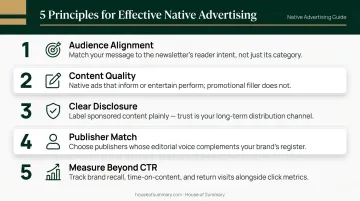
Five principles consistently separate native campaigns that convert from those that burn budget:
Prioritize audience-content alignment over scale — a native placement in a highly relevant environment will outperform a high-volume placement in an unrelated context.
Invest in content quality — a weak advertorial placed in a premium environment breaks the editorial trust that makes native effective. Allocate time and budget to copy and creative that adds value for the reader.
Disclose clearly and prominently — the FTC requires that native ads be identifiable as paid content, with disclosures placed immediately in front of or above the headline. Audiences who feel deceived associate that experience with the brand — not the publisher.
Match publisher to customer profile — for brands targeting media buyers, finance professionals, or global executives, high-intent newsletter audiences offer direct inbox access with no algorithmic filtering. House of Summary's specialized publications — Presidential Summary, Geopolitical Summary, Dubai Summary, and London Summary — reach over 500,000 subscribers with one ad per edition, ensuring full reader focus on each placement.
Measure beyond CTR — track dwell time, scroll depth, post-click engagement, and conversion rate. These metrics tell you whether the content is moving audiences through the funnel, informing iteration on headlines, formats, and publisher selection.
Conclusion
Native advertising's core value is straightforward: it delivers brand messages without disruption, earns audience trust through editorial context, and improves cost efficiency through precise, relevant targeting.
These advantages compound when native advertising is applied consistently in the right environments. Each impression in a trusted publication builds the credibility and familiarity that eventually converts high-intent readers into customers. Brands that build sustained presence where their audiences already choose to spend attention will consistently outperform those relying on interruptive formats, no matter how crowded ad channels get.
For advertisers targeting decision-makers and engaged readers, that presence starts in the inbox — where editorial trust is already established and attention is undivided.
Frequently Asked Questions
What are the benefits of native advertising?
Native advertising delivers higher engagement rates, stronger audience trust through editorial context, and better targeting precision than standard display formats. It also bypasses ad blockers when delivered through email newsletters, ensuring every placement reaches a real reader. The combined effect is improved cost efficiency and stronger brand recall.
How effective is native advertising?
Native ads consistently outperform display on engagement metrics. IPG Media Lab and Sharethrough found consumers viewed native ads 53% more frequently than display, while Outbrain reports native CTRs of 0.2% versus 0.05% for display. Effectiveness is highest when content quality and audience-context alignment are strong.
How much do native ads typically cost?
Pricing varies by platform, format, targeting model (CPM, CPC, or CPA), and whether placements are bought direct or programmatically. Native content can cost more to produce than banner ads, but the lower effective cost per action typically delivers stronger ROI across a campaign's full lifecycle.
Are native ads good for small businesses?
Native ads work well for small businesses, particularly in newsletter or niche publication placements where precise targeting reduces wasted spend. The content investment requires realistic budget planning, but tightly targeted placements in relevant editorial environments often outperform broad-reach display buys.
What is the difference between native advertising and display advertising?
Display ads (banners, sidebars, pre-rolls) stand apart from content and are frequently ignored or blocked. Native ads blend into the editorial environment — less disruptive, resistant to ad blockers in email, and more likely to generate genuine engagement from readers already paying attention.
What makes a native ad effective?
Three factors determine native ad effectiveness: audience-content relevance (the right publisher environment), content quality (genuine value for the reader, not just a product pitch), and clear disclosure (transparency that preserves trust rather than undermining it).