
Introduction
Native advertising is one of the fastest-growing ad formats in digital media — and one of the most legally misunderstood. EMARKETER projects U.S. native display ad spending will reach $147.98 billion by 2026, yet a Polar analysis found nearly one-third of native placements failed to meet FTC disclosure standards.
That gap between scale and compliance isn't just a regulatory problem. When paid content passes as independent editorial, audiences lose trust in the publisher and the brand simultaneously — and that trust rarely comes back.
The FTC native advertising guidelines are consumer protection rules that require paid commercial content to be clearly identifiable as advertising — not disguised as independent editorial work.
They apply broadly: advertisers, publishers, media buyers, content marketers, influencers, newsletter operators, and ad agencies all fall within scope. If you create, distribute, or pay for content that resembles editorial material, these rules apply to you.
This guide breaks down exactly what the FTC requires, where publishers and brands commonly fall short, and how to stay compliant without undermining your content's effectiveness.
Key Takeaways
- Native ads must be labeled clearly as advertising before consumers engage — not buried after the click
- Acceptable disclosure terms: "Ad," "Advertisement," "Paid Advertisement," "Sponsored Advertising Content"
- Vague labels like "Promoted," "Presented by," or "Brought to You by" are not sufficient
- Disclosure obligations follow the content across social shares, search results, and email distribution
- Both advertisers and publishers carry compliance responsibility, as do agencies and content recommendation networks
What Is Native Advertising?
The FTC defines native advertising as content that "bears a similarity to the news, feature articles, product reviews, entertainment, and other material that surrounds it online." More specifically, it includes messages that "match the design, style, and behavior of the digital media in which it is disseminated."
That definition covers a wide range of formats:
- Sponsored articles on news and content sites
- In-feed social media ads
- Branded videos within editorial programming
- Email newsletter placements
- In-app and mobile ads
- Infographics, animations, and in-game integrations
- Content recommendation widget placements
How Native Ads Differ From Display Ads
The distinction matters legally. A banner ad or pop-up doesn't pretend to be anything other than an ad. Native advertising is specifically designed to blend in with the surrounding content — same tone, same format, same subject matter. That resemblance is exactly what triggers the disclosure requirement.
Native advertising is not the same as a simple sponsorship. A weather forecast "brought to you by XYZ Company" involves an advertiser funding content they didn't create or shape. A brand-created article published alongside editorial content is a different situation entirely — that's where the FTC's disclosure requirements apply.
That regulatory line has direct implications for newsletter publishers. At House of Summary, this distinction shapes how sponsored placements are structured. Sponsored content appears in the reading flow — written in the editorial voice of the newsletter — but with clear advertiser disclosure. The content resembles editorial material by design, which means the disclosure isn't optional; it's the entire compliance framework.
Why the FTC Regulates Native Advertising
The Legal Foundation
Native advertising regulation isn't a new legal category. It's an extension of Section 5 of the FTC Act, which has prohibited unfair or deceptive acts and practices in commerce for decades. The FTC has applied this standard to deceptively formatted advertising since at least the 1960s:
- Newspaper columns formatted as news features while advertising restaurants (1967)
- Infomercials produced to look like consumer programming (1989)
- Direct-mail ads designed to resemble magazine book reviews (1996)
Why Format Deception Is Material
The core legal test for deception requires two elements: the practice must mislead reasonable consumers, and the misleading impression must be material — meaning it affects consumer behavior.
Native advertising clears both bars. The FTC has stated that knowing the source of a message "typically affects the weight or credibility consumers give it" and that misleading formatting can cause consumers to interact with content they otherwise would not have engaged with.
The FTC's Enforcement Policy Statement on Deceptively Formatted Advertisements makes clear that misleadingly formatted ads can be deceptive "even if the product claims communicated are truthful and non-misleading." The deception isn't in what the content says — it's in the failure to identify who paid for it.
Why Consumers Are Particularly Vulnerable
When content matches the visual format, tone, and subject matter of editorial content on a site, consumers may reasonably assume they're reading independent journalism — not content paid for by a brand. Advertising is allowed to persuade. The FTC's concern is that consumers are being persuaded without knowing they're being marketed to.
When Disclosure Is Required (and When It Isn't)
The Core Test
The guiding question is whether a reasonable consumer would immediately recognize the content as advertising based on its subject matter, format, and visual presentation. The more closely a native ad resembles the editorial content around it, the more clearly a disclosure is required.
The Door-Opener Rule
Disclosure must happen before consumers engage with the content — not on the landing page after the click. If a headline and thumbnail in a news feed appear editorial but lead to sponsored content, the entry point itself must be labeled. The FTC's native advertising guidance explicitly states that advertisers cannot use "deceptive door openers" and that the law may be violated even if a consumer later learns the truth.
Put differently: the disclosure must exist where the decision to click happens — not after it.
The Republication Rule
Disclosure obligations travel with the content. If a native ad is shared on social media, appears in non-paid search results, or is distributed through a content recommendation widget, the disclosure requirement follows. A label on the original publisher page isn't sufficient if consumers can access the content through other pathways.
Which Contexts Are Covered
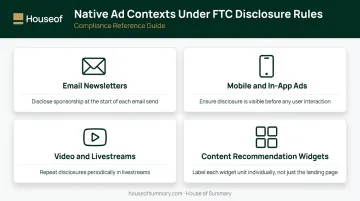
FTC rules extend well beyond obvious advertorial formats:
- Email newsletters — sponsored placements within curated email publications are covered
- Mobile and in-app ads — including in-game integrations with promotional content
- Video — including vignettes within larger programming and influencer videos on social platforms
- Livestreams — where disclosures should be repeated periodically, not just stated once at the start
When Disclosure Is Not Required
A few narrow cases exist where disclosure may not be necessary:
- Branded product placements within entertainment that convey no objective product claims (a game character using a branded product without any recommendation)
- Sponsorships where the advertiser's role is apparent and the advertiser had no control over the content
These exceptions are narrow and fact-specific. If the advertiser's involvement isn't immediately obvious to a reasonable consumer, the safer position is to disclose.
How to Make FTC-Compliant Disclosures
The FTC's standard for disclosure effectiveness is performance-based, not presence-based: "Only disclosures that consumers notice, process, and understand can be effective." A disclosure that exists but goes unnoticed carries no legal weight.
Placement and Proximity
- Disclosures must appear before or above the headline — not below it, not to the right
- When an image or video thumbnail is the focal point of the ad, the disclosure should appear directly on that focal point
- For video or audio ads, disclosure should come before the advertising message begins — not during or after
Language and Clarity
Acceptable terms under FTC guidance:
| ✅ Acceptable | ❌ Insufficient |
|---|---|
| Ad | Promoted |
| Advertisement | Promoted Stories |
| Paid Advertisement | Presented by [Brand] |
| Sponsored Advertising Content | Brought to You by [Brand] |
| Sponsored by [Brand] |
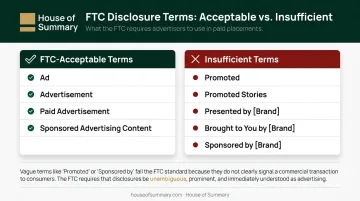
The insufficient terms imply the advertiser only funded the content — not that they influenced or created it. That's inaccurate for most native ad arrangements, which is why the FTC rejects them.
Disclosures also need to meet these language standards:
- Written in the same language as the ad content
- Free of industry jargon consumers wouldn't recognize
- Never replaced by logos or visual branding alone
- Consistent across a publisher's entire ad inventory — mixed terminology increases reader confusion
Visual and Audio Standards
Formatting and delivery matter as much as word choice. Even technically correct disclosures fail if they're visually obscured or rushed past the audience.
- Disclosure text must be in a font size and color that is readable, with strong contrast against the background
- Background shading that separates ads from editorial content must be saturated enough to be noticeable
- Audio disclosures must be read at a pace consumers can follow
- Video disclosures must remain on screen long enough for an average consumer to read and understand
Common Mistakes and Misconceptions
"Only the Advertiser Is Responsible"
The FTC explicitly identifies everyone directly or indirectly involved in creating or distributing native ads: advertisers, publishers, ad agencies, affiliate networks, and content recommendation network operators. If a publisher hosts and labels sponsored content inadequately, that publisher is exposed — not just the brand that paid for it.
The Lord & Taylor case (2016) shows how this plays out in practice. The FTC charged the retailer for a paid article in Nylon magazine and paid Instagram posts by 50 fashion influencers — each compensated $1,000 to $4,000 and given the dress for free — without any disclosure of those material connections.
"Truthful Claims Eliminate the Need for Disclosure"
Accurate product claims don't offset deceptive formatting. The FTC treats a misleadingly formatted ad as deceptive regardless of whether the underlying claims are true. The violation lies in concealing the commercial source — not in anything the ad says about the product.
Common Labeling Errors to Avoid
- Each sponsored unit in a mixed content block needs its own label — a single disclosure covering the whole grouping doesn't meet the standard
- Disclosures placed after the content has been consumed don't count; they must appear before or alongside the ad
- A company logo alone doesn't communicate commercial intent to ordinary readers; text is required
- Rotating between "Ad," "Sponsored," and "Promoted" on the same platform undermines clarity — pick one term and use it consistently
Frequently Asked Questions
What are the FTC native advertising guidelines?
The FTC native advertising guidelines are rules issued under the FTC Act requiring that paid content resembling editorial material be clearly labeled as advertising. Disclosures must be clear, prominent, and placed where consumers will notice them before they engage with the content.
What is considered native advertising?
Native advertising is any paid commercial content designed to match the look, feel, and format of the editorial content surrounding it — sponsored articles, branded videos, in-feed social ads, influencer content, and email newsletter placements all qualify. What makes it "native" is that it's paid for yet crafted to resemble non-commercial content.
What are the FTC rules for advertising?
All advertising must be truthful, non-misleading, and substantiated. For native ads, that standard goes one step further: if the content could be mistaken for independent editorial, it must carry a clear and prominent disclosure — even when every product claim in it is accurate.
Why does native advertising need to be regulated?
When paid content is indistinguishable from editorial content, consumers cannot make informed decisions about how much credibility to extend to it. The FTC treats this as a material deception because knowing the source of information directly affects whether consumers trust and act on it.
What disclosures are required for sponsored content?
Sponsored content must carry a plain-language label — "Ad," "Advertisement," or "Sponsored Advertising Content" — placed before or above the headline. The disclosure must remain visible across every access point: social shares, search results, and click-through pages alike.
Who is responsible for FTC native advertising compliance?
Compliance responsibility falls on everyone in the chain: the advertiser, the publisher, the ad agency, and content recommendation networks. Under FTC enforcement principles, publishers who host sponsored content are equally accountable — not just the brand that funded it.