
That gap — between what advertisers consider smart targeting and what readers experience as editorial content — sits at the center of the native advertising ethics debate.
This article covers what native advertising actually is, why its design creates ethical friction, the strongest arguments on both sides, what ethical practice looks like in execution, and what the FTC legally requires.
Key Takeaways
- Native advertising blends paid content into editorial environments, weakening readers' natural ad skepticism
- Research shows many readers fail to recognize native ads even with disclosure labels present
- The FTC requires clear, prominent disclosures — vague labels like "Promoted" or "Presented by" often fall short
- Ethical native advertising is achievable: transparent labeling, genuine reader value, and editorial separation are the key differentiators
- Whether native advertising is ethical depends entirely on how it's executed, not the format itself
What Is Native Advertising?
Native advertising is paid commercial content designed to match the look, tone, and format of the surrounding editorial content on a platform. The IAB defines it as ads that are "cohesive with the page content," "assimilated into the design," and "consistent with the platform behavior."
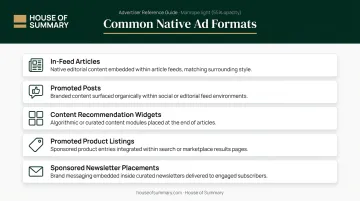
Common formats include:
- In-feed articles on news and media sites
- Promoted posts in social media feeds
- Content recommendation widgets ("You might also like...")
- Promoted product listings in search and e-commerce
- Sponsored newsletter placements within editorial email content
"Native" simply means the ad borrows the format of surrounding content rather than standing apart as a clearly commercial unit.
Why the Blending Creates the Tension
Unlike a banner ad, which signals its commercial nature through visual distinction, native advertising is engineered to reduce that signal. That's the point — and also the problem. When an ad looks and reads like editorial content, the reader's brain may not switch into advertising-evaluation mode at all.
Research confirms the gap is real. A study published in Digital Journalism found that only 17% of participants could identify native advertising without any priming — and that figure rose to just 27% even when participants were forewarned to look for it.
Why the Ethical Debate Exists
Journalism has historically maintained a strict separation between editorial and advertising (often called the "church and state" divide). The principle is straightforward: editorial coverage should reflect independent journalistic judgment, not the preferences of whoever paid for ad space. Readers trust editorial content partly because they believe it wasn't purchased.
Native advertising disrupts this. When an advertiser funds or creates content, that content exists because a commercial entity paid for it — not because a journalist decided it was newsworthy. The editorial wrapper becomes a commercial vehicle.
The Atlantic/Scientology Case
In January 2013, The Atlantic ran a sponsored article titled "David Miscavige Leads Scientology to Milestone Year," labeled "Sponsor Content." Reader backlash was swift and public. The piece was pulled within hours. What made it instructive went beyond the controversial sponsor. Several factors combined to spark the backlash:
- The content closely mimicked The Atlantic's editorial voice
- The "Sponsor Content" label was easy to overlook at a glance
- The piece read as endorsement, not disclosure
- Readers felt deceived, not just surprised
The Atlantic subsequently issued new sponsored content guidelines requiring prominent "SPONSOR CONTENT" labeling and a clear statement that the content was not produced by editorial staff.
That incident didn't kill native advertising — it clarified what responsible execution requires.
The Counterargument Worth Taking Seriously
Publishers and advertisers have a point: native advertising fills a real revenue gap. Banner ad revenue has declined sharply, and many free digital publications depend on native formats to survive. When done transparently, native content can genuinely inform readers. The format itself isn't the problem. Execution without clear disclosure is.
The Strongest Arguments Against Native Advertising
1. Consumer Deception, Even With Labels
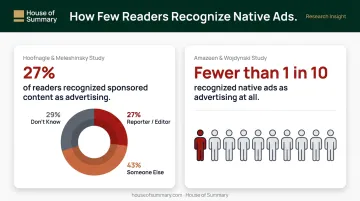
A UC Berkeley study by Hoofnagle and Meleshinsky surveyed 598 consumers. When presented with an advertorial labeled "Sponsored Report," 27% still believed it was written by a reporter or editor. Another 43% identified the source as "someone else," and 29% said they simply didn't know.
Two dynamics drive this confusion:
- Readers don't activate advertising skepticism when content looks editorial — the format itself disarms their defenses
- Advertorials inherit credibility from the surrounding publication, regardless of what any label says
A separate study by Amazeen and Wojdynski found that fewer than 1 in 10 participants in native advertising conditions recognized the content as advertising at all.
2. Trust Erosion When Readers Catch On
Research by Amazeen and Muddiman found that readers rated both legacy and online publishers less favorably after encountering native advertising on their platforms — with measurable declines in perceived credibility and attitude toward the publisher.
Short-term ad revenue gained through opaque native placements can cost more in long-term reader trust than it returns. Publications that depend on reader loyalty cannot afford to treat disclosure as a technicality.
3. Structural Pressure on Editorial Independence
When advertisers also fund editorial content, structural pressure builds — subtle, rarely spoken, but real. Publications may avoid coverage angles that displease sponsors. Over time, that restraint erodes the editorial independence journalism depends on for credibility.
4. Ambiguous Labels That Still Mislead
Even where disclosure exists, the language often fails. Terms like "Promoted," "Presented by," and "Brought to You by" are routinely misread as publisher endorsement or underwriting rather than advertiser-created content. The FTC has explicitly flagged these as potentially insufficient. Readers may technically have access to a disclosure and still walk away with the wrong impression.
What Ethical Native Advertising Actually Looks Like
The format isn't inherently problematic. These five standards separate ethical execution from deceptive practice.
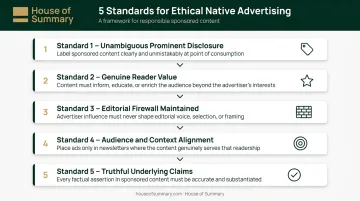
Standard 1: Unambiguous, Prominent Disclosure
Use plain-language labels: "Ad," "Advertisement," "Paid Advertisement," or "Sponsored Advertising Content." The FTC's guidance treats these as clear; terms like "Promoted" or "Presented by" are flagged as potentially ambiguous.
Placement rules:
- Label appears before the headline, not buried at the bottom
- Sufficient size and contrast to be noticed — not styled to match body text
- Present on every page a reader might access, not just a homepage
Standard 2: Genuine Value, Not Just a Sales Pitch
The NYT/Netflix campaign for Orange Is the New Black — titled "Women Inmates: Separate But Not Equal" — is a well-documented case of branded content delivering real editorial value. It covered female incarceration with audio, graphics, and reported depth. Journalist Melanie Deziel wrote it for the Times' T Brand Studio. The Netflix association was clear; the hard sell was absent.
The commercial relationship stays visible. The journalism stays real. That balance is the standard.
Standard 3 : Editorial Firewall Maintained
The publication's newsroom should not write sponsored content. Publishers that create separate branded content studios — as the NYT did with T Brand Studio — operationalize this separation. The firewall protects two things at once: the integrity of the newsroom and the reader's ability to understand what they're reading.
In practice, this means:
- Sponsored content is produced outside the editorial team
- Journalists don't take direction from advertisers
- Newsroom standards don't apply to ad units — and ad units don't pass as news
House of Summary takes a similar approach: sponsored newsletter content is produced with clear advertiser disclosure and integrated within the reading flow, but the company's core editorial standards — accuracy, verification, no sensationalism — govern what reaches subscribers.
Standard 4 : Audience and Context Alignment
Ethical native advertising places content where it genuinely serves reader interests. Newsletter placements are particularly well-suited to this standard. When readers have actively opted into a curated newsletter — on geopolitics, business, or city-specific news — sponsored content on relevant topics reaches an audience that self-selected for that subject area.
House of Summary's network of over 500,000 opted-in subscribers — across Presidential Summary, Geopolitical Summary, Dubai Summary, and London Summary — illustrates this directly. Advertisers reach readers who chose to be there. One ad per edition, no competing feed noise. Clear labeling lands differently when there's nothing else to look at.
Standard 5 — Truthful Underlying Claims
Transparent format doesn't excuse false product claims. The FTC's position is clear: misleading format is a problem regardless of whether product claims are true, and true disclosure doesn't excuse false product claims. Both conditions must be met. Format transparency and claim accuracy aren't interchangeable — they're independent requirements that apply at the same time.
The FTC's Role: What the Rules Actually Require
The FTC's "Commission Enforcement Policy Statement on Deceptively Formatted Advertisements", issued December 22, 2015, established that native advertising in digital media falls fully under existing truth-in-advertising law. An ad's format is deceptive if it materially misleads consumers about its commercial nature — including by suggesting it is independent, impartial, or from a non-commercial source.
The FTC's guidance comes down to three practical requirements:
- Advertising cannot imply it's something other than an ad — format and presentation must not create a false editorial impression
- Disclosure is required whenever content could deceive readers about its commercial nature
- Disclosures must be clear and prominent — unambiguous language, positioned near the ad's focal point, readable font and contrast, present on every page a reader might access
Beyond advertisers, the FTC extends responsibility to everyone in the chain. The guidance states that "everyone who participates directly or indirectly in creating or presenting native ads" is responsible for ensuring ads don't mislead — including ad agencies and affiliate network operators.
On labeling, the FTC draws a clear line between terms it accepts and those it questions:
- Acceptable: "Ad," "Advertisement," "Paid Advertisement," "Sponsored Advertising Content"
- Potentially insufficient: "Promoted," "Promoted Stories," "Presented by," "Brought to You by," "Sponsored by"
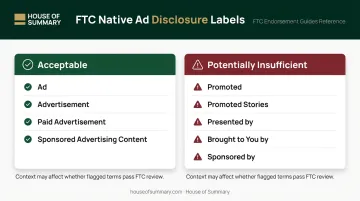
Whether flagged terms pass depends on context — but relying on them carries real compliance risk.
So, Is Native Advertising Ethical?
Native advertising is not inherently ethical or unethical. The ethics depend entirely on execution.
When it is clearly labeled, audience-relevant, and produced without compromising editorial independence, native advertising is a legitimate and valuable format. When it mimics editorial content to obscure its commercial nature — or uses labels most readers will misread — it crosses into deception.
The publications and advertisers that have made native advertising work sustainably are those that treated disclosure as non-negotiable — not a technicality to satisfy with the smallest legally permissible label. Reader trust, once lost through deceptive native advertising, is difficult to rebuild.
For publishers and brands alike, the practical conclusion is the same: disclose clearly, match content to audience expectations, and keep editorial judgment free from advertiser influence. That's what makes native advertising worth doing.
Frequently Asked Questions
What is native advertising in simple terms?
Native advertising is paid content designed to match the look and format of the surrounding editorial content on a platform — such as a sponsored article on a news site or a promoted post in a social feed. The word "native" refers to how the ad fits naturally into its environment rather than standing apart as a distinct ad unit.
What are the five advertising ethics?
Five core ethical principles guide advertising practice:
- Truthfulness — no false or misleading claims
- Transparency — clear disclosure of commercial intent
- Fairness — no manipulation or exploitation of consumers
- Social responsibility — avoiding harm to individuals or society
- Consumer autonomy — allowing people to make genuinely informed choices
Is native advertising inherently deceptive?
It is not inherently deceptive but carries a high risk of deception when disclosures are unclear or absent. Studies consistently show many consumers fail to recognize native ads even when labeled, making best practices around disclosure especially important.
What does the FTC require for native advertising disclosures?
The FTC requires that disclosures be:
- Clear and prominent, placed close to the ad's focal point
- Written in plain language — "Ad" or "Paid Advertisement"
- Present on every page a consumer might access, not just the publisher's main page
What is the difference between native advertising and sponsored content?
The terms are often used interchangeably. Sponsored content typically refers to content produced or funded by a brand and published on a media platform. Native advertising is broader — it covers any paid format designed to match a platform's look and feel, including in-feed ads, promoted listings, and recommendation widgets.
How can I tell if content is actually a native ad?
Look for labels such as "Ad," "Sponsored," "Paid Advertisement," or "Sponsored Advertising Content" near the headline or before the content begins. Terms like "Promoted," "Presented by," or "From Around the Web" are common but can be ambiguous; they don't always make the commercial nature of the content clear.