
Introduction
Healthcare marketers face a genuinely difficult problem with display advertising. The reach is there — but the constraints that come with it don't exist in almost any other industry. HIPAA restricts how you can target audiences. Meta, Google, and TikTok classify health content as a sensitive category. Ad blockers strip out a significant portion of web display inventory before it's ever seen. And patients, unlike most consumers, require a much higher trust threshold before they act.
Campaigns built on tactics that work in retail, finance, or travel routinely fail in healthcare. The channel isn't broken — the playbook just needs to be different.
This guide covers that playbook in full: the compliance ground rules, how to build creative that earns trust, which channels to prioritize, and what realistic performance looks like for healthcare display campaigns.
Key Takeaways
- Healthcare display is an awareness channel, not a direct-response tool — low CTR is expected and normal.
- HIPAA and platform policies prohibit health-based audience targeting; use contextual, geographic, and behavioral signals instead.
- Creative should lead with patient trust and emotional relevance, not clinical detail or promotional claims.
- Newsletter placements bypass ad blockers entirely — and tend to outperform standard web display on CTR.
- Track branded search lift, appointment bookings, and time-on-site — not clicks alone.
What Is Healthcare Display Advertising (and Why It's Different)
Display advertising covers visual placements that appear across websites, apps, newsletters, and streaming platforms — banner ads, rich media units, video pre-rolls, sponsored content. Unlike search ads, which intercept users who are already looking for something specific, display ads reach people who aren't actively searching. That distinction shapes everything about how healthcare display campaigns must be built.
What Makes Healthcare Different
Several forces combine to create a uniquely constrained environment:
- HIPAA privacy requirements restrict the use of health data in targeting and retargeting
- Platform sensitive category policies (Meta, Google, TikTok) limit custom audiences and health-based interest targeting
- Patient trust dynamics mean audiences need to feel confident in a provider before they'll engage — a much higher bar than most product categories
- Longer decision timelines mean patients rarely convert from a single ad exposure; they research, compare, and then decide
Display's Real Job in Healthcare
Those constraints point toward a specific function. Display advertising doesn't close healthcare decisions; its job is to open them. The role is awareness and consideration: getting a provider's name in front of potential patients before they start searching, so that when they reach the decision stage, the brand is already familiar.
A 2023 McKinsey report found that 60% of surveyed healthcare consumers reported greater satisfaction with providers when digital tools were part of their experience. Display is one piece of that digital presence — not the conversion mechanism, but the recognition layer that makes it easier for patients to choose a provider they already know when they're ready to act.
Compliance First: What HIPAA and Platform Policies Actually Mean for Your Display Ads
Compliance in healthcare display runs through every layer of a campaign: targeting setup, pixel configuration, creative claims, and landing page content. It's not a pre-launch formality — it's an ongoing operational requirement.
What HIPAA Actually Prohibits
The HHS Summary of the HIPAA Privacy Rule defines protected health information (PHI) as individually identifiable health information held or transmitted by a covered entity or business associate. This includes demographic data tied to a person's past, present, or future physical or mental health condition, healthcare provision, or payment.
For display advertising, the practical implication is direct: you cannot use someone's symptoms, diagnoses, treatment history, or condition-linked behavior to target or retarget them. The condition-specific audience segmentation that's routine in other industries is off the table.
HHS/OCR's online tracking guidance extends this further. Regulated entities cannot use tracking technologies in ways that cause impermissible PHI disclosures to vendors. IP addresses and device identifiers can constitute PHI when connected to health-related interactions — a detail that catches many advertisers off guard.
The enforcement risk is real. In 2023, the FTC alleged GoodRx had shared sensitive health data with Facebook, Google, and Criteo for advertising purposes — resulting in a $1.5 million civil penalty and a permanent ban on sharing health data for advertising.
How Major Platforms Classify Healthcare
Meta, Google, and TikTok all treat health and wellness as a sensitive category — but advertising is still permitted. What's restricted is how campaigns are structured and targeted, not whether healthcare advertisers can run ads at all:
- Google restricts personalized advertising for health-related interest categories and limits Customer Match and remarketing for sensitive segments
- Meta classifies health and wellness as a restricted data source category and prohibits ads that imply personal health attributes
- TikTok requires healthcare advertisers to comply with local law and flags medical conditions and treatments as potentially prohibited data in event tracking
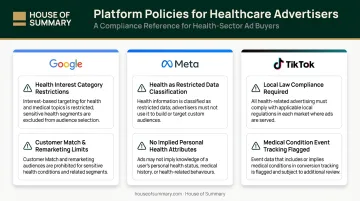
(Platform policies accessed May 2026 — these change frequently and should be verified before campaign launch.)
What You Can Do
Safe targeting approaches for healthcare display:
- Contextual targeting — place ads adjacent to health-relevant content without using personal user data
- Geographic/market-level targeting — reach audiences by location, not by health status
- Behavioral signals that don't infer medical conditions — general interest signals, not condition-specific browsing behavior
Standard pixel-based retargeting sits outside these safe approaches and deserves its own warning.
Retargeting Caution
Pixel-based retargeting is high-risk in healthcare. Visiting a page about a specific condition implies medical intent — and using that visit to serve targeted ads could constitute impermissible PHI disclosure. Healthcare retargeting requires legal and technical review before implementation.
Pre-Launch Compliance Checklist
Before any healthcare display campaign goes live, confirm:
- Targeting uses only approved, non-PHI data sources
- No sensitive health identifiers appear in audience segments
- Pixel and event tracking configuration has been reviewed for PHI exposure risk
- Ad copy and landing pages have passed legal and regulatory review
- Data-sharing arrangements with ad tech vendors are documented and HIPAA-compliant
Creative Best Practices for Healthcare Display Ads
Lead With Trust, Not Features
Healthcare audiences are making high-stakes decisions. A 2024 Deloitte survey found that 74% of respondents identified physicians as their most trusted source for healthcare treatment information. That trust baseline matters for advertising too — creative that feels credible and human-centered will always outperform creative that leads with pricing or service lists.

Research on healthcare provider selection consistently identifies trust, online reputation, and perceived competence as primary decision factors. Display creative should signal those qualities — compassion, credentials, patient-first values — before it mentions anything promotional.
Write to the Emotional State
Effective healthcare display ads meet patients where they are emotionally before presenting a solution. Someone searching for orthopedic care isn't thinking about features — they're thinking about pain, recovery time, and whether their life can get back to normal.
Tone guidance:
- Use reassuring, plain language — avoid clinical terminology
- Acknowledge the patient's situation before presenting the provider
- Make the next step feel easy and low-commitment
Getting the tone right is only half the equation. Equally important is knowing what to cut:
- Avoid fear-based tactics ("Don't wait — this condition gets worse")
- Skip unverified outcome claims ("95% of patients recover in 6 weeks")
- Drop jargon that creates distance ("multimodal perioperative pain management protocol")
Align the Ad and the Landing Page
A display ad for a knee replacement consultation that lands on a general orthopedics department page is wasted spend. The landing page must directly address the question or concern the ad raised. Every step of that path should feel continuous.
A strong healthcare landing page includes:
- A direct answer to whatever the ad promised or implied
- Trust signals (credentials, patient reviews, board certifications)
- A single, clear next step (book an appointment, call a number, request information)
Design for Visibility
Practical requirements for healthcare display creative:
- Follow standard IAB ad sizes for broad placement compatibility
- Design mobile-first — the majority of display impressions are served on mobile
- Use high-contrast visuals and a headline that's readable at a glance
- Include one CTA — not two or three — that tells the viewer exactly what to do next
Refresh Creative on a Regular Cadence
Healthcare display typically runs within defined audience pools — geographic markets, contextual content categories. That means the same people see the same ads repeatedly. Creative fatigue sets in faster than you'd expect: engagement drops, frequency rises, and performance deteriorates.
Set a refresh cadence before the campaign launches — not when you notice the numbers sliding. Monthly creative updates are a reasonable starting point for most healthcare display campaigns.
Where to Run Healthcare Display Ads: Choosing the Right Channels
Programmatic Display Networks
Programmatic is the default approach for healthcare display, and contextual and geographic targeting make it HIPAA-compatible. The critical variable is placement quality — premium publisher environments outperform low-quality ad networks on trust and recall, not just volume.
Programmatic also requires active management. Without ongoing oversight, placements drift toward brand-unsafe or irrelevant environments. Two non-negotiables:
- Exclusion lists: Updated regularly to block unsafe or off-target placements
- Placement audits: Reviewed on a recurring schedule, not just at campaign launch
News and Editorial Websites
Brand adjacency — where your ad appears relative to surrounding content — matters more in healthcare than in most other categories. When a hospital ad appears alongside credible health journalism, the trust association transfers. The IAB's News Trust Halo study found that 84% of news consumers said advertising in news media increased or maintained brand trust and 45% were more likely to visit a brand's website after exposure — though that research is from 2020 and is not healthcare-specific.
The principle still holds: where your ad appears shapes how it's perceived.
Newsletter Advertising
Newsletter placements are one of the most consistently underused channels for healthcare advertisers — and one of the most effective.
Three structural advantages make newsletters worth serious consideration:
- Ad blockers don't reach the inbox. According to eMarketer citing YouGov 2024 data, 45% of US consumers had installed or used an ad blocker. Newsletter ads arrive as part of the content subscribers opted to receive — blockers don't apply.
- Readers are actively engaged. Newsletter readers opened because they intended to read, not passively scroll. That attention level is fundamentally different from web display.
- Less competition for attention. A placement in a focused newsletter sits alongside editorial content, not a screen full of competing ads.
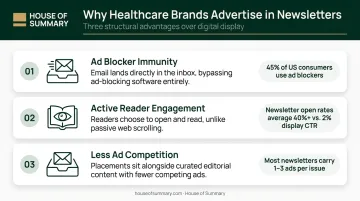
Campaign Monitor's 2022 benchmark data (based on 2021 campaigns) puts Healthcare Services email CTR at 3.0% — compared to the 0.10–0.15% range typical of healthcare web display. That's a 20–30x difference — not a rounding error.
House of Summary's newsletter network — Presidential Summary, Geopolitical Summary, Dubai Summary, and London Summary — reaches 500,000+ subscribers with 254,866+ emails opened daily. The audience skews toward executives, decision-makers, and high-income professionals across the US, UK, and UAE: a strong fit for healthcare brands targeting patients with purchasing power or employers evaluating health benefits.
Available formats include native editorial placements, sponsored content, and full-issue takeovers — delivered within a human-written editorial environment, which keeps brand context clean and relevant.
Connected TV (CTV)
CTV is a strong fit for healthcare brand awareness at the local or regional level. Unlike traditional broadcast, CTV can measure downstream outcomes — website visits and branded search activity following ad exposure — that linear TV cannot. For hospital systems or health plans building brand recognition in a defined market, CTV offers TV-quality reach with more accountable measurement.
Healthcare Display Advertising Benchmarks: What Good Performance Looks Like
CTR Expectations
Healthcare display CTR is low — that reflects how the channel works. Display reaches people who aren't actively searching, so lower click rates are expected. WordStream/LOCALiQ data from 2020–2021 campaigns across approximately 2,800 North American clients puts benchmarks at:
| Healthcare Segment | Display CTR | CPC | CPL | Avg Monthly Spend |
|---|---|---|---|---|
| Overall Healthcare | 0.12% | $4.78 | $100.57 | — |
| Hospitals & Clinics | 0.13% | $3.03 | $127.74 | $800 |
| Assisted Living / Home Care | 0.11% | $5.37 | $23.34 | $500 |
| Addiction Recovery | 0.14% | $4.22 | $116.75 | $500 |
| General Dentistry | 0.12% | $5.16 | $116.75 | $750 |
| Diet & Weight Loss | 0.11% | $5.58 | — | $1,000 |
Note: This data is from 2020–2021 campaigns. Current benchmarks may vary — treat these as directional, not precise.
A 0.12% CTR is not underperformance. At this stage, the goal is awareness — clicks come later.
Metrics That Matter More Than CTR
CTR alone doesn't tell the full story. The real value of healthcare display appears in downstream outcomes:
- Branded search lift — an increase in branded searches during or after a display campaign indicates awareness is building
- Appointment bookings attributed to display exposure — view-through and multi-touch attribution can capture this, though setup requires care
- Time on site from display referrals — quality of the visit matters more than volume
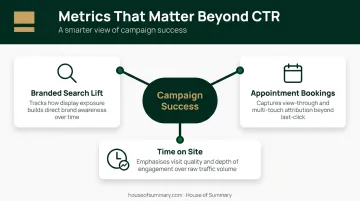
Set up attribution to capture these signals before launch. UTM parameters handle click traffic; view-through attribution tracks post-impression behavior, brand lift studies measure awareness shifts, and branded search monitoring reveals whether recall is building over time.
Common Mistakes Healthcare Advertisers Make with Display
Treating Display Like a Direct-Response Channel
The most common strategic error is optimizing healthcare display campaigns for CTR, then cutting them when clicks don't match search benchmarks. Display's job is awareness, not conversion. If KPIs are set incorrectly at the start, performance will look like failure even when the campaign is working.
Set awareness-appropriate goals from day one: reach, frequency, brand recall, and downstream search activity — not CTR.
Ignoring Compliance Across Every Campaign Layer
Healthcare marketers often apply compliance review to ad copy and stop there. Regulatory exposure can come just as easily from other campaign elements, including:
- Targeting configuration and audience segment definitions
- Pixel setup and data collection logic
- Retargeting rules and suppression lists
- Landing page content and claims
Compliance review should run as a checklist across every element before launch — not just a final copy read.
Frequently Asked Questions
What is an example of display advertising?
A banner ad for a local hospital's orthopedic surgery program appearing on a health news website is display advertising. So is a sponsored placement in a health-focused email newsletter — the ad appears alongside editorial content in a reader's inbox rather than in response to a search query.
What are the best practices for display ads?
Build creative around patient trust and emotional relevance rather than features, align every ad precisely to its landing page, use contextual and geographic targeting to stay HIPAA-compliant, and measure downstream outcomes — branded search, appointment volume, time on site — rather than CTR alone.
What makes healthcare display advertising different from other industries?
HIPAA restricts the use of health data in targeting and retargeting, major platforms classify health content as a sensitive category, patient decision timelines are longer than most consumer categories, and the trust threshold healthcare brands must clear before a prospect acts is far higher than in retail or finance.
How do I target healthcare audiences without violating HIPAA?
Three approaches are reliably compliant:
- Contextual targeting — place ads next to relevant health content without using personal data
- Geographic or market-level targeting — reach audiences by location, not health profile
- Behavioral signals — use only signals that don't infer a specific condition or treatment
Avoid condition-specific audience segments entirely.
Should I use display ads or search ads for my healthcare brand?
They serve different functions. Search captures patients who are actively looking for something specific. Display builds the awareness and familiarity that makes patients more likely to click when they do search. A coordinated strategy that uses both — display to build recognition, search to capture intent — consistently outperforms either channel on its own.
What CTR should I expect from healthcare display ads?
Healthcare display CTR typically falls in the 0.10–0.15% range, based on WordStream/LOCALiQ benchmark data (2020–2021 — current rates may vary). This is expected for top-of-funnel activity. Real ROI shows up downstream: branded search lift, appointment bookings, and site engagement.