
The result is a crowded market where many campaigns are simultaneously over-broad and under-compliant. US healthcare and pharma digital ad spending is projected to reach $24.77 billion in 2025, growing 13.3% year-over-year. That's significant budget chasing audiences that are harder than ever to reach without triggering HIPAA exposure.
This article covers how to segment healthcare audiences effectively, which channels actually perform, how to stay on the right side of HIPAA and FTC enforcement, and how to personalize messaging without crossing into restricted territory.
Key Takeaways
- Demographic and geographic segmentation are the safest, most effective starting points for healthcare audience strategy
- Paid search, CTV, contextual programmatic, and newsletter placements lead for compliance-conscious healthcare campaigns
- Most major ad platforms won't sign Business Associate Agreements — which forces a shift toward privacy-safe targeting methods
- FTC enforcement against GoodRx ($1.5M) and BetterHelp ($7.8M) in 2023 confirmed that health data misuse carries real financial consequences
- Downstream measurement (booked appointments, patient volume) requires privacy-safe alternatives to standard pixel tracking
What Is Targeted Healthcare Advertising?
Targeted healthcare advertising is the practice of delivering specific messages to defined audience segments — based on demographics, behavior, geography, or health-related interests — rather than broadcasting to everyone indiscriminately.
Who Uses It and Why
The category spans several distinct advertiser types, each with different goals:
- Hospitals and health systems filling appointment pipelines for specific service lines
- Pharmaceutical companies reaching defined patient populations or prescribing physicians
- Insurance payers targeting eligible members during open enrollment windows
- Medical device companies marketing to healthcare professionals (HCPs) or patients managing chronic conditions
- Telehealth and digital health brands acquiring new patients at scale
Why Healthcare Is Different
What makes healthcare advertising genuinely harder than retail or travel advertising is how data gets classified. Purchase history, browsing behavior, and location data are routine targeting inputs for most advertisers. In a healthcare context, those same signals — combined with a condition-specific page visit or clinic search — can qualify as protected health information (PHI) under HIPAA.
That distinction restricts how data can be collected, shared with third parties, and applied to ad targeting — including limits on pixel-based tracking and lookalike audience modeling built from health-related signals.
Those restrictions shape every downstream decision: which channels are viable, which data sources are permissible, and how campaigns must be structured to stay compliant.
Know Your Audience: Segmentation Strategies That Work
Demographic Segmentation
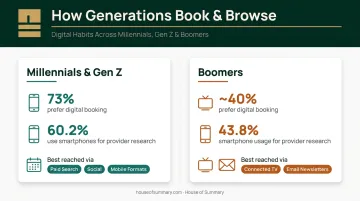
Age, gender, income, and geography form the foundation of any healthcare audience strategy — and generational differences have real implications for channel selection.
Press Ganey research found that 73% of Millennials and Gen Z prefer digital appointment booking, compared to roughly 40% of Boomers. Younger cohorts also skew toward smartphones for provider research (60.2% vs. 43.8% for Boomers).
In practice:
- Younger patients are more reachable through paid search, social, and mobile-first formats
- Older demographics respond better to Connected TV and direct-mail-adjacent channels like email newsletters
- Income segmentation shapes which services to feature and what CTA to use (e.g., cost-transparency messaging for uninsured vs. premium service positioning for high-income audiences)
Behavioral and Contextual Segmentation
Behavioral targeting in healthcare requires a clear line between what's allowed and what's not. Targeting based on general health content consumption (someone reading an article about joint pain) is categorically different from targeting based on PHI-linked signals (a pixel that captured a page visit to a specific condition treatment page).
HHS/OCR guidance confirms that HIPAA applies when tracking technologies collect or disclose data that includes PHI — and that disclosures to ad tracking vendors without proper authorization are impermissible.
Safe behavioral signals include:
- Contextual placement on health-topic content (targeting the content, not the person)
- Anonymous interest category data from third-party data providers
- Geographic signals tied to clinic proximity
Geographic Targeting
Geo-targeting is one of the most compliance-friendly precision tools available to healthcare advertisers. Campaigns focused on specific zip codes, metro areas, or radius zones around clinic locations reduce waste without touching individual-level health data.
This approach is particularly valuable for:
- Practices opening new locations
- Service-line campaigns promoting specialty care to nearby populations
- Regional health systems competing against national telehealth brands for local patients
Lookalike Audiences and Exclusions
Lookalike targeting lets healthcare advertisers model high-value patient segments without exposing PHI directly. The mechanic is straightforward: provide an anonymized seed list to a platform like Google, which then finds users with similar characteristics. The compliance risk lives in how that seed list is built and what data it contains. Google's Customer Match policy explicitly prohibits using the feature for pharmaceutical product advertising.
Audience exclusions deserve equal attention. Skipping them burns budget and creates friction — nobody wants to receive an ad for a flu shot they already got. Practically, exclusions should cover:
- Existing patients who've already converted on the targeted service
- Users who completed a conversion event within the campaign window
- Audiences flagged as recently engaged (to avoid overexposure)
HIPAA complicates exclusion list management because patient status is health-related data. Any exclusion list built from EHR or practice management data requires careful handling and, in most cases, a Business Associate Agreement with the platform or data partner involved.
Choosing the Right Channels for Healthcare Advertising
Paid Search and Programmatic Display
Paid search remains the highest-intent channel available to healthcare advertisers. Kyruus data shows 70% of consumers went online the last time they searched for care, with healthcare consumers using digital resources 2.2x more than provider referrals when choosing a provider.
The key to paid search in healthcare is ad copy that matches actual patient intent. "Same-day back pain appointment" outperforms "Our orthopedic team is here for you" because it answers the question a patient is already asking.
Programmatic display adds scale. In a HIPAA-constrained environment, contextual targeting (placing ads on health-related content rather than following individuals) is the preferred privacy-safe method. It reaches relevant audiences without creating the PHI disclosure risk that behavioral targeting carries.
Paid Social Media
Meta and TikTok allow healthcare advertising but classify health topics as sensitive categories, imposing restrictions on audience targeting granularity and conversion tracking. The practical effect is that creative quality and message clarity now drive performance more than targeting precision.
Key implications for healthcare advertisers:
- Compelling, specific visuals matter more than audience segmentation
- AI-driven delivery systems (Meta Advantage+, etc.) optimize toward asset quality — not audience lists
- Message clarity becomes the primary performance lever
Connected TV
CTV has moved from pure brand awareness into a measurable performance channel. Hospitals can target households by geography and demographic profile, then measure downstream outcomes including site visits and appointment bookings. BIA/SalesFuel forecasts that hospitals will spend $109 million on local CTV/OTT advertising in 2024 — 40% more than in 2021 — with nearly 8% annual growth projected through 2027.
Newsletter Advertising
Newsletter advertising addresses three of healthcare's most persistent advertising constraints simultaneously: compliance risk, ad blocking, and audience intent.
Ads delivered directly to an inbox:
- Bypass ad blockers entirely (pixels don't apply to email)
- Avoid algorithmic gatekeeping — there's no feed ranking suppressing visibility
- Reach subscribers who actively chose to receive that content, not passive scrollers
Because newsletter advertising doesn't rely on pixel-based behavioral tracking or PHI-linked data for targeting, it presents a cleaner compliance profile than cookie-dependent digital channels. Placement is typically contextual — matching ad content to the editorial environment of the newsletter — which aligns with the privacy-safe targeting approaches healthcare advertisers need.
House of Summary's newsletter network reaches 500,000+ subscribers with 254,866+ emails opened daily. The readership skews high-income and decision-maker — 66% US-based, with strong representation across the UK and UAE. For healthcare brands targeting executives or high-net-worth individuals researching premium care options, that audience profile is a direct match.
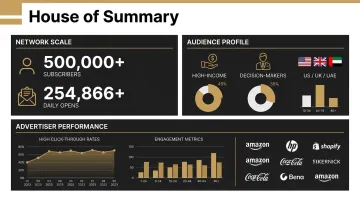
Advertiser results include click-through rates 4x higher than Google AdWords. That gap is significant when web-based channels are competing with banner blindness and ad blockers.
Navigating HIPAA and Privacy Compliance
What Creates Legal Exposure
Standard marketing tools — Meta Pixel, Google Tag, session replay scripts — can inadvertently transmit PHI when a user visits condition-specific pages. HHS/OCR guidance is clear: HIPAA applies whenever tracking data collected or disclosed includes PHI, and sharing that data with ad vendors without HIPAA-compliant authorization is impermissible.
Research found third-party tracking code on 98.6% of hospital websites, and a 2024 analysis reported one-third of healthcare websites still used Meta Pixel — a significant compliance gap given the regulatory environment.
The BAA Problem
Most major ad platforms — Meta and Google among them — do not offer Business Associate Agreements for their advertising products. That means healthcare organizations cannot legally pass patient data to these platforms for targeting purposes without assuming serious legal risk.
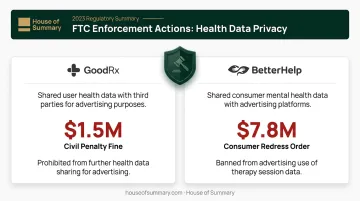
The FTC's 2023 enforcement actions confirmed exactly what that risk looks like in practice:
- GoodRx: Prohibited from sharing user health data with third parties for advertising, $1.5M civil penalty
- BetterHelp: Banned from sharing consumer health data for advertising, $7.8M in consumer redress
The Expanding Regulatory Landscape
HIPAA isn't the only framework healthcare advertisers need to manage. Washington's My Health My Data Act, which took effect in 2024, requires regulated entities to obtain explicit consumer authorization before using health data — and creates per-violation liability under state consumer protection law.
State-level exposure doesn't stop there. Class action litigation applying wiretapping statutes to healthcare organizations using tracking pixels has added another layer of legal risk that many compliance teams weren't anticipating.
A Compliance-First Campaign Framework
Build compliance into campaign structure before launch, not after:
- Build audience strategies on privacy-safe signals — contextual targeting, geographic data, anonymized seed lists with appropriate safeguards
- Review all ad creative against applicable regulatory standards before launch
- Monitor platform policies continuously — Meta, Google, and TikTok update healthcare advertising policies frequently
- Consult legal and compliance teams before activating new data sources, platforms, or audience strategies
How to Measure and Optimize Healthcare Ad Performance
The Right Metrics
Top-of-funnel metrics like impressions and reach tell you how many people saw an ad — not whether any of them booked an appointment. Healthcare advertisers should track:
- Click-through rate (CTR) and cost per acquisition (CPA) as baseline campaign health indicators
- Conversion rate from ad click to appointment request or form fill
- Booked appointments and patient volume by channel as downstream outcome metrics
- Patient lifetime value for practices evaluating long-term acquisition economics
The Measurement Problem
Standard pixel-based conversion tracking is risky in healthcare because the same tools that fire conversion events can capture PHI in the process. Privacy-safe measurement alternatives include:
- Server-side data handling that filters PHI before it reaches ad platforms
- Aggregate outcomes data pulled from CRM or EMR systems and matched to campaign activity
- UTM parameter tracking combined with manual or CRM-based attribution
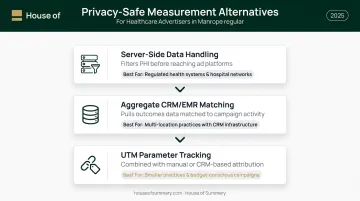
Note: HHS guidance frames compliance around what data is disclosed, not what tool is used. Server-side tracking reduces risk but doesn't automatically make a setup HIPAA-compliant — the underlying data flow still matters.
Once your measurement infrastructure is clean, optimization becomes actionable.
Testing and Optimization
Healthcare campaigns should run regular A/B tests across ad copy, creative formats, audience segments, and landing page structures. AI-driven platforms like Performance Max and Meta Advantage+ optimize dynamically from asset pools — meaning you need to feed them variety: different headlines, distinct CTAs, and multiple image treatments. Reviewing performance weekly rather than monthly catches underperforming combinations before budget is wasted.
Frequently Asked Questions
What is target marketing in healthcare?
Target marketing in healthcare is identifying specific patient or consumer segments — by demographics, geography, behavior, or health interests — and tailoring advertising messages to those groups. The alternative, mass broadcast advertising, reaches a wide audience but converts at much lower rates given how specific healthcare decisions are.
What are some examples of targeted advertising in healthcare?
Common examples include a hospital running geo-targeted paid search ads within a 15-mile radius of a new clinic, a pharmaceutical company placing contextual display ads alongside relevant health content, or a health insurer sending personalized newsletter campaigns to eligible members during open enrollment.
What are the main channels used in healthcare advertising?
The primary channels are paid search, programmatic display (using contextual targeting), paid social media (with platform-imposed restrictions), Connected TV, and newsletter advertising. Channel mix should reflect where target patients and decision-makers actually spend time.
How does HIPAA affect healthcare advertising targeting?
HIPAA restricts how health-related data can be collected, shared, and used. Most major ad platforms won't sign Business Associate Agreements, so patient data can't be passed to them. That shifts targeting strategy toward contextual, geographic, and anonymized audience approaches.
How do you measure the effectiveness of a healthcare advertising campaign?
Key metrics include CTR, CPA, conversion rate, and downstream outcomes like booked appointments. Privacy restrictions limit standard pixel-based tracking, so healthcare advertisers typically combine server-side data handling with CRM-based attribution for accurate measurement without HIPAA exposure.
Is email newsletter advertising effective for healthcare brands?
Newsletter advertising reaches readers who've opted in to relevant content, bypasses ad blockers, and isn't subject to the algorithmic suppression that limits social and display reach. The inbox is also a compliance-friendlier environment — placement doesn't rely on PHI-linked behavioral tracking.