Introduction
According to the KFF 2024 Women's Health Survey, 34% of women who saw a provider in the past two years reported at least one negative interaction—23% felt treated unfairly, 20% had questions ignored outright. That's the healthcare system itself falling short. For advertisers, the gap is even steeper: a 2025 SheSpeaks study found 49% of women feel misunderstood by brands, with just 4% feeling truly understood.
Women shoulder an estimated 80% of family medical decision-making, according to the American Heart Association. Every misstep in messaging reaches far beyond a single consumer.
This article covers what it actually takes to get women's health advertising right: how to segment the audience, what messaging earns trust, which channels work, how to navigate platform restrictions, and how to build loyalty that outlasts a single campaign.
Key Takeaways
- Women control the majority of household health decisions—generic messaging fails them and the brands using it
- Life-stage segmentation shapes everything: concerns, channels, and trust signals differ dramatically by age group
- Female health audiences respond to education-led content far more than to promotional advertising
- Social platform restrictions on reproductive and sexual health content mean brands can't rely on a single channel to reach these audiences
- Newsletter advertising offers a direct, algorithm-free path to female health audiences that social and search can't reliably provide
Why Women's Health Advertising Demands a Different Approach
The Research Gap That Shaped the Marketing Landscape
Modern medicine was built largely around male physiology. Women weren't included in NIH-funded clinical trials as a legal requirement until the NIH Revitalization Act of 1993—before that, their inclusion was policy guidance, not law. Decades of under-researched conditions created a healthcare culture where women routinely felt dismissed, and that skepticism carries directly into how they evaluate health advertising today. For marketers, that means authenticity and clinical honesty aren't differentiators — they're the baseline.
The "Chief Health Officer" Effect
The American Heart Association reports women—especially mothers—shoulder roughly 80% of family medical decision-making. They're not just purchasing for themselves; they're evaluating providers, comparing treatments, and making referral decisions for children, partners, and aging parents.
That amplified role raises the stakes considerably. A woman who feels condescended to doesn't just disengage — she steers her entire household elsewhere. The reach of a single misstep extends far beyond one lost customer.
A Market That Boards Are Finally Noticing
Investment is following the audience. SVB's 2025 Women's Health Report documents $2.6 billion in venture capital flowing into women's health in 2024—a 55% increase year over year. McKinsey estimates closing the women's health gap could add $1 trillion to the global economy annually by 2040.
These figures signal a structural shift — women's health is no longer a niche vertical. Advertisers who treat it as one will find themselves outpaced by those who don't.
Segment First: Understanding Who Your Women's Health Audience Actually Is
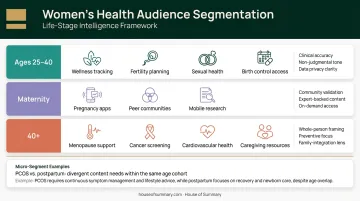
A single campaign can't serve a 28-year-old researching fertility options and a 54-year-old navigating menopause. Life stage isn't a demographic nicety. It determines health concerns, media habits, and trust thresholds.
Younger Women (Roughly Ages 25–40)
This group's primary concerns center on general wellness, fertility, sexual health, and birth control. They're digitally fluent and quick to detect messaging that feels performative or hollow.
What earns their attention:
- Transparency about ingredients, clinical backing, and business practices
- Representation that reflects actual diversity rather than stock photography diversity
- Tone that's direct and values-aligned, not aspirational and vague
They're also highly skeptical. A brand that signals it understands their values gets consideration. One that doesn't gets scrolled past.
Maternity and Reproductive Health
Pregnancy is a high-loyalty gateway. Research published in PMC found 85.7% of pregnant women used at least one pregnancy mobile app, and 70.2% turned to social media for pregnancy-related information.
This audience is actively researching, comparing, and sharing within communities. Brands that show up in the apps, peer communities, and content they already trust during this period can establish relationships that outlast the pregnancy itself.
Women Over 40
Concerns shift here: menopause, cancer screening, bone density, cardiovascular health. KFF data shows 72% of women ages 40–64 had a mammogram in the past two years, and less than half—47%—reported that a provider discussed what to expect during menopause.
That's a significant gap. Brands that address perimenopause, menopause, and midlife wellness with clear, evidence-backed information are filling space that providers are leaving empty.
Many women in this cohort are also managing someone else's health alongside their own. AARP's 2025 caregiving report shows three in five caregivers are women, and 29% support both children and adult dependents simultaneously. For this segment, convenience and credibility aren't preferences: they're requirements.
The micro-segment reminder: Within every age bracket, meaningful sub-groups exist. A 35-year-old with PCOS has different needs than a 35-year-old postpartum. Generic messaging aimed at "women 25–45" often resonates with no one. Define a specific audience profile before building creative.
Messaging That Resonates: Talking to Women, Not at Them
Lead With Education, Not Promotion
Women are more receptive to messaging that helps them understand symptoms, options, and decisions than to messaging that sells. Health decisions follow a trust curve. Brands that show up as educators during the research phase earn credibility that promotional messaging rarely can.
McKinsey's health media research found that 64% of consumers trust health content more when it comes from healthcare providers than from other sources. The implication: brand messaging that positions itself as information, not advertising, earns more attention.
Break Taboos With Honesty, Not Drama
Pelvic floor health, menopause symptoms, constipation, sexual dysfunction—these are underserved in mainstream advertising, which means brands willing to address them clearly have real white space.
The MiraLAX "Gut Gap" campaign is a documented example. By partnering with Broad City stars Ilana Glazer and Abbi Jacobson to address constipation among millennial women directly and with humor, the campaign destigmatized a topic that most brands had avoided—and won a Shorty Award for doing it. Where competitors defaulted to vague language, directness created both cultural traction and measurable engagement.
Authenticity in Practice
Real patient stories and provider voices consistently outperform stock imagery and generic copy in engagement. Custom graphics and even low-production provider interview videos outperform standard display ads—not because production quality doesn't matter, but because authenticity registers faster than polish.
That authenticity requirement doesn't look the same across every audience. Generational context shapes which signals feel genuine and which feel performative.
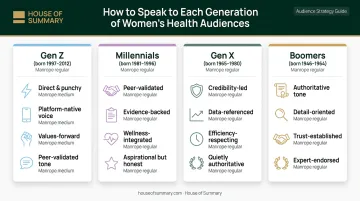
Generational Tone Differences
| Audience | Messaging approach that works |
|---|---|
| Gen Z | Light, direct, values-explicit, no filler |
| Millennials | Relatable, peer-validated, socially conscious |
| Gen X | Evidence-backed, practical, efficient |
| Boomers | Credible, authoritative, respectful of their time |
Values Alignment Drives Decisions
Kantar's 2024 global study found 75% of consumers say a brand's diversity and inclusion reputation influences purchase decisions. Edelman's 2024 Brand Trust report adds that 63% of consumers buy or advocate for brands based on beliefs and values. Women who feel a brand shares their commitments—on transparency, equity, or ethical practice—show higher conversion rates, stronger loyalty, and more organic referrals than audiences who treat the brand as interchangeable.
Choosing Channels That Reach Women Where They Are
Channel selection should follow audience behavior, not advertiser convenience. Here's where the Pew Research 2025 Social Media data actually places female audiences:
| Platform | Women's Usage Rate | Strongest Age Group |
|---|---|---|
| YouTube | 83% of women | 18–49 (92%) |
| 78% of women | 30–49 (80%) | |
| 55% of women | 18–29 (80%) | |
| TikTok | 42% of women | 18–29 (63%) |
Gen Z women gravitate toward TikTok and Instagram short-form video. Millennials use Instagram, YouTube, and Facebook. Gen X skews toward Facebook and prefers substance over flash. Boomers are considerably more active on Facebook and health portals than most media plans assume.
Social Media: High Awareness, High Effort
Social works for awareness and passive engagement—but it demands custom visuals and authentic video, not stock images and text overlays. The channel reaches large audiences; the creative burden is real.
Newsletter Advertising: The Underutilized High-Intent Channel
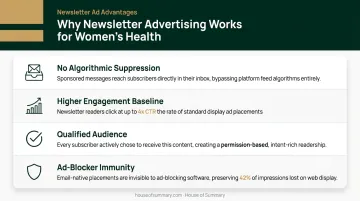
Newsletter placements operate in a fundamentally different environment than social or search. Readers are already in a focused, distraction-free reading mode when the brand appears — no algorithm suppresses delivery, no ad blocker interrupts the message.
For women's health advertisers covering sensitive or stigmatized topics, that distraction-free context matters more than raw reach numbers. Key channel advantages include:
- No algorithmic suppression — delivery goes directly to the subscriber's inbox
- Higher engagement baseline — newsletter click-through rates run 4x higher than search display ads on average
- Qualified audience — subscribers opted in, making intent signals stronger than passive social scrolling
- Ad-blocker immunity — in-email placements bypass the browser tools that block 42% of web display ads
House of Summary's newsletter network, for example, runs a dedicated Women's Brand & Femtech advertising service reaching professional women aged 25–55 across the US (with particular concentration in NY and LA), UK, and UAE — 500,000+ subscribers, with over 254,000 emails opened daily.
Mobile-First, Not Mobile-Adapted
Nearly all US adults own a smartphone, yet many campaigns are still built for desktop and compressed down. Those campaigns underperform. Build mobile-first; adapt up from there.
Direct Mail for Bottom-Funnel Moments
A National Cancer Institute program found that direct mail mammography reminders increased screening rates to 16.1% vs. 10.3% in control groups. Direct mail is not a replacement for digital channels, but for location-specific, high-intent conversion moments—local OB outreach, mammography reminders, health system enrollment—it remains effective when paired with a clear call to action.
Navigating Platform Restrictions on Sensitive Women's Health Content
The Core Challenge
Meta requires ads promoting sexual and reproductive health products—including contraception and family planning—to target adults 18 and older. Google's healthcare and medicines policy lists birth control pills, fertility testing, surrogacy services, condoms, and STI testing under its restricted products category.
In practice, The New York Times reported in 2022 that Facebook had rejected ads from 60 companies focused on women's sexual health, citing adult products and services policies—even when content was purely educational. The impact extends to femtech brands addressing menopause, pelvic health, and hormonal wellness.
Practical Workarounds
Three channels consistently work around platform restrictions without compromising message quality:
- Influencer and advocate partnerships — creators discussing these topics organically operate under different platform rules than paid advertisers, bringing health conversations to platform-native audiences
- SEO and answer engine optimization (AEO) — long-form content answering specific health questions builds discoverability that paid campaigns can't sustain, including in AI-generated search responses
- Editorial placements in trusted health publications — build credibility through earned placement rather than paid distribution
Why Newsletter Advertising Bypasses These Restrictions
Newsletter advertising doesn't operate under social or search platform content policies. Messages arrive directly in subscribers' inboxes—no algorithmic review, no disapproval queue, no restricted distribution for mentioning menopause or contraception. For femtech brands navigating these restrictions, House of Summary's editorial environment—built on verified content and a strict no-sensationalism standard—means sensitive topics that get flagged on Meta reach readers with full context and credibility intact.
Building Long-Term Relationships Through Education-Led Marketing
A woman researching a new OBGYN or weighing hormone therapy options rarely converts on first exposure. The brands that earn her loyalty show up consistently across the decision journey—not just when she's ready to buy.
That means investing in:
- Educational blogs and guides built around the specific questions she's already searching
- Webinars and Q&A formats featuring real providers
- Email newsletters that deliver ongoing value, not just promotional cadences
- Quizzes and self-assessment tools that make the experience feel relevant to her situation
Content investment alone isn't enough — women also verify independently. Tebra's 2025 patient survey found 79% of patients read online reviews before choosing a provider, and Software Advice reports 71% use reviews as their first step in finding a new doctor. Provider-authored content, transparent credentials, and well-managed review profiles are part of how women evaluate trustworthiness before making contact — not an afterthought.
Brands that become reliable information sources don't just earn a purchase. When trust is that well established, referrals follow — often to the rest of the household.
Frequently Asked Questions
What makes women's health advertising different from general healthcare advertising?
Women serve as primary healthcare decision-makers for entire households, not just themselves. They're especially sensitive to brand values and authenticity, and they require life-stage-specific messaging—generic health content typically fails to address the specific concerns, channels, and trust triggers that actually move this audience.
Which digital channels are most effective for reaching women's health audiences?
Effectiveness varies by generation: Instagram and TikTok for younger women, Facebook and YouTube for Millennials and Gen X. Across demographics, email and newsletter advertising consistently delivers high engagement — no algorithmic suppression, no ad blockers, and no competition for attention.
How do you advertise sensitive women's health topics when platforms restrict the content?
The most reliable approaches are influencer and advocate partnerships, SEO-driven educational content, editorial placements in health publications, and newsletter advertising — which operates outside social and search platform content policies, giving brands direct audience access for restricted topics.
How important is generational targeting in women's health advertising?
Generational differences shape not just platform preference but what messaging, tone, and topics earn trust. Gen Z responds to values-explicit directness; Gen X wants evidence and efficiency. Getting the tone wrong for the generation can undermine even an accurate, well-intentioned message.
Does authenticity really affect campaign performance in women's health marketing?
Yes. Real patient voices, provider-led content, and clear brand positioning on issues women care about outperform polished but generic advertising. Women's health audiences are practiced at identifying performative messaging and disengaging from it quickly.
How can a brand build lasting loyalty with women's health consumers?
Loyalty comes from sustained, education-led engagement across the full decision journey, not one-off campaigns. Brands that function as reliable health information sources earn purchase decisions and referrals to the family members women influence.