
Introduction
US healthcare and pharma digital ad spending is projected to hit $24.77 billion in 2025 — a 13.3% year-over-year increase according to eMarketer — yet patient acquisition costs keep climbing for most practices. The problem isn't budget. It's channel selection.
Most healthcare brands default to the same mix: a Google Ads campaign, a Facebook page, maybe some display banners. Meanwhile, patients research across five or more touchpoints before booking an appointment — and healthcare marketers are burning spend on channels that don't reach them at the moments that matter.
Effective healthcare advertising means matching channel to intent — and that requires knowing which formats actually convert in a compliance-heavy category. This article covers the specific tactics that drive patient acquisition, from paid search to email, with context on why each one works.
Key Takeaways
- Google Ads and Local SEO capture high-intent patients already searching for services — these are non-negotiable foundations.
- Social media ads build awareness but require HIPAA-safe targeting strategies; retargeting is what drives measurable ROI.
- OTT/CTV advertising is growing fast — 88% of healthcare marketers plan to increase digital video spend in 2025.
- Email and newsletter advertising delivers healthcare CTRs of 3.0% — well above most social and display benchmarks.
- Content marketing and geofencing complete a full-funnel strategy — one builds lasting trust, the other targets the right patients at the right moment.
What Makes Healthcare Advertising Different
Healthcare advertising isn't just another vertical with stricter creative guidelines. The compliance and trust barriers are structural.
The Compliance Reality
Platform restrictions have reshaped what's possible:
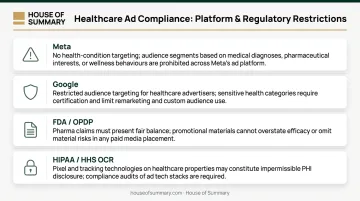
- Meta removed health-condition-based targeting in January 2022, eliminating the ability to target audiences based on diagnosed conditions or health interests
- Google restricts advertiser-curated audiences (Customer Match, lookalikes) for sensitive health categories — meaning standard retargeting tactics require workarounds
- FDA's Office of Prescription Drug Promotion governs pharma and device ad claims, requiring truthful, balanced communication across all channels
- HIPAA applies to digital tracking tools — the HHS OCR has clarified that covered entities must comply with HIPAA when using website pixels and tracking technologies for advertising
The FTC has made enforcement a priority. GoodRx paid $1.5 million and BetterHelp paid $7.8 million in 2023 settlements for sharing health data with ad platforms without proper consent. Regulators are actively pursuing violations, and settlement costs are only part of the exposure — reputational damage compounds the financial hit.
The Trust Equation
Patients making healthcare decisions aren't impulse buyers. They research, compare, and second-guess. Advertising that leads with urgency or discounts alone rarely converts in this category.
Channels that build credibility — educational content, physician-facing video, curated newsletters — consistently outperform pure promotional pushes. Audiences respond to brands that inform before they sell. Your mix should lean toward formats that earn attention rather than interrupt it.
Top Healthcare Advertising Ideas That Work
The following ideas are ranked for real-world impact across patient acquisition and brand-building goals, and can be scaled across different budgets and practice sizes.
Search Engine Advertising (Google Ads and PPC)
Paid search is the closest thing healthcare has to a guaranteed intent signal. A patient typing "orthopedic surgeon near me" or "dermatology clinic Chicago" is already in decision mode — the advertising just needs to show up and answer the question.
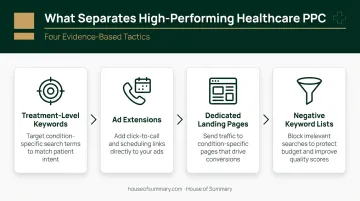
What separates high-performing healthcare PPC from wasted spend:
- Condition and treatment-level keywords instead of broad specialty terms — "knee replacement surgeon Austin" converts better than "orthopedic"
- Ad extensions showing phone numbers, appointment booking links, and location — reducing friction between the ad and the call
- Dedicated landing pages matched to the searched service — sending traffic to a generic homepage is the single biggest conversion killer in healthcare PPC
- Negative keyword lists that filter irrelevant queries and protect budget
LocaliQ's healthcare search advertising benchmarks across 16 specialties show that average CTR has decreased for 81% of healthcare businesses — meaning the practices that optimize carefully are increasingly separating themselves from those running set-and-forget campaigns.
Local SEO and Google Business Profile Optimization
For any practice with a physical location, the Google local 3-pack — the map-based results that appear above organic listings — delivers the highest-visibility placement on the page. A fully optimized Google Business Profile (accurate name/address/phone, updated photos, correct service categories, and active patient reviews) is the foundation.
According to Healthgrades, 76% of people say a positive online reputation directly influences which doctor they choose — making reviews not just social proof but an active ranking and conversion factor.
Beyond the profile itself, Local SEO requires:
- Service-specific pages with local keywords ("knee replacement surgeon in Austin," "pediatric dentist Brooklyn")
- Consistent listings across Healthgrades, Vitals, and Yelp
- Backlinks from local health directories and medical associations
Unlike paid ads, this is a compounding asset. The effort you put in today continues generating visibility for years.
Social Media Advertising
Facebook and Instagram remain the strongest paid social channels for healthcare reach — but the playbook has changed since Meta's 2022 targeting restrictions. Health-condition-based targeting is gone. What works now:
- Life-stage targeting: new parents, retirees, active adults
- Interest and behavior signals that infer health relevance without using condition data
- Short-form video ads featuring physician face-time — these build trust faster than static creative
- Patient testimonial carousel ads with proper consent documentation
- Awareness campaigns for free screenings or community health events
Social ads are push marketing — the audience isn't searching for you. Creative must earn attention within the first two seconds. Pair social campaigns with retargeting to re-engage users who've already shown interest, and the ROI picture improves significantly.
For Physicians and Surgeons specifically, Facebook traffic campaigns average a $0.82 CPC and 0.83% CTR, per LocaliQ's 2025 benchmarks — useful for setting realistic expectations before launch.
Video Marketing and OTT/Connected TV Advertising
Two distinct opportunities exist here, and smart healthcare advertisers pursue both.
Physician-led YouTube content builds organic search presence and long-term authority. Videos that answer real patient questions — "What happens during a hip replacement?" or "How do I know if I need a sleep study?" — drive consistent traffic and establish physician credibility before the first appointment.
OTT/CTV ads on Roku, Hulu, and Amazon Fire TV allow healthcare brands to serve TV-quality spots to hyper-local, demographically filtered audiences at a fraction of traditional broadcast costs. Streaming represented 44.8% of US TV viewership in May 2025, exceeding broadcast and cable combined for the first time, according to Nielsen.
88% of healthcare and pharma marketers plan to increase digital video spending in 2025 — the channel has moved from experimental to mainstream.
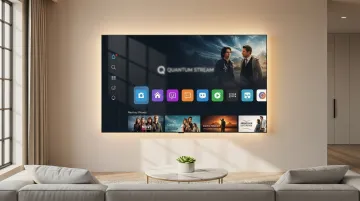
The most effective healthcare videos lead with the patient's problem or concern in the first 10 seconds — not the brand name. Show the outcome, answer the question, then introduce the practice. This mirrors direct-response principles and builds trust before asking for action.
Email and Newsletter Advertising
The inbox is the most underused channel in healthcare advertising — and one of the most effective.
Healthcare services email achieves a 3.0% CTR according to Campaign Monitor benchmarks, compared to 0.83% for Facebook traffic ads in the same category. That's not a small gap. Email reaches readers in an uninterrupted, algorithm-free environment where ad blockers don't apply and the reader's attention is already engaged.
For B2B healthcare brands — medical device companies, health insurance carriers, telehealth platforms, and hospital systems — newsletter advertising offers something paid social and programmatic genuinely struggle to deliver: reliable access to executive and decision-maker audiences.
House of Summary's newsletter network, which reaches 500,000+ subscribers with 254,866+ emails opened daily, places brand messages directly in front of executives, founders, and policy professionals across the US (66% of readership), UK, and UAE. The audience skews toward C-suite and senior professionals — exactly the decision-makers that B2B healthcare brands need to reach but rarely find through algorithmic targeting.
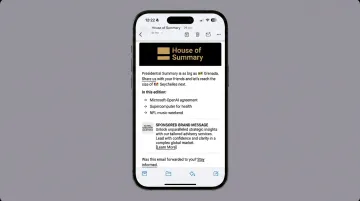
The editorial environment matters too. Healthcare advertising operates under tight regulatory constraints that make many digital channels difficult to navigate. Newsletter placements in human-written, brand-safe publications offer compliance-friendly positioning that pharma and device brands can actually use.
Geofencing and Retargeting Ads
Geofencing draws a virtual boundary around a physical location — a competitor's clinic, a pharmacy, a gym, a specialist's waiting room — and serves mobile ads to people who enter that space. A urology practice can target men who frequent specific sports facilities. A women's health clinic can target visitors to OB/GYN offices nearby. The targeting is location-based, not condition-based, keeping it on the right side of HIPAA.
Retargeting is the essential follow-up layer. Only a fraction of website visitors book on their first visit — retargeting ads served via Google Display Network or Meta re-engage those visitors across other sites and platforms, keeping the practice top-of-mind until they convert.
Critical compliance note: retargeting in healthcare must use HIPAA-compliant tools. Standard pixels can inadvertently transmit condition-specific data (if a user visits a page about a specific treatment) to ad platforms — a risk the FTC has already enforced against. Verify your tech stack before launching.
Content Marketing and Educational Campaigns
According to CDC/NCHS data, 58.5% of US adults used the internet to look for health or medical information in the past year — and they're looking before they book.
Educational content — condition explainers, FAQ videos, symptom guides, downloadable checklists — meets patients where they are in the research phase and positions your practice as the credible answer. The SEO benefit compounds over time; the trust benefit converts at the appointment.
Distribution multiplies the value of every piece:
- Long-form blog posts → repurposed as social snippets and email newsletter sections
- Video explainers → YouTube, embedded on service pages, clipped for Instagram
- Physician Q&As → press submissions to local health publications
Content that only lives on the practice website is underperforming. An omnichannel distribution approach turns one piece of content into five touchpoints.
How to Choose the Right Healthcare Advertising Mix
Channel selection without a clear objective is how budgets disappear.
Start With the Goal
| Primary Objective | Best-Fit Channels |
|---|---|
| New patient acquisition | Google Ads, Local SEO, Geofencing |
| Brand awareness | OTT/CTV, Social Ads, Newsletter Advertising |
| Patient retention | Email marketing, Content, Review management |
| B2B/decision-maker reach | Newsletter advertising, LinkedIn |
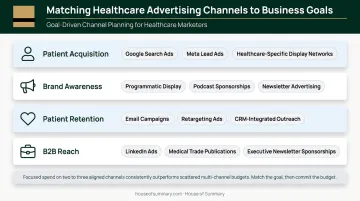
Mixing goals without matching channels is the most common reason healthcare campaigns underperform.
Budget Tiers That Make Sense
Single practice on a minimal budget:
- Google Business Profile optimization (free)
- One focused Google Ads campaign for top 3-5 treatment keywords
- Basic review generation strategy
Multi-location or mid-size organization:
- Layer in OTT/CTV for local brand awareness
- Add social retargeting for website visitors
- Test newsletter placements for executive or B2B audience reach
Focused spend on fewer channels outperforms sporadic budgets scattered across too many.
The Compliance Checkpoint
Before any campaign launches, verify:
- Audience targeting methods don't use PHI or condition-based signals
- Ad copy claims are truthful and don't imply knowledge of the user's health status
- Retargeting and email tools are HIPAA-compliant
- Pharma and device copy meets FDA promotional guidelines
- Platform certifications (Google healthcare ad certification) are current
Skipping this step carries real consequences. GoodRx and BetterHelp both faced FTC enforcement actions and significant reputational damage — outcomes that started with compliance gaps in their advertising practices.
Conclusion
The healthcare advertisers that consistently win aren't the ones with the largest budgets. They match channel to goal, prioritize trust-building creative over promotional noise, and measure success against actual patient appointments — not impressions.
As AI-driven search reshapes organic visibility and platform targeting restrictions continue tightening, the brands that move beyond over-saturated social feeds will have a genuine advantage. Direct inbox channels — newsletter sponsorships in particular — cut through algorithmic noise and reach informed, high-intent readers who are already engaged with the content around your message. That's the kind of environment where healthcare brands build both trust and appointments.
Frequently Asked Questions
What is the most cost-effective healthcare advertising idea for small practices?
Start with your Google Business Profile — it's free, compounds over time, and directly influences local search visibility. Add a patient review generation strategy and basic local SEO before investing in paid ads. These foundations build durable visibility without ongoing spend.
Are Google Ads or social media ads better for healthcare marketing?
Google Ads typically drive higher-intent leads because patients are actively searching for a solution. Social media ads work better for awareness and community reach. Most effective strategies use both — Google for capturing demand, social for creating it.
What HIPAA rules apply to healthcare advertising?
Healthcare advertisers cannot use protected health information (PHI) for ad targeting without patient consent, must use HIPAA-compliant tools for retargeting and email campaigns, and should avoid copy that implies knowledge of a user's condition. Website pixels collecting condition-specific data fall under HHS/OCR scrutiny as well.
How do healthcare brands measure advertising success?
The clearest measure is tying spend directly to new patient appointments booked. Supporting metrics include cost per lead, website conversion rate, and phone call volume. For awareness campaigns, track reach, brand recall, and engagement rates rather than direct conversions.
Can healthcare brands use influencer marketing?
Yes — particularly with physician influencers or patient advocates for wellness and preventive care. Strict FTC disclosure compliance and careful vetting of health claims are required; the approach is better suited to consumer health products and digital health platforms than clinical services.
Why is newsletter advertising effective for reaching healthcare decision-makers?
Newsletter audiences are self-selected readers who actively consume content — not passive scrollers. This produces significantly higher engagement rates than display or social ads. For B2B healthcare brands targeting executives, it's one of the few channels where decision-maker reach is reliable — not approximated through demographic proxies — with some newsletter placements delivering click-through rates several times higher than paid search.