
This guide covers the full compliance landscape: which regulatory bodies govern healthcare ads, what HIPAA requires of marketers using patient data, how the FTC and FDA set the rules for claims and disclosures, and how channel selection itself becomes a compliance decision.
Whether you're a pharmaceutical marketer, hospital system, supplement brand, or media buyer placing campaigns in the health space, this guide gives you the framework you need to advertise responsibly and effectively.
Key Takeaways
- Healthcare advertising is governed by multiple federal agencies — the FTC, FDA, CMS, and others — each covering different products and claim types
- HIPAA requires written patient authorization before protected health information (PHI) can be used for marketing; "implied consent" doesn't qualify
- All health claims must be substantiated before the ad runs, not after — including outcome claims made by hospitals and providers
- FDA rules mandate specific disclosures in prescription drug ads and prohibit off-label promotion entirely
- Channel choice carries compliance risk: pixel-based targeting and behavioral data tools can create HIPAA exposure that other ad formats may not
The Key Regulatory Bodies Overseeing Healthcare Advertising
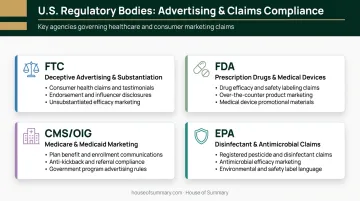
No single agency governs healthcare advertising. Jurisdiction is split across multiple federal bodies — and understanding which one applies to your campaign depends on what you're selling and what you're claiming.
| Regulatory Body | Primary Scope | Products Most Affected |
|---|---|---|
| FTC | Deceptive advertising, substantiation for health claims | OTC drugs, supplements, hospitals, clinics, nonprescription products |
| FDA | Prescription drug and device promotion, labeling | Rx drugs, medical devices, biologics, vaccines |
| CMS/OIG | Medicare/Medicaid marketing, inducements, price transparency | Hospitals, providers, Medicare Advantage plans |
| EPA | Disinfectant and antimicrobial health claims under FIFRA | Pesticides, disinfectants making pathogen-kill claims |
Federal Trade Commission (FTC)
The FTC is the primary watchdog for consumer-facing healthcare marketing outside prescription drugs. Its reach covers OTC products, dietary supplements, hospitals, clinics, and virtually any health claim made to consumers. The FTC enforces against ads that are deceptive or lack adequate scientific substantiation — and its enforcement record is active.
Recent examples: the FTC sued Xlear in 2021 for falsely claiming its nasal spray could prevent or treat COVID-19. In 2024, the FTC obtained a $195 million judgment against Simple Health Plans for deceptive telemarketing of healthcare products.
Food and Drug Administration (FDA)
The FDA regulates advertising and promotional labeling for prescription drugs, medical devices, biologics, and vaccines. Its Office of Prescription Drug Promotion (OPDP) monitors direct-to-consumer (DTC) campaigns, and in 2025 the FDA announced it was issuing approximately 100 cease-and-desist letters plus thousands of warning letters tied to deceptive drug advertising.
The FTC-FDA Memorandum of Understanding divides jurisdiction: the FTC holds primary responsibility for truth or falsity in advertising for foods, devices, cosmetics, and nonprescription drugs, while the FDA controls prescription drug advertising and labeling.
Centers for Medicare & Medicaid Services (CMS)
CMS governs how hospitals and providers market to Medicare and Medicaid patients. Key restrictions include prohibitions on inducements — offering free screenings, gifts, or other incentives designed to influence patient choice of provider — and requirements for hospital price transparency. CMS rules require hospitals to publicly display standard charges for at least 300 shoppable services.
State Medical Boards and Departments of Health
State licensing boards introduce a separate set of requirements. They regulate how physicians, nurses, and healthcare facilities describe credentials and services in advertising — with Illinois, New York, Kentucky, and West Virginia each maintaining documented discipline authority over advertising practices.
Before running state-specific campaigns, consult state-level legal guidance or a compliance attorney familiar with your jurisdiction.
HIPAA Compliance in Healthcare Advertising
HIPAA — the Health Insurance Portability and Accountability Act — sets the rules for how protected health information (PHI) can be collected, used, and disclosed. For healthcare marketers, those rules apply directly to advertising practices.
What Counts as Protected Health Information
HHS defines PHI as individually identifiable health information held or transmitted by a covered entity or business associate in any form. Under the Safe Harbor de-identification method, 18 categories of identifiers must be removed before data is considered de-identified — including names, email addresses, IP addresses, dates (other than year), geographic data smaller than a state, and medical record numbers.
This matters for advertisers because audience lists, analytics tools, web forms collecting health information, and email identifiers can all constitute PHI handling if they're connected to identifiable health data.
When Patient Consent Is Required
Under 45 CFR 164.508(a)(3), HIPAA requires written patient authorization before a covered entity uses or discloses PHI for marketing. Exceptions are narrow — limited to in-person communications and gifts of nominal value. Implied consent is not sufficient. If marketing involves payment from a third party, the authorization must explicitly state that remuneration is involved.
Patient Privacy in Digital Marketing
Digital marketing tools introduce HIPAA exposure that's easy to overlook:
- Web forms collecting health data must be encrypted and HIPAA-compliant
- Tracking pixels and analytics tools may require Business Associate Agreements (BAAs) with vendors
- HHS/OCR's 2024 tracking guidance states that HIPAA-regulated entities may not use tracking technologies in ways that cause impermissible PHI disclosures
- The FTC's enforcement against GoodRx ($1.5M civil penalty) and BetterHelp ($7.8M) both targeted sharing sensitive health data with advertising platforms including Facebook and Google
HIPAA Penalties
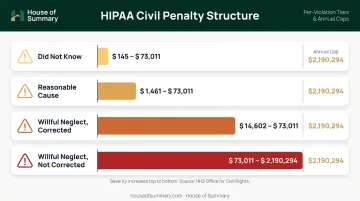
The 2026 Federal Register inflation adjustment sets HIPAA civil monetary penalties across four culpability tiers:
| Culpability Tier | Per-Violation Range | Annual Cap |
|---|---|---|
| Did not know | $145 – $73,011 | $2,190,294 |
| Reasonable cause | $1,461 – $73,011 | $2,190,294 |
| Willful neglect, corrected | $14,602 – $73,011 | $2,190,294 |
| Willful neglect, not corrected | $73,011 – $2,190,294 | $2,190,294 |
Civil penalties address negligence and oversight failures. Criminal exposure is a separate track: under 42 U.S.C. 1320d-6, wrongful disclosures made with intent to sell or use PHI for commercial gain carry penalties up to $250,000 and 10 years imprisonment.
Patient Testimonials and HIPAA
Using patient testimonials in advertising requires explicit written authorization — not just verbal agreement. That authorization must be specific to the marketing use, and the testimonial must accurately represent typical patient outcomes. That second requirement is where HIPAA and FTC rules overlap — a single testimonial can trigger violations under both frameworks simultaneously.
FTC Standards: Making and Substantiating Health Claims
The FTC's deception standard has three elements: a representation must (1) be likely to mislead consumers, (2) in a way a reasonable consumer would interpret, and (3) on a matter material to their decision. All three must be present for a violation — but in practice, health claims fail this test more often than marketers expect.
The Substantiation Requirement
Every health claim — express or implied — must be substantiated before the ad runs. The FTC requires "competent and reliable scientific evidence," judged on quality, quantity, and the totality of evidence available.
For healthcare providers, outcome claims require documented evidence specific to both the claim and its context. A hospital advertising "shortest ER wait times," for example, would need to document:
- Geographic competitor comparisons with a defined scope
- Measurement methodology used to calculate wait times
- An accurate, current timeframe — not a single favorable data point
Rules for Patient Endorsements
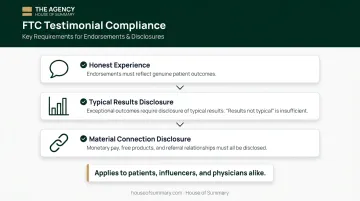
The FTC is explicit: "Results not typical" is not an adequate disclaimer. If a testimonial features an exceptional outcome, advertisers must disclose what the typical result actually is. Under 16 CFR Part 255, endorsements must reflect honest experiences, and material connections must be disclosed — including:
- Monetary compensation
- Free products or services
- Referral or affiliate relationships
This applies to patient stories, influencer partnerships, and physician endorsements alike. A testimonial implying a drug cured a patient's condition is treated as an efficacy claim and must be substantiated accordingly.
FTC Rules in Digital Advertising
Because most endorsements today appear across digital channels, it's worth noting that FTC law applies equally online. Paid endorsements must be disclosed even in constrained formats like social media posts. If required disclaimers cannot fit within a format's character or space limitations, the ad should not run in that format. This is a direct constraint on certain social and search placements for healthcare brands.
FDA Advertising Rules for Drugs and Medical Devices
The FDA's advertising jurisdiction is narrower than the FTC's but considerably more prescriptive. It applies specifically to prescription drugs, medical devices, biologics, and vaccines — and its requirements for promotional materials are specific and enforceable.
Required Disclosures in Pharmaceutical Ads
Under 21 CFR 202.1, prescription drug advertisements must include:
- The drug's established (generic) name
- At least one FDA-approved use for the drug
- A true statement of major side effects, contraindications, and effectiveness
For DTC television and radio ads, the FDA's 2023 final rule guidance requires the major statement of risks and side effects to be presented in a clear, conspicuous, and neutral manner — meaning no fast-talking disclaimers buried under upbeat music.
Off-Label Promotion Is Prohibited
Disclosure requirements address how you present information. Off-label rules govern what you're permitted to claim in the first place.
Pharmaceutical companies cannot market a drug for uses not approved by the FDA. This prohibition extends beyond direct statements: suggesting unapproved benefits through implication, omission, or selective data presentation can trigger enforcement. The three most common off-label violations involve:
- Implying broader efficacy than the approved indication covers
- Omitting safety data that would qualify a benefit claim
- Presenting cherry-picked clinical results without full context
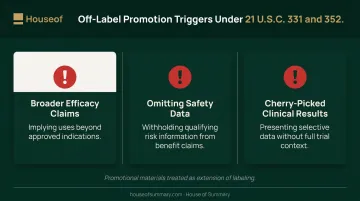
The legal basis is misbranding under 21 U.S.C. 331 and 352. A drug or device is misbranded if its labeling is false or misleading — and the FDA treats promotional materials as an extension of labeling.
Additional Compliance Layers: Stark Law, CMS Rules, and State Variations
Federal agency rules don't tell the whole story. Several additional compliance frameworks apply depending on your organization type, payer context, and operating state.
Stark Law
The Stark Law (42 U.S.C. 1395nn) prohibits physicians from referring Medicare patients to healthcare entities where the physician or an immediate family member has a financial relationship — unless a specific exception applies.
In advertising, the risk surfaces when physician endorsements, referral pathways, or compensation arrangements create implied referral value. Not every physician appearance in an ad is unlawful, but any arrangement involving physician compensation or endorsement warrants Stark Law review.
CMS Beneficiary Inducement Rules
CMS beneficiary inducement rules, enforced by the OIG, prohibit offering or transferring remuneration to Medicare or Medicaid beneficiaries when the offeror knows or should know it's likely to influence their selection of a provider. Free screenings, complimentary consultations, and gifts designed to drive patient choice fall within this prohibition. OIG maintains a nominal-value gifts exception, currently capped at $15 per item and $75 annually per beneficiary — thresholds that are easy to exceed in promotional campaign planning.
State-Level Variations
State medical boards operate independently of federal rules, and their advertising standards vary enough to create real compliance risk across multi-state campaigns. Illinois and New York have documented advertising frameworks with conduct-based restrictions. Kentucky and West Virginia maintain board discipline authority that extends to advertising practices. State rules can include:
- Restrictions on testimonials in healthcare advertising
- Limitations on use of specialty titles or credential claims in ads
- Additional substantiation requirements for specific claim types
Before running campaigns targeting specific states, consult state-specific legal guidance. A claim or format that clears federal review may still trigger a board complaint at the state level.
Choosing Compliant Channels for Healthcare Advertising
Channel selection is not a purely strategic decision for healthcare brands — it's a compliance decision. The mechanism by which an ad reaches an audience determines what data is collected, what vendors become business associates, and whether targeting methods create HIPAA exposure.
The Risk Profile of Pixel-Based and Behavioral Channels
Social media and programmatic platforms that rely on behavioral targeting or location data present real HIPAA risk when health-intent signals are involved. OCR's guidance is clear: regulated entities may not use tracking technologies in ways that create impermissible PHI disclosures. The enforcement record confirms this isn't theoretical — Monument, an alcohol addiction treatment platform, faced a 2024 FTC order banning it from disclosing health data for advertising after sharing patient information with ad platforms.
Reach is also a practical concern. As of March 2023, 31% of U.S. adult consumers reported using ad blockers — cutting into open-web and social campaign reach while offering no corresponding compliance benefit.
Newsletter Advertising as a Lower-Risk Channel
Newsletter advertising offers a structurally different risk profile. Ads are delivered directly to opted-in subscribers without pixel-based retargeting or behavioral health-data targeting. There are no tracking pixels embedded in ad units that could create PHI exposure through health-condition page visits. Ad blockers don't apply to email placements, which preserves reach.
For healthcare brands evaluating this channel, House of Summary's network illustrates the model in practice. With 500,000+ subscribers and 66% U.S.-based readership concentrated in major metros, the audience skews toward high-income decision-makers and executives — segments that align well with healthcare's professional and affluent consumer targets.
Available formats include native ads, sponsored editorial content with disclosure compliance, display placements, and full-issue takeovers. The human-written editorial environment provides brand-safe context without the data-intensive infrastructure that creates compliance complexity on social and programmatic platforms.
Channel Compliance Checklist
Before committing to any advertising channel, evaluate it against these questions:
- Does the channel collect or use PHI at any point in the targeting or delivery process?
- Is a Business Associate Agreement required with the vendor?
- Can required FTC or FDA disclosures be displayed fully within the format's constraints?
- Does the targeting methodology rely on health-intent signals, condition-specific behavioral data, or location proxies for healthcare facilities?
- Are subscribers opted in — and is the consent mechanism documented?
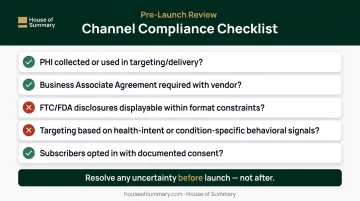
If any answer creates compliance uncertainty, resolve it before the campaign launches, not after.
Frequently Asked Questions
What are the FDA regulations for advertising?
The FDA regulates advertising of prescription drugs, medical devices, biologics, and vaccines. Under 21 CFR 202.1, ads must include the drug's established name, at least one approved use, and a true statement of major side effects and contraindications. Off-label promotion — marketing a drug for unapproved uses — is prohibited under the FD&C Act's misbranding provisions.
What are the compliance requirements for healthcare advertising?
Healthcare advertising compliance spans multiple overlapping frameworks — HIPAA, FTC, FDA, CMS, and state medical boards — each governing a different aspect of how health products and services can be promoted. Most campaigns implicate at least two of these simultaneously, which is why legal review before launch is standard practice.
What is HIPAA's role in healthcare advertising?
HIPAA restricts how marketers can use patient health information — explicit written authorization is required before PHI appears in any promotional context. Advertisers must also execute Business Associate Agreements with vendors whose digital tools (analytics platforms, tracking pixels, email systems) touch PHI. Violations carry tiered civil and criminal penalties.
Can healthcare advertisers use patient testimonials in ads?
Yes, but with firm restrictions. HIPAA requires explicit written patient authorization for testimonial use. The FTC requires that testimonials reflect typical patient outcomes — if the featured result is exceptional, the actual typical result must be disclosed. "Results not typical" alone is not sufficient under current FTC guidance.
What happens if you violate healthcare advertising laws?
Penalties scale with severity. HIPAA civil fines run from $145 to over $2.1 million per violation, with criminal exposure up to $250,000 and 10 years imprisonment for intentional PHI misuse. FTC violations can trigger mandatory corrective advertising, and state medical boards may suspend or revoke professional licenses.
Is newsletter advertising a compliant option for healthcare brands?
Newsletter advertising is lower-risk than pixel-based digital channels because it avoids behavioral health data and condition-specific retargeting. That said, FTC truthfulness standards and FDA disclosure requirements apply regardless of channel. Contact the newsletter publisher directly before launch to confirm their compliance documentation.