
Patients no longer wait for a referral or flip through a phone book. They search symptoms at midnight, compare providers on their lunch break, and read condition forums before they ever call a clinic. By the time someone contacts a healthcare organization, they've often already made a shortlist. If you're not visible during that research phase, you're not in consideration.
This article breaks down the most effective healthcare digital advertising strategies available today — what they are, how they work within HIPAA's boundaries, and how to combine them for campaigns that actually move the needle.
Key Takeaways
- Healthcare advertisers have six main channels to work with: SEO, paid search, social media, email/newsletter ads, video, and contextual targeting — each with distinct reach and compliance considerations
- HIPAA limits certain behavioral and remarketing tactics, making channel selection more consequential than in most industries
- Email and newsletter advertising bypass ad blockers and algorithm filters, delivering ads to opted-in, engaged readers
- Multi-channel approaches (2–3 complementary channels) consistently outperform single-channel tactics
- Track patient acquisition rate, cost per lead, and appointment bookings — impressions alone don't reflect real performance
What Is Healthcare Digital Advertising?
Healthcare digital advertising is the strategic use of online channels — search, social media, email, video, programmatic display, and more — to promote healthcare services, products, or information to patients, caregivers, and healthcare professionals (HCPs).
It looks similar to general digital advertising on the surface. The differences lie underneath.
Healthcare marketers operate within a web of ethical obligations and privacy regulations that don't apply to most other sectors. HIPAA restricts how patient data can be collected, stored, and used — ruling out behavioral targeting methods that retail or finance brands take for granted. Common tactics that are off-limits include:
- Retargeting users based on health conditions they've searched
- Segmenting audiences by chronic illness or diagnosis
- Using third-party data tied to medical history or treatment
The guardrails are real, and violating them carries serious legal and reputational consequences.
This makes channel and strategy selection more consequential than in any other industry. A tactic that works brilliantly for an e-commerce brand may be entirely off-limits for a hospital system.
Despite these constraints, digital now accounts for the majority of healthcare and pharma media spend in the US — because the alternatives can't match digital's reach, precision, or measurability. The strategies below represent the most effective approaches available within those boundaries.
Top Healthcare Digital Advertising Strategies
These strategies are ranked not by hype but by proven impact on patient acquisition, HCP engagement, and brand trust. Each can be deployed independently or layered into a multi-channel approach.
Strategy 1: Search Engine Optimization (SEO) and Content Marketing
Search is where the patient journey begins. Research from Google's Digital Journey to Wellness found that 77% of patients use search engines before booking an appointment, making organic visibility foundational to any healthcare digital strategy.
SEO in healthcare isn't just about rankings — it's about showing up when someone is actively looking for answers, providers, or treatment options.
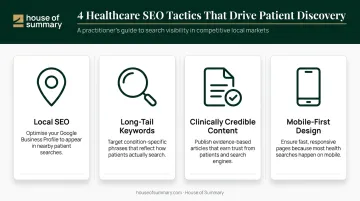
Key SEO tactics for healthcare organizations:
- Local SEO — Optimize Google Business Profile listings and location pages for queries like "urgent care near me" or "cardiologist in [city]"
- Long-tail keyword targeting — Create content around condition-specific searches like "type 2 diabetes management options" or "what causes recurring migraines"
- Clinically credible content — Blog posts, FAQ pages, and condition guides that match patient search intent and meet Google's E-E-A-T standards (Experience, Expertise, Authoritativeness, Trustworthiness)
- Mobile-first design — Fast load times and responsive layouts are non-negotiable; most health searches happen on mobile
Content marketing layers directly onto SEO. Educational articles, explainer videos, and detailed provider bios build authority over time — and authority matters twice in healthcare: it improves search rankings and increases patient trust before they ever pick up the phone.
Strategy 2: Paid Search (PPC) and Programmatic Display
When a patient searches "knee replacement surgeon in Denver" or "pediatric allergist near me," they're ready to act. Paid search captures that intent at exactly the right moment.
Google Ads campaigns targeting service-specific keywords drive appointment bookings more directly than almost any other digital channel. The trade-off is cost — healthcare keywords carry some of the highest CPCs in digital advertising — but the quality of intent justifies the investment when campaigns are structured properly.
Programmatic display works differently. Rather than capturing active search intent, programmatic serves display and native ads across premium publisher networks while a patient is still in research mode — reading a health article, browsing a news site, or comparing providers. It reinforces brand recall and keeps your organization visible throughout the research journey.
A critical compliance note: Google's ad policies restrict healthcare advertisers from using remarketing based on health conditions. Targeting users because they previously visited a page about cancer treatment or mental health services is off-limits. HIPAA-aware audience segmentation is required from the start — not bolted on afterward.
Strategy 3: Social Media Advertising
Social platforms aren't monolithic. Patient behavior varies by age group, and healthcare campaigns need to reflect that.
Younger patients — Gen Z and Millennials — frequently turn to TikTok and Instagram when researching health topics. A 2024 Pew Research report found that roughly 40% of US adults under 30 use TikTok, with health content driving substantial engagement on the platform. Older demographics skew heavily toward Facebook, which remains the dominant platform for adults 50 and above.
What paid social does well in healthcare:
- Promoting new service lines or health screening programs by age and geography
- Reaching specific demographics without relying on sensitive health data
- Driving open enrollment awareness for health plans and insurance products
- Building community around chronic condition management or wellness programs
What it can't do: Target users based on health conditions, diagnoses, or medical history. HIPAA applies here too, and healthcare organizations must ensure staff understand compliant social media practices — including what can and cannot appear in comments, posts, and ad copy.
Strategy 4: Email and Newsletter Advertising
Email is the quiet workhorse of healthcare digital advertising. No algorithm decides who sees your message. No ad blocker strips it out. It arrives directly in the subscriber's inbox — where attention is already present.
Healthcare email open rates consistently outperform most other industries, with medical and healthcare emails averaging open rates between 20–25% according to Mailchimp's email benchmarks data. For HCP outreach, patient retention campaigns, and health education content, the inbox is often the most cost-effective channel available.
Newsletter advertising takes this a step further. Rather than building your own list from scratch, placing ads within established topic-specific newsletters gives healthcare brands immediate access to audiences that have already opted in for exactly this kind of content — healthcare executives, medical professionals, business decision-makers who read health news alongside business coverage.
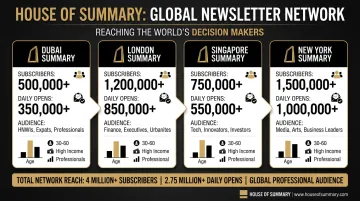
House of Summary's network of four specialized newsletters — Presidential Summary, Geopolitical Summary, Dubai Summary, and London Summary — reaches 500,000+ subscribers with 254,866+ emails opened daily. The audience skews heavily toward executives and decision-makers, with 66% based in the US (concentrated in New York and Los Angeles). For healthcare brands targeting business professionals, health insurance purchasers, or executives responsible for healthcare decisions, this is a direct channel that ad blockers simply cannot touch.
Compliance requirements for healthcare email:
- Permission-based lists only — no purchased or rented data
- Mobile-optimized design (the majority of emails are opened on phones)
- Clear CTAs directing readers to appropriate next steps (appointment booking, content download, etc.)
- No sharing of identifiable patient information in any format
Strategy 5: Video and Connected TV (CTV) Advertising
Healthcare decisions are often emotionally charged. A patient choosing a surgeon, selecting a mental health provider, or deciding on a treatment plan is making one of the most personal choices of their life. Video brings a human element to that process that static ads cannot replicate.
Patient testimonials, condition explainers, and provider introduction videos build trust that text-based formats rarely achieve. According to Wyzowl's Video Marketing Report, 84% of people say they've been convinced to buy a product or service after watching a brand's video — a dynamic that translates directly to healthcare, where seeing a real provider explain a procedure is more reassuring than any headline.
Connected TV (CTV) applies programmatic precision to video's emotional impact. Rather than buying broad broadcast slots, CTV lets healthcare marketers serve video ads to specific audience segments across streaming platforms — reaching patients while they're relaxed, attentive, and watching on their largest screen.
According to Nielsen, CTV adoption has hit historic levels, with streaming now accounting for the largest share of TV viewing time in the US. Nearly 6 in 10 pharma marketers planned to increase CTV ad spending in 2024, per eMarketer data — a clear indicator of where healthcare media investment is heading.
CTV works best for:
- Reaching adults 50+, who are both heavy streaming viewers and among the highest utilizers of healthcare services
- Brand-building campaigns where emotional resonance matters (new service lines, provider introductions)
- Retargeting patients who engaged with search or display ads earlier in their research journey
- Pharma and health system campaigns requiring precise demographic targeting without health-condition data
Strategy 6: Contextual and Privacy-First Advertising
Contextual advertising is HIPAA's best friend among digital targeting approaches. Instead of using personal health data to decide who sees an ad, contextual solutions serve ads based on the content of the page a user is actively reading — an article about managing blood pressure triggers a cardiovascular service ad; a piece on diabetes surfaces a relevant telehealth option.
No personal health data is collected, stored, or exposed to regulatory risk.
This approach is gaining real traction for two reasons. First, tightening privacy regulations and the ongoing evolution away from third-party cookies have made behavioral targeting increasingly complex in healthcare. Second, contextual targeting reaches patients at a demonstrably high-intent moment — someone actively reading about symptoms or treatment options is closer to a decision than someone who happened to visit a health website three weeks ago.
Contextual advertising works best when layered with programmatic display or native ads, creating a coordinated presence across the patient research journey without crossing any privacy boundaries.
How to Choose the Right Healthcare Advertising Mix
The most common mistake in healthcare digital advertising is treating channel selection as an either/or decision. Single-channel campaigns underperform. The strongest campaigns use 2–3 channels that reinforce each other across the patient journey.
Consider how this plays out: A patient sees a CTV ad for a local health system while streaming in the evening. Three days later, they search for the condition it mentioned and find a well-optimized article from that same health system. They sign up for a health newsletter. Two weeks later, a newsletter ad promotes a free consultation. They book.
Each touchpoint contributed. The conversion happened because every channel was working in the same direction.
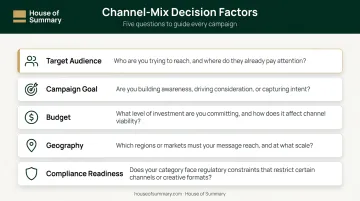
Factors that should guide your channel mix:
| Factor | Questions to Ask |
|---|---|
| Target audience | Patients, HCPs, caregivers, or all three? |
| Campaign goal | Acquisition, education, brand awareness, or retention? |
| Budget | What's the minimum to activate each channel effectively? |
| Geography | Local provider vs. national health system or pharma brand? |
| Compliance readiness | Does your team have the infrastructure to activate each channel safely? |
Reach alone is a weak metric in healthcare. A smaller, highly engaged audience — like newsletter subscribers or active search users — often delivers stronger patient acquisition outcomes than broad social media impressions from people who weren't looking for healthcare at all.
Conclusion
Successful healthcare digital advertising requires balancing patient-centricity, regulatory compliance, and measurable performance — none of which move in the same direction at once. Organizations that combine high-intent channels like SEO, email/newsletter advertising, and paid search with broader awareness tools like social, CTV, and contextual targeting consistently outperform those relying on one tactic alone.
Audit your channel mix against actual performance data regularly. That audit often surfaces one consistent gap: underutilized formats. Newsletter advertising, in particular, reaches engaged, opted-in audiences with strong click-through rates — and sidesteps both ad blockers and algorithm suppression entirely.
For healthcare brands looking to reach decision-makers and executives through a brand-safe, compliance-friendly channel, House of Summary's newsletter network offers premium placements across a 500,000+ subscriber base — delivered directly to the inbox, with no algorithm standing between your message and the reader. Contact sales@houseofsummary.com to explore advertising opportunities.
Frequently Asked Questions
What is healthcare digital advertising?
Healthcare digital advertising uses online channels — including search, social media, email, video, and programmatic platforms — to promote services, products, or health information to patients and HCPs. It differs from general digital advertising primarily through its compliance obligations under HIPAA and the ethical sensitivity of health-related messaging.
What are the most effective digital advertising channels for healthcare?
Effectiveness depends on campaign goals, but SEO, paid search, email/newsletter advertising, and contextual targeting consistently deliver strong ROI in healthcare. These channels combine high audience intent with privacy-friendly mechanics that work within HIPAA's restrictions.
How do HIPAA regulations affect healthcare digital advertising?
HIPAA restricts how patient data can be collected, stored, and used in advertising — limiting remarketing and behavioral targeting based on health conditions. This makes contextual, SEO, and email-based strategies particularly attractive as compliant alternatives with fewer regulatory risks.
How much does healthcare digital advertising typically cost?
Costs vary widely by channel, geography, and specialization — healthcare paid search keywords typically carry higher CPCs than most industries. Evaluate cost per lead (CPL) against patient lifetime value: a higher CPL can still mean strong ROI when the acquired patient has significant long-term value to the practice.
What metrics should healthcare marketers track?
Key metrics include patient acquisition rate, cost per lead, appointment bookings, website engagement, and email/ad click-through rates. Brand awareness campaigns should also track brand lift metrics that measure treatment intent changes over time.
Is newsletter advertising effective for healthcare brands?
Yes. Newsletter advertising reaches opted-in, engaged readers in a trusted editorial environment: no ad blockers, no algorithmic filtering, and CTRs that typically outperform display and social formats. That makes it particularly well-suited for reaching healthcare decision-makers and executives who follow health and business news closely.