Introduction: Why Advertising is the Growth Engine Healthcare Clinics Can't Ignore
Patients no longer choose a clinic based on proximity alone. They research, compare reviews, check websites, and often decide before making a single phone call. According to Software Advice's survey of 498 U.S. patients, 90% use online reviews to evaluate physicians, and 71% use reviews as their first step when finding a new doctor.
The competitive pressure is structural, too. The AMA reports that private practice ownership among physicians fell from 60.1% in 2012 to 42.2% in 2024, as hospital systems and corporate entities absorb more practices. Independent clinics are competing against organizations with dedicated marketing departments and larger budgets.
Visibility has become a prerequisite for growth. This guide gives clinic owners a practical advertising framework — covering digital channels, reputation building, and measurement — built specifically for the competitive environment described above.
Key Takeaways
- Strategy before spending: Define your target patient profile and competitive gap before running a single ad
- Google is non-negotiable: Google Business Profile optimization is free and directly affects who finds you in local searches
- Paid search captures intent: Google Ads for high-intent keywords deliver measurable leads at benchmarked costs
- Newsletter advertising bypasses blockers: Inbox-based ads reach engaged readers directly, with no algorithms or ad blockers in the way
- Measurement closes the loop: Measure what matters: Track booked appointments, not just clicks
Build Your Advertising Foundation Before Spending a Dollar
Most clinics jump straight to tactics — Google Ads, Instagram posts, maybe a flyer — without answering the two questions that determine whether any of it works: Who are you trying to reach? and Why should they pick you?
Define Your Target Patient Profile
A useful patient profile goes beyond "adults in our city." It includes:
- Age range, ZIP codes, and insurance types your clinic actually accepts
- Whether your patients are proactive about health or only come in when something is wrong
- What people in your area are searching for — urgent care, pediatric checkups, sports medicine, or something else entirely
Once this is clear, channel selection becomes obvious. A clinic targeting young families will prioritize Facebook and Instagram differently than one focused on executive wellness.
Run a Competitive Analysis
Before writing ad copy, spend 30 minutes researching what nearby clinics are already doing:
- What services do they prominently advertise?
- Which channels are they active on?
- What do their Google reviews say — and what complaints go unaddressed?
The gaps in their reputation or visibility are your opportunity. If three competitors have weak review profiles, winning reviews becomes your fastest path to differentiation.
Branding and Messaging That Builds Trust
Patients weigh healthcare decisions differently than most purchases. They're not choosing a product they can return — they're choosing someone to care for their health. Inconsistent branding across platforms creates friction and doubt before they've even called.
Your unique value proposition (UVP) should be specific and patient-centered. "Compassionate, quality care" tells patients nothing. "Same-day appointments, bilingual staff, in-network with most major plans" gives them a reason to choose you. That message needs to appear consistently across every ad, your website, and your Google Business Profile.
Setting a Realistic Advertising Budget
Tebra's 2024 survey of 106 private practices found 62% spend between 1% and 5% of revenue on marketing. That's a useful starting range, not a universal rule.
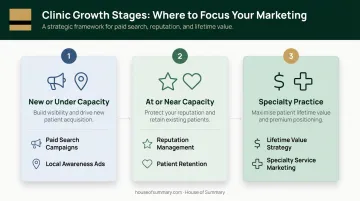
Budget allocation should reflect your growth stage:
- New clinic or below capacity: Allocate toward paid search and local awareness — you need new patients now
- At or near capacity: Shift toward reputation management, retention, and high-margin service promotion
- Specialty practice: Factor in patient lifetime value — a dental implant patient is worth far more than a single urgent care visit
Digital Advertising Channels That Drive New Patients
Patients begin their healthcare journey online. The channels below are where clinic advertising dollars produce the most measurable returns.
Local SEO and Google Business Profile
Your Google Business Profile (GBP) determines whether you appear when someone searches "urgent care near me" or "family doctor [city]." Google confirms that local rankings are driven by relevance, distance, and prominence — and that review count and score directly influence ranking.
GBP optimization checklist:
- Accurate NAP (name, address, phone) — consistent across all directories
- Updated hours, including holidays
- Photos of the clinic interior, exterior, and staff
- Detailed service descriptions using patient-friendly language
- Actively requesting reviews from satisfied patients
On your website, use location-specific keywords in page titles, meta descriptions, and service pages. A fast, mobile-optimized site is non-negotiable — Press Ganey's analysis of 6.5 million patient encounters found 80% of patients say online scheduling influences their provider choice.
Also claim profiles on Healthgrades (which reports more than 13 million patient ratings) and Zocdoc (250,000+ listed providers across all 50 states). These aren't just SEO citations — they're active conversion surfaces where patients book.
Pay-Per-Click (PPC) and Paid Search Ads
Google Ads let you appear at the top of search results for high-intent queries like "pediatrician near me" or "walk-in clinic open now." You pay only when someone clicks.
WordStream's 2024 Google Ads benchmarks provide realistic expectations:
| Category | Avg. CPC | Avg. Conversion Rate | Avg. Cost Per Lead |
|---|---|---|---|
| Physicians & Surgeons | $4.76 | 11.08% | $59.74 |
| Dentists & Dental Services | $6.82 | 8.36% | $86.49 |
A few critical PPC principles for clinics:
- Send clicks to a dedicated landing page, not your homepage — a landing page focused on one service converts far better
- Match the ad promise to the page: If your ad says "same-day appointments," the landing page must let patients book one
- Retargeting requires care: Google restricts personalized ads based on health interests, so consult your legal counsel before building health-condition retargeting audiences
Newsletter Advertising as a High-Engagement Channel
PPC's retargeting restrictions make it a limited tool for condition-specific awareness. Newsletter advertising fills that gap — it reaches engaged readers directly, without algorithm filters or ad blockers competing for visibility. When an issue goes out, it lands in inboxes of subscribers who actively chose to be there.
Campaign Monitor's benchmarks across 100 billion emails show Healthcare Services emails achieving a 23.7% open rate and 3.0% CTR — compare that to healthcare display ads, which average around 0.13% CTR according to LocaliQ's benchmark data.
House of Summary's newsletter network reaches 500,000+ subscribers, with 254,866+ emails opened daily across high-income metropolitan markets including New York, Los Angeles, London, and Dubai. The readership skews toward executives, senior professionals, and decision-makers — the same demographic that drives demand for premium healthcare, preventive care, and specialist services.

For clinic advertisers, the most practical formats are sponsored content and native editorial placements. These allow for contextual, narrative-driven messaging within a focused editorial environment: no competing ads on the same page, no intrusive display formats, and no risk of ad blockers stripping the placement before it's seen.
Clinics interested in newsletter placements can reach House of Summary's sales team at sales@houseofsummary.com to request a media kit.
Content, Social Media, and Reputation-Building
Building Authority Through Educational Content
Blog posts and health guides targeting questions patients are already asking — "when should I go to urgent care vs. the ER?" or "how often do I need a physical?" — build organic search visibility and position the clinic as a trustworthy resource.
The efficiency move: repurpose one piece of long-form content across multiple formats.
- Write a thorough blog post answering a common patient question
- Pull 3-4 key points for social media captions
- Record a 60-second video summary for Instagram Reels or YouTube Shorts
- Summarize it as a section in a patient email newsletter
That single content investment reaches patients across every channel they use.
Social Media Advertising and Organic Posting
Facebook and Instagram allow geographic targeting by ZIP code, age, and interest category — useful for promoting specific services like flu shots, pediatric checkups, or cosmetic dermatology to the right demographic.
For organic posting, consistency matters more than volume. A realistic content calendar might include:
- Health tips relevant to the season or local community
- Staff spotlights and provider introductions
- Behind-the-scenes clinic content
- Community involvement and local event participation
Patients research a clinic's social profile before booking. An account with sporadic posts from two years ago reads as neglected — and patients interpret that as a reason to look elsewhere.
Online Reviews and Reputation Management
53% of patients will not consider a provider with fewer than 4 stars, according to Tebra's 2025 patient survey. Reviews aren't a secondary concern — they're a primary filter.
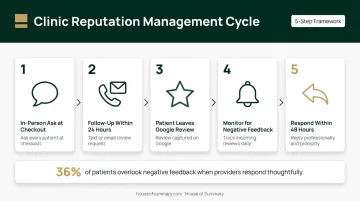
A simple review request process:
- Ask at checkout, naturally and specifically: "Would you mind leaving us a review on Google? It helps others find us."
- Send a follow-up text or email within 24 hours with a direct link
- Train front desk staff to mention it consistently
Collecting reviews is only half the equation. When negative feedback appears, respond within 48 hours — acknowledge the concern without disclosing patient information, and offer to resolve it offline. Software Advice found 36% of patients overlook negative feedback if the provider responds thoughtfully — a professional response often converts a liability into a trust signal.
Local and Offline Advertising Tactics
For most clinics, the primary patient pool lives within a 5–10 mile radius. Local trust outweighs broad brand awareness.
Tactics Worth Prioritizing
Direct mail has stronger healthcare support than most digital marketers acknowledge. USPS Delivers reports that health businesses see direct mail response rates of 11% to 15%, with health companies the most likely industry to exceed 25% response rates. A postcard campaign to nearby ZIP codes — with a QR code linking to an online booking page — is measurable and typically lower cost-per-impression than digital for hyper-local reach.
Community sponsorships — sponsoring a local 5K, school health fair, or community wellness event — put your clinic's name in front of neighbors in a context that feels credible, not commercial. Don't expect immediate patient volume; expect slower but stickier recognition.
Cross-referrals with complementary providers (physical therapists, chiropractors, OB/GYNs) create a mutual referral network with no media spend required — just consistent follow-through.
Tracking Offline Conversions
None of these tactics have to be a black box. Each one can be tied to measurable outcomes:
- Unique phone numbers on each physical ad to trace which piece drove calls
- QR codes on postcards and event materials linking to trackable landing pages
- "How did you hear about us?" as a standard intake question, then log it in your EHR or CRM
Measuring What Works: Tracking and Optimizing Advertising ROI
Most clinic advertising budgets leak quietly — not because the ads are bad, but because no one is tracking which ones actually fill appointment slots. Impressions and reach are easy to measure; booked appointments take more intentional setup.
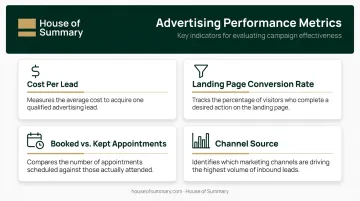
Key Metrics to Track
| Metric | What It Tells You |
|---|---|
| Cost per lead (CPL) | How much you're paying per appointment inquiry |
| Landing page conversion rate | Whether your page is convincing patients to book |
| Booked vs. kept appointments | Whether your scheduling experience follows through |
| Channel source (intake data) | Which advertising actually drives patients through the door |
Practical Tracking Tools
- Google Analytics (GA4): Track website traffic by source — but note that HIPAA-regulated entities must not expose protected health information (PHI) to analytics platforms
- Call tracking software: Google Ads supports call conversion tracking, so you can attribute phone appointments to specific campaigns
- UTM parameters: Add campaign tags to every URL so GA4 distinguishes traffic from Google Ads, newsletter placements, social posts, and direct mail QR codes
A/B Testing and Review Cadence
Test one variable at a time: headline vs. headline, or one landing page layout vs. another. Don't change five things simultaneously or you won't know what moved the needle.
Set a monthly review cadence and act on what you find:
- Pause campaigns that aren't generating appointment inquiries
- Reallocate budget toward channels producing booked visits
- Adjust messaging based on what patients are responding to
Frequently Asked Questions
How do I advertise my clinic?
Start with the free fundamentals — optimize your Google Business Profile, build your review volume, and make sure your website loads fast on mobile. Layer in Google Ads for immediate visibility on high-intent searches, then add social media and community tactics to build awareness over time.
What is the most effective advertising channel for a medical clinic?
Google Ads and local SEO capture patients already searching for care, while content marketing, social media, and newsletter placements build the trust that makes those searches convert. The most effective approach combines high-intent channels with awareness channels based on your budget and goals.
How much should a medical clinic spend on advertising?
Tebra's survey found 62% of private practices allocate 1%–5% of revenue to marketing. New clinics building awareness typically need to spend at the higher end; established practices focused on retention can often spend less. Tie your budget to patient capacity and the actual cost of acquiring a new appointment, not a flat percentage.
How do I advertise my clinic on Google?
Two strategies work together: optimize your Google Business Profile for free organic local search visibility, and run Google Ads (PPC) to appear at the top of results for high-intent queries like "clinic near me." Both should point to a website where patients can easily book.
Do healthcare clinics need to follow special rules when advertising?
Yes. HIPAA requires authorization before using patient information or testimonials in marketing materials. The FTC requires that health-related advertising claims be truthful and backed by evidence. Google and Meta both restrict certain health-based audience targeting. If you're unsure, consult legal counsel before launching campaigns.
How can I grow my patient base without a large marketing budget?
Focus on compounding, low-cost tactics:
- Optimize your Google Business Profile (free)
- Build a consistent review request process
- Publish educational blog content targeting patient search queries
- Create a simple referral program for existing patients
These build compounding returns without ongoing ad spend.