Search remains the dominant channel for patient acquisition. But rising CPCs, tightening privacy regulations, and increasingly sophisticated competitors mean that showing up isn't enough — you have to show up for the right query, with the right message, on a landing page that actually converts.
This guide breaks down what's working in healthcare search advertising right now: from keyword intent targeting and HIPAA-compliant tracking setups, to Quality Score optimization and multi-channel integration.
Key Takeaways
- Healthcare search CPCs average $5.64 overall, but vary sharply by specialty — keyword precision directly affects profitability
- Google restricts condition-based targeting; compliant audience strategies use in-market signals and demographics instead
- Ad Rank is determined by bid, auction-time quality, and expected asset impact — not just budget
- Conversion rates range from 25% (Dermatology) to under 1% (Addiction Recovery): specialty context shapes every campaign decision
- Newsletter advertising sidesteps Google's restrictions entirely — no algorithms, no ad blockers, and direct inbox access for health brands
Precision Keyword Targeting for High-Intent Healthcare Patients
Match Intent Before You Bid
Healthcare search queries don't all carry the same weight. Someone typing "emergency dentist open now" is ready to book in the next hour. Someone searching "what causes knee pain" is still three research sessions away from calling a clinic. Treating these queries the same — same bids, same ads, same landing pages — is where most healthcare campaigns waste budget.
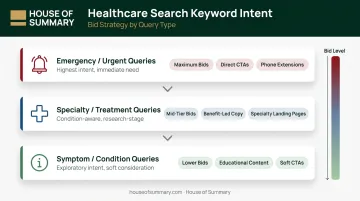
The fix is structuring your keyword list around three intent tiers:
- Emergency/urgent queries ("same-day appointment," "emergency dentist near me"): Maximum bids, direct CTAs, phone number extensions front and center
- Specialty/treatment-specific queries ("knee replacement surgeon," "LASIK consultation"): Mid-tier bids, benefit-led copy, specialty-specific landing pages
- Symptom/condition queries ("knee pain when walking," "blurry vision causes"): Lower bids, awareness-oriented copy, educational content with soft conversion paths
Intent tiering also determines match type strategy. Exact match protects high-bid urgent queries from irrelevant traffic. Phrase match works well for treatment-specific searches with natural variation. Broad match can surface symptom queries efficiently, but only when paired with a strong negative keyword list. Without that discipline, budget leaks fast.
Negative Keywords: Where Budget Quietly Disappears
Negative keywords are where most healthcare campaigns hemorrhage budget without realizing it. Without a disciplined exclusion list, your ads appear for queries like "free dental care," "home remedies for knee pain," or a competitor's brand name — clicks that cost real money and convert at near-zero rates.
Priority negative categories in healthcare:
- DIY and home remedy queries ("how to fix at home," "natural cure for")
- Insurance and cost-focused queries that don't match your offering
- Competitor brand names (unless you're running conquest campaigns deliberately)
- Medical education queries ("how to become a surgeon," "nursing school requirements")
- Symptom queries too early in the funnel for your specialty's typical patient journey
Review your search terms report weekly, particularly in the first 30-60 days of a campaign. The irrelevant queries that surface early tell you exactly where your match types are too broad.
Layer Geography for Local Patient Acquisition
Once your keyword list is tight, geography becomes the next lever. Search intent and location compound each other in ways that shift bid strategy significantly. A bid for "knee surgeon" means something very different in a major metro with five orthopedic groups running ads versus a mid-sized city with one specialist.
Effective geographic layering includes:
- Radius bidding centered on clinic locations (typically 10-25 miles for primary care, wider for specialists)
- City-specific ad copy ("Serving Houston patients since 2008")
- Bid adjustments that increase spend in your highest-converting zip codes
- Separate campaigns for locations with meaningfully different competitive landscapes
In practice, the campaigns that consistently hit cost-per-acquisition targets are the ones that treat geography as a signal — not just a filter. Zip-level bid data often reveals that 20% of your radius drives 60% of your conversions.
Navigating HIPAA Compliance and Google's Sensitive Category Restrictions
What Google Actually Restricts
Google's advertising policy prohibits personalized advertising based on sensitive health categories, including specific medical conditions, treatments, and procedures. This means you cannot target users because they have been diagnosed with — or inferred to have — a particular condition.
What this rules out in practice:
- Audience segments built around condition-specific browsing behavior
- Customer Match lists uploaded with health condition data
- Remarketing audiences created from condition-specific page visits (with important nuances below)
What remains available:
- In-market audiences ("people researching health services")
- Demographic targeting by age, gender, and location
- Custom intent audiences built around relevant search terms, without referencing specific conditions
- Geographic and time-of-day targeting
HIPAA vs. Google Policy: Two Different Frameworks
Conflating HIPAA and Google's ad policies creates problems in both directions — either under-compliance that creates legal risk, or over-restriction that unnecessarily limits campaigns.
HIPAA governs how covered entities and their business associates handle protected health information (PHI). It applies to your CRM, your patient portal, your appointment history, and to how you configure conversion tracking. HHS OCR has clarified that HIPAA obligations extend to tracking technologies on a covered entity's website that collect or disclose PHI.
Google's policy is a separate commercial restriction on what signals you can use for ad targeting. Both frameworks matter, but they require different responses.
Privacy-Safe Conversion Tracking
Standard Google Ads conversion tags create compliance exposure in healthcare. A standard pixel on a contact form submission can capture a patient's name, condition, or appointment request and transmit that data to Google, potentially disclosing PHI without authorization.
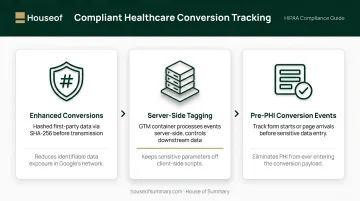
Compliant configurations include:
- Enhanced conversions with hashed data: Google's enhanced conversions apply SHA-256 hashing to first-party data before transmission. This is a technical layer, not a legal guarantee — your legal team should evaluate whether your specific implementation meets HIPAA standards
- Server-side tagging: Processing conversion events through a server-side Google Tag Manager container keeps raw form data off the client-side and gives you control over exactly what's sent downstream
- Conversion events triggered before PHI entry: Track form starts or page arrivals rather than form submissions that capture condition details
These configurations matter. The FTC's 2023 enforcement actions against GoodRx ($1.5M penalty) and BetterHelp ($7.8M consumer payment) involved sharing health data with advertising platforms through standard ad tech setups, not unusual or exotic implementations. The controls were simply missing.
Ad Copy Compliance
Healthcare ad copy cannot make diagnostic claims, guarantee outcomes, or imply that a patient has a specific condition. Compliant copy focuses on credentials ("Board-certified orthopedic surgeons"), availability ("Same-day appointments available"), location ("Serving downtown Chicago"), and patient-centered CTAs ("Request a consultation today"). That focus is sufficient. Ads built on credentials, availability, and access consistently convert without stepping near compliance lines.
Optimizing Quality Score, Ad Copy, and Landing Pages
How Ad Rank Actually Works
Quality Score is Google's diagnostic rating across three components: expected click-through rate, ad relevance, and landing page experience. It's a useful signal, but the actual auction mechanism is more nuanced.
Google calculates Ad Rank using five inputs:
- Bid amount
- Auction-time ad quality (all three Quality Score components)
- Ad Rank thresholds
- Auction competitiveness
- Expected impact of your ad assets and formats
A higher Quality Score lowers your effective CPC and improves your position. Better creative and landing page work directly reduces what you pay per click.
Writing Ad Copy That Converts Healthcare Searches
The difference between a healthcare ad that gets clicked and one that gets skipped is specificity. Generic service names ("Orthopedic Care") underperform benefit-led, specific headlines ("See a Knee Surgeon This Week – Same-Day Consults").
High-performing healthcare ad copy includes:
- A patient-centric lead: What does the patient get, not just what do you offer
- Trust signals: Years in practice, patient volume, board certifications, insurance acceptance
- Availability signals: "Accepting new patients," "same-day availability," "telehealth options"
- Intent-matched CTAs: "Book Your Free Consultation" for elective services, "Call Now" for urgent care, "Check Availability" for scheduling-focused ads
Match the CTA to the urgency of the keyword. A patient searching "emergency dentist now" should see "Call Now, We're Open" — not "Learn About Our Services."
Landing Pages: Stop Sending Clicks to Homepages
A click from "knee replacement surgeon" that lands on a general orthopedic practice homepage is a near-certain conversion loss. Patients expect to land on a page about exactly what they searched for.
Each campaign's landing pages should include:
- A headline that mirrors the ad's primary message
- A visible phone number within the first scroll (ideally click-to-call on mobile)
- A short, frictionless booking form (name, contact, preferred time — not a medical intake form)
- Trust elements: credentials, reviews, insurance logos, years in practice
- Fast mobile load times — most healthcare searches happen on phones
Conversion Rate Reality by Specialty
According to LocaliQ's healthcare search benchmarks, conversion rates vary dramatically across specialties:
| Specialty | CVR | CPL |
|---|---|---|
| Dermatology | 25.33% | $18.54 |
| Physical Therapy | 15.35% | $32.79 |
| Physicians & Surgeons | 11.08% | $59.74 |
| Healthcare Overall | 8.09% | $66.02 |
| Mental Health | 1.85% | $141.17 |
| Addiction Recovery | 0.50% | $120.30 |
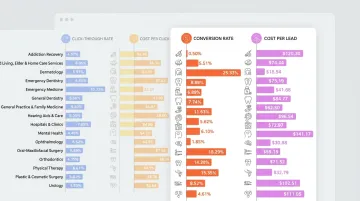
The gap between Dermatology and Addiction Recovery isn't purely about landing page quality. Mental health and addiction recovery face additional friction: Google's sensitive category restrictions, patient hesitancy, and longer decision timelines all compound the challenge. These specialties require softer CTAs, more educational content, and multi-touch attribution to convert effectively.
Integrating Display, Social, and Newsletter Advertising Into Your Search Strategy
Paid search captures patients the moment they're ready to act. But that moment rarely comes out of nowhere — it follows brand exposure, social proof, and repeated touchpoints that build enough trust for a patient to click and convert.
Display and Social as the Warm-Up Layer
Display ads handle brand familiarity. Retargeting connects users who visited your website but didn't book, keeping your practice visible while they continue researching. Social platforms — particularly Facebook and Instagram — reach patients who match demographic and interest profiles relevant to elective care specialties before they start searching. Cosmetic surgery, dermatology, and physical therapy practices use social effectively to create demand that later converts via search.
Social creates awareness. Search captures intent. Retargeting bridges what falls between them.
Newsletter Advertising as a High-ROI Search Complement
With healthcare search CPCs averaging $5.64 overall — and significantly higher in competitive specialties like orthodontics ($8.76) and emergency dentistry ($7.85) — diversifying into newsletter advertising offers a cost-efficient counterbalance.
Newsletter ads arrive in inboxes without algorithmic filtering, ad blockers, or banner blindness. For healthcare marketers, this matters structurally. Display ads get blocked. Social ads compete with competing posts, notifications, and videos fighting for the same screen. Newsletter placements appear inside content that readers chose to receive and are actively reading.
House of Summary's newsletter network reaches 500,000+ subscribers across Presidential Summary, Geopolitical Summary, Dubai Summary, and London Summary — with 66% of readers based in the US, concentrated in high-income markets like New York and Los Angeles.
That readership skews toward executives, decision-makers, and high-income consumers: demographics that align directly with elective care, premium health services, and direct-to-consumer health brands.
The platform supports native ads, sponsored editorial content with disclosure compliance, and multi-newsletter campaigns — all within an editorially controlled, human-written environment that sidesteps many of the platform restrictions that complicate healthcare advertising on Google and Meta. For healthcare brands navigating FDA compliance requirements — and international advertisers contending with MHRA rules — that compliance-friendly context removes a meaningful operational obstacle.

What's Driving the Healthcare Search Advertising Shift
Rising Costs and More Competition
More healthcare providers entered paid search post-pandemic, driving up CPCs across most specialties. LocaliQ's current benchmark data shows a roughly 6% year-over-year CPC increase across healthcare search overall. Telehealth's expansion (McKinsey estimated telehealth utilization stabilized at 38x pre-pandemic levels) created an entirely new category of digital-native health brands competing for search real estate that previously belonged to local practices.
Elective-care patients are also more price-sensitive and deliberate. They research more, compare more options, and take longer to book — which changes the economics of search advertising for anything non-urgent.
First-Party Data Is Now the Foundation
Third-party cookie targeting is eroding. Google's Privacy Sandbox shifted from a full cookie deprecation to a user-choice model in July 2024, but the direction is clear: audience targeting that relies on third-party behavioral data is becoming less reliable, and healthcare advertisers who built their retargeting strategies on it need alternatives.
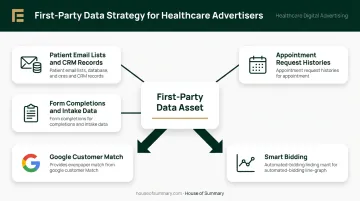
First-party data is now a core targeting asset for healthcare advertisers. Combined with platform-native tools like Google's Customer Match and Smart Bidding, it maintains audience precision without third-party cookie dependency. Key sources include:
- Patient email lists and CRM records
- Appointment request histories
- Form completions and intake data
AI Is Changing the Marketer's Role
Performance Max campaigns, responsive search ads, and automated bidding have shifted the healthcare marketer's job from manual bid management to strategic oversight. AI handles real-time optimization across placements and audiences; the marketer's job is to set the right goals, provide high-quality creative inputs, and audit what the automation is actually doing.
This shift is particularly significant in healthcare, where AI and Performance Max can disrupt paid search attribution in ways that require careful monitoring. Automated systems that optimize for conversions don't inherently know the difference between a high-value patient booking a surgical consult and a low-value inquiry that never responds — unless your conversion events are configured to reflect that distinction. Getting that setup right is where most healthcare advertisers gain or lose their edge.
Frequently Asked Questions
What is an example of a paid search ad in healthcare?
A healthcare paid search ad looks like a standard Google result but carries a "Sponsored" label. A typical example: "Board-Certified Family Doctor Near You — Same-Day Appointments Available," followed by a brief description of services offered, plus location or phone number extensions. Top placement is what makes the format effective — most users don't distinguish between sponsored and organic results at a glance.
How much does healthcare search advertising typically cost?
Healthcare search averages $5.64 CPC and $66.02 CPL overall, but specialty costs vary considerably. Orthodontics runs $8.76 CPC and Emergency Dentistry $7.85 CPC at the higher end, while Emergency Medicine averages just $2.29 CPC. Budget accordingly based on your specialty's competitive landscape.
What HIPAA rules apply to healthcare search ads?
HIPAA doesn't regulate ad copy directly, but it applies when your tracking setup collects or discloses PHI. Standard Google conversion pixels on healthcare forms can inadvertently capture patient data, and enhanced conversions with hashed data or server-side tagging reduce that risk. Review your setup with legal counsel before launching any campaigns involving form submissions.
What is a good click-through rate for healthcare Google Ads?
The overall healthcare search benchmark CTR is 6.07%, but specialty performance varies widely. Emergency Medicine leads at 10.33%, while Orthodontics (4.35%) and Mental Health (4.46%) sit lower. Your CTR benchmark should be calibrated to your specialty, competition level, and ad copy quality — not the overall average.
Should healthcare practices use paid search or organic SEO?
Both serve different roles. Paid search delivers immediate visibility for high-intent queries and lets you appear at the top of results while organic rankings develop. SEO builds long-term authority that reduces dependency on ad spend. The most effective approach uses paid search to cover high-priority queries immediately and fills the organic pipeline in parallel — they compound rather than compete.