Introduction
People ask more than 1 billion health questions every day on Google Search. For healthcare providers, that represents an enormous opportunity — but also a complicated one.
Healthcare PPC sits at an uncomfortable intersection: enormous reach and immediate visibility on one side, and strict compliance obligations, expensive keywords, and a patient decision journey that rarely ends with a single click on the other. A campaign that works beautifully for a retail brand can fail badly — or worse, create legal exposure — when transplanted into healthcare without modification.
Getting it right requires more than budget. This guide walks through foundational definitions, compliant campaign structure, ad format selection, bidding strategy, and how to measure whether your spend is actually generating patients.
Key Takeaways
- Healthcare PPC = paying for ads that appear when patients search for medical services; you pay only when someone clicks.
- HIPAA and Google's ad policies impose restrictions on tracking, retargeting, and audience targeting that don't exist in most other industries.
- High-intent, location-specific keywords — not broad informational ones — drive the best patient acquisition results.
- Service-specific landing pages, mobile optimization, and call tracking are essential for converting clicks into appointments.
- Success metrics = cost-per-lead, cost-per-acquisition, and patient lifetime value (not impressions or raw click volume).
What Is Healthcare PPC Advertising?
PPC (pay-per-click) advertising in healthcare is a digital model where providers pay a fee each time a potential patient clicks their ad. When someone searches "urgent care near me" or "dermatologist accepting new patients," those ads appear above organic search results — putting a practice at the top of the page at exactly the right moment. Each platform where PPC runs serves a different stage of that patient journey.
Where Healthcare PPC Runs
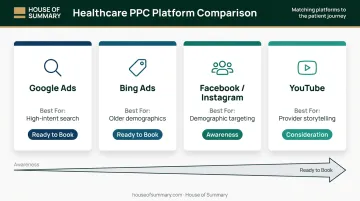
Four main platforms cover the spectrum from awareness to booking:
| Platform | Best For | Stage |
|---|---|---|
| Google Ads | High-intent search capture | Ready to book |
| Bing Ads | Lower CPC, older demographics | Ready to book |
| Facebook/Instagram | Demographic and interest targeting | Awareness, reminders |
| YouTube | Trust-building, provider storytelling | Consideration |
PPC vs. SEO: The Core Difference
These two channels are often compared as if you must choose between them — but most healthcare practices use both for different reasons.
- PPC delivers visibility within hours of launch but requires continuous spend to maintain it.
- SEO builds organic traffic over months and eventually reduces reliance on paid spend.
The practical split: PPC handles immediate patient acquisition while SEO builds sustainable, lower-cost traffic over time. Used together, they cover short-term demand and long-term growth.
Why Healthcare PPC Is Fundamentally Different
Healthcare advertisers face compliance obligations, platform restrictions, and patient behavior patterns that simply don't exist in other verticals. Campaigns built without accounting for these factors risk ad disapprovals, compliance exposure, and wasted budget — often all three at once.
HIPAA and Tracking Technology Risk
HHS OCR's guidance on online tracking classifies cookies, web beacons, tracking pixels, session replay scripts, fingerprinting, and mobile advertising IDs as potential HIPAA risks when they collect individually identifiable health information — including IP addresses combined with health-related page visits.
In July 2023, the FTC and HHS jointly warned approximately 130 hospital systems and telehealth providers about privacy risks from tracking technologies, specifically naming Meta/Facebook Pixel and Google Analytics.
A 2024 court decision did narrow OCR's position — an IP address combined with a visit to an unauthenticated public webpage is no longer automatically treated as PHI. But the broader tracking risk remains. Healthcare advertisers should:
- Require a Business Associate Agreement with any tracking vendor that may handle PHI
- Audit pixel and analytics setups before launching retargeting campaigns
- Treat remarketing as a high-risk tactic requiring specific compliance review, not a default campaign layer
Google's Personalized Targeting Restrictions
Platform restrictions add another layer on top of legal risk. Google prohibits personalized advertising targeting for sensitive health categories, and the restricted list covers conditions that represent major service lines for many healthcare providers:
- Mental health conditions (depression, anxiety)
- Addiction and substance use treatment
- Sexually transmitted infections
- Fertility testing and infertility treatment
- Pregnancy-related content
This means campaigns for behavioral health, addiction recovery, or fertility services cannot use standard remarketing lists, Customer Match, or lookalike-style audience expansion. Campaigns must be built on keyword and geographic targeting alone.
Ad Copy Compliance
Healthcare ad copy cannot make outcome guarantees, unsubstantiated claims, or superlatives that could mislead patients. Phrases like "guaranteed results," "best doctor in the city," or specific success rate claims can trigger platform flags or draw regulatory scrutiny. Compliant copy sticks to what the practice offers, where it's located, and how to schedule — no claims that can't be verified, no comparisons that can't be substantiated.
The Patient Decision Journey
Unlike an e-commerce purchase, healthcare decisions involve research, insurance verification, second opinions, and often weeks of deliberation. A patient who clicks an ad for orthopedic surgery is not buying that day. Campaigns need to support that longer journey — the goal is a form submission or phone call, not an immediate transaction. Building enough trust to earn that first contact is the real conversion target.
Cost Reality
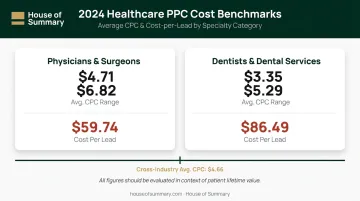
Healthcare is one of the most expensive PPC verticals. WordStream's 2024 Google Ads benchmarks show provider-adjacent categories ranging from $4.71 to $6.82 average CPC, slightly above the cross-industry average of $4.66. Cost-per-lead ranges from $59.74 (Physicians & Surgeons) to $86.49 (Dentists & Dental Services) — figures that need to be evaluated against patient lifetime value, not just the cost of a single click.
Types of Healthcare PPC Ads That Work
Not every ad format suits every healthcare use case. Here's how the main formats stack up.
Search Ads
The foundation of healthcare PPC. Text ads triggered by keyword searches appear at the top of Google or Bing results when patients are actively looking for services. A tight keyword match paired with a clear call-to-action — "Book a Same-Day Appointment" — captures patients at peak intent. This format consistently delivers the highest conversion rates in healthcare.
Local Service Ads (LSAs)
LSAs appear above standard search ads with a Google Verified badge and operate on a pay-per-lead model, not pay-per-click. Healthcare categories including Dentist, Dermatologist, Ophthalmologist, and Primary Care are eligible. Verification is mandatory and includes business registration and identity checks. The badge provides immediate trust signals that are particularly valuable for new patients choosing between unfamiliar providers.
Note: Google is transitioning to a single Google Verified badge and phasing out the money-back guarantee associated with the older Google Guarantee badge.
Display and Remarketing Ads
Display ads build awareness across the Google Display Network using visual banners. Remarketing targets users who previously visited a practice's website but didn't book — keeping the practice visible across their browsing sessions.
Critical caveat: Remarketing setup must be reviewed for HIPAA compliance before launch. Given OCR scrutiny of tracking pixels, standard remarketing configurations may require modification or a compliance review.
Social Media Ads
Facebook and Instagram allow demographic and interest-based targeting — useful for reaching parents for pediatric services, adults 40+ for orthopedics, or women for OB-GYN services. Social PPC works better for awareness and appointment reminders than for capturing immediate booking intent. Patients searching Google are ready to act; patients scrolling Instagram usually aren't.
Call-Only and Video Ads
- Call-only ads appear exclusively on mobile and display a clickable phone number. Ideal for urgent care or specialties where patients want to speak with someone before committing to a visit.
- YouTube video ads let practices demonstrate expertise, share provider introductions, and build credibility in a format with higher engagement than static display. Useful for elective specialties where trust is a significant barrier.
Newsletter Advertising as a Complementary Channel
Beyond these platform-based formats, some healthcare marketers pair paid search with inbox advertising — particularly when platform restrictions or compliance concerns limit their options on Google or Meta.
Newsletter ads bypass ad blockers and reach readers who opted in to receive content — attention is already present, not borrowed from an algorithm.
House of Summary's newsletter network reaches 500,000+ subscribers across publications including Presidential Summary and Geopolitical Summary, and accepts healthcare, pharma, and telehealth advertisers. The audience skews toward executives, policy professionals, and high-income consumers — demographics that align well with healthcare's higher-value patient segments.
For brands seeking a brand-safe, compliance-friendly awareness channel, newsletter placements are worth evaluating alongside traditional PPC. Reach out to sales@houseofsummary.com for media kit and rate details.
Building a Healthcare PPC Strategy That Converts
Intent-First Keyword Strategy
The most common budget waste in healthcare PPC is bidding on informational keywords when the goal is patient acquisition. There's a clear divide:
| Keyword Type | Example | Intent |
|---|---|---|
| Informational | "what causes knee pain" | Research, not booking |
| Transactional | "orthopedic surgeon near me" | Ready to book |
| Informational | "signs of diabetes" | Research, not booking |
| Transactional | "endocrinologist accepting new patients" | Ready to book |
| Informational | "how long does teeth cleaning take" | Research |
| Transactional | "schedule teeth cleaning [city]" | Ready to book |
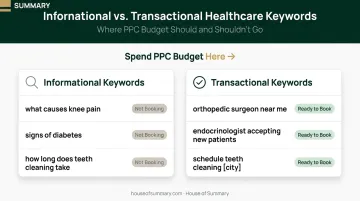
PPC budgets should weight heavily toward transactional, service-specific keywords. Informational keywords have their place in content and SEO strategy, but they burn PPC spend without producing appointments.
Negative keyword lists are equally important. A campaign for an orthodontic practice bidding on "braces" should exclude terms like "neck braces," "back braces," and "leg braces" from the start.
Geo-Targeting and Local Signals
Healthcare is inherently local, and campaign geography should reflect patient travel behavior:
- Urgent care: 3-5 mile radius — patients won't drive far for walk-in care
- Primary care: 5-10 mile radius depending on urban vs. suburban setting
- Rare specialties: Broader regional or state-level targeting is appropriate
Enable location extensions in ads to show the practice's address, and use "near me" keyword variants. These two elements work together to capture local intent and reassure patients that the practice is accessible.
Landing Pages Built for Conversion
Sending ad traffic to a practice's homepage is one of the fastest ways to waste PPC spend. Every ad needs a matching landing page — an ad for same-day back pain appointments should land on a page specifically about that service.
Effective healthcare landing pages include:
- One clear CTA — "Book Online" or "Call Us Today," not five competing options
- Click-to-call button prominent above the fold on mobile
- Online booking for patients who prefer not to call
- Provider credentials, years in practice, and patient reviews for credibility
- A brief HIPAA compliance note to reassure patients about data handling
Ad Extensions That Amplify Performance
Extensions add information and clickable elements to ads without increasing cost-per-click:
- Call extensions — clickable phone number directly in the ad
- Location extensions — practice address surfaced at a glance
- Sitelink extensions — direct links to "Book Now," "Meet Our Doctors," "Insurance Accepted"
- Callout extensions — short trust phrases like "Accepting New Patients" or "Same-Day Appointments Available"
Mobile-First Execution
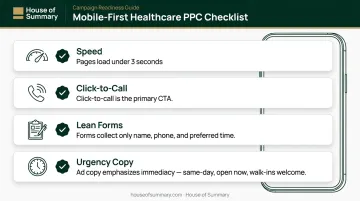
Healthcare searches happen on mobile constantly — someone with a toothache or a new symptom isn't sitting at a desktop. Reaching these patients means the entire ad experience needs to work on a small screen under pressure.
Mobile execution checklist:
- Pages load in under 3 seconds (slow pages lose patients before they read a word)
- Click-to-call is the primary CTA, not buried below a contact form
- Forms ask for name, phone number, and preferred time — nothing more
- Ad copy speaks to immediacy: "same-day," "open now," "walk-ins welcome"
Budgeting, Bidding, and Measuring ROI
Setting Budget Expectations
Healthcare PPC budgets make more sense when framed around patient lifetime value, not click cost. A single new patient relationship in most specialties generates revenue that far exceeds the cost of the click that brought them in.
Using 2024 benchmarks: Physicians & Surgeons average $59.74 cost-per-lead, Dentists average $86.49. Whether those figures represent good value depends entirely on the practice's average revenue per patient and retention rate.
Bidding Strategy by Campaign Stage
| Campaign Stage | Recommended Approach |
|---|---|
| Early (limited data) | Manual CPC or Maximize Clicks |
| Established (30+ conversions) | Target CPA bidding |
| Scaling | Target ROAS if revenue data is trackable |
The 30-conversion threshold for Target CPA isn't arbitrary — Google recommends evaluating Smart Bidding over at least one month at that volume before the algorithm has enough signal to optimize reliably. Smaller practices that don't reach it quickly should hold on manual or maximize-clicks bidding until the data catches up.
Measurement Fundamentals
Without proper tracking, healthcare campaigns fly blind. Three non-negotiable measurement layers:
- Call tracking — Links phone calls back to specific keywords and campaigns. Essential because many patients call rather than submit a form.
- Google Ads conversion tracking + GA4 — Captures form submissions, appointment booking completions, and on-site engagement signals.
- Offline conversion import — Connects CRM or EMR data back to Google Ads, so appointments actually booked (not just leads generated) can be tied to specific campaigns.
Primary metrics to monitor:
- Cost-per-lead and cost-per-new-patient acquisition
- Landing page conversion rate
- Tracked call volume by campaign and keyword
Healthcare PPC Best Practices Checklist
Use this checklist before launching a new campaign or running a compliance and performance audit. It covers the four areas where healthcare PPC campaigns most commonly break down.
Compliance
- Verified campaign structure against Google's healthcare ad policies
- Confirmed HIPAA-safe pixel and tracking setup with legal or compliance review
- Removed personalized audience targeting from campaigns covering sensitive health categories
Campaign Structure
- High-intent transactional keywords separated from informational ones
- Negative keyword list built and active
- Geo-targeting set to realistic patient travel radius
- Service-specific landing pages (not homepage) connected to each ad group
Measurement
- Call tracking enabled and linked to campaign/keyword data
- Conversion goals configured in Google Ads and GA4
- Bid strategy matched to campaign data maturity
Common Mistakes to Avoid
| Mistake | Why It Costs You |
|---|---|
| Sending traffic to homepage | Generic pages don't match ad intent; conversion rates drop sharply |
| Broad match without negatives | Irrelevant clicks drain budget fast |
| No call tracking | Misses a major conversion channel; looks like ads aren't working |
| No mobile optimization | Slow or clunky mobile experience loses patients at the last step |
Frequently Asked Questions
What does PPC mean in healthcare?
PPC (pay-per-click) in healthcare is a digital advertising model where providers pay only when a potential patient clicks their ad. Ads appear at the top of search results when patients search for relevant medical services, making it a fast way to reach people already looking for care.
How much does PPC advertising cost?
Costs vary by specialty and location. WordStream's 2024 benchmarks show provider-adjacent healthcare categories averaging $4.71 to $6.82 per click and $59.74 to $86.49 per lead. Budget decisions should be based on patient lifetime value, not just click cost.
Is PPC better than SEO?
Neither is better — they serve different purposes. PPC delivers immediate visibility for fast patient acquisition; SEO builds long-term organic traffic that reduces paid spend over time. Most practices benefit from running both simultaneously.
What are examples of PPC advertising?
The main formats for healthcare are:
- Google Search Ads — keyword-triggered text ads
- Local Service Ads — pay-per-lead with Google Verified badge
- Display Ads — visual banners across websites
- Facebook/Instagram Ads — demographic targeting
- YouTube Video Ads — provider storytelling
- Call-Only Ads — mobile ads with a direct call button
What makes healthcare PPC different from regular PPC?
Healthcare PPC is shaped by two distinct pressures: compliance requirements and patient behavior. HIPAA restricts how tracking and retargeting can be used; Google prohibits personalized targeting for sensitive health categories. And unlike e-commerce, patients take weeks to decide — campaigns must support a longer decision journey rather than expect an immediate conversion.
How do I know if my healthcare PPC campaign is working?
Focus on these four metrics:
- Cost-per-lead
- Cost-per-new-patient acquisition
- Landing page conversion rate
- Call volume from tracked numbers
Effective measurement requires call tracking and properly configured conversion goals in both Google Ads and GA4. Without those in place, you're working with an incomplete picture.