The 2022 HHS/OCR bulletin made this harder. Regulators clarified that standard ad-tech identifiers — IP addresses, device IDs, health-related URLs — constitute PHI when tied to an individual visiting a healthcare website. That classification made Google Analytics, Meta Ads, and most mainstream ad platforms structurally non-compliant for healthcare use without additional safeguards.
This guide covers the best platforms healthcare marketers can use in 2025 — with BAA availability, primary use case, and compliance posture for each.
Key Takeaways
- HIPAA-compliant advertising requires platforms that sign Business Associate Agreements (BAAs) and prevent PHI from reaching non-consented third parties
- Google Ads, Meta Ads, and GA4 do not sign BAAs; using them for PHI-touching workflows requires a compliant privacy middleware layer
- The strongest platforms span five categories: privacy middleware, compliant analytics, call tracking, programmatic DSPs, and email marketing
- Non-negotiable evaluation criteria: BAA availability, PHI filtering architecture, security certifications, and audit logging
- Newsletter advertising keeps reader data with the publisher and no tracking pixels reach ad platforms, making it one of the lowest-risk channels for healthcare brands
Why Healthcare Advertising Is Different
Under HIPAA, protected health information (PHI) in advertising contexts extends well beyond medical records.
PHI in digital advertising includes:
- IP addresses and device identifiers
- URLs containing health-related terms (e.g.,
/oncology/,/mental-health/) - Appointment dates and geographic location
- Any combination of identifiers that links a person to a healthcare service
Standard analytics and ad platforms collect all of these automatically, by design. When a user visits a hospital's depression treatment page, Google Tag Manager fires, captures the IP and URL, and sends both to Google's servers. That transmission, without a BAA and without PHI filtering, is a potential HIPAA violation.
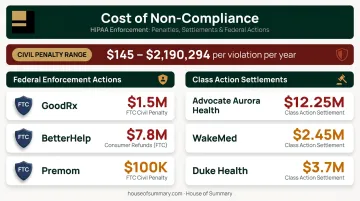
The regulatory consequences are concrete. The FTC took enforcement action against GoodRx ($1.5M), BetterHelp ($7.8M in consumer refunds), and Premom ($100K) in 2023 — each penalized for sharing consumer health data with ad platforms. Beyond federal enforcement, pixel-related class action settlements have reached $12.25M (Advocate Aurora), $2.45M (WakeMed), and $3.7M (Duke Health).
The FTC and HHS also sent joint warning letters to approximately 130 hospital systems and telehealth providers in July 2023 about online tracking risks. For healthcare marketers, that means standard ad tech workflows need compliance review before campaigns go live.
Best HIPAA-Compliant Healthcare Advertising Platforms
Each platform below was evaluated on BAA availability, compliance architecture, documented security certifications, and real-world use by healthcare marketing teams. No single tool covers every need — the right choice depends on your channel mix and existing infrastructure.
Freshpaint — Healthcare Privacy Platform / CDP
Freshpaint sits between a healthcare organization's website and its downstream ad and analytics tools. Rather than replacing Google or Meta, it routes data through a compliant server-side layer that strips PHI before anything reaches those platforms. Healthcare organizations can continue using Google Ads and GA4 without building custom infrastructure.
Columbus Regional Health used Freshpaint to remove non-compliant trackers and reintegrate Google Analytics in 20 days with no reported drop in marketing performance.
| Attribute | Detail |
|---|---|
| BAA Availability | Yes — signed as standard for every healthcare organization |
| Best For | Orgs that want to keep using Google/Meta ecosystems compliantly |
| Key Feature | PHI redaction engine using allowlists, hashed device IDs, and ID masking before data reaches non-BAA platforms |
Invoca — HIPAA-Compliant Call Tracking & Conversation Analytics
Invoca is an AI-powered call tracking and analytics platform built for high-compliance industries. Multi-location healthcare groups use it to attribute phone-based patient acquisition to specific campaigns and keywords — without exposing PHI.
It captures call intent signals (including appointment conversions), de-identifies caller data using SHA-256 one-way encryption, and passes anonymized signals back to ad platforms for campaign optimization.
| Attribute | Detail |
|---|---|
| BAA Availability | Yes — Invoca signs BAAs and offers an industry-standard template |
| Best For | Healthcare providers with high call volume who need campaign-level appointment attribution |
| Key Feature | AI conversation analysis identifying lead quality, patient sentiment, and conversion barriers from call recordings |
Invoca holds SOC 2 Type 2, ISO 27001, and PCI DSS certifications.
Piwik PRO — HIPAA-Compliant Analytics Platform
Piwik PRO is the most credible HIPAA-compliant alternative to Google Analytics 4. It offers a full analytics, tag manager, consent manager, and CDP suite — all within its own infrastructure. Unlike GA4, data never touches Google's servers.
Shepherd Center, a hospital using Piwik PRO, reported a 40% rise in online patient referrals and 215% increase in page views after switching.
| Attribute | Detail |
|---|---|
| BAA Availability | Yes — BAA available; data stays within Piwik PRO's controlled infrastructure |
| Best For | Marketing teams replacing GA4 and GTM with a full-featured, compliant analytics stack |
| Key Feature | US-based HIPAA-compliant Azure hosting, SOC 2 Type II, ISO 27001, audit logs, and role-based access controls |
Illumin — Programmatic Advertising / DSP
Illumin operates in the healthcare and pharma programmatic space, offering display, video, CTV, and audio advertising with contextual and propensity-based targeting rather than PHI-linked audience data. Its visual campaign mapping gives marketers full visibility into patient journey touchpoints.
Note on BAA: We could not verify an official BAA statement from Illumin in publicly available sources at time of writing. Healthcare organizations should request BAA documentation directly before contracting.
| Attribute | Detail |
|---|---|
| BAA Availability | Confirm directly with Illumin — not publicly verified |
| Best For | Healthcare orgs running programmatic display, video, or CTV campaigns |
| Key Feature | Canvas-based full-funnel campaign builder with Pathlight reporting and contextual/propensity targeting |
US healthcare and pharma ad spending surpassed $30B in 2024, up 5% year-over-year — programmatic channels are a significant share of that budget.
Paubox — HIPAA-Compliant Email Marketing
Paubox was built specifically for healthcare email, offering end-to-end encrypted delivery for both transactional and promotional communications. Unlike general email platforms that explicitly exclude PHI from their terms, Paubox makes HIPAA compliance the foundation of its service.
| Attribute | Detail |
|---|---|
| BAA Availability | Yes — BAA included as standard for all accounts |
| Best For | Hospitals, clinics, and health plans sending appointment reminders, care communications, or compliant promotional emails |
| Key Feature | Inbound and outbound encryption with zero-friction delivery — patients receive messages without a separate portal or password |
If you're weighing Paubox against mainstream options, note that Constant Contact does offer BAA arrangements, and HubSpot has introduced PHI-capable features in its Smart CRM. Mailchimp's PHI stance is less clearly documented — verify directly before use.
How We Chose These Platforms
Two criteria were non-negotiable:
- BAA availability — a documented willingness to sign a Business Associate Agreement
- Compliant technical architecture — evidence that PHI does not flow to unauthorized downstream systems
Signing a BAA does not, by itself, satisfy HIPAA's Security Rule. A vendor can agree to one and still route PHI to non-compliant subprocessors, which is why the underlying architecture matters as much as the contract itself.
Additional evaluation factors:
- Healthcare-specific customer base and documented case studies
- Third-party security certifications (SOC 2 Type II, HITRUST, ISO 27001)
- Consent and tag governance controls
- Audit log availability
- Track record following the 2022 HHS bulletin and 2024 guidance updates
The most common mistake buyers make is evaluating platforms on features and pricing before confirming BAA availability. Google Analytics 4, Meta Ads, and most standard email platforms explicitly state in their terms that PHI should not be passed to them. Using these platforms for PHI-touching workflows without a compliant middleware layer leaves the covered entity liable.
How to Build Your HIPAA-Compliant Advertising Stack
No single platform covers the full advertising workflow. A layered approach is required:
Layer 1 — Privacy Middleware A CDP or server-side solution (Freshpaint) that sanitizes data before it reaches any downstream tool. Without it, every other platform in the stack is at risk.
Layer 2 — Compliant Analytics Replace GA4 with a HIPAA-ready analytics platform (Piwik PRO) that provides full measurement without transmitting data to Google's infrastructure.
Layer 3 — Compliant Activation Channels
- Programmatic/display: Illumin (confirm BAA before contracting)
- Email: Paubox for patient and prospect communications
- Call tracking: Invoca for phone-based attribution
Layer 4 — PHI-Free Channels Newsletter advertising eliminates PHI risk at the channel level — no tracking pixels, no cookie-based retargeting, no data transmitted to ad platforms. Reader data stays with the publisher. For healthcare brands pursuing brand awareness with opted-in audiences, this channel sidesteps the compliance complexity of digital ad platforms entirely.
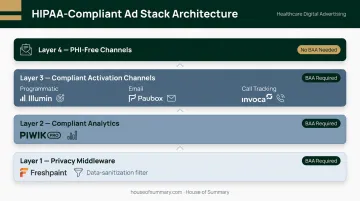
One critical rule across the entire stack: every vendor that touches campaign data must have a signed BAA in place. Review how data flows between systems. Any gap — a tag management tool, an analytics integration, a reporting dashboard — can expose PHI without authorization.
Conclusion
Choosing HIPAA-compliant advertising platforms is not a box to check once. The regulatory landscape continues to shift — post-HHS bulletin enforcement, the AHA lawsuit challenging OCR guidance, and ongoing FTC action mean the rules will keep evolving. Compliance must be treated as an ongoing operational discipline.
Evaluate platforms on the complete picture: BAA availability, technical architecture, security certifications, and demonstrated experience in the healthcare sector — not just feature sets or price.
For healthcare brands that want a high-engagement channel without the compliance overhead of digital ad platforms, newsletter advertising is a category worth considering alongside traditional options. House of Summary's network of specialized newsletters reaches 500,000+ subscribers — decision-makers, executives, and high-income professionals — delivered directly to the inbox.
No tracking pixels pass to ad platforms. No BAA required. It's a PHI-free channel by architecture, not by policy workaround.
Reach out to sales@houseofsummary.com to explore placement options.
Frequently Asked Questions
What is a HIPAA-compliant marketing platform?
A HIPAA-compliant marketing platform signs a Business Associate Agreement, implements required technical safeguards (encryption, access controls, audit logs), and does not transmit PHI to unauthorized third parties. Both the contractual obligation and the underlying data architecture must meet HIPAA's Privacy and Security Rules.
Which platforms are HIPAA compliant?
Relatively few mainstream platforms are natively HIPAA-compliant. Those with documented BAA availability include Freshpaint, Piwik PRO, Invoca, and Paubox. Google Analytics 4, Meta Ads, and Google Ads do not sign BAAs — they cannot be used for PHI-touching workflows without a compliant privacy middleware layer in between.
Are Google Ads HIPAA compliant?
Google Ads is not inherently HIPAA-compliant. Google does not sign BAAs for its advertising products, and tracking mechanisms can capture PHI such as IP addresses linked to health-related URLs. Healthcare organizations can use Google Ads only if a compliant server-side solution (like Freshpaint) strips PHI before data reaches Google.
What is a Business Associate Agreement (BAA) and why does it matter?
A BAA is a legally required contract under HIPAA between a covered entity and any vendor that may access or handle PHI. Any advertising platform touching health-linked campaign data must have a signed BAA; without one, the covered entity bears full liability for unauthorized disclosure or breach.
Can healthcare organizations use social media advertising under HIPAA?
Major social platforms (Meta, LinkedIn, TikTok) do not sign BAAs, making PHI-linked targeting and retargeting non-compliant. Healthcare brands can run general awareness campaigns with broad targeting, but must remove tracking pixels from health-specific or authenticated pages and avoid audience segments built on health conditions.
What happens if a healthcare advertiser violates HIPAA?
Civil penalties range from $145 to $2,190,294 per violation per year; criminal sanctions under 42 U.S.C. § 1320d-6 reach up to $250,000 and 10 years in prison. Class action exposure is equally serious — pixel-related settlements at WakeMed ($2.45M), Advocate Aurora ($12.25M), and Duke Health ($3.7M) show the real litigation cost.