Introduction
Today's patients rarely pick up the phone before doing their homework. They search symptoms, compare providers, scan reviews, and often have a shortlist in mind — all before making first contact with a clinic or hospital.
This shift has made marketing an operational necessity for healthcare organizations. According to a 2025 rater8 report, the vast majority of patients now use online resources when selecting a provider, and organizations without a visible digital presence are effectively invisible to a large portion of their prospective patient base.
But healthcare marketing isn't just about visibility. Done well, it builds trust, drives preventive care, and supports long-term patient relationships. Done poorly — or without compliance guardrails — it carries real regulatory risk.
This guide covers everything healthcare organizations need to build an effective, compliant marketing strategy: channel selection, campaign structure, regulatory requirements, and how to measure what's actually working.
Key Takeaways
- Healthcare consumers research providers online before making any contact; a strong digital presence is now a baseline requirement, not a differentiator
- Effective strategies blend SEO, paid search, social media, content, and email/newsletter advertising
- HIPAA compliance, BAAs, and FTC/FDA rules are non-negotiable guardrails for any healthcare campaign
- 88% of patients check online reviews before choosing a provider, making reputation management a core marketing function
- Newsletter advertising reaches subscribers directly in the inbox — no algorithms, no ad blockers, and open rates that consistently outperform display and social formats
What Is Healthcare Marketing?
Healthcare marketing is the process of strategic outreach and communication designed to attract prospective patients, guide them through their care journey, and retain them over time — while supporting the organization's broader business objectives.
It spans two broad format categories:
| Format Type | Examples |
|---|---|
| Traditional | Print, radio, TV, billboards, direct mail |
| Digital | SEO, paid search, social media, email, content marketing |
Modern strategies blend both based on audience demographics and campaign goals. A hospital system targeting older local populations might lean on radio and direct mail; a telehealth startup targeting younger urban patients will concentrate almost entirely on digital channels.
Healthcare marketing serves a wide range of organizational types, each with distinct audience targets and campaign objectives:
- Hospitals and health systems — large-scale brand awareness and service line promotion
- Private practices — local patient acquisition and appointment generation
- Health insurers — enrollment campaigns and member retention
- Pharmaceutical companies — branded drug campaigns with strict regulatory guardrails
- Medical device manufacturers — B2B outreach to clinicians and procurement teams
A pharma company running a branded drug campaign operates under very different rules than a primary care practice promoting flu shot availability.
Key Benefits of Healthcare Marketing
Patient Acquisition and Retention
Consistent, visible marketing helps healthcare organizations stand out in a crowded provider landscape. It also maintains engagement with existing patients — reducing churn through appointment reminders, health education content, and loyalty touchpoints.
Brand Trust and Authority
Strategic marketing builds credibility before a patient ever walks through the door. When a provider appears consistently in search results, maintains an active social presence, and has a strong review profile, patients arrive at that first appointment with confidence rather than doubt.
Public Health and Behavioral Impact
Few marketing disciplines carry the social weight that healthcare does — the right campaign can shift public behavior at scale. Efforts that drive real-world impact include:
- Promoting preventive screenings before conditions become acute
- Correcting health misinformation circulating on social media
- Reducing stigma around mental health conditions
- Encouraging healthier lifestyle choices through sustained education
These campaigns deliver measurable public health value, not just organizational returns.
Types of Healthcare Marketing Channels
Digital Channels
Search Engine Optimization (SEO) and Local Search
Ranking for condition- and location-specific queries is foundational for any patient-facing healthcare organization. A patient searching "cardiologist near me" or "urgent care open Sunday Chicago" is ready to act — the organization that appears in those results gets the appointment.
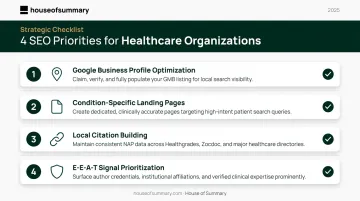
Key SEO priorities for healthcare organizations:
- Optimize Google Business Profile with accurate hours, services, and photos
- Create condition-specific landing pages with clear, authoritative content
- Build local citations across healthcare directories (Healthgrades, WebMD, Zocdoc)
- Prioritize E-E-A-T signals — Experience, Expertise, Authoritativeness, Trustworthiness — as Google's AI-driven search increasingly surfaces content from credible medical sources
Paid Search and Programmatic Advertising
Google Ads and programmatic display campaigns let healthcare marketers reach targeted local audiences quickly. Filtering by geography, demographics, and search intent makes paid search particularly useful for new practice launches or service line promotions. It's especially valuable where organic rankings haven't yet built up.
Healthcare paid search does carry higher cost-per-click than most industries due to competition, but the patient acquisition economics typically justify the spend when campaigns are tightly geo-targeted and conversion-tracked.
Social Media and Video Marketing
Platforms like Facebook, Instagram, and YouTube allow healthcare organizations to build community, share educational content, and humanize their brand. Video performs especially well — patient testimonials, provider introductions, and procedure explainers drive strong engagement.
One important caveat: HIPAA restrictions apply to social media engagement. Healthcare organizations cannot interact with patient health information in social contexts — even responding to a comment in a way that confirms someone is a patient constitutes a potential violation.
Content Marketing
Blogs, videos, webinars, infographics, and downloadable guides establish thought leadership and improve organic search rankings. For healthcare organizations, content marketing serves a dual purpose: it gives patients trustworthy resources that build trust before conversion, and it signals to search engines that the organization is an authoritative source on specific health topics.
Email and Newsletter Advertising
Email remains one of the highest-performing channels in healthcare marketing. Messages land directly in a reader's inbox with no algorithmic filtering, no ad blockers, and no competing visual clutter.
According to Mailchimp's email marketing benchmarks, healthcare email campaigns average an open rate around 22-23%, with click-through rates typically in the 2-3% range. These figures significantly outperform standard display advertising click-through rates, which average well under 1% across most formats.
Advertising in specialized, high-intent newsletters takes this a step further. Networks like House of Summary — which reaches 500,000+ subscribers including executives, decision-makers, and policy professionals — deliver placement inside the reading flow where attention is already present. With 254,866+ emails opened daily and no risk of ad blocking (newsletter ads bypass blockers entirely), it's a direct path to high-intent readers for healthcare brands that need engaged, qualified audiences without the noise of display formats.
For healthcare advertisers specifically, newsletter advertising offers an additional compliance advantage: no Protected Health Information (PHI) is required or collected, making it a genuinely HIPAA-friendly placement channel.
Traditional Channels
Print, radio, TV, and out-of-home advertising remain relevant for reaching certain demographics — particularly older patients and local communities where digital penetration is lower. Broad awareness campaigns for hospital systems, community health events, and seasonal health reminders often benefit from traditional formats.
The key is integration. Traditional channels work best when paired with digital follow-up. Used in isolation, traditional advertising offers little measurability and limited optimization. Paired with digital, the results compound:
- A billboard directs patients to a dedicated landing page
- A radio spot reinforces an active Google search campaign
- A direct mail piece drives recipients to a QR-coded appointment booking flow
How to Build a Healthcare Marketing Strategy Step by Step
Step 1: Define Your Audience and Map the Patient Journey
Start by identifying specific patient personas — not just demographics, but the conditions they're managing, the questions they're asking, and the channels they use to find answers.
Then map the full path from first awareness to appointment booking to ongoing care. Where do patients discover your organization? Where do they drop off? A chronic care patient's journey looks nothing like an urgent care walk-in's — your strategy should reflect that.
Step 2: Build a Consistent, Differentiated Brand
What makes your organization distinct? Specialized expertise, a patient-centered care model, technology, or community trust are all defensible differentiators — but only if they're translated consistently into messaging, visual identity, staff communication, and the actual patient experience.
Brand consistency across all channels (website, social, email, print, staff communication) builds the recognition that makes patients choose you before they've walked through the door.
Step 3: Build and Optimize a Professional Website
Your website is the hub of all digital marketing activity. Patients will land here from search, social, email, and referral traffic — and a poor experience will lose them regardless of how good the upstream marketing is.
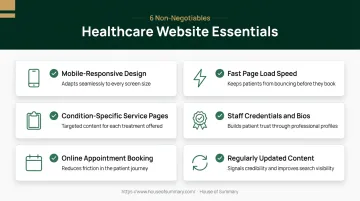
Non-negotiable website requirements:
- Mobile-responsive design (most health searches happen on mobile)
- Fast page load speeds
- Clear service pages with condition-specific detail
- Visible staff credentials and bios
- Online appointment booking
- Regularly updated content for SEO support
Step 4: Choose the Right Channel Mix
Prioritize channels based on your audience, budget, and goals. A new practice with no organic search presence needs paid search first — fast visibility while SEO gains traction. For an established health system focused on retention, email and content marketing typically deliver stronger returns.
Reaching patients across multiple channels outperforms any single-channel approach — a patient might discover your practice through search, follow you on Instagram, read your newsletter, and book after a positive Google review tips the decision. Each touchpoint reinforces the last.
Step 5: Manage Online Reviews and Reputation
Research from Software Advice found that 88% of patients use online reviews to evaluate providers. That number alone makes reputation management a marketing priority, not an afterthought.
Best practices:
- Actively solicit reviews from satisfied patients via post-visit email or text
- Respond to negative reviews professionally and without referencing PHI
- Monitor major review platforms (Google, Healthgrades, Yelp) consistently
- Never incentivize reviews — it violates platform policies and can raise FTC concerns
Step 6: Align Marketing with Measurable Goals
Marketing strategy should connect directly to business objectives — service line volume, payer mix optimization, patient retention rate. Vanity metrics (impressions, follower counts) tell you little. Cost-per-acquisition, conversion rate by channel, and patient lifetime value tell you where your budget is actually working.
Set KPIs before launching campaigns. Review performance monthly and reallocate budget toward what's converting — not what looks good in a report. The goal isn't activity; it's knowing which channels are driving appointments and at what cost.
Regulatory Compliance in Healthcare Marketing
Healthcare marketers operate in one of the most heavily regulated environments in advertising. Violations — even unintentional ones — can trigger federal fines, patient trust breakdowns, and enforcement actions that take years to resolve.
HIPAA and Patient Data
Under HIPAA, Protected Health Information (PHI) includes any individually identifiable health information — diagnosis, treatment history, appointment records. Using PHI in marketing communications without explicit patient authorization is a violation, regardless of intent.
HIPAA penalties for violations range from $100 to $50,000 per violation, with annual caps reaching $1.9 million per violation category. Beyond fines, breaches damage patient trust in ways that are difficult to recover from.
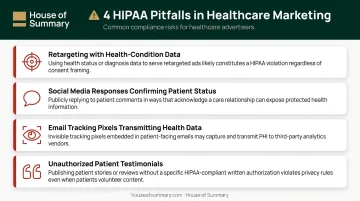
Common HIPAA pitfalls in marketing:
- Retargeting website visitors using health-condition data
- Responding to social media comments in ways that confirm patient status
- Using email tracking pixels that transmit health data to third parties
- Including patient names or conditions in testimonials without signed authorization
CAN-SPAM and Email Marketing Rules
The CAN-SPAM Act requires all commercial emails to include:
- Accurate sender identification and physical address
- Clear opt-out mechanisms honored within 10 business days
- Honest, non-deceptive subject lines
- No false routing information
Healthcare organizations sending email marketing (as distinct from transactional/care-related communications) must comply fully.
FDA and FTC Considerations
Email compliance is just one layer. Organizations promoting treatments, devices, supplements, or prescription drugs also face oversight from two federal bodies with distinct mandates:
- FTC: Prohibits unfair or deceptive acts, including unsubstantiated health claims — any effectiveness claim must be backed by competent, reliable scientific evidence
- FDA's OPDP: Actively monitors pharmaceutical advertising for misleading content, omitted risks, and off-label promotion
- "Clinically proven": A phrase that invites regulatory scrutiny unless supported by peer-reviewed data tied directly to the claim
Practical Compliance Step
Every marketing technology vendor that handles patient-adjacent data — including CRM platforms, email tools, and analytics providers — must operate under a signed Business Associate Agreement (BAA). This is a legal requirement under HIPAA, not a best-practice suggestion.
Before any campaign goes live, map every tool that touches patient data, confirm BAAs are signed, and have a HIPAA-experienced attorney or compliance officer review content and technology integrations together — not separately.
Measuring and Optimizing Your Healthcare Marketing Campaigns
Key Metrics to Track
| Metric | What It Tells You |
|---|---|
| Click-through rate (CTR) | Ad and content engagement quality |
| Cost-per-acquisition | Efficiency of patient conversion spend |
| Conversion rate by channel | Which channels actually drive appointments |
| Patient lifetime value | Long-term revenue impact of acquisition |
| Overall marketing ROI | Return on total marketing investment |
Tools for Measurement
- Google Analytics — traffic sources, behavior flow, goal completions
- CRM platforms — patient acquisition attribution, retention tracking
- Social media dashboards — engagement, reach, follower growth
- Email analytics — open rates, CTR, unsubscribes, list health
- Call tracking tools — for offline conversion attribution from digital campaigns
Continuous Optimization
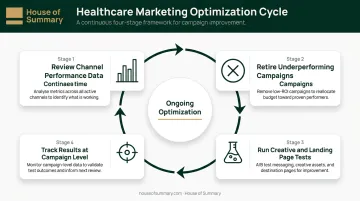
Healthcare marketing isn't a one-time build. High-performing organizations treat it as a continuous cycle. That means:
- Reviewing channel performance data monthly and reallocating budget toward what works
- Retiring underperforming campaigns before they drain resources
- Running ongoing tests on ad creative, landing page variants, and email subject lines
- Tracking results at the campaign level, not just the channel level
Frequently Asked Questions
What are healthcare marketing strategies?
Healthcare marketing strategies are the combination of branding, digital channels, content, reputation management, and paid advertising used to attract and retain patients. The right mix depends on the organization's size, patient population, competitive landscape, and growth objectives.
How do healthcare organizations comply with HIPAA in their marketing?
Key requirements: avoid using PHI in marketing without patient authorization, ensure all vendors handling patient-adjacent data have signed BAAs, follow CAN-SPAM rules for email, and train marketing staff on which data can legally appear in campaign workflows.
What is the most effective digital channel for healthcare marketing?
It depends on your goals. SEO drives long-term organic acquisition; paid search delivers fast visibility for new practices or service lines. Email and newsletter advertising consistently produce high engagement with no ad-blocking risk, making them strong options for sustained brand exposure.
How much should a healthcare organization budget for marketing?
Industry benchmarks typically place healthcare marketing spend at 2-5% of revenue, though this varies widely by organization type and competitive market. Allocation should be data-driven and tied to specific growth targets, not set arbitrarily.
How do patient reviews affect healthcare marketing?
Online reviews are a major factor in provider selection — 88% of patients consult them before choosing a provider. Actively soliciting reviews from satisfied patients, monitoring major platforms, and responding professionally to negative feedback are core components of any healthcare marketing strategy.
Can healthcare brands advertise in newsletters to reach patients or decision-makers?
Newsletter advertising is a HIPAA-friendly channel — no PHI is required or collected from readers. It reaches engaged audiences directly in the inbox, bypassing ad blockers entirely. House of Summary connects healthcare advertisers with executives, decision-makers, and affluent professionals across its newsletter portfolio.