
For healthcare organizations, this shift isn't just a marketing opportunity. It's a mandate. The challenge is that healthcare operates under rules that don't apply to most other industries — HIPAA restrictions on data use, FDA guidelines on health claims, and the inherent sensitivity of communicating about people's health. Getting digital marketing right here requires more than a social media calendar and a Google Ads budget.
This guide covers the strategies, channels, and compliance considerations that matter most for healthcare marketers in 2025.
Key Takeaways
- 84% of patients check online reviews before booking — your digital presence is your first impression
- Healthcare digital marketing is constrained by HIPAA, FDA rules, and ethical content standards, which limits which channels and tactics are actually viable
- Younger patients start on TikTok and YouTube; older demographics rely on search engines — matching the right channel to the right audience drives measurable reach
- Email remains a high-ROI channel, with healthcare services averaging a 23.7% open rate
- Contextual advertising is emerging as a privacy-safe alternative to cookie-based behavioral targeting
What Is Healthcare Digital Marketing — and Why It Stands Apart
Few industries carry as much weight in marketing decisions as healthcare. Healthcare digital marketing covers the use of online channels — search, social media, email, video, and programmatic advertising — to connect health services, providers, and brands with patients, caregivers, and healthcare professionals (HCPs).
What separates it from marketing in other industries isn't just regulatory complexity. It's the stakes. When someone clicks an ad for a new mattress and regrets the purchase, the consequences are minor. When someone makes a health decision based on misleading content, the consequences can be serious. That emotional and ethical weight shapes every aspect of how healthcare marketers must operate.
Three things make healthcare digital marketing distinct:
- HIPAA governs patient data collection and use; FDA rules dictate what health claims can legally appear in advertising
- Content must be accurate, grounded, and sensitive to the emotional weight of health decisions
- The audience spans hospitals, private practices, pharma brands, insurers, and individual clinicians — each with different goals and compliance requirements
Why Healthcare Organizations Can No Longer Afford to Ignore Digital
McKinsey found that healthcare providers who improved consumer experience — including marketing — saw revenue increase by up to 20% over five years and cost to serve fall by up to 30%. The patients, the ad dollars, and the competitors have all moved online. The data confirms it:
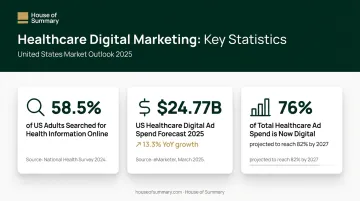
- 58.5% of US adults looked for health or medical information online in 2022, per CDC/NCHS — with Pew Research putting 60% using major health websites at least sometimes
- US healthcare and pharma digital ad spend is forecast at $24.77 billion in 2025, up 13.3% year-over-year
- Digital now accounts for 76% of total healthcare ad spend in 2025, projected to reach 82% by 2027
Healthcare organizations that deprioritize digital marketing aren't holding steady — they're actively losing ground to providers who show up where patients are already searching.
Understanding Your Audience: Trends Shaping Healthcare Digital Marketing Today
The Generational Divide
No single channel reaches every patient. McKinsey's research on Gen Z health behavior illustrates the split clearly: 38% of Gen Z use social media for health information, with platform usage at YouTube (96%), TikTok (72%), and Instagram (69%). Meanwhile, older demographics — Gen X and baby boomers — rely far more heavily on search engines and established medical websites.
That spread demands a multi-channel strategy, not a single bet on one platform — because no one channel captures the full patient population.
Women as the Primary Healthcare Decision-Maker
Women are the dominant force in US healthcare decisions, yet the industry's marketing still underrepresents them:
- 80%+ of US healthcare spending decisions are made by women
- 65% of the healthcare workforce is female
- Only ~one-third of pharma ads accurately portray women, per the ANA's SeeHer initiative
Healthcare brands that close this representation gap speak more credibly to the audience already driving their revenue.
HCPs Have Shifted Their Preferences
Healthcare professionals themselves have moved away from in-person rep visits. Post-pandemic data from Accenture found that only 12% of HCPs want exclusively in-person meetings with pharma companies, while 38% want fully virtual engagement, and 46% prefer hybrid. A separate survey by Indegene found that 68% of HCPs named webinars or webcasts as their most preferred channel for receiving clinical information, while 62% report feeling overwhelmed by purely promotional digital content.
For marketers, that's a clear signal: educational content delivered through digital channels consistently outperforms promotional messaging when the goal is reaching and retaining HCP attention.
Core Digital Marketing Strategies for Healthcare Organizations
Search Engine Optimization and Local Search
Search is where healthcare decisions often begin. Press Ganey data shows 37% of consumers find healthcare providers through online research, and 84% won't consider a physician with a rating below four stars.
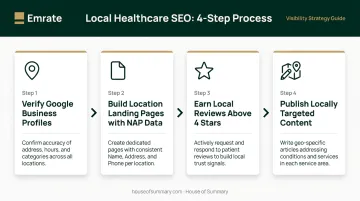
For providers with physical locations, local SEO is particularly high-value. Optimizing for queries like "urgent care near me" or "pediatrician in [city]" through accurate Google Business profiles, location-specific pages, and locally relevant content translates directly into appointment bookings — with no per-click cost. Key tactics include:
- Completing and verifying Google Business profiles for every location
- Building location-specific landing pages with accurate NAP data
- Earning local reviews to clear the four-star threshold patients expect
- Publishing locally relevant content that targets city- and neighborhood-level queries
Social Media Marketing
Social media plays a dual role: nurturing existing patient relationships through health tips and community content, while attracting new patients via organic presence and paid targeting. The influence on provider selection is measurable — 35% of patients have chosen a physician based on social media presence, and nearly 25% list social platforms as a top influence in their decision.
Platform selection matters enormously here:
- Gen Z audiences (mental health apps, preventive care): TikTok and Instagram
- Millennials (family medicine, OB-GYN, dental): Instagram and Facebook
- Older adults (cardiology, orthopedics, Medicare-related services): Facebook and search
Email and Newsletter Advertising
Email consistently delivers for healthcare marketers. Campaign Monitor's analysis of over 100 billion emails found healthcare services averaged a 23.7% open rate and 3.0% click-through rate — solid benchmarks that hold up against most other channels.
Beyond owned email programs, newsletter advertising offers an underused path to engaged audiences. Specialized newsletters deliver ads directly to subscribers' inboxes with no algorithmic filtering and no ad blockers — a meaningful advantage when platform reach is increasingly unpredictable.
For healthcare brands targeting decision-makers and affluent professionals, publishers like House of Summary illustrate the model well: 500,000+ subscribers across publications covering US politics, geopolitics, and city news in London and Dubai, with 254,866+ emails opened daily. That combination of guaranteed delivery and high-intent readership is difficult to replicate through programmatic display.
Newsletter ads also sidestep a persistent challenge in healthcare advertising: platform restrictions. Where social and search platforms frequently restrict or reject health-related ad content, email placements in brand-safe editorial environments provide a compliance-friendlier path to audience reach.
Video Content Marketing
Video is particularly well-suited to healthcare. It humanizes providers, simplifies complex information, and builds patient trust in ways written content rarely achieves on its own.
The data on YouTube health content is striking: a BMC Public Health study of 3,000 participants found 87.6% watch health-related content on YouTube, and 84.7% report making health-related decisions based on those videos. Notably, 40% watched specifically to decide whether to consult a doctor — making YouTube a genuine patient acquisition channel, not just an awareness play.

Short-form video on TikTok and Instagram Reels now serves as a patient education format for younger demographics. A well-produced clip explaining a common condition or walking through a procedure can reach audiences that text-based content simply doesn't convert.
Data-Driven Personalization and Analytics
Personalization improves both patient experience and campaign ROI. When a healthcare system can segment its email list to send diabetic care content only to patients managing diabetes, or surface relevant services based on a user's past engagement, the message lands with more relevance and less noise.
Analytics is the other half of that equation. Tracking brand awareness, content engagement, click-through rates, and appointment conversion data allows marketers to identify what's working and eliminate what isn't before budget is wasted.
One critical caveat: healthcare marketers must use HIPAA-compliant analytics tools. Standard platforms that collect personally identifiable information or rely on third-party tracking pixels can create serious compliance exposure — a point covered in more detail below.
Staying Compliant: How HIPAA Shapes Your Digital Marketing Approach
HIPAA's implications for digital marketing are more expansive than many organizations realize. The HHS Office for Civil Rights has explicitly identified cookies, tracking pixels, session replay scripts, and fingerprinting scripts as technologies that can result in impermissible disclosures of protected health information (PHI). The FTC has taken enforcement action against health platforms — including GoodRx and BetterHelp — for sharing health information through advertising platforms and tracking tools.
Practical implications for healthcare marketers:
- Standard programmatic retargeting that uses cookie-based tracking is high-risk on regulated health properties
- Third-party analytics tools that pass user data to advertising platforms may violate HIPAA without explicit safeguards
- Audience data built from health-related browsing behavior requires careful legal review before use in campaigns
Contextual Advertising as a Compliant Alternative
Given these risks, many healthcare marketers are shifting away from behavioral tracking entirely. Contextual targeting places ads alongside relevant content — an article about managing hypertension, for example — reaching high-intent audiences without accessing or disclosing PHI. This approach has become the more viable alternative to cookie-based retargeting, and it aligns naturally with newsletter advertising, where placement is based on publication topic and audience composition rather than individual user data.
Accuracy standards apply across every channel. Healthcare marketing content — ads, emails, blog posts, and social posts alike — that overstates treatment outcomes, creates unnecessary fear, or makes unsubstantiated clinical claims creates regulatory exposure that can outlast any single campaign and erode patient trust that's difficult to rebuild.
Frequently Asked Questions
What is healthcare digital marketing?
Healthcare digital marketing is the strategic use of online channels (search, social media, email, and video) to connect healthcare providers, brands, and services with patients and healthcare professionals. It differs from general digital marketing through its emphasis on trust, regulatory compliance, and ethical content standards.
How is healthcare digital marketing different from marketing in other industries?
The key differences are regulatory requirements (HIPAA, FDA guidelines), stricter ethical standards around patient safety and accurate health claims, and the deeply personal nature of health decisions. These constraints limit certain tactics and require more careful audience targeting and content review.
How do HIPAA regulations affect digital marketing strategies?
HIPAA restricts how patient data can be collected and used for advertising targeting, which limits standard programmatic and cookie-based retargeting. Healthcare marketers are shifting to privacy-safe alternatives (contextual advertising, owned email channels) that don't require access to protected health information.
What digital channels work best for reaching healthcare consumers?
It depends on the audience. Younger patients favor YouTube, TikTok, and Instagram; older demographics rely on search engines and established medical websites. A multi-channel approach that covers both is more effective than betting on a single platform.
Is email marketing still effective for healthcare organizations?
Yes. Healthcare email averages a 23.7% open rate — strong by most industry comparisons. Email works particularly well for patient education, appointment reminders, and personalized outreach, especially when content is educational rather than purely promotional.
How can healthcare organizations measure the success of their digital marketing?
Track website traffic, appointment conversion rates, social engagement, and email open and click-through rates as core metrics. For awareness-focused campaigns like video, brand lift studies can measure shifts in patient awareness and treatment intent that conversion tracking won't capture.