
Third-party cookies are unreliable across major browsers. HIPAA limits how patient data can be used in marketing. The FTC levied a $1.5M civil penalty against GoodRx and $7.8M in consumer redress against BetterHelp for sharing sensitive health data with ad platforms. The risk of getting this wrong isn't theoretical.
Contextual advertising sidesteps all of this. It matches ads to content environments rather than individual user profiles — no personal data collected, no regulatory exposure from identity-linked health signals. This post covers what contextual advertising is in healthcare, why behavioral targeting is failing the industry, how the technology works, and which channels deliver the best results.
Key Takeaways
- Contextual advertising serves ads based on surrounding content, not tracked user identities — no cookies required
- Contextual targeting is HIPAA-compatible by design — no personal health data is processed or transmitted
- Healthcare-specific taxonomies enable precise matching by condition, specialty, and treatment stage
- Ads reach patients and HCPs when they're already in a health-focused mindset, improving receptivity and recall
- Newsletter advertising is one of the most effective contextual channels in healthcare, yet it remains widely underused
What Is Contextual Advertising in Healthcare?
Contextual advertising serves ads based on the content of the page or environment where they appear — independent of who is viewing it or what they've browsed elsewhere.
That's the core distinction from behavioral targeting. Behavioral advertising follows an individual across the web using a unique identifier, building a profile of interests, conditions, and intent over time. Contextual targeting analyzes the environment itself. The ad is relevant to whoever happens to be consuming that content, regardless of who they are.
The Mindset Advantage
A practical example: a rheumatoid arthritis medication appearing alongside an article about managing joint inflammation. The reader is already thinking about that condition. The ad feels like a natural extension of what they're reading — placed, not pushed.
This matters more than it might seem. IAS research using eye-tracking methodology found that in-context ads were noticed in 0.4 seconds versus 1.0 second out of context, drove 14% higher purchase intent, 5% higher brand favorability, and 4x higher unaided brand recall. A separate IAS congruence study found that 74% of consumers are more likely to remember an ad related to the surrounding content.
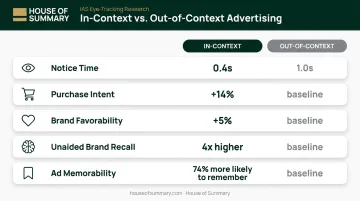
These numbers aren't healthcare-specific, but the mindset principle is especially relevant in health contexts, where readers seeking condition information are already in a high-intent, actively engaged state.
Why Healthcare Needs Specialized Taxonomies
General contextual targeting uses broad IAB content categories — "health," "fitness," "diabetes" — that don't capture the clinical specificity healthcare advertisers need. A standard "diabetes" category lumps together newly diagnosed patients, long-term Type 2 management content, and clinical research on insulin resistance — three very different audiences.
Healthcare contextual targeting uses layered medical taxonomies instead:
- Generic IAB: Diabetes
- Healthcare taxonomy: Endocrine System Disorders > Diabetes Mellitus > Type 1 Diabetes > Insulin Management
That granularity lets a glucose monitoring brand place ads next to content that matches its product's use case, rather than anything loosely related to blood sugar.
Platforms like Doceree use MeSH-based taxonomies with 7M+ medical keywords for real-time page analysis. That depth of classification simply isn't available in general programmatic tools — which is why healthcare contextual targeting requires purpose-built platforms, not repurposed general infrastructure.
Why Cookie-Based Targeting Is Failing Healthcare Marketers
The structural shift away from third-party cookies is real, even if it hasn't followed a clean timeline. Google reversed its plan for a full Chrome deprecation, instead opting to give users cookie consent choices — but that doesn't mean identity data is stable or reliable.
Safari and Firefox already block cross-site tracking cookies by default. StatCounter data from April 2026 shows Chrome holds 68% of global browser share, while Safari and Firefox together account for over 19% — a substantial portion of traffic where behavioral tracking is already constrained. Cookie deprecation isn't a single cutoff date. It's a gradual, ongoing erosion — and it's already underway.
The Regulatory Dimension
That erosion of tracking reliability compounds a problem healthcare marketers already face: the legal exposure from behavioral targeting in this category is more acute than in almost any other industry.
- HIPAA requires written authorization before protected health information (PHI) is used for marketing. HHS has clarified that tracking technologies disclosing PHI to ad vendors without authorization constitute impermissible disclosures
- CCPA/CPRA classifies health-related personal information as sensitive data, adding state-level exposure on top of HIPAA
- NAI guidelines require opt-in consent when using sensitive health information for tailored advertising, explicitly covering inferences about cancer, mental health, and sexually transmitted diseases
The FTC enforcement cases against GoodRx and BetterHelp weren't edge cases — they reflect exactly how regulators treat sensitive health data flowing to ad platforms. That regulatory posture extends beyond fines. It shapes how patients perceive brands that advertise to them using health data.
The Trust Problem
According to AMA survey data, 92% of patients believe privacy is a right and that their health data shouldn't be available for purchase. A Pew Research study found 72% of Americans feel they have little or no control over what companies do with their personal data.
When patients notice that an ad for a mental health platform follows them across websites after they searched for anxiety symptoms, they don't feel served — they feel surveilled. That association damages the brand, regardless of how well the ad performed on click metrics.
How Healthcare Contextual Advertising Works
The entire process runs in milliseconds — and at no point does it require access to personal data.
Content Scanning and Classification
When a user loads a page, AI-powered algorithms analyze the page's text, keywords, metadata, and semantic meaning in real time before any ad impression is served. The result is a content classification that determines whether the page is contextually suitable for a given ad.
Platforms like IAS and DoubleVerify use predictive AI that pre-screens pages across 600+ content categories, incorporating emotion and sentiment detection alongside topic classification.
Sentiment and Relevance Filtering
Not every mention of a health condition is an appropriate ad placement. A celebrity gossip article that mentions a public figure's cancer diagnosis is technically "about cancer" — but it's not a relevant placement for an oncology treatment brand.
Advanced contextual solutions layer in sentiment analysis to distinguish between:
- Articles focused on treating or managing a condition (high-relevance)
- Articles that mention a condition tangentially (low-relevance)
- Content with negative or distressing framing around a condition (brand-safety risk)
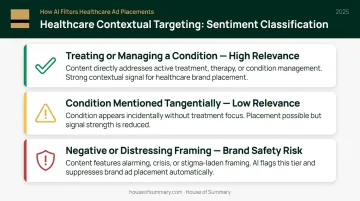
This filtering is what makes healthcare-grade contextual targeting fundamentally different from basic keyword matching.
Non-PII Intent Signals
Endemic health platforms can observe behavioral patterns within their own environment — repeat visits to cardiology content, downloads of a hypertension whitepaper — without identifying any individual. These aggregated signals help advertisers prioritize high-intent placements without crossing into personal data territory.
These signals typically surface through:
- Repeat content visits — users returning to the same condition or treatment category
- Content depth — time spent on clinical or treatment-focused articles vs. general health news
- Resource downloads — whitepapers, guidelines, or formulary documents accessed within the platform
The full pipeline — content analysis, contextual classification, audience qualification, and ad serving — runs programmatically across display, native, video, connected TV, and newsletters. Healthcare marketers get the right clinical audience, across every major ad format, without touching a single personal data point.
Key Strategies for Healthcare Contextual Campaigns
DTC vs. HCP Contextual Approaches
These two audiences require fundamentally different targeting frameworks.
DTC (patient-facing) campaigns target environments where patients actively seek health information:
- General health and wellness sites
- Condition-specific forums and communities
- Health news publications and lifestyle content
HCP campaigns require placement within professional content environments:
- Medical journals and CME platforms
- Specialty-specific hubs like Medscape
- Clinical research content and point-of-care platforms
According to DeepIntent, endemic clinical sites deliver win rates 1.5x to 2x higher than non-endemic placements, but CPMs run 2.5x to 3.5x higher depending on specialty — notably in neurology, pathology, and cardiology. Non-endemic placements deliver 65% higher reach on average.
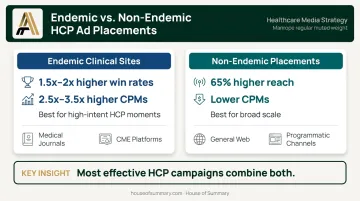
Most effective HCP campaigns use both: endemic inventory for high-intent clinical moments and non-endemic for broader scale.
Precision vs. Broad Contextual Targeting
A glucose monitoring brand, for instance, can work two distinct targeting tiers:
- High-precision: "insulin management, Type 1 diabetes device" targets patients actively researching devices
- Broader awareness: "diabetes management, living with diabetes" reaches a wider audience that includes caregivers, newly diagnosed patients, and adjacent health-seekers
High-precision targeting suits conversion-focused campaigns; broader contextual works for disease awareness and brand building. Campaigns targeting fewer than 100,000 HCPs should be careful about stacking too many contextual and geographic filters — precision can hurt scale in narrow pools.
Matching Creative to Context
Ad creative should mirror the emotional register of the surrounding content. Two pairings consistently outperform generic placements:
- Research environments: Clinical data and outcome statistics align with the analytical mindset readers bring to medical journals and CME platforms
- Condition management content: Patient-narrative storytelling resonates alongside wellness articles and community forums
When tone matches context, both engagement and brand favorability improve.
The Best Channels for Healthcare Contextual Advertising
Endemic Health Platforms
The highest-intent placements are on platforms where every visitor has self-selected into health content — condition-specific sites, medical journals, clinical forums. Endemic environments command higher CPMs for a reason: they deliver audiences who are already engaged with relevant health topics, making them more receptive and converting at higher rates.
For specialist campaigns, endemic inventory is often worth the premium. For broader reach campaigns, a blend of endemic precision and non-endemic scale is typically more cost-effective.
Newsletter Advertising
Newsletter advertising may be the purest form of contextual targeting available, yet it remains one of the most underused channels in healthcare marketing. The difference from programmatic display comes down to a few structural advantages:
- Subscribers opted in to receive content on a specific topic, meaning the audience is pre-qualified by self-selection
- No algorithmic interference between the ad and the reader — the ad appears in editorial flow, not in a sidebar competing with other elements
- Ad blockers don't apply to email, so every opened newsletter delivers 100% ad visibility
- No banner blindness — native placements within editorial content bypass the trained visual filtering that kills display ad attention
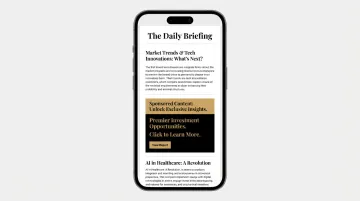
House of Summary's network of specialized newsletters (Presidential Summary, Geopolitical Summary, Dubai Summary, and London Summary) reaches 500,000+ subscribers with 254,866+ emails opened daily. The readership skews toward decision-makers, executives, and high-income professionals, with 66% based in the US.
For healthcare brands targeting executives responsible for purchasing decisions, or reaching affluent consumers in a brand-safe, human-written environment, newsletter placements offer an attention-rich alternative to programmatic channels.
The network explicitly supports healthcare, pharma, telehealth, health insurance, hospital systems, medical device manufacturers, mental health platforms, and digital health companies — with formats including native ads, sponsored editorial content, and full-network takeovers.
Additional Programmatic Channels
Beyond endemic platforms and newsletters, several channels extend contextual reach:
- Connected TV (CTV): Contextual targeting based on show genre, content category, and viewer intent signals — effective for broad DTC awareness
- Digital out-of-home (DOOH): Location-based contextual targeting, with placements near medical facilities, pharmacies, or health-focused venues
- Programmatic audio: Contextual matching based on podcast topic or streaming content category
- Native advertising: In-feed placements that match the look and feel of surrounding editorial, reducing ad blindness
Each channel adds a layer to a full-funnel contextual strategy — awareness through CTV and audio, consideration through endemic platforms, conversion through high-intent newsletter and native placements.
Frequently Asked Questions
What is contextual advertising?
Contextual advertising serves ads based on the content of the surrounding page or environment — not on personal user data or behavioral tracking history. It requires no cookies or individual identifiers; relevance comes from content matching, not identity profiling.
What are contextual features in healthcare?
Healthcare contextual features include specialized medical taxonomies that classify content by condition, specialty, and treatment stage; sentiment analysis to ensure brand-safe, genuinely relevant placements; and non-PII intent signals derived from content engagement patterns within health-specific platforms.
How does contextual advertising comply with HIPAA?
Contextual advertising analyzes page content rather than user identity, so it doesn't collect or transmit personally identifiable health information. HHS guidance centers on PHI disclosure risk, and contextual targeting — which uses no individual health data — significantly reduces that exposure, though compliance always depends on specific data flows.
Is contextual advertising more effective than cookie-based targeting in healthcare?
No published benchmark directly compares contextual vs. behavioral eCPA or ROAS in healthcare. General studies do show contextual ads delivering higher attention, purchase intent, and brand recall — and they sidestep the regulatory and reputational risks that make behavioral targeting particularly precarious in health categories.
What types of healthcare brands benefit most from contextual advertising?
Pharmaceutical brands, medical device companies, health systems, telehealth providers, and mental health platforms all benefit. Those in sensitive condition categories gain the most: NAI guidelines restrict behavioral targeting for mental health, sexual health, and chronic disease, making contextual the practical default.
How does contextual advertising work in newsletters?
In newsletter advertising, ads appear within editorial content that subscribers actively chose to receive. The audience is self-selected around a specific topic, meaning contextual alignment is built in from the start. There's no tracking, no algorithmic intermediary, and no ad blocker risk. The result is a genuinely engaged reader encountering a placement that fits the content they sought out.