
Introduction
You open an article about training for your first marathon, and halfway down the page, there's an ad for an energy gel brand. You're reading a personal finance newsletter, and a wealth management firm's ad sits right beneath the lead story. Neither of these is a coincidence — it's contextual advertising doing exactly what it's designed to do.
With privacy regulations tightening under frameworks like GDPR and CCPA, and major browsers moving away from third-party cookie tracking, advertisers need targeting methods that don't depend on personal data. Contextual advertising fits that need.
According to Grand View Research, the global contextual advertising market was valued at $195.44 billion in 2023 and is projected to reach $468.17 billion by 2030 — a 13.3% annual growth rate.
This article covers what contextual advertising actually is, how it works technically, why it's gaining ground again, and how it differs from behavioral targeting.
Key Takeaways
- Contextual advertising places ads based on the content someone is currently reading or watching — not on who they are
- Ads are matched by analyzing a page's topic, keywords, and meaning — no user profiling needed
- No cookies or personal data required — making it privacy-compliant by design
- Contextual ad spend is rising fast as behavioral targeting faces increasing regulatory and technical pressure
- Newsletter advertising is one of the most powerful contextual channels available — and one of the most overlooked
What Is Contextual Advertising?
Contextual advertising places ads based on what a page is about, not who is reading it. The ad aligns with the content on screen, not the profile of the person viewing it.
A running shoe brand appearing inside a marathon training guide. A recipe app promoted alongside a cooking tutorial. These placements feel natural rather than intrusive because they align with what the reader is already thinking about at that moment.
What Contextual Advertising Is Not
Unlike behavioral targeting, contextual advertising:
- It does not track individuals across websites
- It does not require cookies or personal data
- It does not follow users based on their past searches or purchase history
The FTC defined contextual advertising as targeting based on "a consumer's current visit to a single web page or single search query" — with no data retained beyond what's needed to serve that one ad.
A Brief History
Contextual advertising predates modern data-driven targeting by decades. In print, car ads appeared on motoring pages and holiday ads ran in travel sections. Online, Google AdSense made page-content targeting scalable when it launched on June 18, 2003, enabling publishers to serve ads "precisely targeted to the specific content of their individual web pages." By 2013, over 2 million publishers were earning through the platform.
The method never disappeared. It's now experiencing a clear resurgence, driven by privacy demands and improvements in NLP-based content classification that make semantic ad matching far more precise than before.
How Contextual Advertising Works
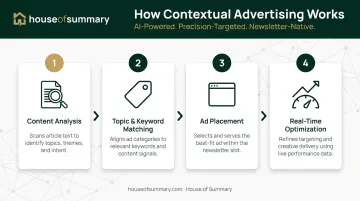
Contextual targeting follows a four-step process. Each step has grown significantly more capable over the past decade, largely because of AI — but the underlying logic remains the same: match the ad to the content, not the person.
Step 1: Content Analysis
When a page loads, automated systems scan its text, images, metadata, and in some cases audio and video. AI and natural language processing (NLP) read meaning and sentiment — not just individual words. According to IAB Europe, semantic targeting platforms "analyze content to attribute keywords and/or categories" using computer science including NLP.
Step 2: Topic and Keyword Matching
The system identifies key themes and looks for advertisers whose ads align with those themes. Targeting can be broad (a general category like "fitness") or highly specific (a keyword like "marathon recovery nutrition"). The IAB's Content Taxonomy 3.0 provides a standardized classification framework that supports both contextual targeting and brand safety assessment.
Step 3: Ad Placement
The matching system selects a relevant ad and places it within or alongside the content — via a programmatic platform or a direct publisher arrangement. The ad appears exactly when the reader is engaged with relevant material.
Step 4: Real-Time Optimization
Because campaigns run programmatically, advertisers can monitor performance in real time and adjust targeting, creative, or placement settings without waiting for a campaign cycle to end.
What AI Actually Does Here
Each of these steps runs on AI — and that's what makes contemporary contextual systems far more precise than early keyword-matching tools. According to IAB Tech Lab, AI-driven contextual systems use large language models to "analyze unstructured data, recognize deeper semantic connections, and distinguish meanings." For example, a page about cars in a movie plot won't serve automotive ads, and an article mentioning "running" in a political context won't trigger running shoe placements.
Why Contextual Advertising Matters Now
Privacy Compliance and Browser Changes
Behavioral advertising relied on third-party cookies to track users across websites. That infrastructure is eroding:
- Safari implemented full third-party cookie blocking by default in March 2020
- Firefox rolled out Total Cookie Protection to all users worldwide in June 2022
- Chrome announced in April 2025 it would maintain a user-choice approach rather than full deprecation
Contextual advertising requires none of this tracking infrastructure. It works cleanly within privacy regulations because it reads content, not people.
Relevance Without Surveillance
A 2022 GumGum and Harris Poll survey of 1,027 UK adults found that:
- 79% were more comfortable with ads relevant to the page they were visiting than ads based on browsing history
- 80% would be more open to ads if they didn't require personal data
- 65% said they'd be more tempted to purchase from a contextually relevant ad versus 35% for a behavioral one
Contextual ads feel less intrusive because the reader is already thinking about the topic. The ad arrives at the right moment, not as a digital ghost of something they searched three weeks ago.
Brand Safety
Relevance matters to consumers — but for brands, the bigger concern is where their ads actually land. Behavioral targeting has produced some notable failures. In 2017, Verizon, Walmart, and AT&T pulled millions of dollars in YouTube advertising after their ads appeared alongside extremist content. With approximately 400 hours of video uploaded per minute, content quarantine was nearly impossible.
Contextual targeting addresses this by tying placements to content category and topic rather than user behavior. Brands control where their ads appear. The editorial environment itself becomes the safety layer.
Performance
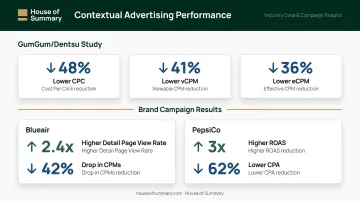
A GumGum and Dentsu Aegis Network study using 1 million impressions compared behavioral and contextual targeting lines directly. Contextual delivered:
- 48% lower CPC
- 41% lower vCPM
- 36% lower eCPM
Real-world brand campaigns echo this. Via IAB Tech Lab, a Blueair campaign using AI-based contextual targeting achieved a 2.4x higher detail page view rate and 42% drop in CPMs. A PepsiCo contextual campaign delivered 3x higher ROAS and 62% lower CPA.
Contextual Advertising vs. Behavioral Advertising
The core distinction: behavioral advertising uses a user's past actions to decide which ads to show them, regardless of what they're currently reading. Contextual advertising ignores past behavior entirely and focuses on the present content.
| Factor | Contextual Advertising | Behavioral Advertising |
|---|---|---|
| Data required | Page content only | User browsing history, cookies |
| Privacy compliance | Yes — no personal data | At risk under GDPR, CCPA |
| Brand safety control | High — based on content category | Lower — depends on placement controls |
| Cookie dependency | None | High |
| Typical use cases | Premium editorial, newsletters, video | Retargeting, e-commerce, app installs |
Many advertisers now run both methods in parallel. With behavioral targeting under regulatory pressure, contextual is attracting growing budget share. The IAB's State of Data 2024 found 66% of contextual ad buyers planned to increase contextual investment that year, with agency buyers even higher at 73%.
Real-World Examples of Contextual Advertising
Web display: A travel insurance ad appearing inside a travel planning article. The reader is already in a trip-planning mindset — the ad arrives at the exact moment of relevant interest, not three days later on a cooking website.
Video and in-app: Video platforms serve contextual ads based on a video's topic. Mobile apps do the same — a puzzle game might display ads for brain-training apps based on the game's content category.
Newsletter advertising: This is one of the most effective and underutilized contextual channels. When a reader opens a newsletter focused on geopolitics or global business news, the surrounding editorial content defines their frame of mind precisely. Ads placed in that context reach a reader who is already engaged and paying attention.
House of Summary is a concrete example of this in practice. Its network of specialized newsletters — Presidential Summary (global news), Geopolitical Summary (international politics), Dubai Summary (UAE business and culture), and London Summary (UK markets and daily life) — places ads directly alongside editorial content that readers actively seek out.
With over 500,000 subscribers and 254,866+ emails opened daily, advertisers reach decision-makers and executives in New York, London, and Dubai with no algorithms filtering reach and no ad blockers in play.

Frequently Asked Questions
Can you give me an example of contextual advertising?
A sportswear brand's ad appearing inside a marathon training article is a clean example. The ad is served because of the page's content — not because the reader previously searched for sportswear. A financial services ad inside a personal finance newsletter works the same way.
What is the difference between contextual and native advertising?
Contextual advertising refers to how an ad is targeted — based on content relevance. Native advertising refers to how an ad looks — formatted to blend with the surrounding content. An ad can be both contextual and native simultaneously.
Is contextual advertising better than behavioral advertising?
Both serve different purposes. Behavioral advertising offers precision based on user history; contextual offers privacy compliance and real-time relevance. As cookie-based tracking declines, contextual is increasingly the sustainable default.
Does contextual advertising work without cookies?
Yes. Contextual advertising reads page content, not user data. It requires no cookies or personal information, making it a natural fit for privacy-first environments.
What types of brands benefit most from contextual advertising?
It's especially powerful for brands with clear content affinities: finance, travel, luxury goods, technology, and lifestyle, where relevant editorial placement naturally reaches high-intent readers. Most brands can apply this effectively once they identify their audience's reading habits.