US healthcare and pharma digital ad spend hit $24.77 billion in 2025, up 13.3% year over year — and social ad spend within that figure is growing even faster, at 18.1% annually. That growth reflects real opportunity, but also real complexity.
This guide covers the major paid channels available to healthcare marketers, what compliance actually requires in practice, how to build campaigns that convert, and which metrics matter when measuring results.
Key Takeaways
- Search, social, display, programmatic, and newsletter channels each serve different healthcare goals — knowing which to use (and when) determines campaign ROI.
- HIPAA, FDA guidelines, and platform-specific restrictions must be built into campaigns before launch, not retrofitted after platform rejections.
- High-intent keyword targeting, purpose-built landing pages, and proper conversion tracking are the three pillars of a performing healthcare campaign.
- Newsletter advertising bypasses ad blockers and algorithms entirely, giving healthcare brands direct, undivided access to engaged readers.
What Is Healthcare Paid Advertising?
Healthcare paid advertising covers any placement a brand, practice, or health organisation pays for to reach patients, caregivers, or healthcare decision-makers. That includes search ads, social ads, programmatic display, sponsored directory listings, and sponsored newsletter placements.
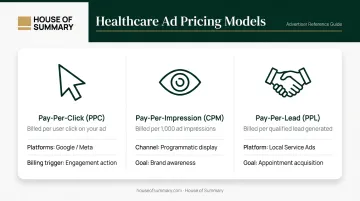
Three core pricing models apply:
- Pay-per-click (PPC): Charges per click, not per view — making it efficient for high-intent searches on Google and Meta where you only pay for engagement.
- Pay-per-impression (CPM): Charges per 1,000 views, used in programmatic display and video when reach and brand awareness are the primary goals.
- Pay-per-lead: Charges for a verified contact or appointment request. Google's Local Service Ads use this model, making it popular for practices focused on patient acquisition.
The audience also splits into two distinct categories that require distinct strategies:
| Audience Type | Examples | Best Channels |
|---|---|---|
| B2C | Patients, caregivers, consumers | Google Search, Meta, healthcare directories |
| B2B | Hospital admins, physicians, procurement officers | LinkedIn, programmatic, newsletter advertising |
Which audience you're targeting shapes every downstream decision — messaging tone, platform selection, creative format, and compliance requirements. Getting that foundation right before launching any campaign is where most healthcare advertisers either gain an edge or waste budget.
Key Channels for Healthcare Paid Advertising
Google Search Ads and Local Service Ads
Google captures the highest-intent healthcare searches — "urgent care near me," "cardiologist accepting new patients," "same-day dermatology appointment." That intent is why search remains the default starting point for patient acquisition.
According to LocaliQ's 2026 healthcare benchmark — based on 3,542 US campaigns — the average healthcare search ad delivers:
- 6.07% CTR
- $5.64 CPC
- 8.09% conversion rate
- $66.02 cost per lead
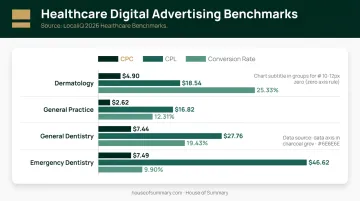
Performance varies significantly by specialty:
| Specialty | CPC | CPL | Conversion Rate |
|---|---|---|---|
| Dermatology | $4.90 | $18.54 | 25.33% |
| General Practice | $5.47 | $62.80 | 11.63% |
| General Dentistry | $7.03 | $84.77 | 7.74% |
| Emergency Dentistry | $7.85 | $75.19 | 8.89% |
Local Service Ads (LSAs) operate differently from standard search ads. LSAs use a pay-per-lead model and display the Google Guaranteed badge, which increases patient trust. For high-volume practices competing on proximity and availability, LSAs can deliver appointment volume at predictable cost without requiring sophisticated keyword strategy.
Social Media Ads: Meta and LinkedIn
Meta platforms (Facebook and Instagram) excel at demographic and interest-based targeting — effective for specialties where awareness and visual outcomes matter, such as aesthetics, dermatology, and elective procedures. WordStream's 2024 Facebook benchmarks show Physicians & Surgeons lead campaigns averaging 2.43% CTR, $2.83 CPC, and $57.97 CPL — competitive with search for certain campaign types.
Meta does impose restrictions healthcare advertisers must understand before building campaigns:
- Weight loss, cosmetic, and reproductive health ads must target users 18+
- Before/after comparison imagery is prohibited in many health categories
- Ads exploiting body image insecurities are banned outright
LinkedIn serves a different purpose. For B2B healthcare campaigns — targeting hospital procurement teams, health system executives, or physicians evaluating clinical tools — LinkedIn's professional targeting is unmatched. Brands like TytoCare have used LinkedIn's account-based approach to penetrate US healthcare markets, combining thought leadership content with direct outreach to decision-makers.
Programmatic and Display Advertising
Programmatic advertising automates ad buying across millions of websites and apps, allowing healthcare brands to reach users based on behavioral signals — someone researching diabetes management or knee replacement options, for example.
The critical constraint is data compliance. Audience segments must be built without using protected health information. Working with HIPAA-compliant data partners and reviewing vendor Business Associate Agreements (BAAs) before campaign launch is required.
Programmatic works well for:
- Condition-awareness campaigns at scale
- Retargeting site visitors (with compliance guardrails — more on that below)
- Video pre-roll on health-adjacent content
Healthcare Directories and Sponsored Listings
Platforms like Healthgrades, Zocdoc, and WebMD place healthcare brands directly in front of patients who are already in decision mode. A patient searching for a rheumatologist on Healthgrades is closer to booking an appointment than someone who clicked a display ad while reading general news.
Sponsored placements in these environments benefit from third-party credibility — patients treat these directories as trusted resources, not advertising channels. For practices focused on appointment volume, directory investment often delivers strong returns relative to effort.
Newsletter Advertising
Newsletter advertising is one of the most underutilized channels in healthcare marketing — and the performance case is clear. Inbox ads bypass ad blockers, reach readers without competing algorithm-driven feeds, and land when someone has actively opted in to content they value.
Mailchimp's email benchmark data shows average click rates across quality newsletters in the 2.62%–3.27% range — and in premium, high-engagement publications, that figure climbs considerably higher.
House of Summary's newsletter network — covering Presidential Summary, Geopolitical Summary, Dubai Summary, and London Summary — reaches 500,000+ subscribers with 254,866+ emails opened daily. The readership skews heavily toward executives, founders, C-suite professionals, and high-net-worth individuals:
- US: 66% of readers
- UAE: 18% of readers
- UK: 10% of readers
For healthcare brands targeting educated, high-income audiences — health insurance products, premium telehealth services, medical device awareness, or pharmaceutical brand campaigns — this demographic profile aligns well. Advertiser engagement across the network has consistently outperformed standard benchmarks — one placement in Dubai Summary delivered click-through rates 4x higher than Google AdWords, reflecting the quality of audience attention that inbox-first media generates.
Available ad formats include:
- Native editorial placements
- Sponsored content
- Display banners within newsletters
- Full-issue takeovers
Healthcare Ad Compliance: HIPAA, FDA, and Platform Policies
In healthcare advertising, compliance shapes every structural decision before a campaign goes live.
HIPAA and Tracking Technologies
HIPAA extends beyond clinical settings. According to HHS/OCR guidance last reviewed in June 2024, regulated entities cannot use tracking technologies in ways that cause impermissible disclosure of protected health information (PHI). That means standard retargeting pixels, Google Analytics configurations, and Meta's conversion API can create compliance exposure if not audited before launch.
The enforcement risk is real:
- GoodRx paid $1.5M in 2023 after the FTC found the company shared users' sensitive health data for advertising purposes
- BetterHelp was ordered to pay $7.8M in 2023 for sharing mental health information with advertising platforms
Both cases involved practices most healthcare marketers would consider routine — retargeting pixels and third-party data sharing. The takeaway: pixel audits and data governance aren't cleanup tasks. They belong in your pre-launch checklist.
FDA Guidelines for Pharma and Device Advertisers
FDA rules set strict boundaries for prescription drug and medical device advertising. Key requirements include:
- Fair balance: Benefits and risks must receive equal prominence in all ad formats
- No off-label promotion: Advertising a drug or device for unapproved uses is prohibited
- Risk disclosure in digital formats: FDA guidance specifically addresses how to present required risk information when character limits constrain space — condensed copy doesn't exempt you from disclosure requirements
The agency has stepped up enforcement of social media drug advertising since 2021, with warning letters targeting Instagram and YouTube campaigns that omitted risk information.
Building Compliance Into Campaign Architecture
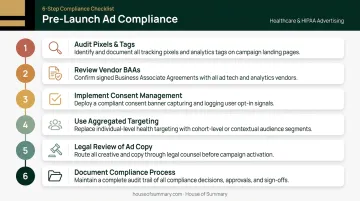
Before any campaign launches:
- Audit all pixels and tags — confirm what data each tracking technology sends to third-party ad platforms
- Review vendor BAAs — ensure data partners have signed HIPAA Business Associate Agreements
- Implement consent management on landing pages, particularly for any data collection
- Use aggregated audience targeting rather than condition-specific behavioral segments
- Have legal review ad copy before it goes live — not after disapprovals force a restart
- Document your compliance review process — if enforcement occurs, a documented review trail matters
How to Build a Healthcare Ad Campaign That Converts
Start With Intent-Driven Keywords
Broad keyword targeting burns budget in healthcare because informational searches rarely convert to appointments. Someone searching "what causes lower back pain" is researching, not booking.
High-performing campaigns prioritize:
- Transactional keywords: "book chiropractor appointment," "urgent care walk-in near me"
- Navigational keywords: "[Practice name] phone number," "dermatologist accepting new patients [city]"
- Service + location combinations: "fertility clinic [city]," "same-day dental extraction"
Build negative keyword lists from the start. Filter out terms like "symptoms," "causes," "free," "research," and condition names without service intent attached.
Design Landing Pages for the Patient Journey
A well-targeted click landing on a generic homepage is wasted spend. Effective healthcare landing pages:
- Confirm the ad's promise immediately — if you advertise same-day availability, the page leads with it
- Display trust signals up front: credentials, patient reviews, board certifications, and accepted insurance
- Offer a simple next step — click-to-call, an online scheduling widget, or a short three-field intake form
- Load fast on mobile, where a large share of healthcare searches happen — slow pages lose patients before they read the offer
Set Budgets Around Patient Lifetime Value
Healthcare CPCs vary by specialty and market. General dentistry averages $7.03; emergency dentistry hits $7.85. Competitive specialties like fertility, plastic surgery, and oncology often run $15–$30+ per click.
Evaluating performance on first-click cost alone misses the larger picture. A patient acquired through a paid ad who returns for ongoing treatment is worth far more than the CPL suggests. Budget decisions should account for:
- Recurring visit frequency for the specialty
- Average revenue per patient per year
- Referral value generated by satisfied patients
- Patient retention rates for the service line
Use Extensions and Remarketing Strategically
Ad extensions improve click quality without adding cost:
- Call extensions let mobile users call directly from the search result
- Location extensions surface address and directions
- Structured snippets can highlight specialties, insurances accepted, or appointment availability
Remarketing re-engages warm audiences but requires careful structure in healthcare. Use site-wide remarketing audiences — not condition-specific page visitors. Don't place visitors from your "knee replacement" page into a segment that signals their health condition to ad platforms. Apply frequency caps to prevent the experience from feeling intrusive.
Measuring Healthcare Paid Ad Performance
Metrics That Indicate Real Outcomes
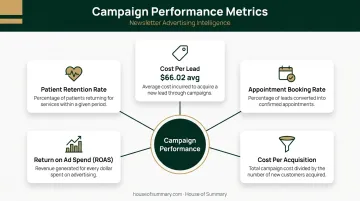
Move past clicks and impressions. The metrics that connect advertising to business results:
- Cost per lead (CPL): The overall healthcare average is $66.02 (LocaliQ, 2026)
- Appointment booking rate: What percentage of leads actually schedule
- Cost per acquisition (CPA): Total cost to acquire a new patient
- Return on ad spend (ROAS): Revenue attributed to ad-driven visits vs. spend
- Patient retention rate: Whether ad-acquired patients return
Set Up Call Tracking From Day One
According to Invoca's 2025 Healthcare Call Conversion Benchmarks, 48% of calls from digital marketing are qualified leads, 59% of those callers speak with a live person, and 43% of answered calls result in an appointment booking request.
Those numbers only show up if you're tracking them. Without call tracking, phone-based conversions are invisible — campaigns appear to underperform when they're actually driving significant volume through calls rather than form fills. Connect Google Ads conversion tracking with GA4 to capture:
- Form submissions
- Phone calls (through dynamic number insertion)
- Appointment requests through scheduling widgets
Track each as a distinct conversion event so you can evaluate which touchpoints actually drive appointments.
Build a Consistent Optimization Cadence
Healthcare paid campaigns rarely perform at their best on launch day — consistent optimization is what moves the needle over time:
- Test headline and CTA phrasing through A/B experiments on ad copy
- Run landing page variants that test form length, trust signal placement, and button copy
- Monthly search term report review — to catch new negative keyword opportunities
- Revisit bid strategies monthly as conversion data accumulates and automated bidding improves
Frequently Asked Questions
What are examples of paid advertising?
Common paid advertising formats include search ads (Google Ads), social media ads (Facebook, Instagram, LinkedIn), display and programmatic ads, video ads (YouTube), sponsored newsletter placements, and healthcare directory listings. Each format serves a different goal: search captures intent, social builds awareness, and newsletters deliver engaged inbox audiences.
What is the best platform for healthcare advertising?
No single platform wins across every use case. Google Ads works best for high-intent patient searches. Meta platforms suit demographic-targeted awareness campaigns for elective or consumer health services. LinkedIn is the right choice for B2B healthcare targeting executives and decision-makers. Newsletter advertising reaches educated, engaged readers without algorithm interference or ad blockers.
How do I make healthcare ads HIPAA compliant?
Audit all tracking pixels and data-sharing settings with ad platforms before launch. Avoid building audience segments based on specific health conditions. Implement consent management tools on landing pages. Confirm vendor BAAs are in place. Consult a HIPAA compliance officer before running any retargeting campaign.
How much should a healthcare practice spend on paid advertising?
There's no universally verified percentage-of-revenue benchmark that applies across specialties. Budget decisions should anchor to your acceptable CPL, target patient acquisition volume, service-line margins, and patient lifetime value assumptions. A fertility clinic with high lifetime value per patient can justify significantly higher CPLs than a general practice with lower per-patient revenue.
Is newsletter advertising effective for healthcare brands?
Newsletter advertising delivers strong engagement because readers opted in — no algorithms filter the content, no blockers intercept it, and no competing feed distracts from it. For healthcare brands targeting high-income, decision-making demographics, newsletter placements offer compliance-friendly visibility and undivided reader attention.
How do I track whether my healthcare ads are driving appointments?
Use call tracking with dynamic number insertion for phone bookings, and set up form submission and scheduling widget interactions as distinct conversion events in Google Ads and GA4. Where possible, integrate your CRM or EMR with ad platform data to connect ad clicks to actual patient visits.