Introduction
Healthcare paid social advertising operates in a different category entirely. The audience isn't browsing for deals or scrolling out of boredom — they're searching for answers to genuinely personal questions about their health, their families, and their options. That changes everything about strategy, targeting, and creative.
According to research published in PMC based on the HINTS 6 survey, 16% of adult social media users used social media information to make health decisions, and 20% discussed that information with their healthcare providers. That's a meaningful slice of the patient population engaging with health content on platforms where your ads can appear.
Yet many healthcare marketers hesitate. HIPAA violations carry real consequences, ad platforms reject health-related creatives without explanation, and ROI is hard to trace when a patient books an appointment weeks after seeing an ad.
This guide covers all of it: platform selection, compliance frameworks, targeting tactics, creative best practices, and measurement — so you can build a paid social strategy that drives patient acquisition without exposing your organization to legal risk.
Key Takeaways
- Meta (Facebook/Instagram) is the strongest starting point for most healthcare paid social campaigns, with physician lead-ad CVR benchmarked at 4.81%
- Meta, TikTok, and Google don't sign a Business Associate Agreement (BAA), so internal compliance controls are non-negotiable
- Safe ad content focuses on education, service awareness, and provider introductions — not condition-specific targeting
- Track performance from impression to booked appointment using UTM parameters and conversion events, not PHI-based signals
- Newsletter placements like House of Summary's offer a measurable, algorithm-free complement to paid social for reaching high-intent decision-makers
Why Healthcare Paid Social Requires a Different Playbook
Organic social reach has been declining for years. A figure cited by Social Media Examiner puts average Facebook organic reach at roughly 6.4% of page followers as of mid-2024. For healthcare brands with modest followings, that translates to very few eyes on any given post — making paid amplification the only reliable path to consistent visibility.
But paid social in healthcare comes with constraints that don't apply to most other industries:
- Platform content restrictions — Meta, TikTok, and Google each restrict how health-related ads can be written, targeted, and served
- No BAA from platforms — Meta, TikTok, and Google do not sign Business Associate Agreements with healthcare organizations, meaning the legal compliance burden falls entirely on the advertiser
- Audience sensitivity — people engaging with health content are often in a vulnerable decision-making state, which makes intrusive or presumptuous targeting both ethically and legally risky
Working within these constraints is entirely possible — but only if strategy, compliance, and targeting decisions are made together from the start, not retrofitted after a campaign is already live.
Choosing the Right Platform for Your Healthcare Paid Social Campaigns
Not every platform delivers equal value for healthcare. Choosing the wrong one wastes budget and creates compliance exposure. The right choice depends on three things: where your target patient demographic spends time, what ad formats the platform supports, and what restrictions the platform places on health content.
Meta (Facebook and Instagram)
Meta remains the dominant choice for most healthcare paid social campaigns. With 3.56 billion daily active people across its Family of Apps as of Q1 2026, the scale is unmatched. Targeting capabilities within Meta Ads Manager — geographic radius, age, interest-based audiences, lookalikes — give healthcare marketers meaningful control over who sees their ads.
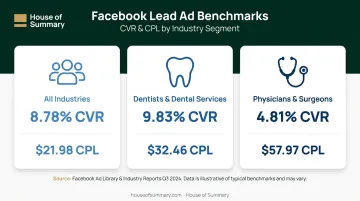
According to WordStream's Facebook lead-ad benchmarks (based on 2,946 campaigns, February 2023–April 2024), conversion rates vary significantly by healthcare segment:
| Segment | Lead-Ad CVR | Cost Per Lead |
|---|---|---|
| All Industries | 8.78% | $21.98 |
| Dentists & Dental Services | 9.83% | $32.46 |
| Physicians & Surgeons | 4.81% | $57.97 |
Meta does not sign BAAs and explicitly prohibits sending sensitive health information through its Business Tools. Those compliance constraints are manageable for most campaigns, and Meta remains the right starting point for most healthcare organizations.
LinkedIn makes sense for B2B healthcare marketing: targeting hospital procurement teams, health plan administrators, HCP networks, or positioning your organization for recruitment and thought leadership.
The tradeoff is cost. Databox benchmarks put LinkedIn's healthcare median CPC at $6.37 versus roughly $1.07 on Facebook — nearly six times higher. Use LinkedIn for campaigns where reaching a professional audience is worth that premium; skip it for patient acquisition.
TikTok and YouTube
Both platforms suit awareness-stage campaigns targeting younger demographics. Pew Research found TikTok usage at 63% of U.S. adults ages 18–29, while YouTube reaches 95% of that same group with broader penetration into older age brackets.
Content restrictions on both platforms are significant. Review policies before launching:
- TikTok (May 2026 policy): requires compliance with local laws, restricts prescription drug ads, and mandates 18+ targeting for most health-related categories
- YouTube/Google: restricts health-based personalized advertising and limits targeting options for sensitive medical topics
The clearest recommendation: Start with Meta for conversion-focused campaigns. Add one additional platform only once Meta campaigns are optimized and you have baseline performance data.
Navigating HIPAA Compliance in Healthcare Paid Social Advertising
Meta, Google, and TikTok do not sign Business Associate Agreements with healthcare organizations. If your campaign setup transmits Protected Health Information (PHI) to these platforms, your organization bears the full legal exposure.
HHS OCR's tracking technology guidance (last reviewed June 2024) is clear: regulated entities may not disclose PHI to tracking vendors without meeting HIPAA authorization requirements or having BAAs in place where vendors qualify as business associates.
That restriction covers pixels, URL parameters, custom event names, and custom audience uploads.
What You Must Never Do
These practices create direct HIPAA exposure:
- Upload patient email lists as custom audiences if those lists originated from clinical records or covered interactions
- Use retargeted ad copy that implies condition awareness — showing someone an ad that references a diagnosis they searched for on your patient portal
- Include patient stories, images, or identifiable information in ad creative without explicit written consent
- Pass health-sensitive URL parameters (e.g., condition names in query strings) to Meta's pixel or any tracking vendor
- Name custom events after clinical actions — booking a "diabetes consultation" as an event name transmits condition data to Meta
The FTC has already acted on exactly this kind of data sharing. GoodRx and BetterHelp both faced enforcement for transmitting health data to Facebook and other ad platforms for targeting purposes. If those violations can happen at scale, they can happen in a single misconfigured pixel.
What Is Safe to Advertise
Compliant content is, in practice, more effective content for cold audiences:
- General wellness education — symptom awareness articles, seasonal health tips, nutrition content
- Service-line awareness — "Our orthopedic team is now accepting new patients" — no condition implied about the viewer
- Community health events — screenings, flu shot clinics, health fairs
- Provider introductions — meet the team, new physician announcements, specialty expansions
Educational, awareness-first content builds trust before asking for a conversion. People don't book appointments with providers they've never heard of — awareness ads exist to close that gap.
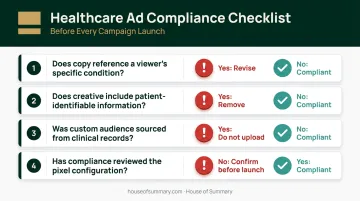
Before publishing any paid social ad, run through this checklist:
- Does the copy reference a specific health condition tied to the viewer? → Revise
- Does the creative include patient-identifiable information? → Remove
- Was the custom audience sourced from clinical records? → Do not upload
- Has a compliance or legal specialist reviewed the pixel configuration? → Confirm before launching
Targeting Strategies That Actually Work in Healthcare Paid Social
Compliant Targeting Options in Meta Ads Manager
Meta removed many detailed health-related targeting options (health causes, specific conditions) starting January 2022. What remains is still workable:
- Interest-based targeting — people who follow health and wellness content, fitness interests, or condition-adjacent topics (e.g., nutrition, physical therapy)
- Geographic targeting — radius around a clinic location, zip code clusters matching your patient service area
- Age and demographic filters — aligned to the likely patient profile for each service line
- Lookalike audiences — built from non-clinical first-party data such as website visitors or social page followers
Funnel-Based Targeting Logic
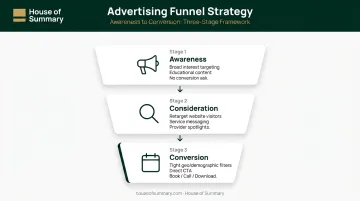
Pushing cold audiences directly to appointment booking is the fastest way to waste ad spend. Structure campaigns by funnel stage instead:
- Awareness — broad interest-based targeting, educational content, no conversion ask
- Consideration — retarget website visitors with service-specific messaging, provider spotlights, patient education resources
- Conversion — tighter geographic and demographic filters, direct CTA (book, call, download), targeted at people who have already engaged
A Note on Retargeting and Lookalikes
Website retargeting is permissible — but only if the site pixel is configured correctly and does not capture or transmit PHI. Have a compliance or legal specialist audit your pixel setup before activating any retargeting campaign — particularly given Meta's updated data usage terms for healthcare advertisers.
The same caution applies to lookalike audiences. The safer approach is to build them from engagement-based signals — people who have interacted with your social content or visited your website — rather than uploading any list that originated from clinical systems. This keeps patient data out of the equation entirely.
Healthcare Paid Social Ad Formats and Creative Best Practices
Ad Formats by Campaign Goal
| Format | Best For |
|---|---|
| Video ads | Trust-building, provider introductions, awareness campaigns |
| Carousel ads | Multiple service lines, educational step-by-step content |
| Single-image ads | Event promotion, direct response, simple offers |
| Lead generation forms | Capturing interest without driving to an external landing page |
Video deserves particular attention. According to Wyzowl's 2024 video marketing report, 87% of video marketers said video directly increased sales, and 91% of businesses now use video as a marketing tool. HubSpot's research identifies short-form video as the format delivering the highest ROI across social platforms. For healthcare, a 30–60 second clip of a provider explaining a common patient concern outperforms almost any static image.

That same logic shapes everything else in healthcare creative. A few principles worth following:
Creative Principles That Keep You Compliant and Convert
- Lead with a patient problem, not a condition — "Struggling with knee pain that won't go away?" outperforms "Treating osteoarthritis?" every time
- Feature real providers instead of stock photos — authenticity builds trust faster than any headline
- One message per ad, one CTA per ad — healthcare audiences are already overwhelmed with information
- For cold audiences, offer a downloadable symptom guide or wellness checklist before asking for an appointment booking
How to Run Creative Tests That Actually Tell You Something
Because healthcare creative restrictions are tight, small variations produce meaningfully different results. Test one variable at a time — headline, image, or CTA — and run each test for at least one week before drawing conclusions. Never pause a test early because one version looks like it's winning on day two.
Measuring and Optimizing Your Healthcare Paid Social ROI
Metrics by Funnel Stage
| Stage | Key Metrics |
|---|---|
| Awareness | Reach, impressions, video views, frequency |
| Consideration | Click-through rate (CTR), landing page views, time on page |
| Conversion | Cost per lead (CPL), cost per acquisition, booked appointments |
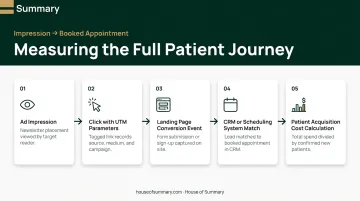
Patient acquisition cost (PAC) is the most meaningful downstream metric, but it requires connecting ad platform data to your scheduling system or CRM. Without that connection, you're measuring cost per lead — not cost per patient.
UTM Parameters and Conversion Tracking
Every ad should carry UTM parameters that identify the campaign source, medium, campaign name, and ad set. This lets your analytics platform attribute website traffic and conversions back to specific ads without exposing health-sensitive data to the platform.
When setting up conversion events in Meta Ads Manager:
- Name events generically ("appointment_request," not "diabetes_consultation")
- Avoid passing condition names or clinical identifiers in event parameters
- Confirm your pixel configuration with a compliance specialist before enabling any health-related conversion tracking
Review campaign performance weekly. Set a defined budget threshold at which underperforming ad sets are paused. Waiting to see if a poor performer recovers rarely pays off — it usually just drains budget faster.
Newsletter Advertising as a Complementary Channel
Optimization within paid social only goes so far. Algorithms shift, ad blockers are widespread among desktop users, and Meta's policy changes can affect healthcare campaigns with little warning. Diversifying into channels that operate outside those constraints gives your measurement picture a more complete baseline.
Newsletter placements offer a fundamentally different measurement environment.
House of Summary's network — reaching 500,000+ subscribers with 254,866+ emails opened daily — operates completely outside algorithmic reach limitations. Ad placements appear directly in the inbox, where ad blockers don't apply and banner blindness is not a factor. For healthcare brands targeting U.S.-based decision-makers, executives, and health plan administrators, Presidential Summary and Geopolitical Summary provide concentrated reach into that audience (66% U.S.-based, with strong presence in New York and Los Angeles).
UTM parameters on newsletter placements feed into the same analytics system as your paid social campaigns, giving you a clean channel-by-channel view of which placements are driving qualified engagement and at what cost. Healthcare brands working within FDA and MHRA compliance requirements also benefit from the brand-safe, human-written editorial environment that newsletters provide — a level of editorial control that programmatic and social channels can't consistently offer. Healthcare advertisers can review placement options and audience data in the House of Summary media kit.
Frequently Asked Questions
Which social media platform is best for healthcare paid advertising?
Meta (Facebook and Instagram) is the most effective starting point for most healthcare organizations, offering the largest audience scale, sophisticated targeting tools, and the strongest conversion benchmarks across healthcare service lines. LinkedIn suits B2B campaigns and HCP targeting; TikTok and YouTube work for awareness campaigns aimed at younger demographics.
How do healthcare organizations stay HIPAA compliant with paid social ads?
The core rules: never use PHI in ad targeting, avoid copy that implies awareness of the viewer's health condition, do not upload patient lists sourced from clinical records, and have a compliance specialist audit any pixel or conversion tracking setup before deployment. No major social platform signs a BAA, so the compliance burden sits entirely with your organization.
Can healthcare organizations use retargeting in paid social advertising?
Website retargeting is permissible if the site pixel is configured to avoid capturing or transmitting PHI. Consult a compliance or legal specialist before enabling any pixel-based retargeting, and stay current with Meta's evolving healthcare data terms, which have shifted specifically in response to healthcare-related concerns.
What types of ad creative perform best in healthcare paid social campaigns?
Short-form video featuring real providers, educational carousel ads walking through a patient journey or care process, and lead magnet promotions (downloadable guides, symptom checklists) tend to drive the strongest engagement and lead volume. Authentic provider imagery outperforms stock photography for trust-building; patients respond better to real faces than generic clinical scenes.
How much should a healthcare organization budget for paid social advertising?
Start with a budget that generates meaningful data across 2–3 ad sets — typically $1,500–$3,000 per month for an initial Meta campaign, though your service line, geography, and conversion value all affect the right number. Once you have cost-per-lead benchmarks, scale from there and prioritize Meta before expanding to other platforms.
How do you measure the ROI of healthcare paid social advertising?
Track from ad impression to booked appointment using UTM parameters, conversion events configured in Meta Ads Manager without health-sensitive data, and integration with your scheduling system or CRM. Patient acquisition cost (PAC) — ad spend divided by patients acquired — is the clearest profitability indicator.