The practices filling appointment books aren't necessarily the most skilled. They're often the most visible. Advertising is what separates the two.
This guide covers the full advertising stack for dermatology practices: digital foundations, paid search, social media, newsletter advertising, offline channels, and referral programs. Whether you're a solo practitioner or a multi-location group, you'll leave with a clear set of tactics you can prioritize by practice type and patient base.
Key Takeaways
- Segment your advertising by patient type — medical, cosmetic, and elective patients have different motivations, channels, and search intent
- Fix your website and Google Business Profile before spending on ads — these are your conversion infrastructure
- Google Ads captures high-intent patients already searching; social media builds awareness earlier in the journey
- Newsletter advertising reaches affluent, opted-in readers directly in their inbox, bypassing algorithms and ad blockers entirely
- Track cost per lead by channel from day one, or you won't know what's actually working
Know Your Dermatology Patient Before You Advertise
Advertising without audience clarity burns budget. A campaign targeting Botox patients and a campaign targeting patients with suspected melanoma require completely different messaging, channels, and timing.
The Three Core Patient Segments
| Segment | Primary Motivation | Best Channels |
|---|---|---|
| Medical dermatology | Diagnosis, treatment, referral | Google Search, physician referrals, reviews |
| Cosmetic dermatology | Appearance improvement | Instagram, TikTok, Google Ads |
| Elective aesthetic | Enhancement, self-investment | Social media, influencer content, newsletter ads |
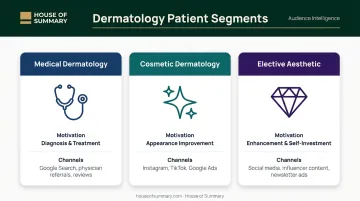
Medical dermatology held the largest market share in 2023, but aesthetic dermatology carries the highest projected growth rate. According to FTI Consulting, average practice revenue sits at $5.3M for medical versus $4.9M for cosmetic — close enough that a blended practice needs distinct campaigns for each segment to move the needle on either.
Generational Channel Preferences
Healthgrades' 2024 generational research shows clear patterns in how different age groups find and choose providers:
- Gen Z (59%) and Millennials (55%) conduct additional research after a doctor visit — they're active on social media and respond to peer reviews
- Gen X (49%) relies heavily on clinical authority combined with online search
- Boomers (41%) still trust physician referrals and professional credentials most
Pew Research confirms the platform split: Instagram reaches 78% of 18–29 year olds versus just 15% of those 65+. Facebook, by contrast, maintains strong penetration across every age group — 67% of 18–29 all the way to 58% of 65+.
Those benchmarks tell you where to look. Your own patient data tells you where to start.
Start With Your Own Data
Before selecting a channel, mine your existing patient records:
- Which services generate the most bookings?
- What age and location profile do those patients share?
- What prompted them to book — search, referral, or social?
This internal audience profile should guide every advertising decision you make.
Build a Digital Foundation That Converts
Paid advertising is wasted if traffic lands on a slow, confusing website with no clear path to booking. The foundation comes first.
Website and Online Scheduling Essentials
Google data shows 53% of mobile users abandon sites that take more than 3 seconds to load — and a shift from 1 to 3 seconds raises bounce probability by 32%. For a dermatology practice, a slow site doesn't just frustrate visitors; it hands them to a competitor.
Your website needs:
- A mobile-first design, since most patients search from their phones
- Page load times under 3 seconds — every extra second raises your bounce rate
- Prominent "Book Now" or "Request a Consultation" CTAs above the fold on every service page
- Integrated online scheduling — a 2025 review found 68% of patients prefer booking online, rising to 77% of Millennials
Local SEO and Google Business Profile
Local SEO connects high-intent searches — "dermatologist near me," "acne specialist in [city]" — directly to your practice. The mechanics:
- Use location-specific keywords throughout service pages and meta descriptions
- Keep your NAP (name, address, phone number) identical across all directories — Google Maps, Yelp, Healthgrades, Zocdoc
- Add local schema markup to your website so search engines understand your location and services
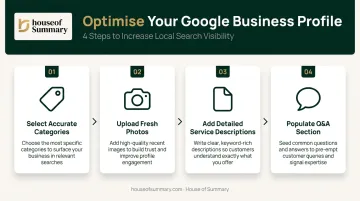
NAP consistency gets you indexed. Your Google Business Profile gets you chosen. A complete, regularly updated profile improves your chances of appearing in Google's local 3-pack — the three listings shown above organic results. Key steps:
- Select the most accurate primary and secondary categories — this determines which searches trigger your listing
- Upload fresh photos of your practice, team, and procedures regularly — profiles with photos get significantly more clicks
- Add detailed service descriptions with relevant keywords so patients and search engines both understand what you treat
- Keep Q&A populated with questions patients actually ask, which reduces calls for basic information and signals to Google that your profile is active
Reviews and Reputation Management
Press Ganey's 2023 consumer experience research found patients read about 5 reviews and visit 2–3 sites before choosing a provider. Healthgrades reports 90% of healthcare consumers use online reviews in their decision-making.
To build review volume systematically:
- Send automated post-visit SMS or email prompts requesting a Google review — timing matters, aim for within 24 hours of the appointment
- Make the link one-click direct to your review page
- Respond to every review — positive and negative — to show prospective patients that feedback is read and taken seriously
Content Marketing as Long-Term SEO
Publishing condition-specific content — "what causes adult acne," "how to prepare for a mole removal," "is my mole suspicious?" — builds topical authority over time. Practices with active condition-focused blogs typically rank for dozens of long-tail search terms their competitors aren't targeting — reducing paid ad dependency while pulling in patients who are still researching, not yet decided.
Paid Advertising Strategies That Fill Appointment Books
Paid advertising moves patients from awareness to booked appointment faster than organic channels alone. Each platform below serves a distinct stage of that journey.
Google Ads for High-Intent Searches
Google Search captures patients who are already looking for a solution. LocaliQ's healthcare search benchmarks, based on 3,542 U.S. campaigns from October 2024 through September 2025, show dermatology-specific figures of a 5.91% CTR, $4.90 CPC, and $18.54 CPL — notably lower cost per lead than the broader healthcare median of $66.02.
Campaign structure best practices:
- Build procedure-specific ad groups — separate campaigns for acne treatment, Botox, skin cancer screening, and laser resurfacing
- Use geo-targeting to limit spend to your actual service area
- Send every click to a dedicated landing page, not your homepage
Meta Advertising for Awareness and Consideration
Facebook and Instagram serve a different purpose: reaching patients before they're actively searching. Visual content — before-and-after imagery, short treatment explainer reels, provider introduction videos — performs well here, particularly for cosmetic services.
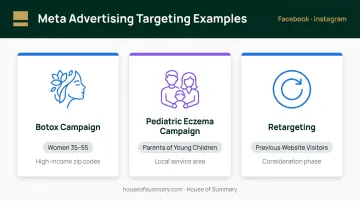
Demographic and interest targeting lets you segment by age, location, and lifestyle with real precision:
- A Botox campaign might target women 35–55 in high-income zip codes
- A pediatric eczema campaign targets parents of young children in your service area
- Retargeting website visitors keeps your practice visible through the consideration phase
Newsletter Advertising: Direct Inbox Access
Newsletter advertising is an underused channel for dermatology — it sidesteps problems that web and social ads can't avoid. Ad blockers don't work on email, and no algorithm decides whether it gets delivered. When a newsletter goes out, it reaches inboxes directly.
House of Summary's newsletter network covers Presidential Summary, Geopolitical Summary, Dubai Summary, and London Summary. Together, they reach 500,000+ subscribers, with 254,866+ emails opened daily. The audience skews toward decision-makers, executives, and high-income professionals — 66% based in the U.S., concentrated in New York and Los Angeles, where premium dermatology and cosmetic practices thrive.
For practices targeting affluent patient demographics, this format offers:
- Native ad placements that integrate with editorial content
- Sponsored content for longer-form brand narratives
- Full-issue takeovers for exclusive advertiser presence
- Reach into high-net-worth audiences that are expensive to target on programmatic platforms
Healthcare and cosmetic procedure advertising requires pre-approval given platform policies, but House of Summary offers compliance-friendly placement for exactly these categories. Contact sales@houseofsummary.com to request a media kit.
Landing Pages That Convert
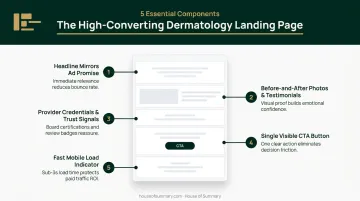
Whether traffic comes from Google Ads, Meta, or newsletter campaigns, it should land on a purpose-built page — not your homepage. A high-converting dermatology landing page includes:
- A headline that mirrors the ad's exact promise
- Before-and-after photos and patient testimonials (with proper HIPAA releases)
- Provider credentials and practice trust signals above the fold
- A single, visible CTA — book, call, or request a consultation
- Fast mobile load time
Unbounce's 2024 benchmarks put healthcare and wellness landing page conversion rates at 4.6%, with medical services specifically at 3.6%. Your actual rate depends heavily on page quality and traffic relevance.
Social Media and HIPAA Compliance for Dermatology
Platform Selection by Audience
Don't spread budget across every platform. Choose based on your patient mix:
- Instagram and TikTok — best for cosmetic and elective services; most effective with patients under 45
- Facebook — suits medical dermatology, older demographics, and community health content
- LinkedIn — useful for B2B referral relationships with other healthcare providers
A 2021 study of 175 dermatology clinic patients found 73.1% said before-and-after photos influenced their provider selection, and 53.7% cited educational videos as influential. These two content types should anchor your social strategy.
Content Types That Build Trust
- HIPAA-compliant before-and-after transformations (signed release forms required)
- Short educational reels — skincare myth-busting, treatment explainers
- Behind-the-scenes practice content that shows the people behind the practice
- Provider introduction videos that establish personality and credentials
Producing this content effectively means staying within legal boundaries — and in healthcare, those boundaries are clearly defined.
What HIPAA Requires for Patient Content
Before-and-after images, patient testimonials, and any content featuring identifiable patients can involve Protected Health Information (PHI) under HIPAA. The consequences of mishandling this are serious.
Essential compliance steps:
- Obtain signed HIPAA-compliant release forms before using any patient image or story
- Use HIPAA-compliant email and scheduling platforms
- For influencer partnerships, ensure content disclosure requirements under FTC endorsement guidelines are met — sponsored posts must clearly label the commercial relationship
- Treat retargeting pixels with caution — HHS has issued guidance that tracking technologies on healthcare websites can trigger HIPAA obligations when PHI is involved
Offline Advertising and Referral Strategies
Most dermatology practices default to the same digital playbook. Offline channels cut through that noise — especially for demographics that don't respond to ads in a feed, and in markets where Google Ads competition has driven costs up sharply.
Traditional Channels Worth Considering
- Direct mail — effective for reaching older patient segments and announcing new locations or services; response tracking through unique phone numbers or URLs
- TV and radio spots — local brand awareness for practices with broader marketing budgets
- Community health events and sponsorships — positions your practice as a local health resource, generates referrals from patients who met providers in person
Referral Programs and Cross-Practice Partnerships
Offline outreach works best when it connects to a referral system that keeps patients coming back — and bringing others with them.
A 2022 peer-reviewed study found 70% of patients said online reviews were more influential than physician referrals, and 71% found them more influential than hospital reputation — but physician referrals still play a real role. They work best as one channel in a broader acquisition mix, not the entire plan.
Structure your referral program with:
- Patient incentives — service add-ons or product discounts for referring friends and family
- Provider partnerships — formal referral arrangements with med spas, plastic surgeons, and primary care physicians
- Attribution tracking — unique codes or intake form questions to identify which referral source drove each new patient
Low-cost cross-practice tactics include co-hosted skincare events, shared email features, and mutual social mentions with complementary non-competing businesses.
Measuring Dermatology Advertising ROI
Spending without tracking means you'll repeat mistakes and miss what's working.
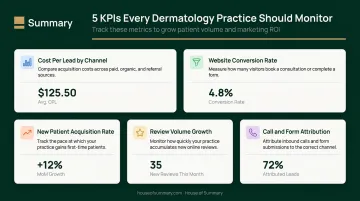
KPIs Every Practice Should Monitor
- Cost per lead by channel — compare Google Ads, Meta, newsletter, and referral sources side by side
- Website conversion rate — percentage of visitors who book or submit a contact form
- New patient acquisition rate — track month-over-month growth tied to campaign activity
- Review volume growth — a leading indicator of reputation health
- Call and form attribution — use call tracking numbers to tie phone bookings back to specific campaigns
Set up call tracking before launching any paid campaign. Without it, you'll see clicks but won't know which ads actually generate appointments.
Build a Quarterly Review Habit
Every quarter, assess:
- Which channels drove the most new patient bookings?
- What content generated the highest engagement?
- Where should budget shift based on actual CPL data?
Practices that review CPL data each quarter — rather than relying on intuition or habit — steadily improve their returns with each campaign cycle. The data tells you where to double down and what to cut before wasted spend becomes a pattern.
Frequently Asked Questions
How do I advertise a skincare product?
Skincare product advertising differs from practice advertising — focus on social media, influencer partnerships, and targeted paid ads on Meta and Google Shopping. All health-related claims must comply with FTC guidelines requiring credible scientific support, and any paid influencer relationships must be disclosed clearly.
How do I promote a skin clinic?
Start with the basics: optimize your Google Business Profile, build a review base through post-visit follow-up messages, run local SEO for neighborhood search terms, and pick one or two social media platforms where your target patients are most active. These four actions alone can increase your visibility before you spend on ads.
What is the most effective advertising channel for dermatologists?
The right channel depends on your services, patient demographics, and budget. Google Ads captures high-intent patients already searching for a solution. Instagram and TikTok work well for cosmetic services targeting younger patients. Newsletter advertising offers direct inbox access with engaged, opted-in readers.
How much should a dermatology practice budget for advertising?
Base your budget on verified benchmarks — a dermatology CPL of roughly $18.54 on paid search and landing page conversion rates of 3.6–4.6% for medical services — then work backward from your new patient revenue targets. Shift allocation over time toward whichever channels deliver the lowest cost per acquired patient.
How do I get more patients to leave Google reviews?
Send automated post-visit SMS or email review requests within 24 hours of the appointment, with a one-click direct link to your Google review page. Respond to existing reviews consistently — patients notice when providers engage, and it signals that feedback matters.
Does social media marketing actually bring in new dermatology patients?
Yes, particularly for cosmetic and elective procedures. Social media builds trust and awareness, but the actual conversion depends on a clear path from your profile to a booking-enabled website — so that link between your social presence and your scheduling page is non-negotiable.