This guide covers both sides of the equation: advertising strategies for healthcare practices trying to attract patients, and strategies for brands and pharma companies trying to reach healthcare professionals (HCPs). From paid search to newsletter placements, from compliance requirements to measurement frameworks — here's what actually works.
Key Takeaways
- Healthcare advertising serves two goals: patient acquisition for practices and HCP influence for brands, pharma, and device companies
- Search, social, email, and newsletters now drive the majority of healthcare ad spend and audience reach
- HIPAA, FTC, and FDA compliance must be built into every campaign from the start — not treated as an afterthought
- HCPs respond to clinical evidence and patient outcome data, not feature lists
- Attribution models and first-party measurement matter more than ever as ad spend scales
Why Healthcare Advertising Is More Competitive Than Ever
Two pressures are colliding at once.
On the supply side, the AAMC projects a physician shortage of up to 86,000 by 2036, driven by an aging population (the 65+ cohort is expected to grow 34.1% by 2036) and practitioner retirements. Busier physicians mean less attention available for advertisers — and that's before accounting for the 3.4 million registered nurses and 335,000 pharmacists who also receive constant outreach from competing brands.
On the demand side, ad spend keeps climbing anyway. Digital healthcare ad budgets are growing at 13.3% annually, which means more advertisers chasing the same audience with higher media costs and more noise.
Two Distinct Advertising Objectives
The distinction matters — strategy, compliance, and measurement diverge sharply depending on which direction the ad is flowing:
- Advertising BY healthcare professionals — practices promoting their services to attract patients. Think Google Ads for a dermatology clinic or local SEO for a dental group.
- Advertising TO healthcare professionals — pharma companies, medical device brands, or health tech platforms trying to influence clinical decision-making. Examples include journal placements, conference sponsorships, and targeted digital campaigns aimed at prescribers.
Most of this guide applies to both. Where the paths diverge — on audience segmentation, compliance, and measurement — those differences are called out directly.
Know Your Audience Before You Advertise
The Three Primary HCP Segments
HCPs are not one audience. The AAMC reports 1,032,365 active US physicians, but how you reach a physician differs from how you reach a pharmacist or an ICU nurse.
- Physicians are the primary prescribing decision-makers. They're data-driven, time-poor, and respond best to clinical evidence and peer validation.
- Nurses have high patient contact time and significant influence on OTC recommendations and care protocols. Messaging needs to reflect their patient-centered perspective.
- Pharmacists are the last point of contact before a patient uses a product. They respond well to formulary information, drug interaction data, and practical clinical detail.
A 2021 peer-reviewed survey of 511 US HCPs found 88.5% search for medical information daily or several times per week — physicians at 92.6%, pharmacists at 87.6%, and registered nurses at 70.0%. That behavior is your opening.
HCP Career Stage Changes What Resonates
- Early-career physicians respond well to educational content on emerging treatments — they're still building clinical frameworks
- Mid-career physicians want patient outcome data and peer case studies — validation from colleagues carries weight
- Established practitioners prioritize efficiency and workflow improvements — they know the science, they need practical application
Where HCPs Are Actually Reachable
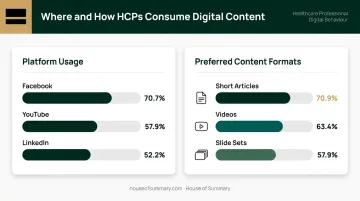
A 2024 peer-reviewed study of 2,615 HCPs found 71.2% used social media. Top platforms and preferred formats break down as follows:
- Facebook – used by 70.7% of HCPs
- YouTube – 57.9%
- LinkedIn – 52.2%
- Preferred formats: short articles (70.9%), videos (63.4%), slide sets (57.9%)
HCPs consume news and scroll social feeds outside clinical hours. Meeting them there with credible, relevant messaging builds brand familiarity that paid journal placements alone cannot replicate.
Core Digital Advertising Strategies That Work
Paid Search and Local SEO
For patient-facing practices, paid search through Google Ads is one of the most direct acquisition tools available. It puts your practice at the top of search results immediately for high-intent queries like "knee surgeon near me" or "telehealth psychiatry appointment" — no months of waiting for organic rankings to build.
CDC data shows 58.5% of US adults searched online for health or medical information during a six-month window in 2022. EMARKETER's data goes further: 77% of patients search online for doctors often or sometimes, and 58% begin that search on Google specifically.
Local SEO complements paid search over the longer term:
- Claim and optimize your Google Business Profile
- Use location-specific keywords tied to your specialty and neighborhood
- Collect and respond to patient reviews (93% of patients say reviews are at least somewhat important in choosing a provider)
- Ensure your website loads quickly on mobile
Social Media Advertising
Paid social on Facebook and Instagram allows precise demographic targeting by age, location, and health interests, making it effective for both patient acquisition and brand awareness campaigns. Organic social content runs alongside: health tips, practice updates, and patient success stories (with written consent) all build trust between paid campaigns.
One caveat from the research: 58.3% of HCPs express concerns about the legitimacy of medical information on social media. If you're targeting HCPs specifically, every claim needs to be anchored in peer-reviewed or label-supported content. Social works as a distribution layer, not as a standalone clinical credibility engine.
Email and Newsletter Advertising
Email reaches your audience directly. No algorithm filters your message, and no ad blocker strips it from the page. For practices, this means nurturing patient relationships with appointment reminders, health updates, and educational content. For brands targeting HCPs, it means reaching engaged readers during their personal reading time.
EMARKETER reports that 45% of US consumers have installed or used an ad blocker on a browser or mobile device — which creates a structural problem for display-heavy campaigns. Newsletter advertising bypasses this entirely. Because ads are embedded in email content, they arrive with the newsletter, not as a separate tracked asset that blockers can intercept.
: retargeting keeps your practice visible across the web and social platforms until they're ready to act.
Keep retargeting windows reasonable (7–14 days is common) and frequency-cap your ads. Seeing the same healthcare ad dozens of times is more likely to create annoyance than urgency.
Content Marketing and Professional Publications
Content marketing earns HCP attention through educational value rather than interruption. The formats that work:
- Blog posts and white papers establish clinical credibility and rank in search for informational queries
- Case studies with real patient outcome data resonate more than any product spec sheet
- Webinars allow live Q&A that builds genuine engagement with clinical audiences
- Explainer videos work particularly well for complex drug mechanisms or device procedures, and 63.4% of HCP social media users prefer video content over static formats
Digital content is only part of the mix. For brands targeting HCPs directly, conference and event sponsorship remains a strong complement. MM+M data shows the average HCP attended two in-person and two virtual meetings in 2023. In-person remains the preference — 85% of US medical residents and fellows prefer in-person conferences over virtual formats. That said, virtual events extend geographic reach and reduce scheduling friction.
The strongest measurement evidence on content effectiveness comes from Veeva: a rep call was 30% more likely to result in a prescription when followed by digital content exposure within 10 days. That 10-day window is a planning cue — campaigns that sequence rep calls with targeted digital follow-up outperform either channel used in isolation.
Navigating Compliance and Ethical Boundaries
Compliance in healthcare advertising is a core design requirement, not an afterthought. Three regulatory bodies govern this space:
| Regulator | What They Govern |
|---|---|
| HHS / HIPAA | Patient data privacy; written authorization required before using PHI for marketing |
| FTC | Health claims must be truthful and substantiated with competent scientific evidence |
| FDA OPDP | Prescription drug promotion must be truthful, balanced, and not misleading; off-label promotion is prohibited |
What HIPAA Means for Advertisers
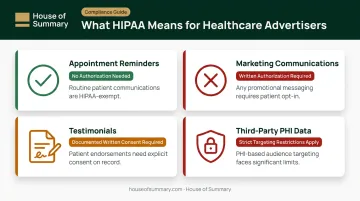
HIPAA separates operational communications from marketing — and the distinction has direct implications for how campaigns are structured:
- Appointment reminders and care coordination messages don't require additional authorization
- Marketing communications that use patient health information do require explicit written authorization
- Testimonials require documented patient consent; verbal agreement is not sufficient
- Third-party data that includes protected health information faces strict restrictions on use for ad targeting
Ethical Boundaries Beyond the Legal Minimums
Ads must clearly identify themselves as promotional. Health claims need substantiation — not just internal belief in the product, but documented scientific evidence. Before-and-after guarantees, unqualified outcome promises, and selective risk presentation all cross the line.
The stakes extend beyond regulatory exposure. Healthcare audiences — patients and HCPs alike — are trained to spot overreach. Misleading claims erode the trust that healthcare brands spend years building, often faster than any campaign can recover from.
Best practices for compliant digital campaigns:
- Use first-party data rather than third-party data sources wherever possible
- Document consent before using any patient information
- Gate HCP-only promotional content behind credential verification
- Route all campaign materials through legal, medical, and regulatory review before launch
Measuring Campaign Performance and ROI
Metrics by Objective
What you track depends entirely on which campaign goal you're measuring:
For patient acquisition:
- Cost per new patient
- Appointment conversion rate
- Website traffic by source
- Review volume and average rating
For HCP-targeted campaigns:
- Content downloads and webinar attendance
- Email engagement rates
- Prescribing behavior changes (where data is available)
- Sequenced exposure and downstream clinical action
Attribution Models Matter
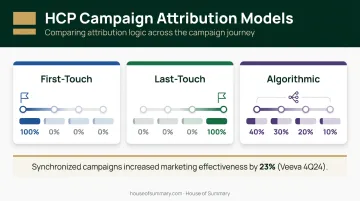
A multi-touchpoint HCP campaign — journal ad, conference sponsorship, email, retargeting — assigns conversion credit differently depending on which model you use:
- First-touch: Credit goes to the initial exposure
- Last-touch: Credit goes to the final click
- Algorithmic: Credit is distributed across the full journey
Each model tells a different story about which channels are working.
Veeva's 4Q24 data found that 65% of HCP engagements were not synchronized across sales and marketing — and synchronized campaigns increased marketing effectiveness by 23%. Poor coordination between teams is just as likely to undermine ROI as poor media buying decisions.
The practical takeaway: build first-party ROI benchmarks by service line or specialty. Generic industry benchmarks vary too much by market, specialty, and campaign quality to serve as useful guides for budget planning.
Frequently Asked Questions
Are doctors allowed to advertise products?
Yes — physicians can advertise their services and products, but must comply with ethical guidelines from their medical boards, FTC rules requiring truthful and substantiated claims, and HIPAA requirements on patient data privacy. Product endorsements such as supplements carry additional FTC disclosure obligations.
What are the 4 P's of marketing in healthcare?
The 4 P's of healthcare marketing cover the full patient journey:
- Product — the service or treatment offered
- Price — transparent pricing or insurance coverage clarity
- Place — how and where patients access the service
- Promotion — the advertising strategies used to drive awareness and action
What are the HIPAA rules for marketing?
HIPAA requires written patient authorization before using protected health information (PHI) for marketing purposes. Appointment reminders are permitted under healthcare operations, but promotional communications using PHI require separate, explicit consent — and PHI-based ad targeting faces strict restrictions.
What advertising channels work best for reaching healthcare professionals?
Professional journals, conference sponsorships, targeted email and newsletter advertising, and LinkedIn are consistently the strongest HCP channels. Reaching HCPs through personal digital habits — newsletter subscriptions, news platforms, and video — is increasingly effective and far less saturated than traditional medical media.
How can healthcare practices advertise ethically without misleading patients?
Base all claims on documented evidence, avoid outcome guarantees, clearly disclose any sponsored content, and obtain written patient consent for any testimonials. Honest representation of risks alongside benefits is both an ethical obligation and a genuine trust signal to prospective patients.