
Introduction
Patients today behave like consumers. They compare providers online, read reviews before booking, and switch when they feel ignored. That shift has turned healthcare advertising from a "nice to have" into a business necessity.
Local healthcare advertising spend is projected to exceed $12 billion in 2024, up nearly 20% from pre-pandemic levels — a clear signal that providers who hesitate to advertise are conceding ground to those who don't.
Beyond visibility, healthcare advertising delivers measurable results: broader patient reach, faster trust-building, and stronger retention. This article breaks down what healthcare advertising is, why its benefits compound over time, and which tactics consistently outperform the rest.
Key Takeaways
- 56% of consumers use Google to find healthcare providers — search ads reach them at peak intent
- Review recency and credentials directly influence whether a patient books an appointment
- 1 in 5 patients switched providers in 2024, often citing poor access — retention campaigns counter this
- Well-executed paid search, email, and video content convert awareness into scheduled visits
- HIPAA, FTC guidelines, and platform restrictions must shape messaging from day one
What Is Healthcare Advertising?
Healthcare advertising is the strategic promotion of healthcare services, providers, or products across paid and organic channels — with the goal of attracting new patients, retaining existing ones, and building provider credibility.
It spans traditional formats (TV, print, direct mail) and digital formats (search ads, social media, email, video). The channel mix varies by organization, but digital has become dominant for one practical reason: it's measurable. You can track exactly which ad led to which appointment.
Healthcare advertising also reduces friction. Patients make high-stakes decisions under stress and time pressure. A well-placed ad connects a specific need — "urgent care near me at 8pm" — with the right provider at the right moment.
The formats that work best depend on where a patient sits in the decision cycle:
- Awareness stage: social media, display ads, video content
- Consideration stage: search ads, review platforms, educational content
- Retention stage: email campaigns, appointment reminders, follow-up sequences
Key Benefits of Healthcare Advertising
The benefits below are tied to measurable business and patient outcomes. Each one builds on the last when advertising runs consistently, not just during slow periods.
Benefit 1: Expanded Patient Reach and Acquisition
Advertising directly increases the volume of patients who discover a practice — through search, social, or direct channels — particularly those actively seeking care right now.
McKinsey's 2024 survey of 1,129 consumers found 56% used Google for healthcare content discovery, and 42% were more likely to schedule an appointment with a health system that provided relevant information. That's the opportunity paid search and content advertising capture: patients already in motion, ready to book.
Targeted digital advertising narrows spend toward high-intent patients:
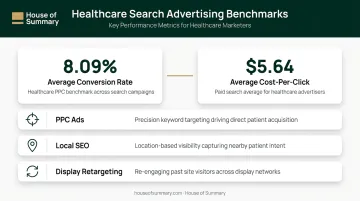
- PPC ads place a practice at the top of search results for specific, ready-to-act queries
- Local SEO drives organic discovery for nearby patients without per-click cost
- Display retargeting re-engages patients who visited a website but didn't book
For benchmarking: LocaliQ's analysis of 3,542 US healthcare search campaigns reported an average 8.09% conversion rate and $5.64 cost-per-click — conversion rates that outperform most other advertising categories.
This benefit matters most for: New practices, recently expanded service lines, or providers entering new geographic markets where organic referrals haven't had time to build.
KPIs to track: New patient volume, cost per acquisition, appointment conversion rate, geographic reach
Benefit 2: Trust-Building and Reputation Management
In healthcare, trust precedes action. A patient who doesn't trust a provider won't book — regardless of how good the ad is. Reputation isn't a soft metric; it's a direct revenue driver.
Advertising that features provider credentials, patient testimonials, transparent service information, and empathetic messaging builds trust faster — before a patient ever walks through the door.
This matters most in specialties where patients feel vulnerable: oncology, mental health, pediatrics. Hesitation to seek care drops when advertising addresses it proactively.
Review data reinforces this: a 2022 JAMA Internal Medicine study of over 1.1 million active US physicians found the average displayed physician rating was 5.3 years old — yet 71% of patients valued rating recency when selecting a provider. Fresh, recent reviews matter more than star averages alone.
That gap between stale ratings and patient expectations is exactly what trust-based advertising can close. It works best when it combines:
- Authentic patient stories (with appropriate HIPAA-compliant consent)
- Verifiable credentials and accreditations
- Honest, non-sensational messaging about outcomes
- Active, professional responses to negative reviews
This benefit matters most for: Organizations recovering from reputational events, entering new markets, or competing against larger, more recognized health systems.
KPIs to track: Online review ratings, website conversion rate, patient satisfaction scores, referral volume
Benefit 3: Patient Retention and Ongoing Engagement
Patient retention is where healthcare advertising delivers its largest long-term return. Retained patients generate more appointments, better care compliance, and stronger referrals — without the cost of re-acquiring them.
The stakes are real. An AHA summary of an 8,000-person 2024 survey reported that approximately 1 in 5 consumers switched providers, with nearly 90% citing the organization being hard to do business with.
Among those who switched voluntarily, service encounter failures were the leading driver — something proactive retention advertising directly addresses.
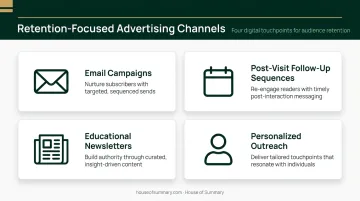
Retention-focused advertising channels:
- Email campaigns with appointment reminders and seasonal health tips
- Post-visit follow-up sequences that reinforce care continuity
- Educational newsletters that keep patients engaged between visits
- Personalized outreach triggered by care gaps or upcoming screenings
The numbers back this up: 61% of consumers said they would consider switching providers for a better digital experience, while those who find their provider easy to work with are 84% more likely to stay. Retention advertising that reduces friction — easy rebooking, clear communication, relevant content — is a direct competitive advantage.
This benefit matters most for: Established practices looking to grow without proportionally increasing marketing spend, and health systems with high churn in competitive urban markets.
KPIs to track: Patient retention rate, appointment frequency, referral rate, email open and click-through rates
Effective Healthcare Advertising Ideas That Work
The most effective healthcare advertising focuses on a few well-executed channels rather than spreading effort thin — each touchpoint below addresses a distinct stage of how patients find, evaluate, and choose a provider.
Search Advertising (SEO and PPC)
Local SEO ensures a practice appears when nearby patients search for care. PPC places it at the top immediately for high-intent queries like "urgent care near me" or "best cardiologist in [city]."
Google Business Profile is the foundation. Name, address, hours, photos, and patient reviews must be accurate and updated regularly — it's often the first thing a patient sees before clicking anything else.
PPC is best deployed for:
- High-value service lines with clear revenue potential
- Competitive markets where organic rankings take months to build
- New practice locations with no established search presence
Budget should map to the revenue potential of the service being advertised, not an arbitrary monthly figure.
Social Media and Video Content
Social platforms let healthcare brands humanize their practice — provider introductions, patient stories, health education content, and behind-the-scenes footage build emotional familiarity before a patient ever books.
Video consistently outperforms static content. Wyzowl's 2026 survey found 82% of businesses report positive ROI from video, and 85% of consumers said video convinced them to purchase a product or service. For healthcare, that translates to explainer videos about procedures, provider introduction reels, and patient testimonial content.
Practical social media priorities:
- Post consistently (2x per week minimum on Instagram drives peak engagement)
- Prioritize short-form video for awareness campaigns
- Use educational content to build authority, not just promotions
Email and Newsletter Advertising
Email reaches patients directly, bypasses social algorithms, and can't be intercepted by ad blockers. For healthcare brands, that guaranteed delivery matters — especially when compliance-reviewed messaging needs to actually reach its audience.
For retention campaigns, personalized sequences work well:
- Appointment reminders reduce no-shows
- Seasonal health tips (flu vaccines, annual checkups) drive timely visits
- Post-visit follow-ups reinforce care continuity and collect feedback
For acquisition campaigns, reaching audiences beyond an existing patient list means finding engaged readers elsewhere. Newsletter advertising — such as placements within the House of Summary network — puts healthcare messaging in front of over 500,000 subscribers, with 254,866+ emails opened daily.
Because newsletter ads are embedded in content readers opted into, they bypass ad blockers entirely. The audience skews toward decision-makers, executives, and high-income consumers: demographics that align well with healthcare brands targeting affluent patient populations or purchasing decision-makers.
Online Reviews and Reputation Advertising
Proactively managing reviews on Google, Healthgrades, and Yelp is itself a form of advertising — a strong review profile influences patient decisions before a single paid ad is ever seen.
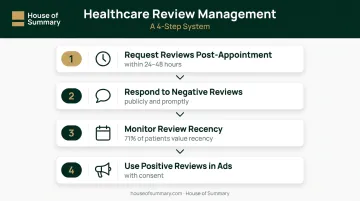
A systematic review process looks like this:
- Request reviews post-appointment via text or email within 24-48 hours
- Respond professionally to every negative review — publicly and promptly
- Monitor review recency — given that 71% of patients value how recent reviews are, a stale review profile actively undermines acquisition
- Use positive reviews in paid advertising creative (with appropriate consent)
Star ratings directly affect patient volume. Research published in AJMC examined how 1-star physician ratings impacted new patient acquisition — the relationship is measurable.
What Happens When Healthcare Advertising Is Neglected
Practices that don't advertise consistently don't stay still — they lose ground while competitors capture the patients searching online, reading reviews, and responding to targeted campaigns.
The consequences compound:
- Declining new patient volume as online visibility erodes without paid or organic promotion
- Reputation vulnerability — without fresh reviews and proactive trust-building, a single negative review carries disproportionate weight
- Accelerated patient churn: patients who don't hear from a provider between visits are far more likely to switch to a competitor who stays in regular contact
Research on provider switching shows churn can reduce revenues by as much as 10%. The encouraging part: voluntary switching driven by poor communication and competitor attraction is largely preventable with consistent outreach.
Rebuilding organic rankings, review scores, and brand familiarity after a period of neglect takes months — often longer than the neglect itself. Starting sooner is always the cheaper option.
How to Get the Most from Your Healthcare Advertising
Three principles separate effective healthcare advertising from wasted spend:
1. Channel coherence. Messaging on social, paid search, and email should reinforce each other. Patients who encounter a consistent brand story across multiple touchpoints book more readily than those who see disconnected, one-off campaigns.
2. Measure what matters. Track cost per new patient, appointment conversion rates, review score changes, and email engagement — not just impressions. Redirect budget toward channels delivering real outcomes.
3. Build compliance in from the start. HIPAA, FTC guidelines, and platform-specific restrictions on Google and Meta govern what can be said, to whom, and through which channels. Non-compliant ads risk platform bans, regulatory penalties, and patient trust erosion. For newsletter advertising, platforms like House of Summary require healthcare advertisers to meet applicable regulations and prohibit unverified health claims — compliance sits with the advertiser, but editorial standards add a practical layer of protection.
Conclusion
Healthcare advertising delivers measurable advantages: expanded patient reach, stronger trust, and improved retention. Those benefits compound over time — but only when the approach is consistent, channel-appropriate, and built around patient trust rather than volume tactics.
The practices and health systems that treat advertising as an ongoing operational discipline — not a periodic expense when patient volume drops — are the ones that sustain growth and patient loyalty in an crowded market. Patients searching for care today rarely scroll past the first few results. A sustained advertising presence is what determines whether they call your practice or move on.
Frequently Asked Questions
What is healthcare advertising?
Healthcare advertising is the strategic promotion of healthcare services, providers, or products across paid and organic channels. Its goals are attracting new patients, retaining existing ones, and building provider credibility across search, social, email, and review platforms.
How do you advertise healthcare services?
Identify your target patient population, select the right channel mix (search, social, email, reviews), ensure all messaging complies with HIPAA and FTC guidelines, and measure results against patient acquisition and retention outcomes — not just reach or impressions.
What are the 7 P's of marketing in healthcare?
The 7 P's are Product, Price, Place, Promotion, People, Process, and Physical Evidence. In healthcare, "People" refers to clinical staff and their role in patient experience, while "Physical Evidence" includes both facility environment and online reputation signals like reviews and ratings.
What is the 70-20-10 rule in digital marketing?
The rule allocates 70% of marketing budget to proven tactics, 20% to emerging channels, and 10% to high-risk experimentation. For healthcare marketers, it balances stability with growth without committing too much to unproven approaches.
What regulations govern healthcare advertising?
HIPAA governs patient data privacy and restricts how tracking technologies can be used in advertising. FTC guidelines require truthful, substantiated health claims. Google and Meta both restrict sensitive health-interest targeting.
How do you measure the success of a healthcare advertising campaign?
Key metrics include new patient acquisition volume, cost per acquisition, appointment conversion rate, patient retention rate, and review score changes. Channel-specific indicators — like email click-through rate or paid search ROAS — matter too. Impressions and clicks alone don't measure campaign success.