The brands keeping up are doing so by tracking which technologies are actually reshaping how healthcare messages get delivered, targeted, and measured. This article covers the trends worth your attention.
Key Takeaways
- AI targeting lets healthcare brands reach high-propensity patient segments without touching protected health information
- Programmatic and CTV are replacing broad traditional media buys with precise, scalable digital reach
- Cookie deprecation and HIPAA are pushing data strategies toward consented, first-party sources
- Email and newsletter advertising bypass ad blockers entirely, delivering brand messages to opted-in, engaged audiences
- Retail media networks and AI-generated creative are the next trends worth watching
AI-Powered Ad Targeting and Personalization
What It Actually Means in Healthcare
AI-powered targeting in healthcare means using machine learning models to analyze anonymized audience signals — search behavior, content consumption patterns, demographic clusters — to identify which users are most likely to be researching a specific condition or service. No names. No medical records. No PHI.
The targeting is built on behavioral inference, not health status disclosure. That distinction matters enormously in a HIPAA-regulated environment.
Where It's Being Deployed
A 2025 Swoop and MM+M survey found that 67% of pharma marketers see predictive AI's potential to improve audience targeting, while 47.3% are actively seeking implementation. The gap between interest and active implementation tells you something useful: confidence is high, but execution is still catching up.
Real examples from the same research illustrate what this looks like in practice:
- A pharma brand using predictive non-adherence audiences saw a 29% year-over-year increase in patient adherence
- A mental health drug campaign used CTV to reach niche patient and caregiver segments, resulting in a 20% increase in HCP appointments
These are vendor case examples — not industry-wide benchmarks — but they point to the kind of targeting precision AI makes possible.
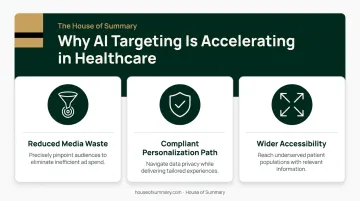
Why Adoption Is Accelerating
Three forces are pushing this forward simultaneously:
- Reduced media waste: Spend concentrates on high-propensity audiences rather than broad demographic buckets
- A compliant path to personalization: Anonymized behavioral inference sidesteps the HIPAA exposure that comes with targeting based on known health status
- Wider accessibility: The tooling has matured enough that mid-size pharma companies and health systems can use it — not just the largest organizations
Programmatic Advertising and Connected TV (CTV)
How Programmatic Works for Healthcare
Programmatic advertising automates media buying in real time through demand-side platforms (DSPs), matching healthcare advertisers with specific audience segments across the open web, streaming platforms, and premium publisher inventory — without requiring manual placement negotiations for each channel.
Both The Trade Desk and StackAdapt have built dedicated healthcare and pharma capabilities:
- StackAdapt NPI targeting — reaches verified healthcare professionals by their National Provider Identifier
- The Trade Desk HCP Endemic Marketplace — connects pharma brands to clinicians across multiple digital touchpoints
The CTV Opportunity
Programmatic pipes now extend directly into streaming. Linear TV viewership is declining fast — StackAdapt data shows 88% of US households had at least one internet-connected TV device in 2023, and cord-cutters were forecast to reach 75% by 2025, up from 53% in 2022.
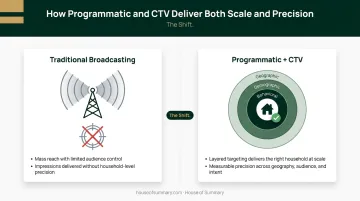
For healthcare brands, the appeal is targeting granularity. CTV allows geographic, demographic, health interest, and behavioral targeting that traditional broadcast can't match — a regional hospital system can reach likely patients by zip code without paying for a national audience where most viewers are irrelevant.
Why This Combination Matters
Programmatic and CTV together solve a problem that has defined healthcare advertising for decades: broad reach came at the cost of precision, and precise targeting limited scale. Used together, these channels now deliver both — and CTV CPMs have dropped enough that many regional health systems are reallocating broadcast budgets toward streaming in 2024 planning cycles.
Privacy-First Advertising and First-Party Data Strategies
Where Third-Party Cookie Deprecation Actually Stands
Google's deprecation of third-party cookies didn't go as originally planned. In 2024, Google shifted from outright removal to a user-choice model in Chrome, and in 2025, several Privacy Sandbox APIs — including Topics and Protected Audience — were retired. The tracking infrastructure underlying behavioral ad targeting remains unsettled.
For healthcare advertisers, this uncertainty compounds HIPAA's existing constraints. HHS OCR is explicit: regulated entities cannot use tracking technologies in ways that result in impermissible disclosures of PHI to tracking vendors. Washington's My Health My Data Act extends similar protections to consumer health data that falls outside HIPAA's traditional scope.
What First-Party Data Strategies Look Like
Healthcare organizations building durable advertising capabilities are moving toward:
- CRM-powered audience building — using opted-in patient records to create targetable segments without relying on third-party behavioral data
- Contextual advertising — serving ads based on the content environment (a cardiac health article) rather than tracking the individual user
- Consent-based email and SMS — reaching patients through channels where the data collection was transparent and explicitly consented to
Organizations that build these capabilities now enter each new regulatory cycle with a working infrastructure rather than a gap to close on short notice.
Email and Newsletter Advertising in the Inbox-First Era
Why the Inbox Has Become Strategic Territory
Ad blocking doesn't reach email. That single fact is reshaping how healthcare advertisers think about channel mix. With 45% of US consumers using ad blockers, web display and social inventory is increasingly reaching only the fraction of users who haven't filtered it out. Email and newsletter advertising deliver brand messages directly to opted-in inboxes — no algorithm suppressing reach, no blocking extension stripping the ad.
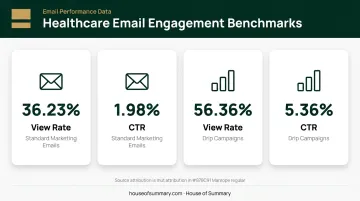
The engagement benchmarks back this up. Paubox's analysis of nearly 18 million healthcare emails from 128 senders found marketing emails averaging a 36.23% view rate and 1.98% CTR, with drip campaigns reaching 56.36% view rate and 5.36% CTR. MailerLite's broader dataset shows medical, dental, and healthcare emails hitting a median 43.75% open rate.
How Newsletter Placement Sidesteps Behavioral Targeting Concerns
When an ad appears inside content a reader chose to subscribe to, it's not being served based on tracked health behavior — it's placed in an editorial environment the reader opted into directly. That distinction sidesteps many of the HIPAA-adjacent concerns that surround behavioral targeting, without requiring advertisers to navigate complex data agreements.
For healthcare brands navigating FDA and MHRA constraints, platform restrictions, and brand-safety requirements, this compliance clarity matters. House of Summary's newsletter network reaches 500,000+ subscribers, with 254,866+ emails opened daily across Presidential Summary, Geopolitical Summary, Dubai Summary, and London Summary. It's built on a human-written, editorially verified environment — no behavioral tracking, no programmatic data concerns.
The audience skews toward decision-makers, executives, and high-income professionals in the US, UK, and UAE: demographics that align well with premium healthcare and health system campaigns. Ad formats include:
- Native sponsored content written in the newsletter's editorial voice
- Display placements within individual issues
- Full-issue takeovers for maximum brand presence
None of these formats are exposed to web ad-blocking, making them consistently deliverable in a way standard display inventory is not.
What's Driving These Healthcare Advertising Technology Trends
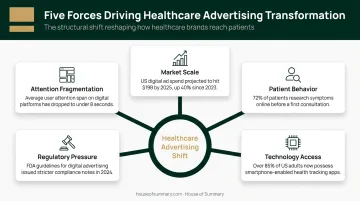
Healthcare advertising isn't shifting gradually — multiple pressures are hitting at once, and they're pulling budgets, targeting practices, and channel strategies in the same direction.
Market scale: EMARKETER projected US healthcare and pharma ad spending at $30.59 billion in 2024, up 5% year-over-year. Digital's share of that is growing faster — healthcare and pharma digital ad spending reached $24.77 billion in 2025, a 13.3% year-over-year increase. The money is moving toward measurable channels.
Patient behavior: Healthcare consumers research providers before booking. Medical Economics data suggests 77% of patients use online reviews as a first step in finding a new doctor. An AHA summary of an Accenture survey of 8,000 US adults found roughly 1 in 5 consumers switched providers in the prior year, with nearly 90% of switchers citing difficulty doing business with the organization.
That means healthcare advertising isn't just impression-generating: it directly feeds acquisition and retention.
Technology access: Machine learning, large language models, and real-time programmatic infrastructure have become accessible to organizations well below the large health system and major pharma tier. What required an enterprise contract and a dedicated data science team in 2019 is increasingly available through DSP interfaces and SaaS marketing platforms.
Regulatory pressure: HIPAA, Google's evolving cookie stance, FTC health breach notification updates, and state-level laws like Washington's My Health My Data Act are all tightening what's permitted. The direction is toward consent and restriction, not toward expanded behavioral targeting capability.
Attention fragmentation: With 45% of US consumers blocking ads and streaming viewership fragmenting what's left of linear TV's captive audience, the inventory of moments where healthcare messages reach undivided attention is shrinking. That scarcity is pushing budgets toward channels where blocking is structurally impossible: inbox placements, native content, and streaming.
How These Trends Are Impacting Healthcare Advertising
Operational Impact
Campaign planning now involves data governance, consent management, and first-party audience building that once belonged to legal and IT teams. Healthcare marketing departments are integrating compliance workflows into campaign cycles — which increases complexity but also reduces regulatory exposure.
Business Impact
Budget allocation is shifting visibly. Healthcare and pharma already spend a greater share of total media ad spending on traditional channels than any other industry EMARKETER measures — but digital's 13.3% growth rate in 2025 signals where CFOs and marketing leaders are putting new budget. Programmatic, CTV, and high-engagement newsletter placements are the destinations for spend that used to go to broadcast and print, because they produce measurable, attributable outcomes.
Workforce Impact
Executing those channel strategies requires capabilities that didn't exist as a defined role five years ago. Healthcare marketing teams now need:
- Data analytics literacy to interpret campaign performance
- Privacy law familiarity to navigate consent and compliance requirements
- DSP and CRM platform fluency for programmatic buying and audience management
- Ability to evaluate AI targeting vendors and their data practices
That combination is rare. It's why specialist agency partnerships and media network consultations have become a meaningful part of how healthcare brands run campaigns.
Future Signals for Healthcare Advertising Technology
Three signals are already visible at the edges and worth tracking closely:
- Retail media networks — CVS Media Exchange is powered by first-party data from 90 million+ addressable ExtraCare shoppers; Walgreens Advertising Group cites 101 million+ loyalty members with first-party purchase-driven data. These are significant health and wellness media assets that don't rely on cookies or behavioral tracking.
- AI-generated creative — IAB reports 83% of ad executives expect to deploy AI in the creative process by 2026, up from 60% in 2024. EMARKETER projects that 39% of video ad creative will be built or enhanced with generative AI by 2026. For healthcare brands, this opens up dynamic creative that adapts messaging by audience segment without expanding data collection.
- Competition for first-party partnerships — Within 1–3 years, healthcare advertisers will actively compete for data partnerships with health systems, pharmacy chains, and editorial environments built on opted-in audiences.
Newsletter and inbox inventory falls directly into that third category — opted-in readers, brand-safe context, no behavioral tracking required. As those placements grow harder to find, early partnerships with high-trust editorial publishers become a practical advantage, not just a preference.
Conclusion
Healthcare advertising is being reshaped by AI targeting precision, programmatic and CTV scalability, tightening privacy regulation, and the fragmentation of traditional audience attention. These forces aren't operating in isolation. They're reinforcing each other, compressing timelines that any single shift would have stretched over years.
The organizations adapting now, building first-party data assets, exploring inbox-based channels, and moving budget toward measurable digital formats, will be better positioned than those waiting for conditions to settle. They won't. The advantage goes to brands that pick a direction based on where the evidence already points and start moving.
Frequently Asked Questions
What are the four types of digital marketing?
The four commonly recognized types are search marketing (SEO and paid search), social media marketing, content marketing, and email and newsletter marketing. In healthcare, each must be applied with HIPAA compliance in mind, particularly search and social, where behavioral targeting intersects with health data restrictions.
How is AI being used in healthcare advertising?
AI analyzes anonymized audience signals — search behavior, content patterns, demographic clusters — to identify high-propensity patient segments for specific conditions or service lines, enabling precise targeting without exposing protected health information. It's one of the few compliant paths to personalization in a HIPAA-constrained environment.
What is programmatic advertising in healthcare?
Programmatic advertising automates the real-time purchase of digital ad placements, allowing healthcare brands to reach defined audience segments across websites, apps, and streaming platforms through automated, bid-based buying. Platforms like The Trade Desk and StackAdapt have built healthcare-specific capabilities including NPI-based HCP targeting.
How do HIPAA regulations affect healthcare advertising technology?
HIPAA restricts how patient health information can be used for marketing, requiring advertisers to rely on consent-based data, contextual targeting, or anonymized behavioral models. HHS OCR has specifically flagged third-party tracking technologies as a compliance risk in this context.
Why is email and newsletter advertising effective for healthcare brands?
Email reaches opted-in audiences directly, bypasses ad blockers, and delivers measurable engagement: healthcare marketing emails average view rates above 36%, with drip campaigns exceeding 56%. Contextual placement also sidesteps the behavioral tracking concerns that complicate other digital healthcare advertising formats.
What is the difference between healthcare marketing and healthcare advertising?
Marketing covers the full strategic picture — content, SEO, branding, patient education, and reputation management. Advertising refers specifically to paid placements designed to reach target audiences through defined channels. Both require HIPAA awareness, but advertising carries additional constraints around data use and targeting methodology.