For brands and media decision-makers tracking where serious ad budgets are moving, healthcare deserves close attention — not just as a category footnote, but as one of the largest and most structurally motivated advertising markets in the country.
This article breaks down the market's size, growth trajectory, key drivers, and the channel shifts that are reshaping how healthcare brands compete for attention.
Key Takeaways
- The US healthcare advertising market was valued at $25.3 billion in 2025 and is projected to reach $35.3 billion by 2034 (IMARC, 2026)
- Digital channels now account for 76% of US healthcare ad spend, with total healthcare/pharma digital spend hitting $24.77 billion in 2025
- The aging US population, with 1 in 5 Americans reaching retirement age by 2030, is a structural demand driver that won't reverse
- FDA approved 50 novel drugs in 2024, with 52% targeting rare or orphan diseases — each approval triggers a dedicated ad campaign
- DTC prescription drug advertising surpassed $10.1 billion in 2024, up from $1.3 billion in 1997
- Newsletter and inbox-based ad formats are gaining share as programmatic CPMs climb — email open rates in healthcare average 40%+, well above display benchmarks
US Healthcare Advertising Market: Size and Growth Projections
Current Market Size and Trajectory
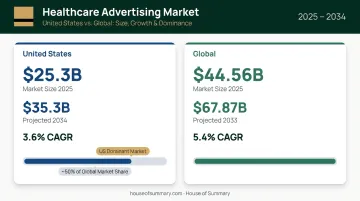
The US healthcare advertising market reached $25.3 billion in 2025 and is forecast to grow to $35.3 billion by 2034 at a 3.6% CAGR, according to IMARC Group's current market report. That's a substantial absolute gain (roughly $10 billion in new spending over nine years), driven by a combination of demographic demand, drug innovation cycles, and the ongoing digital migration of ad budgets.
The US doesn't just lead this market — it dominates it. Market Data Forecast puts global healthcare advertising at $44.56 billion in 2025, growing to $67.87 billion by 2033 at a 5.4% CAGR. The US accounts for nearly 50% of that global spend, reflecting both the scale of the American healthcare system and a permissive direct-to-consumer advertising environment that exists here and almost nowhere else.
| United States | Global | |
|---|---|---|
| 2025 Market Size | $25.3 billion | $44.56 billion |
| Projected Size | $35.3 billion (2034) | $67.87 billion (2033) |
| CAGR | 3.6% | 5.4% |
| US Share of Global | ~50% | — |
What's Included in "Healthcare Advertising"
This market covers a broader category than pharma TV spots alone. IMARC segments it by product type:
- Pharmaceuticals/small molecule drugs — 46.3% of spend
- Biopharmaceuticals — 22.7%
- Vaccines — 18.6%
- OTC drugs — 12.4%
Beyond product type, the category spans DTC pharmaceutical campaigns, hospital and health system advertising, health services promotions, professional/HCP marketing, and digital health platform advertising. Digital channels collectively represent 76% of the US healthcare advertising market.
For additional scale: eMarketer reported total US healthcare and pharma ad spend at $30.59 billion in 2024, up 5% year-over-year. By 2023, pharma and healthcare already accounted for 10% of total US digital ad spend.
What's Driving Healthcare Advertising Growth
Demographic Shifts: The Aging Population Effect
The numbers here are not subtle. According to the US Census Bureau, by 2030 all baby boomers will be 65 or older, and 1 in 5 US residents will be retirement age. The 65+ population is projected to grow from roughly 56 million in 2020 to 73 million by 2030. Medicare currently covers 67.6 million people — 60.3 million aged 65+ and 7.3 million disabled.
That demographic reality translates directly into advertising budgets. Pharmaceutical companies follow patient populations, and an older America means higher demand for cardiovascular drugs, Alzheimer's treatments, and NASH therapies. The FDA approved Kisunla for Alzheimer's disease in July 2024 and Rezdiffra — the first-ever treatment for MASH/NASH with liver scarring — that same year. Each approval anchors a new advertising campaign.
New Drug Approvals and the Specialty Shift
The FDA's CDER approved 50 novel drugs in 2024, with 26 of those (52%) targeting rare or orphan diseases. Each novel approval triggers a dedicated launch campaign, creating predictable demand for advertising inventory.
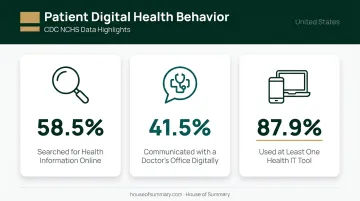
CDC NCHS data shows how far that shift has already gone among US adults (July–December 2022):
- 58.5% used the internet to search for health or medical information
- 41.5% used it to communicate with a doctor's office
- 87.9% used at least one form of health information technology
Patients now arrive at appointments with brand awareness already shaped by advertising. Healthcare brands absent from the channels where patients research — search, social, and inbox — lose that pre-consultation conversation before it starts.
The Digital Shift: Where Healthcare Ad Dollars Are Going
From $13.9 Billion to $24.77 Billion
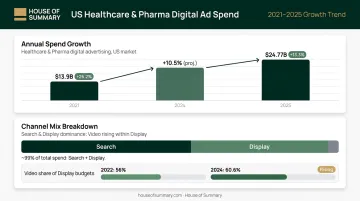
The migration of healthcare ad spend into digital channels has been fast and isn't reversing. US healthcare and pharma digital ad spend rose 26.2% in 2021 to reach $13.9 billion, according to MM+M citing Insider Intelligence forecasts — and by 2025, that figure had climbed to $24.77 billion, up 13.3% year-over-year.
Search and display dominate the digital mix, comprising almost 99% of healthcare/pharma digital spending as of 2022. Display's share has been growing relative to search, with video — a display subcategory — rising from 56% of display budgets in 2022 toward 60.6% by 2024.
The Saturation Problem and the Case for High-Attention Channels
As healthcare brands pile into the same programmatic inventory, CPMs climb and attention drops. The growth rate of pharma digital ad spend has decelerated — from 26.2% in 2021 to a projected 10.5% in 2024 — not because budgets are shrinking, but because returns in saturated channels diminish.
Sophisticated media buyers are responding by diversifying into formats where their messages face fewer competitors for a reader's attention. Email newsletter advertising has grown steadily as a result. The core advantages are practical:
- Ads land directly in the inbox and bypass ad blockers entirely
- Audiences have opted in for content they trust — attention is already earned
- Editorial placements sit outside the FDA-restricted ad platforms and social media policy constraints that limit pharma creative
For healthcare and pharma brands navigating those restrictions, newsletter environments like House of Summary offer a direct path to decision-makers through human-written editorial content, without the algorithmic gatekeeping of social or programmatic channels.
Key Advertising Segments Driving Spend
Direct-to-Consumer (DTC) Pharmaceutical Advertising
DTC pharma advertising is one of the sector's most striking growth stories. Prescription drug DTC spend climbed from $1.3 billion in 1997 to $6.0 billion in 2016 and $6.58 billion in 2020 — and IMARC reports it surpassed $10.1 billion in 2024. That's nearly an eightfold increase in under three decades.
The composition of DTC spending has shifted along with the drug pipeline. Mass-market lifestyle drugs once dominated TV airtime. Today, the biggest DTC investments are in specialty biologics, cancer immunotherapies, and rare disease treatments — categories where patient education is complex and brand differentiation matters most.
Professional and HCP-Directed Marketing
Marketing to healthcare professionals remains the single largest slice of total pharmaceutical marketing spend. Per JAMA data, professional pharma marketing grew from $15.6 billion in 1997 to $20.3 billion in 2016, spanning multiple channels:
- Detailing visits and field-force engagement
- Medical journal advertising and sponsored education events
- Free samples programs
- Digital platforms like Doximity, which reaches the majority of US physicians
Digital hasn't displaced traditional HCP marketing — it has extended it. Each channel now reinforces the other.
Health Services and Hospital Advertising
DTC advertising for health services grew from $542 million in 1997 to $2.9 billion in 2016, according to JAMA. Hospitals, cancer centers, dental chains, and mental health clinics showed the steepest growth. Competitive local markets and patient acquisition pressure have pushed health systems to treat advertising as a core operational cost, not a discretionary line item.
Taken together, these three segments — pharma DTC, HCP marketing, and health services — account for the bulk of US healthcare advertising spend and each continues to expand.
The Road Ahead: Future Outlook for Healthcare Advertisers
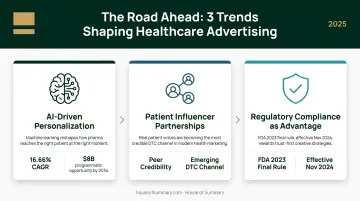
Three trends will shape the next phase of healthcare advertising spending:
AI-driven personalization: Market Data Forecast identifies AI as the fastest-growing technology segment within healthcare advertising, at a 16.66% CAGR. IMARC projects programmatic healthcare advertising as an $8 billion opportunity by 2034, driven by predictive targeting and real-time audience modeling.
Patient influencer partnerships: Academic research published in PMC identifies patient influencers as an emerging DTC pharma marketing channel, providing peer-to-peer credibility that conventional brand campaigns rarely achieve. Brands are testing these partnerships as an alternative path to authentic patient engagement.
Regulatory compliance as a competitive advantage: The FDA published a final rule in November 2023 requiring DTC prescription drug TV and radio ads to present side effects and contraindications in a "clear, conspicuous, and neutral manner," with consumer-friendly language, readable text, and no distracting audio-visual elements. Full compliance was required by November 2024. Advertisers who build compliant, trust-first creative will outperform as consumer skepticism of health claims continues to rise.
That trust gap points to a broader channel question. As algorithm volatility and ad blocking compress returns on display and social, healthcare brands are moving budget toward channels with direct, unfiltered audience access.
Email newsletters — particularly curated, human-written publications reaching executives and high-intent professionals — offer inbox-level attention, no ad blocking, and editorial credibility that display formats can't match. For brands targeting business professionals and health-conscious decision-makers, newsletter placements deserve a place in the core media mix.
Frequently Asked Questions
How big is the US healthcare advertising market?
The US healthcare advertising market was valued at $25.3 billion in 2025 and is projected to reach $35.3 billion by 2034, representing a CAGR of approximately 3.6%, according to IMARC Group. That puts it ahead of automotive and financial services in category-level ad spend.
What is the fastest-growing segment within healthcare advertising?
Digital advertising is the fastest-growing channel, with US healthcare and pharma digital spend reaching $24.77 billion in 2025 — up 13.3% year-over-year. Within digital, programmatic display and video are gaining share relative to paid search, driven by DTC pharma campaigns and health service promotions.
How much do pharmaceutical companies spend on direct-to-consumer advertising?
US DTC prescription drug advertising surpassed $10.1 billion in 2024, up from $1.3 billion in 1997. The shift from mass-market lifestyle drugs to high-cost specialty biologics and rare disease treatments has been the primary driver of this growth.
What regulations govern healthcare advertising in the United States?
The FDA oversees prescription drug ads, requiring fair balance between benefit and risk claims, while the FTC polices health service advertising for misleading content. A 2023 FDA final rule — effective November 2024 — tightened DTC TV and radio requirements, mandating clearer risk disclosures and consumer-friendly language.
Why are healthcare advertisers moving toward digital and inbox-based channels?
Digital channels offer precision targeting and real-time measurement that traditional media cannot match. Email newsletters are particularly valued for healthcare brands — they bypass ad blockers, avoid algorithmic suppression, and reach opted-in readers without the platform restrictions that complicate paid social and display campaigns.
What demographic trends are shaping healthcare advertising growth?
The aging US baby boomer population is the primary driver — by 2030, 1 in 5 Americans will be retirement age and the 65+ cohort will reach approximately 73 million. Rising rates of chronic disease and digitally empowered patients who research treatments online are amplifying demand for healthcare advertising across all channels.