That gap is expensive. U.S. healthcare and pharma digital ad spending is projected to reach $24.77 billion in 2025, up 13.3% year over year. With that much money flowing into the market, the brands that win aren't necessarily those with the largest budgets. They're the ones with the clearest picture of where those budgets are going — and where the white space is.
This article breaks down what healthcare advertising intelligence actually is, which signals matter most, and how to convert those signals into concrete growth decisions.
Key Takeaways
- Healthcare advertising intelligence tracks competitor spend, creative, and audience behavior — not just your own campaign performance
- It exposes where competitors are under-investing, which audiences they're ignoring, and which channels are overcrowded
- Timing gaps, messaging angles, and channel white space can be identified before competitors move in
- Channel selection should be driven by audience receptivity and competitive density — not reach metrics alone
- An ongoing intelligence practice compounds into durable strategic advantage; a one-time audit doesn't
What Is Healthcare Advertising Intelligence?
Healthcare advertising intelligence is the disciplined practice of tracking competitor advertising activity across the market. It covers media spend patterns, creative messaging, channel performance, and audience behavior — all with the goal of making sharper, more competitive decisions.
This is distinct from internal analytics. Marketing analytics tells you how your campaigns are performing. Advertising intelligence tells you what the market is doing: where money is flowing, which messages are winning attention, and where gaps exist that your brand could occupy.
Where It Applies
Healthcare advertising intelligence applies across a broad range of categories:
- Pharma — drug launches, condition awareness, DTC campaigns
- Hospital systems — service line marketing, patient acquisition, regional competition
- Health tech — app and device promotion, category education
- Health insurance — open enrollment campaigns, plan differentiation
In each case, the competitive dynamic is the same: multiple brands targeting the same audience, with limited visibility into what's actually working for anyone else.
Key Data Sources
Healthcare marketers typically draw from several distinct tool categories:
- Competitive ad spend tools — Kantar, Nielsen Ad Intel, Vivvix/CMAG, Pathmatics by Sensor Tower
- Creative intelligence platforms — systematic tracking of competitor ad copy and visual themes
- Social listening services — monitoring brand and condition-related conversations
- Share-of-voice trackers — measuring a brand's spend as a percentage of total category spend
- Publisher audience engagement data — signals from media partners on reader behavior
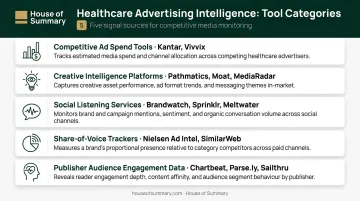
No single tool covers everything. Spend data shows where budgets are going; creative intelligence shows what messages are being tested; social listening captures how audiences are responding. The value comes from combining them.
The Regulatory Boundary
Healthcare intelligence must operate within clear ethical and legal limits. HIPAA's Privacy Rule protects individually identifiable health information held by covered entities — but advertising intelligence draws on aggregated competitive spend data, public creative libraries, and properly de-identified audience-level data, none of which qualifies as protected health information.
The risk sits elsewhere: in 2023, the FTC barred GoodRx from sharing user health data with advertising platforms and imposed a $1.5 million civil penalty. The lesson isn't that intelligence is dangerous — it's that patient-level tracking data is a different category entirely, and should never be part of an advertising intelligence program.
Why Healthcare Advertisers Need Advertising Intelligence Now
The market has changed structurally, not just grown.
According to CDC/NCHS data, 58.5% of U.S. adults used the internet to look for health or medical information in the second half of 2022 — and 41.5% communicated with a doctor's office online during the same period. Patients are researching conditions, comparing providers, and evaluating treatments before making any decisions. Digital visibility is now part of the care journey, not an optional add-on.
The advertising environment has also grown more crowded and more expensive. Healthcare paid search CPCs range from $4.71 to $6.82 across relevant categories, according to WordStream benchmark data from nearly 18,000 U.S. campaigns. Kantar's research found that 55% of HCPs feel overwhelmed by pharmaceutical content — a signal that message saturation is already a real problem, not a theoretical one.
Three pressures are converging:
- Pharma accounts for nearly 90% of healthcare digital spending, concentrated heavily in paid search
- Patients and caregivers are spread across search, social, CTV, audio, and email — varying significantly by age, condition, and geography
- The most obvious channels are also the most expensive and the most contested
Advertising intelligence is what separates marketers who respond to these pressures from those who keep absorbing them.
Key Types of Healthcare Advertising Intelligence Signals
Competitive Spend Intelligence
This signal tracks where competitors allocate media budgets — across TV, digital display, paid search, social, and direct channels — at what cadence and volume. It reveals investment priorities, market share ambitions, and the "dark periods" when competitors pull back spend and create temporary share-of-voice openings.
KFF's analysis of Medicare open enrollment is a concrete example of how spend intelligence works in practice: during the 2022 season, more than 643,000 TV ad airings from over 1,200 unique ads were tracked using Vivvix CMAG data. Medicare Advantage dominated at 85% of airings — roughly 9,500 ads per day. That density signal alone tells a challenger brand when and where to enter, and when to wait.
Creative Intelligence
Creative intelligence means tracking competitor ad copy, visual themes, emotional appeals, and messaging frameworks. When you map what competitors are saying, patterns emerge quickly. In healthcare, common frames include "hope," "innovation," and "partnership with your doctor."
A brand that identifies when all major competitors have converged on the same narrative — and stakes out a different, credible position — can stand out without increasing spend.
Audience Intelligence
Audience intelligence goes beyond basic demographics. The signals that matter most include:
- Psychographic profiles and health-seeking behaviors
- Media consumption patterns by patient or HCP segment
- Social determinants of health that shape receptivity
- Timing windows when specific audiences are most engaged
The goal isn't just knowing who the audience is. It's understanding how and when to reach them.
Timing Intelligence
Timing intelligence maps competitor advertising surges against health calendar events: open enrollment periods, seasonal conditions, drug launch cycles, and awareness months. The payoff is identifying lower-competition windows where launching or scaling a campaign delivers higher share of voice at lower cost.
How to Turn Advertising Intelligence Into Growth Opportunities
White Space Identification
Use competitive spend mapping to find therapeutic areas, geographic markets, or patient/HCP segments where competitors are under-investing. These gaps are your lowest-resistance entry points: a well-resourced campaign can build share of voice without triggering a bidding war.
Message Differentiation
When creative intelligence reveals that every major competitor is using the same narrative frame, a brand with distinct, credible positioning stands out clearly. Functional proof points and outcome-specific claims consistently outperform generic emotional appeals when the emotional territory is already crowded.
Targeting Overlooked Segments
Audience intelligence regularly surfaces cohorts that competitors have bypassed. Older male patients with low health literacy who rely on caregivers. Younger adults who respond to low-friction digital prompts rather than clinical messaging. These segments can be reached at low competitive cost because the main players aren't fighting for them.
Timing Arbitrage
Intelligence on competitor campaign cycles reveals predictable quiet periods — post-launch maintenance phases, seasonal off-peaks, gaps between enrollment windows. Launching or scaling during these periods delivers a higher share of voice without additional budget, because the noise floor has dropped.
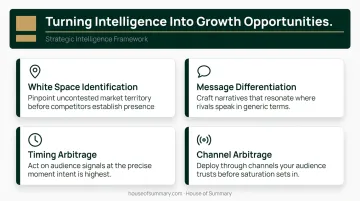
Channel Arbitrage
When a high-quality channel is being systematically underused by competitors, early movers establish audience relationships and lower CPAs before the channel becomes crowded. This is directly relevant for direct-access channels — email newsletters, in particular — where competitor density is low and audience engagement is measurably high.
House of Summary's newsletter network, which reaches 500,000+ subscribers and generates 254,866+ emails opened daily, represents exactly this kind of channel. One advertiser, BSH Hausgeräte, reported click-through rates 4x higher than Google AdWords from a campaign in Dubai Summary, a result that reflects both audience quality and the absence of competitive noise. Newsletter ads bypass ad blockers, reach readers without algorithmic filtering, and run as the sole ad per edition — conditions that are difficult to replicate in paid search or social.
Choosing the Right Channels Using Advertising Intelligence
The intelligence-driven channel selection framework is straightforward: match channel choice to both audience media behavior and the competitive density signal from your intelligence.
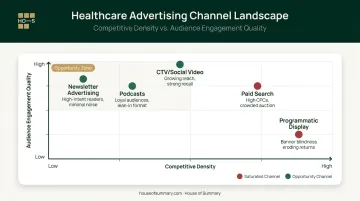
A channel where your target audience is highly active but competitors are under-invested offers the best economics. A channel that's active but competitor-saturated requires either a significantly larger budget or sharper creative differentiation to win.
The Saturation Problem in Default Channels
Paid search and programmatic display have become the most expensive and contested environments for healthcare brands. eMarketer data confirms the sector skews heavily toward search. Kantar notes that 65% of pharma ads contain three or more messages — a sign that brands are overloading content because they're fighting for diminishing attention in crowded placements.
These channels aren't wrong. They're just the default — and defaults rarely deliver the best economics.
Where Advertising Intelligence Points Instead
eMarketer's 2025 analysis shows healthcare marketers are actively shifting toward CTV, social video, and digital. Kantar documented a 208% surge in pharma podcast advertising spend at the start of 2023, signaling that some brands are already moving to find less contested ground.
The channels drawing early-mover interest share a common trait: lower competitive density relative to audience quality. That includes:
eMarketer's 2025 analysis shows healthcare marketers are actively shifting toward CTV, social video, and digital. Kantar documented a 208% surge in pharma podcast advertising spend at the start of 2023, signaling that some brands are already moving to find less contested ground.
The channels drawing early-mover interest share a common trait: lower competitive density relative to audience quality. That includes:
- CTV and social video — growing inventory with still-developing competitive saturation
- Podcasts — high listener loyalty, category-specific targeting, difficult to block
- Newsletter advertising — direct inbox delivery, high engagement, immune to ad blockers
Nearly 20% of U.S. internet users use ad-blocking software, which has no effect on email-delivered content. For healthcare brands targeting business professionals and health-literate executives, newsletters offer documented engagement and no algorithmic interference. That combination is difficult to replicate through programmatic at equivalent audience quality.
That principle plays out in practice with networks like House of Summary, whose four newsletters — Presidential Summary, Geopolitical Summary, Dubai Summary, and London Summary — serve an audience concentrated in high-income professional markets: 66% U.S.-based, with strong readership in London and Dubai. For healthcare brands targeting decision-makers, executives, and affluent consumers with above-average health purchasing power, that audience profile is a direct match.
Building a Healthcare Advertising Intelligence Practice
Start with an Honest Audit
Most healthcare marketing teams have informal intelligence at best — competitor website checks, occasional social listening, trade press monitoring. Before investing in tools, map what your team currently tracks versus what a structured practice would add: spend tracking, creative monitoring, audience benchmarking, share-of-voice analysis.
Establish a Sustainable Cadence
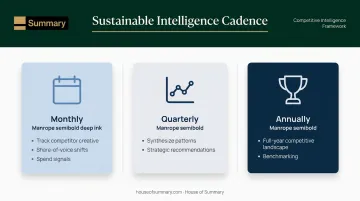
Advertising intelligence is most valuable as a continuous practice, not a one-time audit. A practical structure:
- Monthly: Track new competitor creative, share-of-voice shifts, spend signals
- Quarterly: Synthesize patterns into strategic recommendations for the next campaign cycle
- Annually: Benchmark full-year competitive landscape against prior periods
Close the Loop Between Intelligence and Execution
The most common failure in advertising intelligence programs is that insights live in a research report that never reaches the creative brief or media plan. Build a clear handoff workflow so intelligence outputs directly inform:
- Channel allocation decisions — based on where competitors are gaining or losing share
- Audience targeting parameters — refined against observed competitor audience overlaps
- Creative messaging and positioning — shaped by gaps and whitespace in competitor creative
- Timing of campaign launches and pauses — timed around competitive spend cycles
Teams that wire intelligence directly into their workflow — not a standalone research report, but a standing input reviewed before every brief — consistently find shorter decision cycles and fewer reactive pivots mid-campaign.
Frequently Asked Questions
What is advertising intelligence?
Advertising intelligence is the practice of systematically tracking, analyzing, and interpreting competitor advertising activity — including where they spend, what messages they use, and which audiences they target — to inform smarter decisions for your own campaigns. It provides external market context that internal analytics alone can't deliver.
What are the 5 main advertising techniques?
The five widely recognized techniques are emotional appeal, social proof, scarcity/urgency, authority/endorsement, and direct response. Advertising intelligence helps healthcare marketers identify which of these competitors are relying on, revealing where differentiation remains possible without increasing spend.
How is healthcare advertising intelligence different from general marketing analytics?
Marketing analytics measures the performance of your own campaigns — impressions, clicks, conversions. Advertising intelligence monitors the broader competitive market: what rivals are spending, saying, and doing. The distinction is internal performance data versus external strategic perspective.
What data sources are used in healthcare advertising intelligence?
Primary sources include competitive ad spend tools (Kantar, Vivvix, Nielsen Ad Intel, Pathmatics), creative intelligence databases, social listening platforms, and share-of-voice trackers. In healthcare, all data must be aggregated, de-identified, and kept separate from regulated patient-level records.
How can healthcare advertisers use advertising intelligence without violating HIPAA?
HIPAA governs individually identifiable health information held by covered entities. Advertising intelligence draws on aggregated spend data, anonymized audience behavior, and publicly available creative content. None of this qualifies as protected health information when properly sourced and not tied to patient-level tracking.
What channels are most competitive for healthcare advertisers right now?
Paid search and programmatic display are the most saturated and expensive channels for healthcare brands. Direct-access channels such as email newsletters, connected TV, and audio continue to offer lower competitive density and higher engagement for brands willing to move beyond the defaults.