Introduction
Digital advertising is unusually difficult in healthcare. 86% of consumers experience banner blindness, regulatory scrutiny is intense, and trust is harder to earn here than in almost any other category.
Add in ad blockers—used by approximately 29.5% of internet users worldwide—plus platform restrictions on pharmaceutical content, and the path to reaching patients and healthcare professionals narrows considerably.
Native advertising is gaining ground in healthcare because it sidesteps these obstacles. Rather than interrupting, it educates and informs — delivering content that matches the look, feel, and context of the platform where it appears. For an industry where trust is everything, this format offers a way to build credibility before driving action.
But native advertising in healthcare isn't a plug-and-play solution. The regulatory constraints are real, the audiences are skeptical, and measuring success requires a different framework entirely.
Key Takeaways
- Native ads match editorial environments, earning 53% more visual attention than display
- Healthcare audiences are high-intent, making contextual placements particularly effective
- FTC requires clear disclosure; FDA requires fair balance for branded drug ads
- Newsletter native bypasses ad blockers and delivers undivided attention
- Success requires extended attribution windows (90-180 days) due to long healthcare decision cycles
Why Native Advertising Works Differently in Healthcare
Native ads are designed to match the look, feel, and tone of the platform on which they appear—appearing as articles, sponsored posts, or recommended content rather than disruptive display units. For healthcare, that matters more than in almost any other category: readers arrive with specific questions, real anxiety, and a strong need to trust what they're reading.
Placement alongside relevant editorial content creates a natural opening that other formats can't replicate. A reader who just finished an article about managing type 2 diabetes is in a fundamentally different mindset than a general news reader browsing social media.
The Banner Blindness Problem
Healthcare marketers face a severe attention deficit. Research shows consumers view native ads 53% more frequently than display ads, and native formats register 18% higher purchase intent and 9% higher brand affinity than banner ads. In healthcare specifically, where banner CTR averages just 0.58%, the engagement gap is even more pronounced.
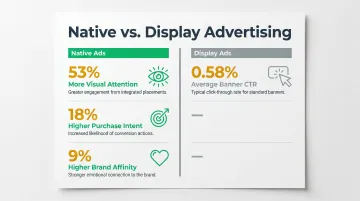
Banner formats signal "advertising" at the exact moment readers are looking for trusted medical information. Native formats sidestep that reaction by presenting as content the reader would have sought out anyway.
Two Distinct Audiences, Two Different Approaches
Health companies target two primary audiences, each requiring entirely different content approaches:
Direct-to-consumer (DTC) targeting patients:
- Tone: empathetic, empowering, accessible
- Content focus: condition education, symptom recognition, treatment options
- Platforms: health publisher sites, condition-specific content, targeted newsletters
Healthcare professional (HCP) targeting physicians and clinicians:
- Tone: clinical, evidence-based, precise
- Content focus: efficacy data, clinical trial results, prescribing information
- Platforms: endemic medical platforms with NPI-level targeting
Native ads serve both, but a DTC diabetes awareness campaign and an HCP cardiovascular drug promotion cannot use the same creative or placement strategy.
The Trust Dimension
In healthcare, a brand that provides genuinely useful information through native content builds credibility that converts over time. Overly promotional messaging undercuts that credibility fast. Studies show 32% of consumers would share a native ad versus just 19% for display ads—in healthcare, shareability is a proxy for trust.
Healthcare decisions run on consideration cycles of weeks or months. A patient researches symptoms, weighs treatment options, and evaluates sources long before taking action. Brands that show up consistently with useful content get remembered when that decision finally gets made.
Types of Native Ads Health Companies Can Use
In-Feed and Sponsored Content
In-feed ads appear within editorial article feeds on health publisher sites, formatted to match surrounding articles. Sponsored content consists of branded articles or videos placed on third-party publications with a "sponsored" or "paid content" label. These are the most common formats for pharma, hospital, and health system campaigns.
In-feed placements work because they don't ask readers to leave the content experience—they simply extend it. A sponsored article on "Understanding Treatment Options for Rheumatoid Arthritis" sits alongside editorial health content, earning attention through relevance alone, not through visual disruption.
Newsletter Native Advertising
Sponsored content within targeted newsletters represents a distinct and increasingly valuable format. Content is delivered directly to the inbox of a subscribed, self-selected audience, bypassing ad blockers and algorithm feeds entirely.
With approximately 1.77 billion internet users blocking ads, nearly one-third of potential healthcare audiences never see display advertising. Email placements are immune to this barrier.
Health-focused newsletter networks allow health brands to reach engaged readers in a clutter-free environment where sponsored content gets undivided attention. This makes the format particularly effective for awareness-stage campaigns and category education. House of Summary, for example, reaches over 500,000 subscribers across the USA, UK, and UAE, with 254,866+ emails opened daily among decision-makers and affluent consumers — a demographic that maps well to premium healthcare and wellness brands.
Content Recommendation Widgets and Promoted Listings
Recommendation widgets (the "you might also like" ad blocks at the bottom of health publisher articles, served by networks like Taboola or Outbrain) and promoted listings in health search environments are better suited to performance-focused campaigns. Use them when the goal is driving traffic to landing pages or condition-specific content.
Both formats operate on a cost-per-click basis and excel at volume. The trade-off is reduced contextual alignment compared to in-feed or newsletter placements — they generate traffic, but build less brand credibility in the process.
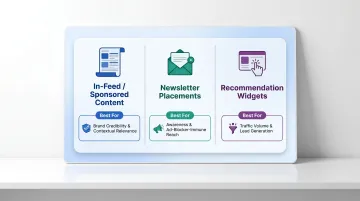
Quick comparison of native ad formats for health campaigns:
- In-feed / sponsored content — Best for brand credibility and contextual relevance on health publisher sites
- Newsletter placements — Best for awareness campaigns; reaches self-selected, high-intent audiences immune to ad blockers
- Recommendation widgets / promoted listings — Best for traffic volume and lead generation at lower CPCs
Navigating Compliance: FTC, FDA, and Healthcare Regulations
FTC Disclosure Requirements
The Federal Trade Commission (FTC) requires all native ads—including in healthcare—to carry clear and conspicuous disclosures indicating the content is paid advertising. "Clear and conspicuous" means labels like "Sponsored," "Advertisement," or "Paid Content" must be prominent, not buried in fine print, and must appear before the reader engages with the content.
Acceptable disclosure terms:
- "Ad" or "Advertisement"
- "Paid Advertisement"
- "Sponsored Advertising Content"
Discouraged terms (potentially ambiguous):
- "Promoted"
- "Presented by"
- "Brought to You by"
The FTC's Lord & Taylor settlement (March 2016) established that paid native content appearing as editorial without disclosure violates the FTC Act, with future violations carrying penalties up to $16,000 per occurrence.
FDA Pharmaceutical Advertising Rules
Where the FTC governs disclosure, the FDA governs claims — and the distinction matters for how you structure pharmaceutical native content.
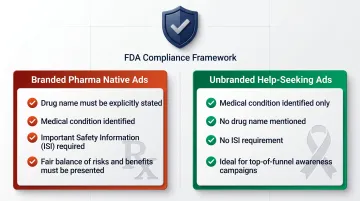
FDA oversight applies specifically to pharmaceutical native advertising through the branded vs. unbranded distinction:
Branded pharma native ads name a specific drug and its condition. These must include fair balance of risks and benefits—specifically, Important Safety Information (ISI). The format doesn't matter; if you name the drug and make efficacy claims, you must present risks alongside benefits.
Unbranded or "help-seeking" ads identify a medical condition without naming a drug. These are not subject to the same ISI requirements and are therefore more commonly used for awareness campaigns at the top of the funnel.
The FDA has consistently flagged fair balance failures as a top enforcement priority, with warning letters frequently citing promotional materials that lead with efficacy claims while omitting or minimizing risk information — a pattern that applies to native formats just as it does to traditional ads.
Compliance Is Not a Native Format Problem
A common misconception: native advertising is inherently non-compliant in healthcare. In fact, native formats have been formally addressed in FTC guidelines since December 2015, and healthcare marketers run compliant native campaigns every day across pharma, device, and health system categories.
Working with publishers that have established healthcare advertising standards lowers regulatory exposure. House of Summary, for instance, operates brand-safe editorial environments where sponsored placements are clearly labeled and content is reviewed against FTC disclosure requirements before distribution.
Internal MLR Review Process
Native content typically moves through medical, legal, and regulatory (MLR) review just like any other promotional material. Because native creative (image, headline, source name, URL) is simpler to produce than full banner creative suites, approval cycles are often faster.
Companies optimizing MLR workflows have achieved a 57% reduction in review cycle times, particularly for modular digital assets with pre-approved claims.
Key Risk Area: Ad-to-Landing Page Alignment
Misalignment between the native ad's claim and the landing page creates both a credibility problem and a potential regulatory exposure. If the ad promises one thing and the landing page delivers another, you've broken trust and potentially violated truth-in-advertising rules.
Health companies must ensure that the content journey from ad to landing page is consistent and that no unsubstantiated claims are made at any touchpoint.
Building an Effective Healthcare Native Ad Campaign
Define Your Audience and Match the Channel
Define whether the campaign targets patients/consumers or HCPs before selecting any platform. Publisher environments, content tone, and targeting capabilities differ completely.
For HCP targeting: Endemic health platforms operating within verified clinical content environments offer NPI-level targeting capabilities, ensuring ads reach practicing physicians and clinicians.
For DTC targeting: Contextual targeting on condition-specific content sites or health-adjacent newsletter audiences delivers intent-aligned reach.
Timing shapes performance. Research shows contextually relevant ads generate 43% more neural engagement and 2.2x better ad recall than ads with low contextual relevance. A reader finishing an article about heart health is already primed for cardiovascular content — native ads work because they meet that moment directly.
For House of Summary's newsletter placements, advertisers can target by geography (USA, UK, UAE), professional category (executives, decision-makers), and content interest area (global news, geopolitics, business). This tri-market footprint is particularly valuable for health brands reaching affluent, internationally active audiences.
Create Content That Educates First
The most effective healthcare native ads lead with genuinely useful information — a tip, a fact, or a clear framing of a patient concern — before introducing the brand or product. The ad should feel like something the reader would have sought out independently.
For prescription drugs, surgical procedures, and specialist services — where patients need a diagnosis before accessing treatment — unbranded awareness content often outperforms direct product promotion. Content that helps patients ask better questions builds the trust that product-forward ads rarely earn upfront.
Example:
- Effective unbranded headline: "5 Heart Health Symptoms Women Often Miss"
- Ineffective branded headline: "Ask Your Doctor About [Drug Name] for Cardiovascular Health"
The first earns attention by delivering real value. The second asks for action before the reader has any reason to give it — and in a regulated category, that sequence matters for compliance as much as performance.
Creative Execution and Landing Page Alignment
A strong healthcare native creative unit includes:
- Relevant image that does not sensationalize a health condition
- Headline that speaks to a specific concern or question the target audience has
- Source name that signals credibility (brand name or publisher partnership)
- URL that indicates where the click leads
Keep the tone consistent with the publisher environment. Avoid stock imagery that looks overly clinical or staged—authenticity matters in health contexts.
The landing page must deliver on whatever the ad implied. If the ad addresses a specific question, answer it before introducing the product. A mismatch between ad and landing page creates distrust, increases bounce rates, and invites regulatory scrutiny — three outcomes no healthcare advertiser can afford.
Measuring the Performance of Your Healthcare Native Ads
Key Metrics to Track
Health marketers should track these metrics for native campaigns:
- Click-through rate (CTR) — baseline engagement indicator
- Time on page — proxy for how deeply readers engaged with the content
- Scroll depth — shows whether readers consumed the full message
- Downstream conversions — form completions, video views, appointment requests, script lift (for pharma)
Native ads are typically priced on a cost-per-click (CPC) basis, which makes performance measurement simpler to track than CPM display campaigns.
Extended Attribution Windows
Measuring success in healthcare native campaigns often requires a longer attribution window than e-commerce because healthcare decisions involve consideration cycles of days, weeks, or months.
Google/Compete research on the patient decision journey found:
- 48% of patients take over two weeks to research before booking an appointment
- Converting patients conduct 3x as many searches (15.3 queries) as those who don't convert
- Patients visit two or more hospital websites on average before choosing a provider
- Only 10% of searches start with a branded term — but 48% finish with one, showing a clear shift from general research to specific provider selection
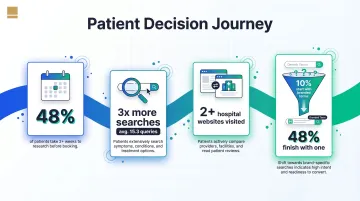
Academic medical centers are extending attribution windows from 30 days to 180 days to capture the full patient decision journey. Standard 30-day windows systematically undervalue awareness-stage content, including native ads that typically appear early in the funnel.
Conversion Tracking Implementation
Conversion tracking pixels can and should be deployed on landing pages to measure specific downstream actions. This data—not just CTR—is what separates a cost center from a provable ROI story for budget holders.
For healthcare brands running placements through newsletter channels, House of Summary supports tracking links and UTM parameters so advertisers can connect placements directly to downstream actions. Post-campaign reporting covers:
- Emails opened and ad clicks
- Geographic distribution of engaged readers
- Subscriber engagement metrics by placement
Frequently Asked Questions
What are the types of native advertising?
The main formats include in-feed/sponsored content articles, newsletter sponsored content, content recommendation widgets, promoted listings, and branded content partnerships. Healthcare brands most commonly favor in-feed and newsletter formats for their compliance-friendly disclosure environments and stronger engagement rates.
What are the 5 P's of healthcare marketing?
The 5 P's are Product, Price, Place, Promotion, and People — though some healthcare frameworks expand this to Patient, Provider, Payer, and Policy. Native advertising sits within the "Promotion" pillar, offering a credible, non-disruptive channel for reaching patients and providers through educational content.
Is native advertising compliant with FDA and FTC regulations for healthcare?
Yes, when properly disclosed — FTC requires clear "Sponsored" or "Advertisement" labels, and FDA requires ISI for branded drug ads. Pharma brands can run unbranded awareness campaigns or include full fair balance for branded promotions.
What is the difference between DTC and HCP native advertising in healthcare?
DTC native ads target patients on health content sites and newsletters using empathetic, accessible messaging centered on condition education. HCP native ads target physicians through medical-specific platforms with verified audience data, using clinical, evidence-based content that emphasizes efficacy and prescribing information.
How does native advertising in healthcare compare to traditional display ads?
Native ads consistently outperform display: consumers view native ads 53% more frequently, and native drives 18% higher purchase intent and 9% higher brand affinity. This advantage is even more pronounced in healthcare, where trust and credibility determine engagement and banner blindness affects 86% of consumers.
Can small or regional healthcare providers use native advertising effectively?
Yes, native advertising is accessible for smaller health companies and regional providers because creative requirements are minimal (image, headline, URL), campaigns can be run on a cost-per-click basis without large upfront commitments, and local or regional targeting is available on most native platforms. Newsletter placements like those offered by House of Summary allow flexible campaign configurations based on placement, frequency, and budget.
For health brands interested in exploring compliant, high-engagement newsletter native advertising, contact House of Summary at sales@houseofsummary.com for a media kit and rate card.