Introduction
Healthcare marketing is in the middle of a structural shift. The combination of AI-driven automation, stricter privacy regulation, and changing patient behavior is forcing practices, pharma brands, and health systems to rethink how they reach and convert audiences.
The numbers reflect the pressure. Pharma digital ad spend is forecast to hit $26.2 billion in 2026, compared to just $6.9 billion for traditional channels. Meanwhile, 37% of US consumers already use generative AI for health-related research — and those searches don't always lead back to your website.
The organizations gaining ground aren't outspending their competitors. They're moving earlier — building compliant measurement infrastructure, structuring content for AI discovery, and coordinating across channels before the window closes.
This piece unpacks five trends reshaping healthcare marketing in 2026: AI-powered targeting, Answer Engine Optimization, HCP–DTC omnichannel convergence, privacy-first measurement, and the growing role of video and creator-led trust-building.
Key Takeaways
- AI is operational, not experimental — real-time bid optimization and audience targeting require human oversight in regulated healthcare environments
- Patients start health searches on ChatGPT and Google AI Overviews, making Answer Engine Optimization as important as traditional SEO
- HCP and DTC campaigns must be coordinated — siloed activation costs measurable performance
- Privacy compliance is now a measurement advantage, not just a legal checkbox
- Short-form, clinician-led video outperforms polished brand content — patients respond to authenticity, not production value
AI-Powered Targeting and Agentic Workflows Are Now Central to Healthcare Marketing Strategy
The Gap Between AI Ambition and Operational Reality
Deloitte's 2026 Life Sciences Outlook, surveying 280 C-suite biopharma and medtech executives, found that while nearly 80% say future competitiveness depends on effectively harnessing AI, only 22% have successfully scaled it — and just 9% report significant ROI.
That gap matters for marketers. The organizations treating AI as an operational infrastructure change — rather than a campaign add-on — are the ones pulling ahead. Those still running one-off tool experiments are finding their results stay one-off too.
What Agentic AI Actually Does in Healthcare Advertising
Agentic AI workflows go beyond basic automation. These systems can:
- Adjust programmatic bids in real time based on individual signals like device type, time of day, and audience receptivity
- Adjust creative delivery across channels without waiting for weekly reporting cycles
- Segment HCP audiences using clinical attributes, with platforms like Doceree drawing on 50+ clinical data points across 2,000+ specialist medical publishers
- Flag underperforming placements faster than any manual review process could
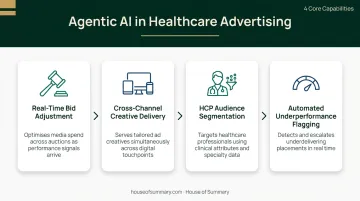
That last point matters more than it sounds. Speed of feedback loop is a genuine competitive edge — and connected workflows, not isolated tools, are what create it.
The Human Oversight Imperative
Fully automated AI campaigns carry real risk in healthcare. State-by-state privacy laws vary significantly. Messaging nuance around conditions, treatments, and off-label implications requires clinical and legal review that no algorithm currently handles reliably.
The consistent pattern across high-performing healthcare marketing teams: hybrid human-plus-AI approaches outperform full automation. AI handles the speed and scale; human judgment handles compliance, context, and brand safety. Teams that have figured out where to draw that line — not in principle, but in their actual workflows — are the ones seeing real returns.
Answer Engine Optimization Is Rewriting How Patients Discover Healthcare
The Search Behavior Shift Is Already Here
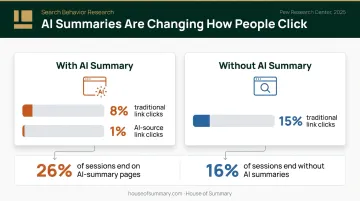
Traditional SEO optimizes for web page rankings. But patients increasingly don't start on Google — they start on ChatGPT, Google AI Overviews, Perplexity, or Gemini. And when AI summaries appear, click behavior changes dramatically.
Pew Research Center analyzed browsing data from 900 US adults in March 2025 and found:
- Users clicked traditional search links in 8% of visits when an AI summary appeared — versus 15% without one
- Users clicked AI-summary source links in just 1% of visits
- Sessions ended after 26% of AI-summary pages versus 16% without summaries
For healthcare marketers who've built their organic strategy around web traffic, this represents a structural shift in how patients find care — one that standard SEO strategies weren't built to handle.
What Answer Engine Optimization Means in Practice
AEO (also called Generative Engine Optimization, or GEO) is the discipline of structuring content so AI platforms can understand, trust, and recommend your practice or brand. That means:
- Writing clear, direct answers to patient questions — not just keyword-optimized paragraphs
- Using structured data, schema markup, and FAQ blocks that AI systems can parse reliably
- Including citations, statistics, and verifiable claims (research suggests these improve AI visibility by up to 40% across mixed domains)
- Keeping service descriptions, provider credentials, and clinical information current — because AI systems scrape your site, your organic social, and third-party platforms like Reddit
Deloitte found that while 37% of US consumers use GenAI for health-related research, distrust in AI-generated health information rose to 30% from 23% the prior year — a credibility gap that content quality can directly address. Healthcare brands that show up with medically reviewed, clearly sourced content will earn AI citations; those that don't will either be absent or misrepresented by outdated third-party content.
Two Disciplines, Not One
AI visibility and traditional search visibility are now distinct — but closely related. Brands that treat SEO, paid search, organic social, and community engagement as separate silos will find their AI-era discoverability suffering. The content feeding AI systems needs to be consistent, accurate, and coordinated across all channels.
HCP–DTC Omnichannel Convergence Is No Longer Optional
Why Siloed Activation Leaves Performance on the Table
For years, healthcare marketers ran HCP campaigns and DTC campaigns as parallel but separate efforts. Different agencies, different timelines, different audience pools. The 2026 reality: that separation has a measurable cost.
Veeva's analysis of coordinated HCP–DTC strategies found clear, consistent lift in new patient starts based on how channels were combined:
| Channel Combination | New Patient Start Lift |
|---|---|
| HCP digital only | Baseline |
| HCP digital + DTC digital | +10% |
| HCP digital + DTC video | +15% |
| HCP digital + DTC digital + DTC video | +20% |
The implication is straightforward: reaching a patient and their physician with coordinated messaging, not just parallel messaging, drives materially better outcomes. The question for 2026 is less about whether to converge these channels and more about how to execute it.
What Coordinated Strategy Looks Like
In practice, HCP–DTC convergence means:
- Using patient-level propensity data to identify individuals most likely connected to target HCPs
- Synchronizing content windows so patients and providers encounter related messaging around the same time
- Relying on shared audience signals rather than independent channel activation built by separate teams
- Tracking incremental contribution by audience combination, not just aggregate campaign performance
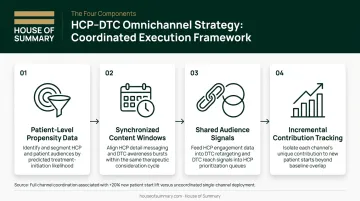
The measurement benefit is as valuable as the targeting benefit. When teams can quantify the lift from reaching both audiences versus either alone, budget allocation shifts from gut instinct to evidence — with specific lift numbers to defend every dollar.
Privacy-First Infrastructure Is Becoming a Competitive Advantage
The Tracking Problem Is Bigger Than Most Teams Realize
A Health Affairs study found third-party tracking on 98.6% of hospital websites — the vast majority of which likely include tools that don't meet HIPAA's standards for handling protected health information. In 2023, FTC and HHS OCR sent warning letters to roughly 130 hospital systems and telehealth providers specifically naming Meta Pixel and Google Analytics as compliance risks.
The measurement consequences compound the legal risk. Freshpaint's 2026 State of Healthcare Marketing report found:
- 49% of healthcare marketing leaders claim they can consistently improve ROI at the appointment level
- Only 1% can connect more than half of spend to actual patient outcomes
- 82% cite compliance and legal constraints as their top measurement obstacle
That gap between claimed capability and actual measurement maturity is the defining infrastructure problem in healthcare marketing right now.
Measurement Maturity as Competitive Edge
That gap has a clear dividing line: teams pulling ahead aren't necessarily spending more — they're measuring better. Privacy-compliant attribution infrastructure, built with tools designed to meet HIPAA requirements, allows marketers to:
- Connect specific campaigns to attended appointments, not just clicks or leads
- Defend budgets internally with outcome-level data
- Optimize across the full funnel rather than relying on last-touch metrics that over-credit the final ad a patient saw
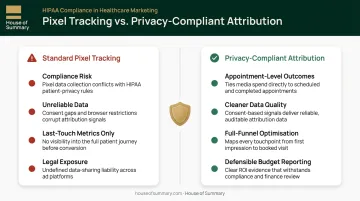
HIPAA-compliant tracking isn't a constraint on what marketers can measure. Purpose-built privacy infrastructure actually produces cleaner, more reliable data than standard pixel-based tracking — and that data quality is what makes meaningful attribution possible in the first place.
Video, Influencer Content, and the Healthcare Trust Economy
Where Attention Is Actually Going
Polished brand videos with actor portrayals and carefully scripted voiceovers are losing ground to physician-recorded clips, patient testimonials, and care team explainers. Authenticity converts better when the topic is personal health.
Healthcare social media benchmarks from Hootsuite's 2025 report confirm that video is where engagement concentrates — Instagram Reels drive a 2.7% engagement rate in healthcare, ahead of static posts on every major platform.
Meanwhile, digital is absorbing the budget that once went to TV. With pharma digital ad spend forecast at $26.2 billion in 2026 versus $6.9 billion for traditional channels, the channel shift isn't speculative — it's already structured into planning cycles.
The Influencer Shift in Healthcare
Patient advocates, clinicians with active social followings, and care team experts are producing content that earns trust because it reads as peer guidance rather than sponsored messaging. That shift in format — from polished campaign to candid conversation — is what makes it effective.
Key characteristics of what's working:
- Clinician-led short-form video explaining conditions, treatments, or care navigation in plain language
- Patient advocates speaking about lived experience with specific diagnoses — particularly effective for DTC awareness in chronic disease categories
- Disclosed but conversational sponsorships that don't interrupt the tone of the content
Deloitte found that 74% of consumers view doctors as their most trusted source for healthcare treatment options. Healthcare brands that find ways to authentically amplify clinician voices — rather than overwriting them with polished brand messaging — are building audiences that stay.

What's Driving These Trends — and What to Watch Next
The Converging Forces Behind the 2026 Shift
These five trends don't exist in isolation. They're being driven by the same set of structural pressures:
- AI advancement making personalization and real-time optimization accessible to mid-size healthcare marketing teams, not just enterprise players
- Privacy regulation (HIPAA, state-level laws) forcing infrastructure investment that separates measurement-capable teams from those still flying blind
- Rising patient expectations around digital self-service — patients now expect to research, compare, and schedule care the same way they manage everything else online
- Executive pressure for marketing to prove ROI beyond impressions or leads — outcome-level attribution is becoming a board-level conversation
The Technology Stack Coming Together
The convergence of LLMs, programmatic platforms, clean room technology, and first-party data strategies is making data interoperability more achievable than it was 24 months ago. Marketers who invest now in connecting fragmented cross-channel data build a measurable edge: each optimization cycle produces cleaner inputs for the next, steadily improving targeting accuracy and spend efficiency.
Digital platforms are forecast to account for 82% of all healthcare/pharma ad spending by 2027, with linear TV dropping to a 12% share. At that scale, teams still anchored to traditional media will find themselves outpaced — not just on reach, but on measurement and iteration speed.
The Channel Worth Watching
As AI noise increases and more vendors make overlapping automation claims, the advantage will belong to teams that invest in high-trust, direct-access channels that bypass platform algorithms entirely. Newsletter advertising reaching opted-in, high-intent audiences represents exactly this kind of channel — inbox placement means no ad blockers, no algorithm dependency, and no competition for attention from the surrounding content environment.
House of Summary's network of human-written newsletters reaches 500,000+ opted-in subscribers — decision-makers, executives, and professionals who've actively chosen to receive curated information. For healthcare brands navigating platform restrictions and brand-safety requirements, that editorial environment and direct inbox access offers something programmatic inventory can't: direct delivery to an audience that actively opted in — no intermediary platform, no algorithm filtering who sees the message.
Conclusion
The five trends covered here — AI-powered workflows, Answer Engine Optimization, HCP–DTC omnichannel convergence, privacy-first measurement infrastructure, and trust-driven content — all point in the same direction: healthcare marketing is being reshaped at once by technology, regulation, and how patients actually behave.
Early adopters building compliant measurement systems, AI-ready content, coordinated channel strategies, and credible content pipelines now will compound their advantage over the next 18 months. Those waiting for the landscape to stabilize are making a bet the evidence doesn't support — the marketers pulling ahead are already moving.
Frequently Asked Questions
What are the top 3 trends in the healthcare industry?
Three forces dominate healthcare in 2026:
- AI integration across clinical operations and marketing workflows
- Patient-centric digital experiences — self-service scheduling, AI-assisted research
- Data privacy as a structural business requirement, not just a compliance checkbox
What are the key trends in healthcare marketing?
Five trends define healthcare marketing in 2026:
- AI-powered targeting and agentic workflows
- Answer Engine Optimization for AI discovery platforms
- Coordinated HCP–DTC omnichannel strategy
- Privacy-first measurement infrastructure
- Short-form video and clinician or patient influencer content
How is AI changing healthcare marketing in 2026?
AI is enabling more precise audience targeting, real-time programmatic bid optimization, and faster campaign workflows across healthcare advertising. The critical caveat is healthcare's regulatory complexity. HIPAA, state privacy laws, and messaging requirements mean fully automated campaigns carry real compliance risk — hybrid human-plus-AI approaches consistently outperform automation alone.
Why is HIPAA-compliant tracking important for healthcare marketers?
Standard tools like Meta Pixel and unmodified Google Analytics can inadvertently capture health-related user data during browsing sessions, creating significant legal exposure. Switching to HIPAA-compliant tracking infrastructure not only reduces that risk but also produces cleaner, more reliable data — which directly improves the quality of marketing decisions and attribution.
What is Answer Engine Optimization and why does it matter for healthcare?
AEO is the practice of structuring content — through schema markup, FAQ formats, and direct answers — so AI platforms like ChatGPT and Google AI Overviews can recommend your practice or brand. As patients shift from traditional search engines to AI tools for health queries, visibility in AI-generated answers is now as strategically important as organic search rankings.
How are healthcare marketers proving ROI in 2026?
Leading teams are building full-funnel attribution systems that connect spend to attended appointments and patient outcomes — far beyond click reporting. Privacy-compliant data infrastructure makes this possible by tracing the full patient journey without creating HIPAA liability.