Introduction
ChatGPT now reaches 800 million weekly users and has crossed $100 million in annualized ad revenue. TikTok Shop is on track to hit $23.41 billion in US ecommerce sales. At the same time, Google has begun penalizing mass-produced AI content while actively rewarding human voice.
The measurement infrastructure marketers have relied on for years is also shifting. Google quietly removed a core search parameter that caused 87.7% of sites to see artificial impression drops, and iOS privacy updates continue to erode attribution accuracy.
Marketers who understand what's driving these shifts will make smarter budget decisions and reach audiences in ways that actually convert. Those still operating on pre-2025 assumptions are already losing ground to competitors who have adapted.
TL;DR
- AI has moved from productivity tool to active collaborator in ad testing, budget optimization, and creative workflows
- Social platforms are accelerating their transformation into full-scale commerce destinations, with creators replacing traditional storefronts
- Newsletter and email marketing is resurging as brands seek direct, algorithm-free channels that ad blockers can't touch
- Community-driven content is outperforming high-production campaigns across most verticals
- Privacy regulations and tracking restrictions are forcing a structural shift toward first-party data and audience ownership
AI as Marketing Collaborator, Not Just a Tool
Marketers are no longer "using" AI—they are working alongside it. AI agents now run autonomous functions such as ad creative testing, budget reallocation, and performance flagging without human input at every step. 88% of organizations report regular AI use in at least one business function, with 80% of marketers using AI for content creation and 75% for media production.
Real-World AI Adoption at Scale
Recent developments signal how deeply AI is embedding itself in marketing infrastructure:
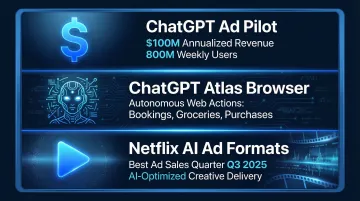
- OpenAI's advertising model: ChatGPT's US ad pilot crossed $100 million in annualized revenue within six weeks of launch, opening a direct path to 800 million weekly users
- ChatGPT Atlas browser with agent mode: Launched in October 2025, Atlas allows ChatGPT to take actions on users' behalf—booking reservations, purchasing groceries, and navigating the web autonomously
- Netflix's AI ad formats: Following its "best ad sales quarter ever" in Q3 2025, Netflix is testing AI-powered ad formats to optimize creative delivery and performance
European marketing executives whose companies have reached mature AI adoption report 22% efficiency gains already realized, confirming that these returns go well beyond early-stage pilots.
Vibe Marketing and Cultural Timing
Brands are shifting from asking "what's our channel strategy?" to "what mood are we creating?" AI provides the speed to test dozens of creative variations, reallocate budget in real time, and surface performance anomalies early—while human creativity supplies the emotional resonance and cultural timing that algorithms cannot replicate.
This partnership model lets marketers focus on strategic questions—audience intent, brand positioning, cultural relevance—while AI handles operational execution like A/B testing, bid management, and performance monitoring. The result is campaigns with more room for judgment and originality, because marketers aren't buried in execution.
The Editorial Oversight Imperative
AI-generated campaigns without editorial oversight risk producing generic or culturally tone-deaf content. Google's December 2025 algorithm update specifically penalized mass-produced, robotic-sounding content and rewarded originality and human voice. The update shifted evaluation from content quality to content necessity, heavily demoting sites that relied on unnecessary AI-generated material.
The pressure to scale content output—across email, social, search, and paid channels—has made full human production untenable for most marketing teams. AI handles the volume; humans set the guardrails. For brands that get this balance right, the efficiency gains are real. For those that don't, the algorithmic penalties are too.
Social Commerce and the Creator Storefront
TikTok, Instagram, and LinkedIn are rapidly expanding shoppable features, pulling the entire path from discovery to purchase inside a single platform. US social commerce sales are forecast to surpass $100 billion in 2026, with TikTok Shop alone expected to reach $23.41 billion in US ecommerce sales—a 48% year-over-year increase. Two dynamics are driving this: creators who now function as storefronts, and an ad inventory landscape that's quietly shifting under brands' feet.
The Creator Economy Pivot
Likes and impressions are giving way to saves, shares, and direct purchases as the metrics that matter. Creator partnerships have moved from brand-building support into a direct revenue channel.
Creator ad spend growth:
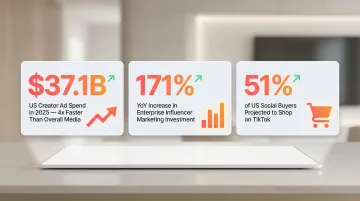
- US creator ad spend is projected to hit $37.1 billion in 2025, growing 4x faster than overall media
- Enterprise organizations increased their average annual influencer marketing investment by 171% year-over-year
- Over half of social buyers (51%) in the US are projected to shop on TikTok this year
Creators are now closing transactions inside the platform, not just directing traffic elsewhere. For brands still treating influencer spend as awareness-only, the budget logic no longer holds.
The Ad Inventory Threat
Meta's no-ads subscription model could shrink available targeting audiences and force budget reallocation. Launched in the EU at €5.99/month and now testing in the UK at £2.99/month, it offers an ad-free experience for paying users.
For those who stay on the free tier, Meta introduced "less personalized ads" and unskippable ad breaks lasting a few seconds. Brands that depend heavily on paid social reach should treat this as an early signal, not a distant concern.
Gen Z and AI Shopping
61% of Gen Z shoppers now use AI tools to assist with purchases—discovering products, comparing prices, and getting gift recommendations. However, 75% of Americans say they would lose trust in AI shopping if results were sponsored, creating tension between AI-powered discovery and paid placement.
What this means for brands:
- Show up across AI-powered discovery surfaces, not just social feeds
- Optimize product information for AI crawlers and language models
- Maintain authentic reviews and user-generated content that AI tools can reference
- Balance paid placement with organic discoverability in AI-driven search
The Newsletter and Email Marketing Renaissance
As algorithmic reach declines, ad costs rise, and privacy restrictions erode third-party targeting, brands and advertisers are returning to owned, direct-to-inbox channels. Email and newsletters bypass ad blockers, sit outside algorithmic gatekeeping, and deliver undivided attention from readers who actively opted in.
The Direct Mail Parallel
The 2025 Franklin Madison Direct Mail Benchmark Report found that 67% of marketers saw improved direct mail performance over the past 12 months, with winback campaigns jumping from 38% to 57% year-over-year. The same logic driving direct mail growth—personalization, owned audiences, measurable response—applies directly to email and newsletters.
Newsletter Advertising Attracts Premium Brands
Readers who subscribe to specialized newsletters signal high intent and deep engagement. Beehiiv reports average newsletter open rates climbed to 41.24% in 2025 across 28 billion emails sent—far exceeding social media engagement rates.
House of Summary's network of specialized newsletters connects brands with professional readers who opted in specifically for verified, noise-free information. That editorial context matters to advertisers: one placement reported click-through rates 4x higher than Google AdWords — a gap that reflects what happens when an ad reaches a reader who is already paying attention.
High-Demand Newsletter Niches
Professional readers actively seek verified, noise-free information in a handful of high-demand niches:
- Business and finance news — decision-makers tracking markets and economic shifts
- Geopolitics — executives who need reliable international intelligence, not headlines
- Technology — practitioners cutting through hype for actionable signal
- Global current affairs — readers who want context, not just breaking news
These audiences value clarity over sensationalism, making newsletters the preferred format for brands targeting people who actually read what lands in their inbox.
Substack crossed 8.4 million paid subscribers in Q1 2026, signaling that readers are willing to pay for quality content delivered directly to their inbox. This willingness to pay reflects the value readers place on trusted, specialized information—and creates a premium environment for advertisers targeting high-intent audiences.
Authenticity Wins Over Production Polish
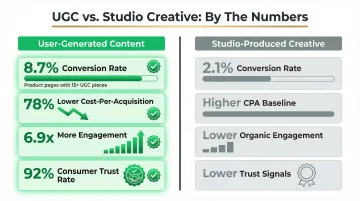
Glossy, over-produced brand campaigns are losing ground to raw video, user-generated content, behind-the-scenes storytelling, and community-driven narratives. Product pages featuring at least 15 pieces of user-generated content converted at 8.7% compared to 2.1% for pages without UGC, while UGC-integrated paid ads delivered a 78% lower cost-per-acquisition than studio-produced creative assets.
The Brands as Studios Shift
Rather than running discrete 30-second campaigns, leading brands are building episodic content—serial formats, mockumentaries, and narrative-driven series—that integrate products into the narrative rather than interrupting entertainment. This approach mirrors media companies more than traditional advertisers.
The risk of ignoring this shift is real. MTV, once a cultural giant, lost its audience by chasing short-term ratings over creative evolution. Brands locked into purely performance-driven campaigns follow the same trajectory—and avoiding it requires genuine creative investment, not just better targeting.
Budget Allocation Implications
Brands that invest in authentic community building, honest storytelling, and transparent values messaging tend to build defensible audience loyalty—which matters more as paid acquisition costs rise and economic pressure tightens marketing budgets.
Trust and engagement data:
- 92% of consumers trust organic, user-generated content more than traditional advertising
- UGC posts generate 6.9x more engagement than brand-generated content
- Meta's global average CPM hit $6.59 in October 2025, with US CPM leading at $23.00
- Snapchat's CPM was up 27.6% year-over-year
As paid acquisition costs climb, owned audiences and organic engagement become the more defensible asset. Brands with genuine community relationships spend less to retain attention—and that lower dependency on paid channels shows up directly in margin.
Privacy-First Measurement and First-Party Data
Traditional marketing measurement is breaking down. Google's removal of the &num=100 search result parameter in September 2025 disrupted rank tracking tools widely used across the industry, causing 87.7% of sites to see artificial impression drops in Google Search Console. Combined with attribution challenges from iOS privacy updates and cookie deprecation, marketers are flying partly blind.
The Structural Response
First-party data—email subscribers, loyalty members, direct purchase history—is becoming non-negotiable. 84% of marketers now use first-party data, while 51.5% of total marketing budget is allocated to loyalty and CRM on average.
Emerging measurement approaches:
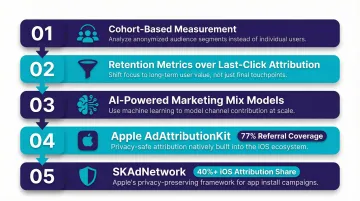
- Cohort-based measurement tracking user groups over time
- Retention metrics replacing last-click attribution
- AI-powered marketing mix models, including transformer-based approaches
- Apple's AdAttributionKit covering 77% of all referral-based conversions to the App Store
- SKAdNetwork holding over 40% market share in iOS attribution
AI-driven improvements in Marketing Mix Modeling could unlock $14.5 billion to $26.3 billion in media investment in 1-2 years, as brands gain confidence in privacy-compliant measurement systems.
Channel Strategy Implications
Channels that generate owned first-party data—email, newsletters, loyalty programs—are gaining strategic value beyond their direct conversion metrics. The ability to prove audience ownership and engagement depth is becoming a competitive differentiator when CFOs scrutinize marketing budgets.
Owned channels compound in value over time. Each email subscriber, loyalty member, and newsletter reader represents a relationship the brand controls directly. Platform algorithm shifts, ad blocker adoption, and tightening privacy regulations cannot touch it. As third-party measurement continues to erode, that ownership becomes a structural advantage — not just a tactical one.
Key reasons owned channels outperform rented audiences long-term:
- No dependency on platform algorithms or ad auction dynamics
- Unaffected by ad blocker adoption rates
- Resistant to third-party cookie deprecation and privacy regulation changes
- Audience data remains proprietary and portable across tools
Conclusion
Five forces are reshaping marketing in 2026: each interconnected, all pointing toward the same shift — owned audiences, verified data, and genuine engagement matter more than volume and reach.
- AI collaboration: human creativity amplified, not replaced
- Social commerce: the buying decision made inside the feed
- Direct-channel renaissance: email and owned media reclaiming the relationship
- Authenticity-led content: trust earned through specificity, not polish
- Privacy-first measurement: consent-based data as the new foundation
Marketers who move early — building direct audience relationships, investing in authentic storytelling, and treating AI as a collaborator — will be harder to displace when conditions tighten. The brands that own their audiences don't have to rent them back from platforms.
Frequently Asked Questions
Are newsletters still relevant in 2026?
Newsletters are not only relevant but growing in strategic importance in 2026. Brands prioritize algorithm-free, ad-blocker-proof direct channels with high-intent, opted-in audiences. Open rates average 41.24%, far exceeding social media engagement.
What is the future of email marketing in 2026?
Email marketing is evolving toward deeper personalization, AI-assisted content, and premium newsletter formats. Inbox-direct channels are gaining ground as third-party tracking erodes and first-party data becomes the primary currency of digital marketing.
What are the top marketing trends in 2026?
The five major trends are AI as a marketing collaborator, social commerce maturation, the newsletter and email renaissance, authenticity over production polish, and privacy-first measurement with first-party data infrastructure.
What are the most popular newsletter topics?
Business and finance news, geopolitics, technology, global current affairs, and lifestyle content rank among the highest-demand newsletter niches. Professional readers seek verified, specialized information without algorithmic noise.
How is AI changing marketing strategy in 2026?
AI now functions as an autonomous collaborator: running ad tests, reallocating budgets, generating creative variations, and powering discovery surfaces like ChatGPT-integrated browsers. Human marketers focus on cultural intuition, strategy, and editorial judgment.
How can brands adapt to tighter marketing budgets in 2026?
Four priorities stand out:
- Invest in owned channels (email, newsletters, loyalty programs)
- Choose authentic community content over expensive production
- Use AI to reduce operational overhead
- Build first-party data assets that hold value regardless of platform shifts