What's changing now is the convergence of three forces simultaneously: AI tools that can optimize creative at machine scale, privacy regulations that are pushing the entire industry toward context-based targeting, and audiences that have become genuinely skilled at ignoring anything that feels like an ad. These shifts don't just favor native advertising — they structurally advantage it over most alternatives.
Understanding where native advertising is heading helps media buyers, brand strategists, and marketers make smarter investment decisions before these trends reach full mainstream adoption.
Key Takeaways
- AI is automating native ad creative optimization at scale, improving conversion rates in ways manual teams cannot replicate
- Newsletter and inbox-native advertising is growing as a premium, algorithm-free channel with higher measurable engagement
- Creators and publishers are merging models to reach audiences that traditional placements increasingly miss
- Contextual targeting — native advertising's structural backbone — is surging as third-party cookies become unreliable
- CTV is expanding native ad formats beyond web feeds as attention-based metrics replace impression counting
AI-Powered Personalization and Creative Optimization
What This Looks Like in Practice
AI-driven dynamic creative optimization (DCO) is no longer a premium add-on for enterprise advertisers. It's rapidly becoming the default operating model for competitive native campaigns.
In practical terms, this means platforms now dynamically generate and test thousands of headline, image, and copy combinations across native placements in real time, matching ad creative to editorial context at a scale human media teams cannot replicate. Yahoo Research's native DCO system delivered a 53.5% CVR lift, 1.69% CTR lift, and 0.44% CPM increase versus uniform random serving in Yahoo Gemini native ads — numbers that reflect a fundamental shift in how performance is achieved, not just optimized.
Taboola's study across 500M+ impressions found AI-generated ads achieved a raw CTR of 0.76% versus 0.65% for human-produced ads, further confirming that generative creative scales variant testing without sacrificing performance.
Why This Trend Is Accelerating
The deeper impact of AI in native advertising goes beyond headline CTR improvements:
- Semantic page analysis enables programmatic platforms to match native placements to contextually aligned environments automatically, reducing brand safety risks
- Generative tools produce multiple creative variants for different audience segments without manual production cycles
- Automated content screening flags placements that conflict with brand safety parameters before the ad serves
- Reduced testing costs mean smaller brands can now compete on native placements that previously required large content teams and long testing timelines
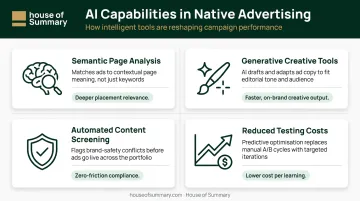
What once demanded a dedicated content production team and months of A/B testing now runs automatically. For media buyers working across multiple placements, that compression of time-to-performance is where the real competitive shift is happening.
Newsletter Native Advertising and the Inbox-First Opportunity
Why the Inbox Is Different
Sponsored editorial placements inside email newsletters represent something genuinely distinct from open-web native advertising. The structural differences matter:
- No ad blockers: Newsletter ads arrive as part of the content, not as separate assets that blocker software can identify and suppress
- No feed algorithm controlling whether your placement reaches readers
- No visual clutter: A newsletter reader arrives with deliberate intent, not mid-scroll distraction
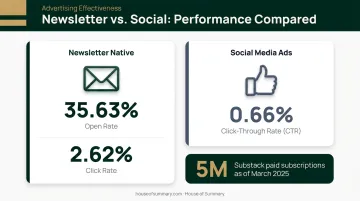
Mailchimp's 2025 benchmarks report an average email open rate of 35.63% and average click rate of 2.62% — compared to a worldwide social ad CTR of 0.66% in Q2 2024 per eMarketer. The comparison isn't apples-to-apples, but it points to a meaningful difference in how much attention each channel actually commands.
Paid newsletter subscriptions are scaling rapidly: Substack crossed 5 million paid subscriptions in March 2025, up from 4 million just four months earlier. When readers actively pay for a publication, sponsored content within it reaches an unusually attentive audience — one that has already signaled its trust in the editorial environment.
The Premium Audience Advantage
That trust translates directly into advertiser value. For brands in finance, B2B, and luxury, inbox-native placements offer something programmatic channels struggle to replicate: reliable access to high-intent, professionally engaged readers.
Specialized newsletter networks serve this need directly. House of Summary operates a portfolio of human-written publications — Presidential Summary, Geopolitical Summary, London Summary, and Dubai Summary — reaching 500,000+ subscribers with 254,866+ emails opened daily. The audience skews heavily toward C-suite executives, founders, policy professionals, and high-net-worth individuals across the US (66%), UAE (18%), and UK (10%).
For brands whose target customer is decision-empowered and globally mobile, this kind of curated, algorithm-free channel delivers precision that open-web native placements rarely achieve.
The Creator Economy Merging with Native Content
Publishers, brand studios, and advertisers are increasingly partnering with individual creators to produce native content — blending established editorial authority with the reach and authenticity of specific voices.
The audience has already moved. Ofcom data shows only 48% of 16-24 year-olds watched broadcast TV weekly in 2023, down from 76% in 2018, while they spend an average of 1 hour 33 minutes daily on video-sharing platforms. The demographic brands most want for long-term brand building is now spending its attention in creator-led environments.
The ROI case for creator-native is now documented at an institutional level. IPA's 2025 influencer database reports:
- Long-term ROI index of 151
- Sales contribution of 6.2%
- The highest long-term channel multiplier of any media at 3.35
These are brand-building indicators, not short-term performance metrics — making creator-native one of the more defensible budget allocations in a diversified media plan.
Those numbers are already reshaping publisher strategy. Future launched its Collab initiative in September 2025, pairing digital creators with media brands including Marie Claire and Ideal Home. DMG Media's creator-led channels followed in October 2025, with more than two dozen creators producing 10–20 daily videos averaging 250,000–300,000 views each.
Both initiatives reflect the same underlying logic: earned trust from a specific audience compounds over time, and creators often build that trust faster than brand studios can manufacture it.
Privacy-First Marketing and the Contextual Targeting Revival
The Cookie Situation — and Why It Doesn't Change the Strategy
Google's timeline for third-party cookie deprecation has shifted repeatedly — a delayed phaseout in 2024, and in April 2025, a confirmation that Chrome would maintain its current approach without a standalone privacy prompt. The specifics keep changing. What hasn't changed is the direction: privacy controls are tightening, behavioral tracking is becoming less reliable, and the industry is restructuring accordingly.
IAB's State of Data 2024, based on over 500 US decision-makers, found that 95% expect ongoing privacy legislation and signal loss, 71% are increasing first-party datasets, and 66% of contextual ad buyers plan to increase contextual spend. The shift is happening regardless of any single cookie deadline.
Why Contextual Is Superior, Not Just Compliant
Contextual targeting matches ads to the content of the page rather than the behavioral profile of the user — and it's native advertising's structural home. A joint study by Seedtag and Nielsen found that contextual ads consistently outperformed demographic targeting across three key measures:
- Boosted consumer interest by 32%
- Made users 2.5x more interested in the advertised category versus no targeting
- Left users 85% more open to future ads from the brand
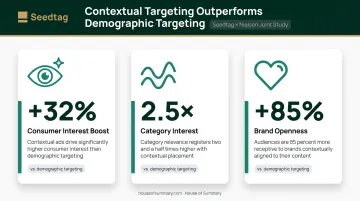
These results reframe the conversation. Contextual isn't a fallback for lost cookie data — it's often the more effective approach.
Native advertising is structurally advantaged here. Because native ads are built around content context by design, the privacy-first shift reinforces their core logic rather than disrupting it.
CTV Expansion and Attention-Based Metrics
Native Beyond the Web Feed
Native advertising principles are extending into connected TV and streaming environments. IAB Tech Lab's CTV Ad Portfolio now includes updates to the Native Ads specification covering in-scene insertion ads, menu ads, pause ads, screensaver ads, and overlay ads — formats where sponsored content integrates into the interface rather than interrupting it. That's the defining logic of native advertising, applied to television.
The inventory opportunity is substantial. eMarketer reports CTV ad spending will reach $33.35 billion in 2025, growing 15.8% that year. IAB projects US digital video ad spend will surpass $80 billion in 2026. Not all of this is native inventory, but the standardization work from IAB Tech Lab confirms native-style CTV formats are moving from concept to active buying.
The Shift to Attention Metrics
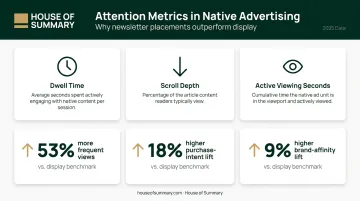
CTV's growth is also accelerating a broader industry shift: impression volume is losing ground as the primary performance currency. In richer, lean-back environments, advertisers need signals that an ad actually landed — not just that it loaded. Attention-based metrics are now filling that gap:
- Dwell time — how long a viewer stays with the content
- Scroll depth — how far a user engaged before moving on
- Active viewing seconds — confirmed eyes-on time, not just ad delivery
This shift directly benefits native advertising. Foundational research from IPG Media Lab and Sharethrough found consumers looked at native ads 53% more frequently than display ads, with native producing 18% higher purchase-intent lift and 9% higher brand-affinity lift. As attention becomes a buyable metric, native's structural edge stops being a soft brand argument and starts showing up directly in performance reporting.
What's Driving These Trends — And Why Now
Three forces are reshaping native advertising at once — and their overlap is what makes the current moment distinct:
Technology: AI and generative tools have dramatically reduced the cost of producing, testing, and optimizing native content at scale. Creative production that once required dedicated content teams now runs on automated DCO systems.
Consumer behavior: Audiences are actively filtering out interruptive advertising. Ad blockers are widespread across desktop environments, and social feeds have trained users to scroll past standard display units without registering them. Native advertising — designed to earn attention rather than demand it — is a direct structural beneficiary of this behavioral shift.
Investment momentum: Grand View Research reports the global native advertising market reached $105.88 billion in 2024 and is projected to reach $346.88 billion by 2033, at a 13.9% CAGR. When capital moves at this scale, it accelerates format standardization, platform investment, and talent migration into the channel.
How These Trends Are Reshaping Digital Marketing Strategy
The operational and strategic implications of these trends are already visible in how marketing teams are restructuring their approaches:
Workflow changes:
- Closer alignment between content, editorial, and paid media functions — because native requires content-led assets, not just ad units
- Longer production cycles for sponsored articles and creator collaborations, offset by AI-assisted creative optimization at the distribution stage
- Direct publisher partnerships replacing some programmatic buying, especially for inbox-native and premium editorial placements
Budget reallocation signals:
- Fewer, higher-quality native placements over high-frequency interruptive formats
- Investment in creator programs as long-term brand-building infrastructure, not just campaign-by-campaign tactics
- Growing premium CPM tolerance for inbox-native and CTV-native inventory as their attention advantages become measurable
These shifts in spending reflect a broader change in how buyers think about media value — moving from volume metrics toward verified attention. The near-term outlook (2025–2027):
- Attention measurement becomes standard buying currency for native campaigns
- AI personalizes native creative in real time at the individual user level
- Newsletter-native and CTV-native command premium CPMs as their attention advantages are independently validated by media buyers
Conclusion
Native advertising's next phase isn't a single breakthrough — it's a convergence. AI optimization, inbox-first formats, creator partnerships, contextual targeting, and attention measurement are all moving together, each reinforcing the same underlying principle: ads that belong in their environment outperform ads that intrude on it.
Brands and media buyers who build native advertising into their strategy before these trends reach full mainstream adoption will capture audience attention at lower costs and higher engagement rates than those who wait.
For brands looking to act on the inbox-native opportunity, specialized newsletter networks offer a ready channel. House of Summary operates a network of specialized newsletters — covering global news, geopolitics, Dubai, and London — with 500,000+ subscribers across the US, UK, and UAE. Placements reach high-intent readers directly in their inbox: no ad blockers, no algorithmic interference, editorial-style formats that fit naturally alongside content. Reach out to sales@houseofsummary.com to explore campaign options.
Frequently Asked Questions
Is native advertising effective?
Native advertising consistently outperforms traditional display on attention, purchase intent, and brand affinity. Aligned with the right audience and content environment, it supports both brand-building and direct-response goals — without interrupting the reading experience.
What are the biggest native advertising trends for 2025 and beyond?
The five trends with the strongest trajectory are AI-driven creative optimization, newsletter and inbox-native formats, creator economy integration, contextual targeting's resurgence in a privacy-constrained environment, and attention-based metrics replacing impression counting as the primary performance currency.
How is AI changing native advertising?
AI enables dynamic creative optimization, semantic content-context matching, automated brand safety screening, and real-time performance adjustment. Brands that previously lacked the content production resources for quality placements can now compete — because AI handles the heavy lifting.
What is the difference between native advertising and traditional display advertising?
Native ads are designed to match the look, tone, and context of the surrounding editorial environment — they earn attention by fitting in. Display ads occupy fixed ad units that sit adjacent to content and interrupt the reading experience, making them easier for audiences to ignore or block.
How does newsletter advertising fit into a native advertising strategy?
Newsletter placements are sponsored content inside publications readers actively choose to receive. That distinction matters: no ad blockers, no algorithmic interference, and direct access to segmented audiences who already trust the editorial voice — which is why open rates and click-through rates consistently outperform web display.