Introduction
D2C advertisers face a stark reality in 2025: Meta prospecting CPMs climbed 7.4% year-over-year to $7.12, while 86% of industries saw Google Ads CPCs rise approximately 10%, with retail brands absorbing roughly 20% increases. These rising platform costs are pushing brands to evaluate alternative channels that deliver measurable performance without the algorithmic uncertainty of social feeds or the escalating auction costs of search.
Executive newsletters have emerged as a high-intent native advertising environment worth benchmarking seriously. Unlike web-based native networks such as Taboola or Outbrain, inbox-delivered placements offer three structural advantages:
- Bypass ad blockers entirely, which affect 32.5% of US internet users
- Compete with a handful of editorial elements rather than hundreds of digital signals
- Reach opted-in audiences who actively chose to receive the content
This post gives D2C media buyers and marketing decision-makers concrete 2025 benchmark numbers and KPI frameworks for native placements inside executive newsletters, so you can evaluate, buy, and measure this channel with confidence.
TLDR: Key Benchmarks at a Glance
- Premium executive newsletter CTRs range 2.1%-7.5% by category—5x to 15x higher than standard web display (0.27%-0.46%)
- Business and finance newsletters achieve 39%-50% open rates, roughly double general email averages of 21%
- Newsletter CPMs range $25-$150+ depending on audience quality, versus $12-$14 for Google Display
- Open-to-click rate (5.3%-7.96%), post-click time on site, and CPA matter more than CTR alone
- Single-CTA native placements increase clicks by 371% and sales by 1,617% versus multi-CTA formats
Executive Newsletters as a Native Advertising Channel — Why They're Different
Structural Advantages Over Web-Native Networks
Executive newsletters operate in a fundamentally different environment than web-based native ad platforms:
Ad blocker immunity: 32.5% of US internet users run ad blockers (37% on desktop), which means web-native widgets from Taboola or Outbrain face routine blocking. Email delivery bypasses this entirely — inbox placements reach the reader every time.
Zero algorithmic competition: A newsletter placement shares space with 2-5 editorial items and 1-2 sponsor messages — that's the entire competitive set. Web-native recommendation widgets fight hundreds of content signals, browser tabs, and social notifications simultaneously.
Captive attention: Readers open newsletters intentionally, not by accident. Email-sourced visitors view 3.6 pages per session versus 3.2 for social traffic — a 12.5% engagement gap that signals meaningfully higher purchase intent.
The Executive Audience Profile
Executive newsletter readers represent a distinctly different conversion dynamic for D2C brands:
- Decision-makers, C-suite executives, and policy professionals concentrated in wealth-dense metros
- Morning Brew's 4M+ subscribers are predominantly 25-40, college-educated, and upwardly mobile — the kind of audience that attracted a $75M acquisition by Business Insider
- High household income ($150k+) and real purchasing authority for premium or aspirational products
- House of Summary's network targets this same demographic, with 66% of readers in metros like New York and LA, plus concentrated affluent audiences in London and Dubai
This profile creates stronger conversion economics for D2C brands selling premium goods compared to broad consumer web traffic.
What "Native" Means in Newsletter Context
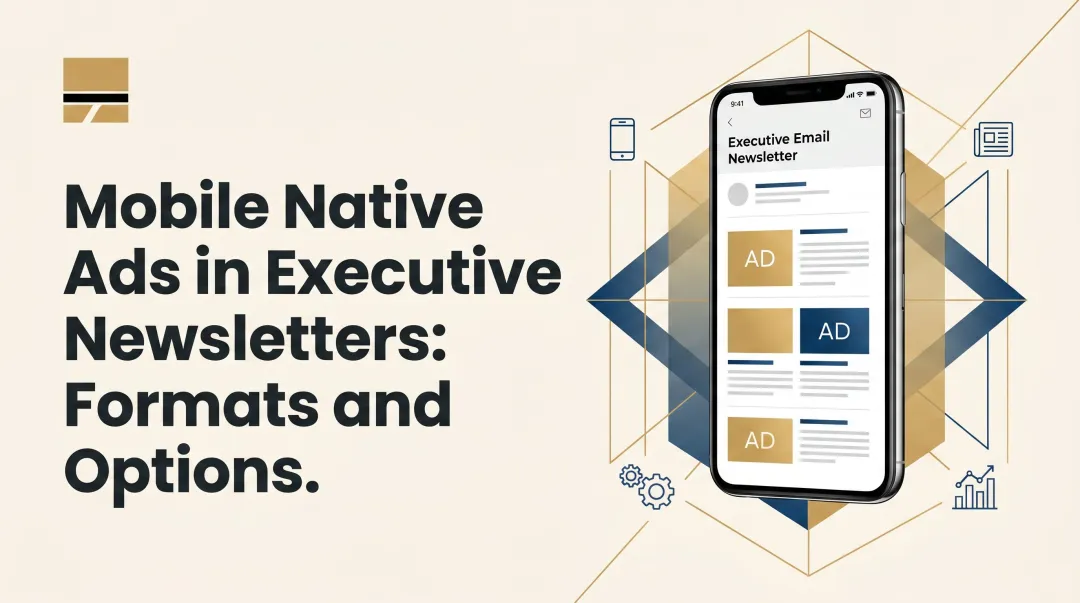
Understanding how these formats work in practice matters as much as knowing who reads them. Newsletter native advertising differs from web-native formats in three key ways:
- Sponsored content sections — editorial-tone articles integrated into the newsletter flow, disclosed as sponsored while matching the publication's voice
- Advertorial placements — longer-form brand narratives that educate rather than pitch directly, effective for products like SaaS tools, financial services, or multi-step D2C offerings
- Product spotlights — concise features highlighting specific offerings within relevant editorial context
These formats avoid the visual separation of banner units or recommendation widgets, appearing as part of the content readers actively consume.
2025 Benchmark Numbers: What D2C Advertisers Should Expect
CTR Benchmarks
Newsletter sponsored content delivers measurably higher engagement than web display:
| Newsletter Category | Sponsored CTR | Open Rate |
|---|---|---|
| Education | 12.5% | 44.8% |
| Sports & Fitness | 11.1% | 34.1% |
| Self-Improvement | 7.4% | 38.2% |
| Finance | 4.7% | 41.8% |
| Business | 3.0% | 39.3% |
| Marketing | 2.3% | 40.1% |
| Startups | 2.1% | 49.5% |
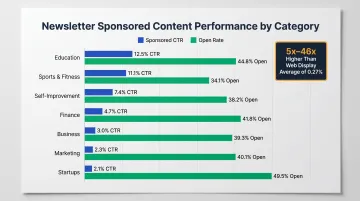
Contrast with web benchmarks: Standard programmatic display averages 0.27% CTR, while overall display averages 0.46%. Newsletter native placements deliver 5x to 46x the engagement.
Platform-specific performance: House of Summary reports click-through rates 4x higher than Google AdWords for advertisers reaching its executive readership. This outcome reflects what happens when ads reach decision-makers in a distraction-free inbox environment rather than a crowded display network.
CPM Benchmarks
Newsletter advertising commands premium pricing justified by audience quality:
| Newsletter Audience | CPM Range |
|---|---|
| B2B Decision-Makers (Sales/Gov) | $100-$200 |
| B2B Decision-Makers (Finance/CFO) | $60-$150 |
| Tech & Developers | $40-$100 |
| Marketing & SaaS | $25-$60 |
| AI & Emerging Tech | $20-$50 |
| Consumer Lifestyle | $15-$40 |
Context: Google Ads median CPM was $12.79 in 2024, rising to $14.07 in 2025. Newsletter CPMs of $50-$150+ appear expensive per impression but become cost-competitive when adjusted for 3-7% CTR versus 0.27-0.46% web display rates.
Paved platform data shows HR newsletters commanding $43 CPM while entertainment newsletters earn $5 CPM. That gap reflects how directly audience quality drives advertiser willingness to pay.
Open Rate Benchmarks
Executive and business newsletters consistently outperform general email averages:
| Newsletter Type | Open Rate |
|---|---|
| Startups | 49.5% |
| Consulting | 45.96% |
| Business & Finance | 43.34% |
| Finance (Paved) | 41.8% |
| Business (Paved) | 39.3% |
| B2B Services | 39.48% |
General email marketing averages 21.33% (Mailchimp) to 42-43% (HubSpot/MailerLite), with the discrepancy reflecting Apple Mail Privacy Protection measurement differences. Executive newsletters consistently hit the 38-50% range.
Conversion and ROI Benchmarks
Broader email marketing ROI sets the floor for what newsletter placements can achieve:
- Email delivers $36 ROI for every $1 spent across all industries
- Retail and ecommerce specifically achieve 45:1 ROI from email marketing
- Newsletters specifically deliver the highest ROI among email types for D2C companies
Category matters when projecting conversions. Klaviyo's placed order benchmarks for email campaigns break down as follows:
- Apparel: 0.08%
- Beauty: 0.09%
- Health & Wellness: 0.10%
- Food & Beverage: 0.14%
Cost Per Acquisition Advantage
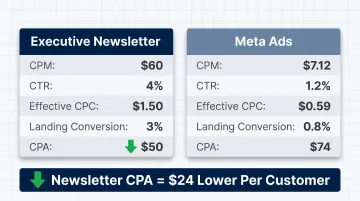
The CPA advantage of newsletter native placements emerges from higher intent traffic rather than lower upfront cost:
Calculation framework:
- Newsletter CPM: $60
- CTR: 4%
- Effective CPC: $1.50
- Landing page conversion: 3%
- CPA: $50
Compare to Meta:
- CPM: $7.12
- CTR: 1.2%
- Effective CPC: $0.59
- Landing page conversion: 0.8%
- CPA: $74
The newsletter CPC is higher, but 3.75x better on-site conversion closes the gap — and then some. A $24 lower CPA means every 100 newsletter-acquired customers costs $2,400 less than the same cohort acquired through Meta.
The KPIs That Actually Matter for D2C Newsletter Campaigns
Click-Through Rate (CTR)
CTR measures unique clicks divided by impressions delivered. For newsletters, "impressions" typically equals sends or opens depending on reporting methodology.
What's good: 2.1%-7.5% for newsletter native placements versus 0.30%-0.60% for web-native. That said, CTR alone doesn't tell the full story. A 7% CTR with zero conversions still represents a failed campaign.
Open-to-Click Rate (CTOR)
CTOR isolates engagement quality among people who actually opened the newsletter:
| Industry | CTOR |
|---|---|
| Media | 12.92% |
| Business & Finance | 7.96% |
| Consulting | 7.67% |
| SaaS | 6.81% |
| All Industries | 5.3%-6.81% |
HubSpot identifies CTOR as the "truest measure of content quality" because it controls for open rate variability across publishers. For evaluating newsletter placements, CTOR is more meaningful than raw CTR.
Post-Click Engagement Metrics
Time on site, pages per session, and scroll depth indicate whether newsletter traffic has genuine purchase intent:
- Email traffic: 3.6 pages per session
- Social traffic: 3.2 pages per session
- Direct traffic: 4.3 pages per session
D2C brands should benchmark these metrics in analytics platforms, setting minimums of 2+ minutes time on site and 2+ pages per session for newsletter-sourced traffic.
Cost Per Acquisition (CPA) and ROAS
Post-click engagement tells you if readers are interested. CPA and ROAS tell you whether that interest is generating revenue — and those are the metrics that decide campaign success or failure:
CPA target framework:
Target CPA = (Average Order Value × Gross Margin %) ÷ Target First-Order Payback
For a product with $100 AOV, 60% margin, and 1.5x first-order payback target:
Target CPA = ($100 × 0.60) ÷ 1.5 = $40
ROAS calculation:
ROAS = Revenue Attributed to Campaign ÷ Campaign Spend
Strong click numbers mean nothing if CPA runs twice your target. An $80 CPA against a $40 benchmark is a money-losing campaign, no matter what the engagement dashboard shows.
Attribution Complexity
Newsletter placements have longer attribution windows than last-click models capture:
- 59% of companies analyze engagement metrics; 41% use direct revenue attribution; 36% use multi-channel models
- 21% of marketing leaders still don't measure email ROI—down from 36% in 2023
Best practices for D2C brands:
- Use dedicated landing pages with UTM parameters for each newsletter placement
- Implement view-through attribution windows of 7-14 days
- Track assisted conversions, not just last-click attribution
- Create newsletter-specific promo codes to capture offline attribution
Creative and Copy Benchmarks: What Works in Executive Inbox Formats
Editorial Tone Outperforms Promotional Copy
Research from IPG Media Lab and Sharethrough surveying 4,770 consumers found:
- Native ads received 53% more visual attention than display ads
- 18% higher purchase intent lift versus banner ads
- 32% of respondents would share native ads versus 19% for display
While this foundational study measured web-native formats, the principle applies to newsletter placements: editorial-tone sponsored content that matches publication voice generates stronger engagement than overtly promotional messaging.
Getting that tone right is only the first step. The next is knowing how much space to use it in.
Headline and Copy Length
Headlines: Research suggests optimal headline length of approximately 50-55 characters and 6 words for email contexts. Focus on curiosity-driven or benefit-led hooks.
Copy length: Newsletter native placements perform best at 150-300 words for sponsored sections — enough to establish context without losing the reader. Longer sponsored sections can extend to 400-600 words for complex products that need more context.
Call-to-Action Best Practices
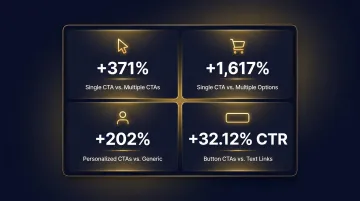
HubSpot's analysis of 229M emails reveals:
- Single CTA emails increase clicks by 371% versus multiple CTAs
- Single CTA emails increase sales by approximately 1,617% versus multiple options
- Personalized CTAs convert 202% better than generic versions
- Button-based CTAs increase CTR by 32.12% versus text links
For executive newsletter placements:
- Use one clear CTA per placement — split attention kills conversions
- Frame value around exclusivity or insider access rather than urgency
- Keep phrasing professional and benefit-focused; aggressive scarcity language reads as noise to executive audiences
- Match the offer type to the category: direct product offers suit clear-value propositions, while content-first approaches work better for complex products that need education first
How to Evaluate and Choose the Right Executive Newsletter for Your D2C Brand
Three Primary Evaluation Criteria
1. Audience Demographics and Verified Data
Request specific subscriber composition data before any commitment:
- Professional seniority (percentage of C-suite, VP-level, director-level readers)
- Income verification or geographic concentration in high-income metros
- Industry verticals represented (finance, tech, healthcare, etc.)
House of Summary, for example, provides detailed analytics showing 66% US concentration in New York and LA, 18.2% in UAE (Dubai), and 10.47% in UK (London). All three are high-income metro concentrations that align directly with premium D2C targeting.
2. Engagement Metrics Publishers Can Share
- Open rates (38–50% for quality business newsletters)
- Open-to-click rate (5.3%–7.96% for business categories)
- Subscriber growth trajectory (consistent growth signals healthy engagement)
- Monthly loyal reader count (percentage opening multiple issues per month)
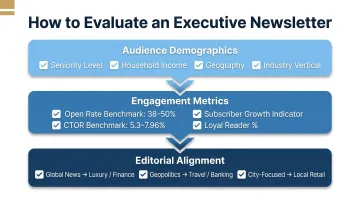
3. Editorial Alignment
Match newsletter editorial focus to your product category:
- Global news/business newsletters (Presidential Summary): financial products, luxury goods, professional services
- Geopolitics/international affairs: premium travel, international banking, global brands
- City-focused newsletters (Dubai Summary, London Summary): local luxury retail, real estate, regional services
Red Flags to Watch For
Walk away from newsletters that check any of these boxes:
- Cannot provide verified open rate data or share only "subscriber count"
- Offer 5+ ad placements per issue, diluting attention share
- Show declining or flat subscriber growth over 6+ months
- Cannot share past advertiser performance data or testimonials
- Use vague language about audience composition ("high-income professionals") without data
Evaluation Checklist
Before signing a contract, ask publishers these questions:
Audience quality:
- What percentage of subscribers are in senior decision-making roles?
- What is the geographic distribution and household income profile?
- How do you verify subscriber quality and prevent list bloat?
Performance transparency:
- What are your average open rates over the past 6 months?
- What open-to-click rate do you typically see for sponsored content?
- Can you share anonymized performance data from past advertiser campaigns?
Ad load and exclusivity:
- How many ad placements appear per issue?
- Do you offer category exclusivity within issues?
- What is your policy on competitor advertising?
Pricing and flexibility:
- What CPM or flat-rate pricing do you offer?
- Are there discounts for multi-issue commitments?
- Do you provide dedicated landing page support or UTM guidance?
Frequently Asked Questions
What are the KPIs for native advertising?
Core KPIs are CTR, engagement rate (time on site, pages per session), conversion rate, viewability, CPA, and ROAS. For newsletter native, also track open-to-click rate (5.3%-7.96% for business categories) and post-click time on site—both signal audience intent quality that raw clicks miss.
What are good benchmark advertising examples?
A strong CTR for web-native is 0.30%-0.60%, while premium executive newsletter placements deliver 2.1%-7.5% depending on category. CPA benchmarks vary by product—luxury D2C brands might target $50-$100 CPA, while subscription services may accept $20-$40. ROAS targets of 3:1 to 5:1 are common for established D2C brands.
What is a good CTR for native ads in email newsletters?
Premium executive newsletters should deliver 2.1%-7.5% CTR for sponsored content, with business and finance categories typically achieving 3%-5%. This far outpaces general web-native averages of 0.30%-0.60% due to higher audience intent and inbox-exclusive attention.
How much does it cost to advertise in executive newsletters?
Premium executive newsletter CPMs range $50-$150+ depending on audience quality, with B2B decision-maker newsletters commanding $100-$200. Flat-rate primary placements typically cost $500-$5,000 per issue. The CPM is higher than $12-$14 web display rates, but a 5x-15x CTR advantage and stronger conversion quality make the math work for D2C brands with healthy margins.
How do newsletter native ads compare to social media ads for D2C brands?
Newsletter native ads reach opted-in readers with no algorithm interference and no ad blockers—a factor that affects 32.5% of web users. Social ads compete in high-distraction feeds with unpredictable reach. Newsletter CPMs run 3x-10x higher, but email traffic views 12.5% more pages per session than social, reflecting meaningfully stronger purchase intent.
What content formats work best for D2C brands in executive newsletters?
Editorial-style sponsored sections with a single clear CTA outperform banner-style placements and generate 18% higher purchase intent when they match the publication's tone. Use concise product spotlights (150-300 words) for straightforward value propositions, and content-led advertorials (400-600 words) for categories that need more education.