For marketers, this creates a genuine problem: your audience is harder to reach than ever. Choosing the wrong advertising format doesn't just waste budget — it means your message never gets seen at all.
That's why the native vs. traditional advertising question matters more now than it did five years ago. This article breaks down the core differences, when each format works, and how to choose between them.
Key Takeaways
- Traditional advertising uses clearly labeled, interruptive formats — TV spots, banner ads, and billboards — built on placement and repetition.
- Native advertising blends with the surrounding content, matching the platform's tone and format so it reads editorial rather than promotional.
- The practical gaps come down to user experience, engagement rates, ad blocker exposure, and targeting precision.
- Traditional formats win on raw reach and broad awareness; native formats win on engagement, trust, and conversion from targeted audiences.
- Most effective media plans use both — sequentially, not as substitutes.
Native vs. Traditional Advertising: Quick Comparison
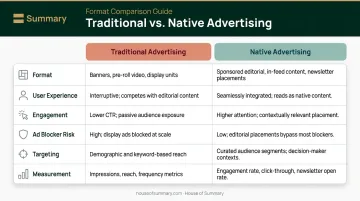
| Factor | Traditional Advertising | Native Advertising |
|---|---|---|
| Format | Visually distinct from surrounding content | Matches the look and tone of the platform |
| User Experience | Interruptive — inserted into content the user didn't choose | Integrative — flows within content the user already engaged with |
| Engagement | Display CTR typically sub-1%; older GDN benchmark at 0.46% | Native ads viewed 53% more frequently than display (IPG/Sharethrough — link source when URL available) |
| Ad Blocker Risk | Standard display ads are frequently blocked | Email-embedded native content bypasses browser-based blockers |
| Targeting | Broad, channel-based (TV time slots, print circulation) | Contextual and audience-based — placed within relevant content environments |
| Measurement | Harder to attribute precisely; relies on impressions and brand lift | Digital native enables post-click tracking: clicks, sign-ups, conversions |
What Is Traditional Advertising?
Traditional advertising covers any paid promotional format that is clearly separate from surrounding content and delivered through established mass-media channels. That includes:
- Broadcast: TV commercials, radio spots
- Print: newspaper and magazine ads
- Outdoor: billboards, transit advertising
- Digital display: banner ads, leaderboards, pop-ups
Digital banners are technically online, but they follow the same interruptive model as a TV spot: visually separate from the content, demanding attention through placement rather than context.
Where Traditional Advertising Still Works
Traditional formats built brands like Coca-Cola and Nike through sheer repetition and mass reach. That reach still has a place in specific situations:
- Reaching older or less digitally active demographics
- High-budget brand campaigns where impression volume is the primary goal
- Local advertising through radio or print in specific geographies
- Consumer goods and retail where high-frequency visual exposure drives recall
The Core Limitation
Digital traditional formats have a visibility problem. WordStream's benchmark data from 14,197 US accounts puts the average Google Display Network CTR at 0.46%. Smart Insights' 2024 compilation describes display CTRs as typically sub-1%, with historic DoubleClick figures as low as 0.05%.
And that's for ads that actually get seen. A 2024 Emerald eye-tracking study found consumers largely disregard banner ads when performing focused tasks like reading news — the audience is present, but their attention isn't.
What Is Native Advertising?
The IAB defines native advertising as paid ads that are cohesive with page content, integrated into the design, and consistent with platform behavior — so the viewer feels the ads belong in that environment.
In practice, that means the ad adopts the visual style, editorial tone, and content format of whatever surrounds it. A sponsored article in a finance publication looks like an article. A promoted post in a LinkedIn feed looks like a post. The format fits the context.
Common Native Advertising Formats
The IAB recognizes several core deployment types:
- In-feed/in-content units — Sponsored posts within social feeds (LinkedIn, Instagram) or embedded in article streams
- Content recommendation widgets — "Suggested for you" placements at the end of articles, directing readers to branded content
- Advertorials and sponsored articles — Editorial-style content within news publishers or specialized publications
- Promoted listings — Sponsored results in search engines or e-commerce platforms
- Sponsored newsletter content — Brand placements embedded within curated editorial newsletters
These aren't interchangeable. A promoted LinkedIn post and a sponsored newsletter article reach different audiences in fundamentally different mindsets.
Performance Advantages
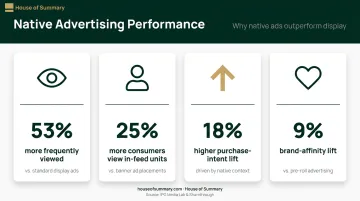
A foundational study by IPG Media Lab and Sharethrough — based on 4,770 consumers — found that native ads were viewed 53% more frequently than standard display ads, with 25% more consumers looking at in-feed native units. The study also recorded an 18% higher purchase-intent lift and 9% brand-affinity lift compared to banner formats.
When an ad doesn't feel like an interruption, readers engage with it on its own terms.
Transparency and FTC Compliance
Native ads are required to carry clear disclosure. The FTC specifies that acceptable labels include "Ad," "Advertisement," "Paid Advertisement," and "Sponsored Advertising Content." The FTC warns that labels like "Promoted" or "Promoted Stories" may be ambiguous and shouldn't be relied upon alone.
When done correctly, disclosure doesn't hurt performance. Readers who find the content genuinely relevant engage regardless of the label — content quality drives the outcome.
Newsletter Native Advertising
Newsletter native advertising deserves specific attention. Sponsored content within a curated editorial newsletter reaches readers in an engaged, receptive mindset — there's no social feed competing for attention, no algorithm deciding who sees it, and no browser ad blocker filtering it out.
House of Summary's advertiser model is built on this principle. Sponsored placements within Presidential Summary, Geopolitical Summary, Dubai Summary, and London Summary reach a combined 500,000+ subscribers — concentrated among decision-makers, executives, and high-net-worth professionals in the US, UK, and UAE. BSH Hausgeräte's CEO attributed a Dubai Summary campaign's click-through rates — 4x higher than Google AdWords — directly to editorial alignment with high-intent readers.
Key Differences: Native vs. Traditional Advertising
Interruption vs. Integration
Traditional advertising is built on the interruption model: your message breaks into content the user chose, demanding attention through placement. Native advertising earns attention by fitting into content the user already engaged with.
This matters for receptivity. A reader scrolling through a newsletter they subscribed to is in a fundamentally different mindset than someone watching a pre-roll ad they can't skip.
Trust and Credibility
When native content appears in a reputable editorial environment, the publisher's credibility transfers to the advertiser — what Digital Content Next describes as a "halo effect" in which quality content environments improve ad attention and engagement.
The FTC flags a real counterpoint: knowing content is advertising affects how much credibility consumers give it. That's precisely why content quality matters. A sponsored article that delivers genuine value works. One that reads as a press release doesn't.
Targeting and Context Relevance
Traditional advertising targets by proxy — buying a time slot during a sports broadcast to reach sports fans. Native advertising allows tight contextual targeting, placing brand content within publications directly relevant to the brand's niche. An executive reading a geopolitics newsletter is already in a professional mindset when they encounter a sponsored message — that context alignment reduces wasted spend and increases message relevance.
Ad Blocker Exposure
Ad blocker adoption is material. YouGov's 2024 study found 23% of US consumers use browser-based ad blockers, with 8% using them on mobile. Standard display ads are directly in the path of these blockers.
Native ads embedded within email newsletters operate differently. Browser-based blockers don't intercept email content — the sponsored message arrives as part of the newsletter itself, not as a separately served ad unit.
Measurement and Attribution
Nielsen's 2024 Annual Marketing Report found that only 38% of marketers evaluate holistic ROI by measuring traditional and digital marketing together — a measurement gap that reflects the difficulty of attributing traditional ad spend.
TV and print campaigns traditionally rely on impressions and brand lift studies. Digital native advertising enables clearer post-click measurement. Key metrics you can track at the campaign level include:
- Clicks and click-through rate — direct response to the sponsored message
- Time on site — signals content engagement beyond the initial click
- Sign-ups and lead captures — ties spend to pipeline activity
- Downstream conversions — connects the campaign to revenue outcomes

That granularity makes it significantly easier to demonstrate concrete ROI to stakeholders.
Which One Should You Choose?
Before choosing, evaluate three variables:
- Campaign goal: awareness vs. engagement vs. conversion
- Audience definition: broad and undefined vs. niche and high-intent
- Measurement requirements: brand lift acceptable vs. hard ROI required
Choose Traditional Advertising If:
- Your primary goal is maximum reach and mass awareness
- Your audience is broad and not easily segmented
- Your product benefits from high-frequency visual or audio impressions (consumer goods, retail)
- You're operating in markets where digital penetration is limited
Choose Native Advertising If:
- Your goal is engagement, trust-building, or conversion from a specific audience
- Your brand message requires context and storytelling (finance, B2B, luxury)
- Your audience is digitally sophisticated and likely using ad blockers
- You need measurable ROI at the campaign level
This is especially relevant for brands targeting executives, senior professionals, or high-income readers — the kind of audience that subscribes to specialized newsletters precisely because they want signal, not noise.
For most marketing decision-makers, the question isn't either/or. Traditional formats build broad awareness at scale; native formats then drive engagement and conversion among audiences already familiar with the brand. The sharpest media plans sequence both — using reach to fill the top of the funnel, then switching to contextual placement to close it.
Frequently Asked Questions
How is native advertising different from traditional ads?
Traditional ads interrupt the user experience and are visually distinct from surrounding content. Native ads are designed to blend with the platform's look and tone, feeling more like editorial content than advertising — which typically results in higher engagement and lower resistance from readers.
Does native advertising work better than traditional advertising?
The answer depends on your goal. Native generally outperforms traditional on engagement, CTR, and conversion metrics. Traditional still leads on raw reach and broad brand awareness. The right format comes down to what success looks like for your specific campaign.
What are examples of traditional advertising?
TV commercials, radio spots, print ads in newspapers or magazines, billboard and outdoor advertising, and digital banner or display ads that appear visually separate from the page's main content all qualify as traditional advertising formats.
Is sponsored content the same as native advertising?
Sponsored content is a primary form of native advertising — branded content written to match the editorial style of the host publication. Native advertising also includes in-feed social ads, promoted listings in search or e-commerce, and content recommendation widgets.
Can native advertising be used in email newsletters?
Yes — sponsored content inside a curated newsletter reaches an already-engaged reader in a focused inbox environment. There's no algorithm filtering and no browser-based ad blocker standing between the message and the reader.
Are native ads blocked by ad blockers?
It depends on delivery method. Native ads inside email newsletters bypass browser-based ad blockers entirely — the content arrives as part of the newsletter itself. Traditional display and banner ads are frequently blocked, meaning a significant portion of your intended audience never sees them.