Introduction
D2C advertisers face a persistent tension: limited budgets, relentless pressure to acquire new customers, and the equally critical need to retain existing ones. Two channels compete for the same marketing dollar—email marketing and PPC advertising—each promising different paths to profitability.
For D2C brands, this decision carries more weight than for most businesses. Unlike B2B or traditional retail, D2C brands live and die by two metrics: CAC (customer acquisition cost) and LTV (lifetime value). The average online apparel shopper isn't profitable until their fourth purchase, and with ecommerce CAC rising 60%+ over the past five years, channel selection directly drives profitability.
What follows is a direct comparison of both channels on the metrics that actually move the needle for D2C brands — so you can put your budget where it earns the most.
Key Takeaways
- Email marketing delivers high-ROI retention from owned audiences, ideal for repeat purchases
- PPC drives fast acquisition but stops completely once budgets run out
- D2C brands use PPC for top-of-funnel awareness and email for retention and LTV
- List ownership is email's core edge: no algorithm, ad blocker, or policy change cuts off access
- High-growth D2C brands combine both: PPC fills the funnel, email monetizes it
Email Marketing vs PPC: Quick Comparison
| Dimension | Email Marketing | PPC Advertising |
|---|---|---|
| Cost Structure | Low marginal cost per send; scales with list size | Pay per click/impression; costs rise with competition |
| Speed to Results | Builds over time; requires list-building investment | Immediate traffic and conversions within hours |
| Audience Type | Owned (opted-in subscribers) | Rented (platform-dependent traffic) |
| ROI Benchmark | $36-$45 per $1 spent (ecommerce: 45:1) | 2.5-4.0:1 ROAS typical; median dropped to 2.04 in 2024 |
| Scalability | Scales slowly; limited by list growth rate | Scales quickly with budget; limited by market saturation |
| Platform Dependency | Independent; immune to algorithm changes | High; performance tied to platform policies and auction dynamics |
| Best Funnel Stage | Bottom-of-funnel retention, repeat purchases, nurturing | Top-of-funnel acquisition, cold traffic, new product launches |
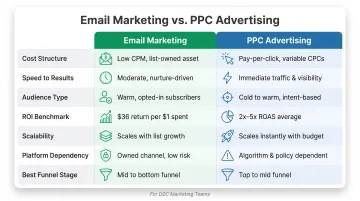
The better channel depends on where a D2C brand is in its growth cycle and what its margins can support. Early-stage brands typically rely on PPC to build their initial customer base — there's no list to email yet. As that list grows, mature brands often shift budget toward email, where retention drives profit more efficiently than continued paid acquisition.
What is Email Marketing for D2C Brands?
Email marketing, in the D2C context, means communicating directly with opted-in subscribers—past customers, leads, or sign-ups—through targeted messages that drive purchases, loyalty, and repeat buying behavior. Unlike social or search audiences, the email list is an owned asset. No platform controls access to it, and no policy change can revoke it overnight.
D2C brands rely on several core email formats:
- Welcome sequences: Onboard new subscribers, set brand expectations, and convert first-time visitors
- Promotional campaigns: Announce product launches, sales events, and seasonal offers
- Abandoned cart emails: Recover high-intent shoppers who left without completing checkout
- Post-purchase flows: Drive reviews, trigger replenishment reminders, and upsell complementary products
Each format ties directly to D2C business outcomes. Abandoned cart emails, for example, generate an average of $3.65 revenue per recipient—33x more than standard promotional campaigns.
The ROI Advantage
Email marketing consistently delivers among the highest ROI of any digital channel. Litmus research shows email drives an average return of $36 for every $1 spent across industries. For retail, ecommerce, and consumer goods specifically, that figure climbs to $45:1.
Compare that to the average ecommerce ROAS of 2.87:1 for PPC—with half of all ecommerce businesses operating below 2:1—and the retention economics become clear. That gap widens as brands build larger lists and apply more precise segmentation.
Why Email Bypasses the Ad Visibility Problem
Email lands directly in the inbox, giving D2C brands undivided attention. Nearly 30% of internet users globally use ad blockers, rendering display and social ads invisible. Email bypasses this barrier entirely.
Newsletter advertising extends this same inbox-first reach to cold audiences. Placing brand messages inside curated, high-engagement email publications like those from House of Summary delivers access to opted-in readers who already trust the publication. Click-through rates in premium newsletters often outperform standard display or search ads because the editorial context elevates the brand message rather than commoditizing it.
The Main Limitation
Email marketing requires list-building investment upfront and scales slowly. A brand with no list starts from zero. Poor list hygiene—invalid addresses, unengaged subscribers—can tank deliverability just as quickly as poor targeting tanks paid spend. Without a strategy to grow and maintain list health, the ROI advantage stays theoretical.
Use Cases for D2C Email Marketing
Email marketing fits best for:
- Consumable products with predictable reorder cycles — skincare, supplements, pet food
- Brands running loyalty programs, VIP tiers, or community-first campaigns
- Post-purchase sequences recommending complementary products based on order history
- Win-back flows targeting dormant subscribers ahead of seasonal peaks
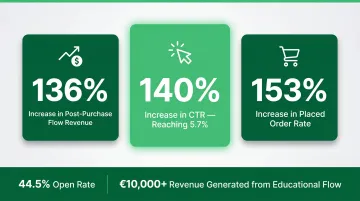
Real-World Example: Freshly Cosmetics, a D2C skincare brand, rebuilt its post-purchase email flow using behavior-based segmentation. The result: a 136% increase in post-purchase flow revenue, a 140% increase in CTR (reaching 5.7%), and a 153% increase in placed order rate. Their product-specific educational flow achieved a 44.5% open rate and generated over €10,000 (~$11,000 USD) in revenue despite being designed as informational, not promotional.
What is PPC Advertising for D2C Brands?
PPC advertising for D2C means paid placements across search engines (Google, Bing), social media (Meta, TikTok, Pinterest), and display networks, where brands pay per click or impression. Unlike email, PPC targets cold audiences who haven't yet interacted with the brand.
Core PPC formats relevant to D2C include:
- Google Shopping ads: High purchase intent from users actively searching for products
- Meta/Instagram dynamic product ads: Interest and behavior-based targeting with massive reach
- TikTok ads: Discovery-driven reach and viral potential, especially for younger demographics
- Retargeting campaigns: Re-engaging site visitors who didn't convert on first visit
PPC's Core Strength: Speed and Scale
A D2C brand can launch a product and begin generating traffic and sales within hours. PPC delivers immediate visibility when email lists don't yet exist or when rapid market entry is critical.
For example, Meta Advantage+ shopping campaigns delivered 11.5X ROAS for LOOKFANTASTIC, an online beauty retailer, with 11% lower CPA and 14% more purchases compared to manual campaign setups. That kind of return is the ceiling, though — not the floor.
Average ecommerce ROAS has dropped to 2.87:1, with the median falling to 2.04 in 2024. Half of all ecommerce brands now operate below breakeven on ad spend.
The Critical Drawback: Rented Audience
PPC is a rented audience. Once ad spend stops, traffic and conversions stop immediately. There is no cumulative equity. Rising CPCs driven by increased competition compress margins over time. Google Ads CPC rose 12.88% year-over-year in 2025, and Meta CPMs hit £10.88 in the UK during Q1 2025—an 89% increase since 2020.
For D2C brands in saturated categories like beauty, health, and apparel, this cost inflation is structural, not cyclical. And that's before factoring in creative burnout.
Ad Fatigue and Platform Dependency Risks
Creative burnout requires constant refresh cycles. On TikTok, ad creative has a 7-14 day lifespan before engagement metrics fall below breakeven ROAS thresholds. Meta requires 5-7 days minimum for ads to graduate from the learning phase. Advertisers should dedicate 20-30% of monthly budget to testing new creative.
Platform policy changes or algorithm shifts can sharply impact campaign performance overnight. Apple's ATT privacy changes caused up to 37.1% less revenue growth for data-dependent SMEs, with Meta campaigns seeing a 36.6% decrease in clicks.
Use Cases for D2C PPC Advertising
PPC makes the most sense for:
- New product launches requiring rapid awareness and initial traction
- Seasonal sales events with time-sensitive promotions
- Audience prospecting in new markets or demographics
- Retargeting warm visitors who engaged but didn't convert
- High AOV brands where CPA math justifies the cost
Email Marketing vs PPC: Key Differences D2C Advertisers Must Know
Cost Structure and Sustainability
Email marketing has low marginal cost per send once a list exists. Cost scales with list size but remains predictable. PPC costs scale directly with spend, and CPCs rise with competition—meaning the same result costs more over time.
For D2C brands in competitive niches, this accelerates fast. TikTok CPMs rose 16% year-over-year, while CPA increased 8.64% and ROAS dropped 5.7%. Email's cost structure remains stable regardless of competitive dynamics.
Audience Ownership vs Platform Dependency
Email lists are owned assets. They cannot be taken away by a platform, an algorithm change, or an ad policy update. PPC audiences are rented—brands pay for each interaction and have no cumulative equity.
The University of Hamburg study quantified this platform risk directly: SMEs heavily reliant on third-party data saw up to 37.1% less revenue growth post-ATT. Email sidesteps this structural vulnerability entirely.
Speed vs Sustainability
PPC delivers results immediately; email builds results over time. For D2C brands, this creates a natural division of labor: PPC generates the initial customer base that email retains and monetizes.
The two channels aren't competing priorities — they're sequential ones:
- Without PPC, new brands struggle to build lists in the first place
- Without email, scaling brands cannot recoup acquisition costs through repeat purchases
Customer Stage Targeting
Cold acquisition is where PPC excels — awareness and first purchase. Email is built for what comes after: warm nurturing, post-purchase retention, and repeat buying.
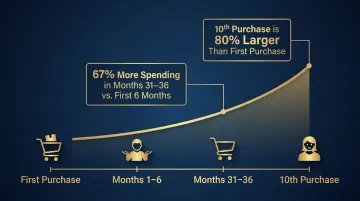
That sequencing matters for D2C LTV math, where most profit comes from repeat purchases. Bain & Company research found that repeat customers spend 67% more in months 31-36 compared to the first six months, and a customer's 10th purchase is typically 80% larger than their first.
Personalization and Messaging Depth
Email allows a level of messaging depth that PPC simply can't match:
- Long-form storytelling and brand narrative
- Segmentation by purchase history and behavior
- Triggered automations tied to specific customer actions
- Personalized product recommendations at scale
PPC is constrained to short headlines and visuals. For premium D2C brands, that limitation affects brand perception — especially when the product requires education, trust-building, or overcoming buyer hesitation before a purchase decision is made.
Which Channel Should D2C Brands Prioritize?
Choose PPC if:
- You're launching a new product and need immediate visibility
- You're entering a new market or demographic with no existing customer base
- You have high AOV and can absorb CPA costs within acceptable payback periods
- You need rapid testing of messaging and positioning
Choose email if:
- You have an established customer base generating predictable revenue
- You want to increase LTV and reduce effective CAC through retention
- Your product has natural replenishment cycles (skincare, supplements, pet food)
- You need to bypass rising PPC costs and platform dependency risks
The Blended Approach Most Successful D2C Brands Use
PPC captures new customers. Email nurtures and retains them.
A documented D2C case study showed that integrating full-funnel PPC with structured email retention flows resulted in:
- 41% reduction in blended CAC
- 2.3x increase in revenue
- 27% increase in repeat purchase rate
The brand's core problem wasn't demand—it was conversion, retention, and unit economics. They had almost no lifecycle marketing and were over-reliant on prospecting. By pairing Meta and Google acquisition with welcome series, abandoned cart recovery, and post-purchase journeys, they turned first-time buyers into repeat customers, improving LTV and making the acquisition investment profitable.
For D2C advertisers looking to reach engaged, high-intent audiences without the rising CPC costs of search or social, newsletter advertising offers a direct path to inbox attention that neither search nor social can replicate. Placing brand messages inside trusted publications like House of Summary's specialized newsletters delivers inbox-first access to curated readers—no ad blockers, no algorithm barriers—with click-through rates reported at 4x those of Google AdWords. For D2C brands managing CAC pressure on both acquisition and retention fronts, that kind of performance efficiency is worth building into the channel mix.
Frequently Asked Questions
Is EDM still relevant in marketing?
Yes. Email (EDM) consistently delivers among the highest ROI of any digital channel—up to $45 per $1 spent for ecommerce brands. For D2C brands, it remains the primary tool for customer retention, repeat purchases, and post-acquisition monetization.
Should D2C startups prioritize PPC or email marketing first?
Most D2C startups begin with PPC to generate their first customers and build an email list, then shift budget toward email as the list grows. Retaining a customer costs 5x less than acquiring a new one, making email the higher-leverage channel once a base exists.
What is the average ROI of email marketing compared to PPC for D2C brands?
Email marketing delivers $36-$45 per $1 spent (45:1 for ecommerce specifically), while typical ecommerce PPC ROAS ranges from 2.5-4.0:1, with the median at 2.04 in 2024. That gap widens significantly once a brand's list is large enough to segment by behavior and purchase history.
How do D2C brands use PPC and email marketing together effectively?
PPC drives cold traffic and first purchases. Post-purchase email flows then convert one-time buyers into repeat customers—welcome series, abandoned cart recovery, and replenishment reminders—compounding LTV while reducing effective CAC over time.
What makes email marketing more cost-effective than PPC for retention?
Once an email list exists, the cost to send a campaign is near-zero per recipient regardless of list size. PPC requires paying for every interaction with no cumulative equity—a brand spending $10K/month on ads gets nothing if it stops. Email compounds instead of resetting.
When does PPC make more sense than email marketing for D2C?
PPC is the stronger choice when a brand needs immediate reach to new audiences—during product launches, seasonal campaigns, or market expansion—where no existing email list exists to activate. PPC fills the funnel that email then monetizes.